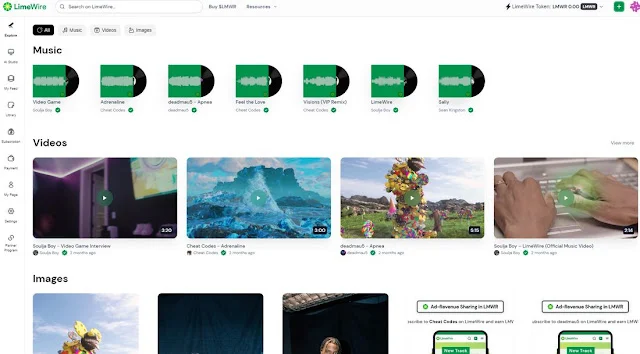
In an era defined by the rapid convergence of artificial intelligence and decentralized finance, LimeWire has officially transitioned from a legacy file-sharing service into a sophisticated AI content publishing platform. This pivot represents one of the most significant brand rehabilitations in the digital age, moving away from its controversial roots in the early 2000s toward a regulated, creator-centric ecosystem. The current iteration of LimeWire is designed to serve as a comprehensive studio for generative AI, offering tools for image creation, blockchain-based ownership, and a novel revenue-sharing model that integrates traditional advertising with cryptocurrency.
The Historical Context and Strategic Pivot
To understand the current trajectory of LimeWire, it is essential to examine its historical background. Originally launched in 2000 as a peer-to-peer (P2P) file-sharing client, the platform became a cultural touchstone of the early internet. However, following a protracted legal battle with the Recording Industry Association of America (RIAA), the original service was shut down by a federal court injunction in 2010.
The brand remained dormant for over a decade until its intellectual property was acquired by entrepreneurs Paul and Julian Zehetmayr. In 2022, the duo announced a relaunch focused on the creator economy and Web3 technology. Unlike the original platform, which operated on a decentralized and often unauthorized distribution model, the new LimeWire is built on a foundation of intellectual property rights and direct monetization for artists. The transition from a P2P service to an AI-driven "Studio" reflects broader industry trends where content creation is increasingly augmented by machine learning and secured via blockchain.
Technical Framework of the LimeWire AI Studio
At the core of the platform’s current offering is the LimeWire AI Studio, a centralized hub for generative media. While the platform initially launched with a focus on static imagery, its technical roadmap indicates a move toward a multi-modal environment.
The image generation suite currently leverages several industry-standard models, providing users with a high degree of flexibility. By integrating Stable Diffusion 2.1, Stable Diffusion XL, and OpenAI’s DALL-E 2, LimeWire allows creators to toggle between different aesthetic outputs and computational strengths. This multi-model approach is a strategic differentiator; while many platforms lock users into a single proprietary algorithm, LimeWire acts as an aggregator of top-tier AI technologies.
Users can manipulate a variety of parameters to refine their output. This includes selecting specific "styles"—such as cinematic, digital art, pixel art, anime, and analog film—and adjusting "samplers" to fine-tune the detail and denoising levels of the generated images. Furthermore, the platform is reportedly developing its own proprietary AI model, which aims to provide a unique visual signature distinct from the open-source models currently available.
Blockchain Integration and Automated NFT Minting
A defining feature of the LimeWire ecosystem is its seamless integration with blockchain technology. In a move to solve the problem of digital provenance and ownership in the AI era, LimeWire has automated the process of minting content as Non-Fungible Tokens (NFTs).
When a creator publishes a piece of content on the LimeWire Studio, the platform utilizes either the Polygon or Algorand blockchains to create a permanent digital record of the asset. The choice of these specific networks is noteworthy: Polygon is a Layer-2 scaling solution for Ethereum known for its low transaction costs and high speed, while Algorand is celebrated for its pure proof-of-stake consensus mechanism and carbon neutrality.
This blockchain layer serves two primary functions. First, it establishes a verifiable "proof of creation," which is increasingly important as AI-generated content floods the internet. Second, it facilitates a secondary market. Every time an NFT is traded within the LimeWire community, the original creator receives a 2.5% royalty. This creates a long-term passive income stream that was previously difficult to capture in the traditional digital art world.
The Economic Model: Ad Revenue and LMWR Tokens
LimeWire has introduced a dual-track monetization strategy that combines Web2 advertising models with Web3 tokenomics. This is perhaps the most innovative aspect of the platform, as it addresses the "monetization gap" often found in free-to-use AI tools.
- Ad Revenue Sharing: LimeWire offers a 70/30 revenue split in favor of the creator. When a user’s content is viewed on the platform, LimeWire generates advertising revenue from those impressions. The creator is entitled to 70% of that revenue. This model mirrors the incentive structures of platforms like YouTube but applies them to the nascent field of AI-generated art and media.
- The LMWR Token: The platform’s native cryptocurrency, the LimeWire Token (LMWR), serves as the primary medium of exchange. Earnings from ad revenue and NFT sales are distributed monthly in LMWR. The token is currently listed on major global exchanges, including Kraken, ByBit, and UniSwap, providing creators with a direct path to liquidity. Beyond its role as a reward, LMWR can be used within the platform to pay for "credits" required for high-intensity AI generations, creating a circular economy.
Creator Tiers and Resource Allocation
To manage the high computational costs associated with generative AI, LimeWire utilizes a tiered subscription model. This allows the platform to offer a functional free entry point while providing scalable resources for professional creators.
- Free Tier: Designed for hobbyists, this tier provides 10 credits daily, allowing for approximately 20 image generations. Users in this tier receive a 50% share of ad revenue.
- Basic ($9.99/mo): This tier increases the monthly allowance to 1,000 credits (roughly 2,000 images) and provides early access to new AI models.
- Advanced ($29/mo): Aimed at more frequent users, this plan offers 3,750 credits and increases the ad revenue share to 60%.
- Pro ($49/mo): This level provides 5,000 credits and grants the creator a 70% share of ad revenue, along with a "Pro" profile badge and faster generation speeds.
- Pro Plus ($99/mo): The highest tier is designed for power users and small studios, offering 11,250 credits per month (up to 22,500 images) and the maximum 70% revenue share.
All premium plans remove advertisements for the user and provide a full history of creations, which is essential for artists managing large portfolios of work.
Future Roadmap: Expanding into Audio and Video
While the current focus remains on image generation, LimeWire’s strategic objective is to become a full-spectrum generative media house. The platform has publicly stated its intention to launch AI-powered music and video generation tools.
The expansion into audio is particularly symbolic given the brand’s history with the music industry. By partnering with high-profile artists like Deadmau5 and Sean Kingston, LimeWire is positioning itself as a legitimate partner for the music world rather than a disruptor of copyright. The upcoming music tools are expected to allow users to generate beats, melodies, and full tracks, which can then be minted and sold as NFT music.
Similarly, the move into AI video generation will place LimeWire in competition with emerging tools like Sora or Runway. By integrating these features into an existing monetization and publishing framework, LimeWire offers a "one-stop-shop" that many standalone AI tools currently lack.
Broader Impact and Industry Implications
The emergence of the new LimeWire is a case study in the maturation of the AI and Web3 sectors. It suggests a move away from the "wild west" era of NFTs and toward a more integrated, utility-focused model. For the broader creative industry, LimeWire’s model presents several implications:
- Democratization of Content Creation: By lowering the technical and financial barriers to high-quality image and media generation, the platform allows individuals without formal training to compete in the digital marketplace.
- The Shift in Ownership: The automated minting of content as NFTs challenges traditional notions of digital copyright. If an AI generates an image based on a user’s prompt, the blockchain provides a definitive claim of ownership for that user, which is a significant development in digital law.
- New Revenue Streams for Artists: The 70% ad revenue share is significantly higher than many traditional social media platforms, potentially attracting professional designers who are looking for alternatives to established platforms like Adobe or Instagram.
Conclusion
LimeWire’s transformation from a defunct file-sharing service to a modern AI studio is a testament to the evolving nature of digital intellectual property and creative technology. By combining generative AI tools with blockchain-based ownership and a transparent revenue-sharing model, the platform provides a unique value proposition in a crowded market. As it expands into music and video, LimeWire is poised to become a central player in the creator economy, offering a glimpse into a future where AI and humans collaborate not just in the creation of art, but in its distribution and monetization as well. For creators, the platform represents a new frontier; for the industry, it represents the potential for a regulated and profitable coexistence between artificial intelligence and human creativity.
About the Author