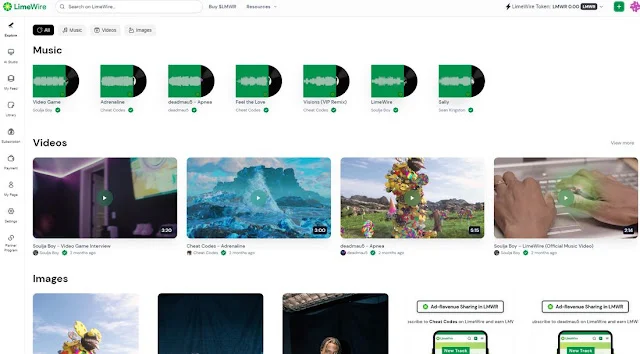
The digital landscape is witnessing a profound transformation of one of the most recognizable names from the early internet era as LimeWire pivots from its controversial roots in peer-to-peer file sharing to become a comprehensive generative Artificial Intelligence (AI) content studio. This strategic rebirth positions the platform at the intersection of three rapidly evolving sectors: generative AI, the creator economy, and blockchain technology. By integrating sophisticated machine learning models with automated Non-Fungible Token (NFT) minting and a decentralized revenue-sharing model, the new LimeWire aims to provide a sustainable ecosystem for digital artists, musicians, and content creators.
The Historical Pivot: From Gnutella to Generative AI
To understand the significance of the current LimeWire platform, one must examine its complex history. Founded in 2000 by Mark Gorton, the original LimeWire operated on the Gnutella network and became the world’s most popular file-sharing application following the demise of Napster. At its peak, the software was installed on one in every three computers globally. However, this success led to a protracted legal battle with the Recording Industry Association of America (RIAA), resulting in a federal injunction and the platform’s permanent shutdown in 2010.
The brand remained dormant for over a decade until 2022, when entrepreneurs Paul and Julian Zehetmayr acquired the rights to the LimeWire name. Their vision was not to resurrect a piracy tool, but to leverage the brand’s high global recognition to build a legal, creator-centric marketplace. This transition reflects a broader trend in the tech industry where "legacy" brands are being repurposed to provide familiar entry points into complex new technologies like Web3 and AI.
The Architecture of LimeWire AI Studio
At the core of the current offering is the LimeWire AI Studio, a centralized hub designed to lower the barrier to entry for high-quality digital content creation. While many AI tools exist in isolation, LimeWire has adopted a "model-as-a-service" approach, integrating several of the industry’s most powerful generative models into a single user interface.
Currently, the platform focuses heavily on image generation, supporting models such as:
- Stable Diffusion 2.1 and XL: Known for their versatility and ability to follow complex stylistic prompts.
- DALL-E 2 and 3: OpenAI’s flagship models, celebrated for their semantic understanding and photorealistic capabilities.
- Proprietary LimeWire Models: The platform is reportedly developing its own native AI models to offer unique aesthetics not available on other platforms.
The interface allows users to toggle between various artistic styles—including cinematic, digital art, pixel art, anime, and analog film—without needing to master complex prompt engineering. Advanced settings such as samplers, quality sliders, and guidance scales are available for power users, providing a granular level of control over the final output.
Blockchain Integration and the Automated NFT Lifecycle
One of LimeWire’s most distinctive features is the seamless bridge it builds between AI generation and blockchain-based ownership. Traditionally, a creator would need to generate an image in one tool, export it, and then manually navigate a marketplace like OpenSea to mint it as an NFT—a process involving "gas fees" and technical hurdles.
LimeWire automates this entire lifecycle. Once an image is generated and the user selects "publish," the platform automatically mints the content as an NFT on either the Polygon or Algorand blockchains. Both networks were chosen for their low environmental impact and negligible transaction costs compared to the Ethereum mainnet.
This automation serves two primary purposes:
- Provenance and Authenticity: It provides an immutable record of when the content was created and by whom, which is increasingly vital in an era of AI-generated misinformation.
- Asset Liquidity: Every piece of content becomes a tradable asset. Fans can subscribe to a creator’s profile to gain access to exclusive content, and if that content is later traded on the secondary market, the original creator receives a 2.5% royalty—enforced by the smart contracts governing the NFT.
Monetization and the LMWR Token Economy
In a departure from the traditional "winner-takes-all" model of social media platforms like Instagram or X (formerly Twitter), LimeWire has introduced a multi-layered revenue-sharing system. This is facilitated through the LMWR token, the platform’s native ERC-20 cryptocurrency.
The Ad-Revenue Share Model
LimeWire shares up to 70% of the advertising revenue generated from content views with the creators themselves. This creates a passive income stream for designers who may not have a massive following but produce high-engagement AI art. The percentage of revenue share is determined by the user’s subscription tier, ranging from 50% for free users to 70% for top-tier "Pro" subscribers.
Token Utility and Market Presence
The LMWR token is more than a reward mechanism; it is the fuel for the platform’s internal economy. Users can spend tokens to purchase "credits" for image generation, pay for premium subscriptions, or tip their favorite creators. Beyond the platform, LMWR has achieved significant liquidity, being listed on major global cryptocurrency exchanges including Kraken, ByBit, and UniSwap. This allows creators to convert their digital earnings into fiat currency or other crypto assets with ease.
Adoption by High-Profile Creators
The platform’s transition has been validated by several high-profile partnerships with artists who were once at odds with the original file-sharing model. Musicians such as Deadmau5, Soulja Boy, Sean Kingston, and Dillon Francis have utilized LimeWire to launch exclusive digital collectibles and music-related content.
These partnerships signal a shift in the music industry’s perception of LimeWire. By providing a platform where artists can monetize directly from their fanbase through NFTs and ad-revenue sharing, the new LimeWire is positioning itself as an ally to the creative community. The platform reports that these "studio" features have attracted millions of users, ranging from casual hobbyists to professional digital artists.
Subscription Tiers and Accessibility
To maintain the high computational costs of running generative AI models, LimeWire employs a tiered subscription model designed to scale with a creator’s needs.
- Free Tier: Offers 10 credits daily (allowing for roughly 20 image generations) and a 50% ad revenue share. This tier is designed to democratize access to AI tools, allowing anyone to experiment with the technology.
- Basic ($9.99/month): Provides 1,000 credits and early access to new AI models.
- Advanced ($29/month): Increases the credit limit to 3,750 and boosts the ad revenue share to 60%.
- Pro and Pro Plus ($49 to $99/month): These tiers are aimed at professional creators, offering up to 11,250 credits, a 70% revenue share, faster generation speeds, and a "Pro" badge for social proof within the community.
Future Outlook: Music and Video Generation
While the current platform is heavily weighted toward image generation, LimeWire’s roadmap includes the imminent launch of AI-powered music and video generation tools. This expansion is particularly poignant given the brand’s history with the music industry.
The goal is to allow users to generate full-length tracks or short-form video content using text prompts, which can then be minted and monetized in the same manner as images. This could potentially disrupt the stock music and video industries, providing a cheaper and more customizable alternative for content creators on platforms like YouTube and TikTok.
Fact-Based Analysis of Market Implications
The re-emergence of LimeWire as an AI powerhouse carries several significant implications for the broader tech industry. First, it demonstrates the "tokenization of everything" trend, where digital content is no longer just a file but a financial asset with built-in royalty rights.
Second, it addresses the "attribution crisis" in AI. By minting content at the moment of creation, LimeWire provides a technological solution to the problem of identifying AI-generated works. However, the platform still faces challenges regarding the copyright of the training data used by the underlying models (like Stable Diffusion), a topic currently being debated in courts worldwide.
Finally, LimeWire’s model suggests a shift in the "Creator Economy 2.0." While the first iteration of the creator economy relied on platform-controlled ad-senses and brand deals, this new iteration focuses on direct-to-fan ownership and decentralized finance (DeFi) mechanisms.
Conclusion
LimeWire’s journey from a pariah of the music industry to a pioneer of AI-driven content creation represents one of the most remarkable brand rehabilitations in digital history. By combining the ease of use of modern AI with the ownership structures of blockchain, the platform offers a compelling blueprint for how creators might operate in the coming decade. As the platform expands into audio and video, its ability to maintain a balance between accessibility for free users and profitability for professional creators will be the ultimate test of its long-term viability in the competitive landscape of generative artificial intelligence.
About the Author