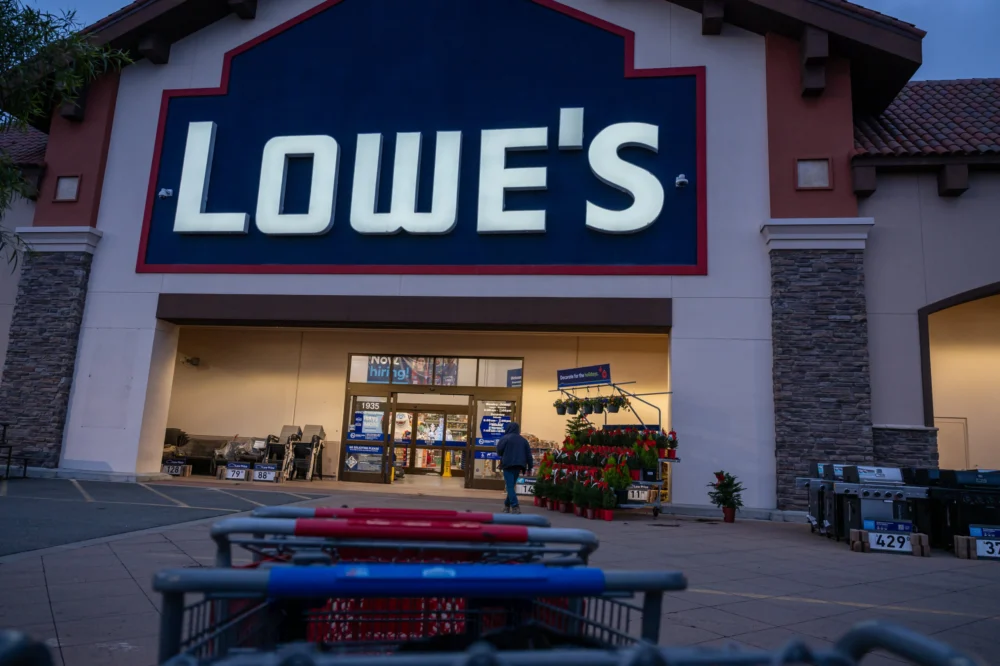
Lowe’s Companies Inc., the prominent home improvement retailer, announced on Wednesday that it had surpassed Wall Street’s projections for both quarterly revenue and earnings, a testament to its strategic resilience in a persistently challenging economic climate. The company reported a robust year-over-year sales growth exceeding 10% for its fiscal fourth quarter, demonstrating strong operational execution. However, despite the impressive quarterly performance, the enthusiasm was tempered by the release of its full-year earnings projections, which fell short of analysts’ consensus expectations, leading to a noticeable decline in the company’s shares during premarket trading.
The fiscal fourth quarter, which concluded on January 30, saw Lowe’s navigate a complex landscape marked by elevated mortgage rates and a decelerating real estate market, factors that typically exert downward pressure on the home improvement sector. The retailer’s ability to not only meet but exceed revenue and adjusted earnings estimates underscores the effectiveness of its dual-pronged strategy targeting both do-it-yourself (DIY) consumers and professional contractors. The precise revenue figure for the quarter, while not explicitly detailed in the summary of the announcement, was confirmed to have risen substantially from the $18.55 billion reported in the corresponding period of the prior year, exceeding analyst forecasts.
A key indicator of the company’s operational health, comparable sales, rose by 1.3% for the quarter. This figure comfortably surpassed the more conservative 0.2% increase that analysts, surveyed by StreetAccount, had anticipated. Comparable sales, which strip out the impact of new store openings or closures, provide a clear picture of performance at existing locations and are closely watched by investors as a measure of underlying demand. This beat suggests that Lowe’s was successful in driving traffic and converting sales within its established footprint, defying some of the broader industry headwinds.
However, a closer look at the financial details reveals a nuanced picture. While adjusted earnings per share (EPS) topped expectations, Lowe’s reported a net income of $999 million, or $1.78 per share, for the three-month period. This represents a decrease from the $1.13 billion, or $1.99 per share, recorded in the year-ago quarter. This divergence between an adjusted EPS beat and a GAAP net income decline often points to specific non-recurring charges, higher operational costs not adjusted out, or changes in tax rates that impact the bottom line, despite strong top-line growth and core profitability. Investors typically focus on adjusted figures for ongoing operational performance, but the GAAP net income decline still warrants consideration for a comprehensive financial assessment.
Strategic Navigation in a Constrained Market
Marvin Ellison, Lowe’s Chief Executive Officer, articulated the company’s strategic success in a news release, emphasizing that their approach is resonating with both their core DIY customer base and the crucial home professional segment. This balance is critical, as the professional segment, often less sensitive to immediate economic fluctuations due to project pipelines, can provide a more stable revenue stream compared to the often discretionary spending of DIY customers.
Ellison acknowledged the prevailing pressures within the housing macro-environment, specifically citing the impact of higher mortgage rates and a slowdown in real estate transactions. These factors directly influence consumer willingness to embark on major home renovation projects or new home purchases, which are traditional drivers of demand for home improvement retailers. Despite these challenges, Ellison expressed confidence in the company’s proactive stance. "While the housing macro remains pressured, we are focused on directing what is within our control, which includes our ongoing productivity initiatives," he stated. This highlights a strategic pivot towards internal efficiencies and cost management as a means to maintain profitability and competitiveness, rather than solely relying on market tailwinds. He further asserted, "We remain confident that we are well-positioned to take share regardless of the macro environment," signaling an aggressive posture aimed at gaining market dominance even amidst adversity. This suggests that Lowe’s is not merely weathering the storm but actively seeking opportunities to expand its market footprint relative to competitors.
Full-Year Outlook and Market Reaction
Despite the strong quarterly showing, the company’s forward-looking guidance for the full current fiscal year proved to be a point of contention for investors. Lowe’s projected total sales for the full year to fall within the range of $92 billion to $94 billion. This forecast implies a year-over-year increase of approximately 7% to 9% over the prior fiscal year, signaling continued growth, albeit at a potentially moderating pace. More critically, the company anticipates adjusted earnings per share to be between $12.25 and $12.75 for the full year. This range notably fell short of the $12.95 consensus expectation established by analysts polled by LSEG, triggering the immediate negative reaction in premarket trading.
The discrepancy between a strong past quarter and a cautious future outlook is often a source of investor concern. While the company’s current performance reflects effective management of immediate market conditions, the lower-than-expected full-year EPS guidance suggests that management anticipates persistent headwinds or increased investment costs in the coming year that analysts may not have fully factored into their models. For comparable sales, a key metric for retail health, Lowe’s projected a range of approximately flat to up 2% for the full year. This relatively conservative outlook for comparable sales, despite the stronger Q4 performance, further reinforced the cautious tone for the fiscal year ahead. It implies that while certain segments or initiatives may drive growth, the overall underlying demand might remain somewhat subdued.
Industry Landscape and Competitive Dynamics
The home improvement sector has been grappling with a complex confluence of economic factors over the past year. Following a boom during the initial phases of the pandemic, when consumers redirected discretionary spending towards home renovations, the industry has faced a cooling off period. This deceleration is primarily attributable to the Federal Reserve’s aggressive interest rate hikes aimed at combating inflation. These hikes have significantly driven up mortgage rates, making homeownership less affordable and dampening both new home sales and refinancing activity, which in turn reduces the incentive for extensive home improvements. Furthermore, persistent inflation has eroded consumer purchasing power, causing many U.S. households to postpone large, non-essential projects due to high borrowing costs and the general economic uncertainty.
Lowe’s primary competitor, Home Depot, offered a comparable narrative in its own earnings report released on the preceding Tuesday. Home Depot also managed to beat Wall Street’s earnings and revenue expectations for its fiscal fourth quarter. However, similar to Lowe’s, Home Depot opted for a conservative full-year guidance, echoing the sentiment that home improvement demand remains tepid. Their results reflected the broader trend of U.S. consumers deferring major projects, a decision influenced by high borrowing costs, elevated housing prices, and overarching economic concerns that impact consumer confidence and willingness to spend on significant home upgrades. The parallel guidance from both industry giants underscores a shared perception of continued macro-economic challenges impacting the sector in the coming year.
Investor Sentiment and Stock Performance
Prior to Wednesday’s earnings announcement, Lowe’s stock had been a strong performer, demonstrating considerable investor confidence. As of Tuesday’s market close, Lowe’s shares had climbed nearly 16% year-to-date, significantly outperforming the broader S&P 500 index, which had seen gains of approximately 1% over the same period. Looking back over the past year, Lowe’s stock was up about 15%, nearly matching the S&P 500’s robust approximately 16% gains. This pre-announcement performance indicated that investors had largely bought into Lowe’s strategic direction and its ability to navigate the evolving market. The subsequent premarket dip, triggered by the cautious full-year guidance, serves as a classic example of how forward-looking statements can often overshadow even strong past performance in the eyes of the market. Investors, especially institutional ones, often weigh future profitability potential more heavily than historical results, and any deviation from analyst consensus can lead to immediate price adjustments.
The market’s reaction highlights the delicate balance companies must strike between delivering strong current results and setting realistic, yet appealing, expectations for the future. While Lowe’s showcased its operational strengths in Q4, its conservative outlook for the full fiscal year suggests a prudent approach to managing expectations in a volatile economic climate. This strategy, while potentially causing short-term stock price fluctuations, could also be interpreted as a responsible move to ensure sustainable growth and avoid over-promising in an environment where consumer behavior and economic indicators remain unpredictable.
Broader Implications and Future Outlook
The performance and outlook from both Lowe’s and Home Depot collectively paint a picture of an industry at a crossroads. While the underlying demand for home improvement remains structurally sound due to an aging housing stock and a general inclination towards home personalization, the immediate economic hurdles are undeniable. The trajectory of mortgage rates, inflation, and consumer discretionary spending will continue to be critical determinants of the sector’s health. Should interest rates begin to ease later in the year, as some economists predict, it could potentially inject renewed vigor into the housing market and, consequently, the home improvement sector.
In the interim, Lowe’s focus on "productivity initiatives" and its dual strategy catering to both DIY and Pro segments will be crucial. Enhancing operational efficiency, optimizing supply chains, and refining customer engagement strategies for both segments can provide a buffer against macro-economic pressures. The company’s confidence in "taking share regardless of the macro environment" suggests an aggressive competitive stance, potentially through targeted marketing, competitive pricing, or enhanced service offerings designed to attract customers from smaller competitors or even its larger rival.
The home improvement industry is also evolving with technological advancements and changing consumer preferences. The integration of e-commerce capabilities, personalized shopping experiences, and sustainable product offerings will likely be key areas for future growth and differentiation. As Lowe’s navigates the coming fiscal year, its ability to adapt to these broader trends while effectively managing costs and maintaining a strong customer focus will be paramount to sustaining its market position and delivering long-term shareholder value, even in the face of a cautious short-term outlook. The coming quarters will reveal whether its strategic execution can indeed defy the prevailing macro pressures and validate its claim of being well-positioned for market share gains.
About the Author