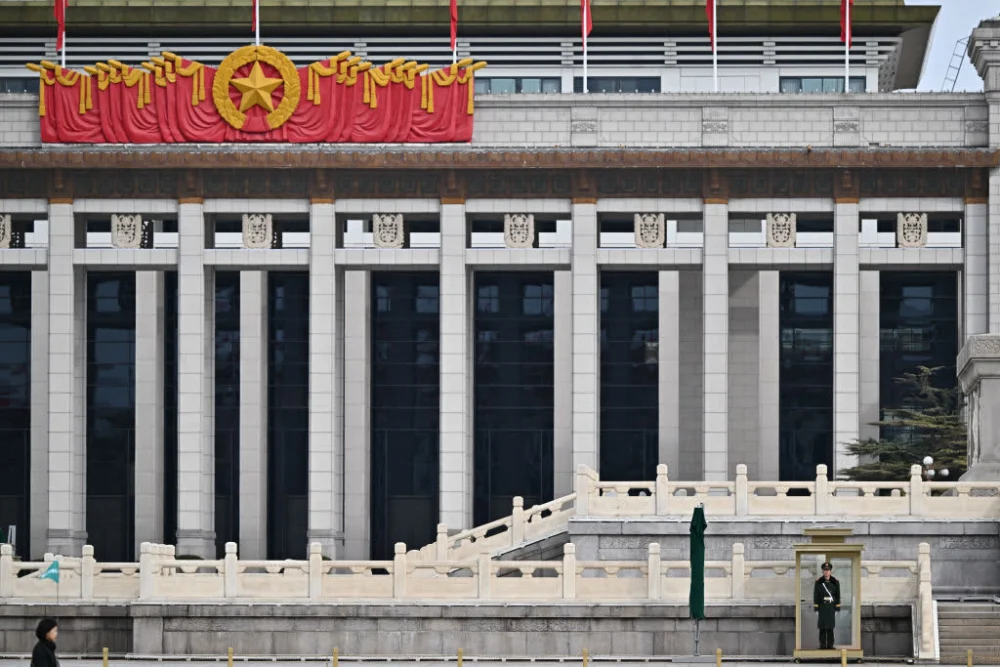
BEIJING – China’s top policymakers are poised to unveil crucial growth targets, comprehensive stimulus plans, and a long-term strategic blueprint for the nation’s economic trajectory at the highly anticipated annual legislative meetings, collectively known as the "Two Sessions," commencing this Wednesday. The gatherings, a pivotal event in China’s political calendar, will bring together thousands of delegates to deliberate on the country’s governance and development priorities for the coming year and beyond. Security measures are visibly heightened across the capital, with personnel from the Chinese People’s Liberation Army (PLA) observed standing guard, such as the soldier positioned in front of the National Museum of China on March 3, 2025, underscoring the significance of the event.
The "Two Sessions" comprise two distinct but interconnected assemblies: the Chinese People’s Political Consultative Conference (CPPCC), a top advisory body, which is scheduled to begin its consultative congress later on Wednesday, and the National People’s Congress (NPC), the country’s supreme legislative body, which is slated to open on Thursday. It is during the NPC that Premier Li Qiang will deliver the government’s work report, outlining a series of economic and social targets that largely crystalized during a closed-door Central Economic Work Conference held in December. Global investors, analysts, and international observers will meticulously scrutinize these announcements for insights into Beijing’s strategic direction and its approach to navigating an increasingly complex domestic and global landscape.
Historical Context and Significance of the Two Sessions
The Two Sessions represent the pinnacle of China’s political calendar, providing a comprehensive overview of the Communist Party’s priorities and policies for the upcoming year. The NPC, with its approximately 3,000 delegates, theoretically holds the power to approve legislation, government budgets, and major personnel appointments. However, in practice, it largely functions as a rubber-stamp parliament, ratifying decisions already made by the Party’s senior leadership. The CPPCC, comprising around 2,000 delegates from various social and political groups, serves as a consultative body, offering advice and suggestions on government policies. While its role is primarily advisory, it provides a platform for broad representation and can influence policy discourse.
These annual meetings serve multiple critical functions: they communicate policy priorities to provincial and local governments, galvanize public support for the Party’s agenda, and signal China’s intentions to the international community. The reports and discussions held during the Two Sessions offer invaluable insights into the government’s understanding of current challenges and its proposed solutions, ranging from economic reforms to environmental protection and social welfare.
Key Economic Targets Under Scrutiny
Foremost among the eagerly awaited announcements is China’s Gross Domestic Product (GDP) growth target for the year. Economists broadly anticipate Premier Li Qiang to set a target in the range of "around 4.5% to 5%." This projection comes after several Chinese local governments have already recalibrated their own growth ambitions downward for 2026, signaling a potential nationwide trend.

A growth target falling below 5% would mark a significant shift, representing the lowest on record for China, excluding the exceptional year of 2020 when no GDP goal was set due to the unprecedented disruption caused by the COVID-19 pandemic. For the preceding three years, the target had consistently been "around 5%." Analysts from the Economist Intelligence Unit suggest that "a slightly lower target would give policymakers more room to prioritise structural reform and improve data quality," forecasting a 4.6% growth rate. This perspective implies a deliberate move by Beijing to shift focus from sheer growth volume to the quality and sustainability of economic development, potentially allowing for greater emphasis on addressing systemic issues rather than simply chasing headline figures.
Conversely, some financial institutions like Morgan Stanley express skepticism about a significantly lower target, noting a "low probability" that Beijing would opt for a smaller range. They highlight that policymakers typically reserve GDP ranges – as opposed to single-figure targets – for periods of profound economic stress. Furthermore, 2026 marks the inaugural year of China’s "15th Five-Year Plan," a critical period that often necessitates a more robust growth projection to instill confidence and set an ambitious tone for the subsequent half-decade. The balancing act between fostering confidence and acknowledging structural headwinds will be a central theme.
Beyond GDP, two other crucial economic indicators will be closely watched:
- Inflation Target: Policymakers are expected to announce an inflation target of "around 2%." This figure is particularly pertinent given China’s recent struggles with deflationary pressures, which have impacted consumer confidence and corporate profitability. A 2% target would signal Beijing’s intent to stimulate demand and maintain price stability without stoking excessive inflation, aiming for a healthy balance.
- Budget Deficit Target: A budget deficit target of "around 4%" is anticipated, mirroring the figure from the previous year. This would represent a notable expansion of government spending relative to GDP, indicating continued fiscal support for the economy. The 4% deficit set in 2025 was, according to data accessed via Wind Information, the highest on record going back to 2010, surpassing the prior high of 3.6% in 2020. Such an elevated deficit underscores the government’s commitment to deploying fiscal tools to counter economic slowdowns, likely channeling funds into infrastructure, strategic industries, and social welfare programs.
The 15th Five-Year Plan: Charting China’s Future
A cornerstone of this year’s Two Sessions will be the unveiling of details for the new five-year development plan – the 15th such program in China’s modern history. These plans are comprehensive blueprints that outline national economic and social development goals, resource allocation, and strategic priorities for the medium term. This specific plan holds immense strategic importance as it represents the penultimate step towards China’s ambitious 2035 goals, with a pronounced emphasis on achieving technological self-sufficiency.
Investors and global tech companies will be keen to glean insights into how Beijing intends to realize its "domestic tech ambitions." This focus is largely driven by escalating geopolitical tensions, particularly with the United States, which has implemented stringent export controls on advanced technologies crucial for China’s semiconductor and artificial intelligence sectors. The 15th Five-Year Plan is expected to detail increased investment in fundamental research, indigenous innovation, talent cultivation, and the establishment of robust domestic supply chains to reduce reliance on foreign technology. Key areas of focus will likely include AI, quantum computing, biotechnology, new energy vehicles, and advanced manufacturing.
Beyond technology, the plan is expected to reinforce commitments to green development, aiming for carbon neutrality by 2060, alongside efforts to boost domestic consumption, deepen rural revitalization, and enhance social welfare programs to address income inequality and improve public services.
Addressing Deeper Economic Challenges

While the official targets provide a framework, the Two Sessions will also confront deeper structural challenges facing the world’s second-largest economy. Policy announcements will be meticulously scrutinized for details on tangible measures to stimulate consumer spending and provide incremental support for the beleaguered property market.
- Property Market Slump: China’s real estate sector remains a significant drag on economic growth and consumer confidence. A cascade of developer defaults, led by Evergrande, has left numerous housing projects unfinished and rattled the financial system. The Two Sessions are expected to shed light on expanded "trade-in subsidies" to encourage homebuyers, potentially coupled with increased financing support for solvent developers to complete projects and manage debt. Measures to stabilize housing prices and restore buyer trust will be critical. S&P Global Ratings noted in a recent report that China’s property slump has been "worse than expected," underscoring the urgency of effective policy intervention.
- Consumer Stimulus: To counter weak domestic demand and deflationary pressures, the government is likely to announce further initiatives to bolster consumption. Beyond trade-in subsidies for durable goods, which proved effective in the past, potential measures could include targeted consumption vouchers, support for specific service sectors, and policies aimed at boosting household income and job security.
- Local Government Debt and Inefficient Lending: Logan Wright, a partner at U.S.-based research firm Rhodium Group, highlighted in a recent report that "There is a widening gap between Beijing’s targets (and data measuring economic performance) and the actual capacity of China’s policymakers to support domestic demand with the tools at their disposal." He elaborated that China’s financial system is heavily engaged in lending to unproductive local government financing vehicles (LGFVs) and state-owned enterprises (SOEs) primarily to prevent their collapse. This dynamic leads to a "declining payoff in terms of investment and economic activity for the same volume of lending or fiscal spending," while private sector investment, a crucial engine of innovation and job creation, remains weak. The Two Sessions may offer clues on how Beijing plans to address this structural inefficiency and rebalance financial flows towards more productive sectors.
- Private Sector Confidence: After years of regulatory crackdowns on tech giants and other sectors, restoring confidence among private entrepreneurs and foreign investors is paramount. While specific policy reversals are unlikely, the government may signal a more supportive stance towards the private economy, emphasizing fair competition, predictable regulatory environments, and intellectual property protection.
Geopolitical Context and External Factors
The backdrop of global uncertainties will inevitably influence the deliberations and policy announcements. The Two Sessions will likely shed light on Beijing’s assessment of the ongoing impact of U.S. trade and technology tensions, which continue to reshape global supply chains and accelerate China’s drive for self-reliance. High-level discussions by senior Chinese leaders, including top diplomat Wang Yi, will be closely watched for signals on foreign policy direction and responses to international challenges.
Furthermore, the developing conflict in the Middle East poses risks to global energy markets and trade routes, potentially impacting China’s energy security and export-oriented economy. While not a direct agenda item, the broader implications of global instability will undoubtedly inform Beijing’s economic planning and risk mitigation strategies. The leadership will also be mindful of broader global economic headwinds, including slower growth in major economies and persistent inflation in some developed markets, which could dampen external demand for Chinese goods.
Internal Dynamics and Leadership
The composition and mood of the delegates at the Two Sessions also offer subtle insights. Analysts from the Asia Society noted that China’s ongoing anti-corruption campaign has "reduced the number of delegates" participating this year. This sustained campaign, a hallmark of President Xi Jinping’s administration, continues to shape governance, official conduct, and cadre discipline, emphasizing loyalty and ideological conformity within the Party ranks.
Senior Chinese leaders, including top diplomat Wang Yi and heads of economic and financial ministries, typically hold press conferences during the Two Sessions. Their statements will be meticulously analyzed for nuances in policy direction, official responses to critical domestic and international issues, and indications of any shifts in leadership priorities. The gathering usually lasts approximately a week and is expected to conclude on March 11 this year.
In conclusion, the 2025 "Two Sessions" are set to be a momentous event, providing a comprehensive roadmap for China’s development in a period marked by profound economic transformation and geopolitical shifts. The announcements regarding GDP targets, stimulus measures, and the 15th Five-Year Plan will not only dictate the trajectory of the world’s second-largest economy but also send crucial signals to global markets, international partners, and strategic competitors alike, all while Beijing strives to balance growth with stability and structural reform.
About the Author