
Understanding Your Cost Per Lead: A Crucial Metric for Business Growth
In the competitive landscape of modern business, the generation of qualified leads is not merely a desirable outcome but a fundamental necessity for sustained growth and profitability. While the adage "you have to speculate to accumulate" rings true for marketing investments, a critical question often remains unanswered: what is the actual cost of acquiring a single potential customer? Without a clear understanding of this figure, businesses operate in a vacuum, unable to accurately assess the efficacy of their marketing and sales endeavors. This is where the metric of Cost Per Lead (CPL) emerges as an indispensable tool for financial optimization and strategic decision-making. This comprehensive analysis will delve into the significance of CPL in managing business expenditures, provide a detailed methodology for its calculation, and offer actionable strategies for its reduction.
What Constitutes Cost Per Lead?
Cost Per Lead (CPL) is a pivotal marketing metric that quantifies the aggregate expenditure required to generate a single lead for a business. It represents the monetary investment made to attract an individual who has demonstrated interest in a company’s products or services. The definition of a "quality lead" can vary significantly depending on the specific marketing campaign and industry. However, it generally encompasses individuals who have taken a discernible action indicating their potential as a future customer. This can include:
- Filling out a contact form on a website.
- Subscribing to a company’s newsletter or mailing list.
- Downloading a whitepaper, e-book, or other gated content.
- Registering for a webinar or online event.
- Requesting a demo or quote.
- Engaging with a company’s social media content through direct messages or comments.
- Making an inquiry via phone or email.
CPL serves as a robust indicator of the success, or lack thereof, of digital marketing initiatives. It empowers businesses to evaluate the performance of individual campaigns across various channels and to gauge the overall efficiency of their marketing budget allocation. It is imperative to distinguish CPL from Cost Per Acquisition (CPA). While CPA measures the total expense associated with securing a paying customer or closing a deal, CPL is exclusively focused on the cost of generating potential customers. The distinction between a lead and a prospect is also a nuanced one, with leads representing an earlier stage in the customer journey, signifying initial interest, while prospects have been further qualified as having a higher likelihood of conversion.
The Paramount Importance of Cost Per Lead
Marketing expenditures typically constitute a substantial portion of a company’s overall business expenses. Consequently, rigorously measuring the effectiveness of these investments and identifying avenues for expenditure optimization is not just prudent but essential. CPL plays a critical role in monitoring the performance of both sales and marketing campaigns.
By understanding the precise cost associated with each potential customer generated, businesses can more effectively allocate their marketing budgets and refine their client management strategies. This data allows for a comparative analysis of different channels and strategies, enabling the identification of those with the highest Return on Investment (ROI). Resources can then be strategically funneled into these high-performing avenues, while underperforming or cost-ineffective strategies can be re-evaluated or discontinued.
Furthermore, when CPL data is integrated with other key marketing metrics, it provides invaluable insights into whether a particular campaign or channel is attracting the right leads – individuals who are genuinely likely to convert. This granular understanding helps in course-correcting marketing efforts, thereby saving both time and financial resources.
Beyond simply illuminating marketing performance, CPL serves as a powerful tool for challenging ingrained assumptions. A large-scale campaign that garners significant attention and generates a high volume of leads might be perceived as inherently effective. However, a detailed CPL analysis could reveal that a smaller, less conspicuous campaign, despite generating fewer leads, might actually yield a superior ROI due to lower operational costs. This nuanced perspective is crucial for making data-driven strategic decisions.
Defining a "Good" Cost Per Lead: A Multifaceted Challenge
The question of what constitutes a "good" CPL is inherently complex and lacks a universally applicable answer. There is no definitive benchmark or average CPL that applies across all businesses and industries. This variability stems from a confluence of factors that significantly influence lead generation costs. These include:
- Industry: Highly competitive sectors or those dealing with high-value products and services, such as enterprise software, financial services, or specialized B2B markets, typically exhibit higher CPLs. This is due to factors like longer and more intricate sales cycles, the higher perceived value of each lead, and the necessity of targeting more specialized market segments. For instance, data from various industry reports in 2023 indicated that average CPLs for B2B SaaS companies could range from $150 to $400, while B2C sectors like e-commerce might see figures as low as $10 to $50 for less qualified leads.
- Product/Service Value: The price point of a company’s offerings directly impacts the acceptable CPL. If a business has a CPL of $80, this might be considered unfavorable if its products are priced at $20 each. Conversely, for a company selling services at $2,000, an $80 CPL would be highly attractive.
- Target Audience: The specificity and accessibility of a target market play a significant role. Niche markets may require more targeted and therefore more expensive outreach, leading to a higher CPL.
- Marketing Channels Utilized: Different marketing channels have vastly different cost structures. Paid advertising, such as pay-per-click (PPC) campaigns on search engines or social media, often incurs higher direct costs than organic strategies like content marketing, SEO, or social media engagement, which tend to have lower CPLs over time due to their cumulative impact.
- Geographic Location: Marketing costs, including advertising rates and labor, can vary significantly by region, impacting CPL.
- Campaign Specifics: The complexity and scope of a particular marketing campaign, including the creative assets, targeting parameters, and promotional offers, will influence its CPL.
Ultimately, a "good" CPL is one that is lower than the anticipated revenue generated from an average lead. Conversely, a "bad" CPL results in a net loss, where the cost of lead generation exceeds the expected revenue. The expected revenue per lead is, in itself, a variable that depends on the average customer lifetime value and the business’s conversion rates. Industry benchmarks can offer a useful point of reference, but they should not be the sole determinant. A higher conversion rate from leads to paying customers can justify a higher CPL, as can the potential for a high lifetime value from those acquired leads.
The Calculation of Cost Per Lead
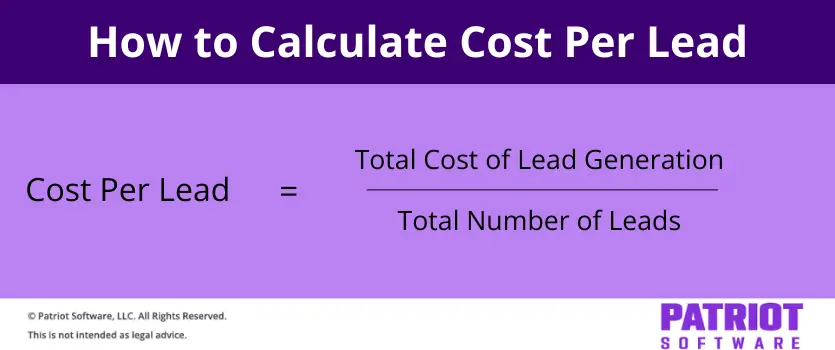
The fundamental formula for calculating Cost Per Lead is straightforward:

Cost Per Lead = Total Cost of Lead Generation / Total Number of Leads Generated
To implement this formula effectively, a systematic approach to identifying and quantifying both costs and leads is necessary.
1. Calculating Costs:
The "Total Cost of Lead Generation" encompasses all expenditures directly or indirectly associated with marketing efforts aimed at acquiring leads within a defined period. This includes:
- Advertising Spend: This covers all direct costs for paid advertisements across various platforms, including search engines (e.g., Google Ads), social media (e.g., Facebook Ads, LinkedIn Ads), display networks, print media, and any other paid promotional activities.
- Content Creation and Marketing: Expenses related to developing blog posts, articles, whitepapers, e-books, videos, infographics, and other content designed to attract and engage potential customers. This also includes costs associated with content distribution and promotion.
- Search Engine Optimization (SEO): Investment in SEO tools, agency fees, or in-house expertise to improve organic search rankings and drive traffic to the website.
- Social Media Marketing: Costs associated with managing social media profiles, creating social media content, running paid social media campaigns, and employing social media management tools.
- Email Marketing: Expenses for email marketing platforms, list acquisition or management, and the creation of email campaigns.
- Website and Landing Page Development: Costs associated with designing, developing, and maintaining websites and dedicated landing pages used for lead capture.
- Marketing Software and Tools: Subscriptions to marketing automation platforms, CRM systems, analytics tools, A/B testing software, and other technologies that support lead generation.
- Agency Fees and Consultant Costs: Any payments made to external marketing agencies, freelancers, or consultants involved in lead generation activities.
- Internal Labor Costs: The portion of salaries and benefits for internal marketing and sales staff directly involved in lead generation activities. This can be calculated by estimating the percentage of their time dedicated to these tasks.
It is crucial to segment costs to understand the CPL for different types of marketing efforts. For instance, a distinction between inbound (organic) and outbound (paid) marketing can provide deeper insights. Inbound marketing strategies often yield lower CPLs over the long term, as they build sustainable organic traffic. Outbound strategies, while potentially faster, typically have higher immediate costs.
A structured approach to cost calculation might involve breaking down expenses by month, quarter, or year. For example:
Total Costs = Advertising Costs + Content & SEO Costs + Software & Tools Costs + Agency/Consultant Fees + Internal Labor Costs
Where:
Advertising Costs = Ad Spend + Ad Management Costs (internal/external)
Content & SEO Costs = Content Creation + SEO Tools/Services + Website/Landing Page Development
2. Calculating Leads:
The "Total Number of Leads Generated" refers to the count of individuals who have taken a defined action indicating interest within the same specified time period used for cost calculation. This includes:
- Inbound Leads: Leads generated through organic channels such as website forms, content downloads, webinar registrations, direct inquiries via email or phone that originated from organic website traffic or content.
- Outbound Leads: Leads generated through paid advertising campaigns, direct mail, telemarketing, or other direct outreach methods.
It is essential to have a robust tracking system in place to accurately capture lead sources. This often involves using UTM parameters for digital campaigns, unique landing pages for specific offers, and CRM systems to log lead origins.
Total Leads = Total Inbound Leads + Total Outbound Leads
Once both the total cost of lead generation and the total number of leads are quantified for a consistent time period, the CPL can be calculated using the primary formula. Many businesses find it beneficial to utilize CPL calculators, readily available online from marketing technology providers, or leverage the built-in analytics of advertising platforms like Google Ads and Facebook Ads, which often provide CPL data directly for their respective campaigns.
Leveraging Cost Per Lead Data for Strategic Advantage
The calculation of CPL is not an end in itself; its true value lies in its application. By regularly monitoring and analyzing CPL, businesses can:
- Compare Channel Effectiveness: Evaluate the cost-effectiveness of different marketing channels (e.g., social media ads vs. Google Ads vs. content marketing). This allows for the optimization of budget allocation towards channels that deliver leads at a lower cost.
- Assess Campaign Performance: Determine the CPL for individual marketing campaigns. This helps identify which campaigns are most efficient in generating leads and which may require adjustments or discontinuation.
- Identify High-Performing Segments: By segmenting CPL data by target audience, demographic, or geographic region, businesses can pinpoint which customer segments are most cost-effectively reached.
- Optimize Marketing Budget: Inform decisions about where to increase or decrease marketing spend based on CPL performance.
- Predict Future Performance: Historical CPL data can be used to forecast the cost of future lead generation efforts and to set realistic marketing goals.
- Enhance Lead Quality Analysis: While CPL focuses on quantity, it can be a starting point for analyzing lead quality. If a channel has a very low CPL but generates poor-quality leads that rarely convert, its overall effectiveness is diminished. This prompts a deeper dive into lead qualification processes.
It is also advisable to calculate CPLs for specific segments of your marketing efforts, such as:
- CPL by Marketing Channel: (e.g., CPL for Facebook Ads, CPL for SEO)
- CPL by Campaign: (e.g., CPL for the "Summer Sale" campaign)
- CPL by Target Audience: (e.g., CPL for small business owners, CPL for enterprise clients)
- CPL by Lead Magnet: (e.g., CPL for e-book downloads, CPL for webinar registrations)
Continuous monitoring of these CPLs over time is crucial to identify emerging trends and opportunities. A flat or increasing CPL might signal a need to re-evaluate marketing strategies, ad creative, targeting, or landing page effectiveness.
Strategies for Reducing Cost Per Lead
The ultimate goal of calculating and analyzing CPL is often to find ways to reduce it, thereby maximizing marketing ROI and stretching the budget further. This is achieved by generating more qualified leads at a lower cost. Several strategies can contribute to this objective:
-
Refine Business Needs and Budget Allocation:
- Enterprise vs. Small Business: Larger enterprises with higher revenue streams might be able to absorb higher advertising spends and thus potentially higher CPLs, especially in competitive markets. Smaller businesses, however, should adopt a more conservative approach, starting with a modest budget and meticulously tracking campaign analytics to identify the optimal moment for expansion. Data suggests that businesses with revenues over $10 million might have a CPL ranging from $50 to $200, while those under $1 million might aim for $20 to $100.
- Strategic Investment: Focus on investing in marketing channels and tactics that have historically proven to be cost-effective for your specific business.
-
Enhance Audience Targeting:
- Precision Targeting: Leverage the advanced targeting capabilities of digital advertising platforms to reach specific demographics, interests, behaviors, and job titles. The more precisely your message resonates with the intended audience, the higher the likelihood of generating a qualified lead and reducing wasted ad spend.
- Retargeting Campaigns: Implement retargeting strategies to re-engage individuals who have previously interacted with your brand but did not convert. Personalized offers and content can draw them back and reduce the CPL for these warmer leads.
- Audience Segmentation: Continuously analyze conversion rates and CPLs across different audience segments. Adjust your targeting parameters to focus on groups that exhibit higher engagement and conversion rates.
-
Optimize Website and Landing Pages:
- SEO Enhancement: Improve your website’s organic search engine rankings by focusing on relevant long-tail keywords that indicate high purchase intent. Regularly update content to maintain freshness and relevance.
- User Experience (UX): Ensure your website is user-friendly, with fast loading speeds and intuitive navigation. A seamless user experience encourages visitors to explore and engage.
- Compelling Landing Pages: Design landing pages that are specifically tailored to each campaign, with clear calls-to-action (CTAs) and concise, benefit-driven copy. Minimize form fields to reduce friction, but consider adding clarifying questions to pre-qualify leads.
- Lead Magnets: Offer valuable lead magnets (e.g., free guides, templates, checklists, webinar access) that directly address the needs and pain points of your target audience.
-
Implement A/B Testing Rigorously:
- Iterative Improvement: Conduct A/B tests on various elements of your marketing materials, including headlines, ad copy, images, CTAs, landing page layouts, and form fields. This data-driven approach allows you to identify the most effective variations that attract more leads and thus lower CPL.
- Channel Experimentation: Test different marketing channels and campaign structures to discover which ones yield the best results for your business. Avoid over-reliance on a single strategy.
- Timing Optimization: Experiment with the timing of your ad placements and content publication to align with peak audience activity online.
-
Leverage the Right Technology Stack:
- Marketing Automation: Utilize marketing automation platforms to streamline repetitive tasks such as email nurturing, social media posting, and lead scoring. This frees up human resources and increases efficiency.
- CRM Systems: Implement a robust Customer Relationship Management (CRM) system to effectively manage lead data, track interactions, and monitor the sales pipeline. This ensures leads are followed up on promptly and efficiently.
- Analytics and Tracking Tools: Invest in comprehensive analytics tools to gain deep insights into campaign performance, user behavior, and lead attribution.
- Specialized Lead Generation Software: Explore software solutions specifically designed to enhance lead generation, such as account-based marketing (ABM) platforms or intent data providers.
-
Continuous Tracking and Analysis:
- Regular Audits: Establish a routine for calculating and reviewing CPLs across all marketing activities. This could be weekly, monthly, or quarterly, depending on the business’s pace.
- Contextual Evaluation: Analyze CPL in conjunction with other key performance indicators (KPIs) such as conversion rates, customer acquisition cost (CAC), and overall ROI. A low CPL is less impactful if the leads generated have a very low conversion rate.
- Adaptability: Recognize that the marketing landscape is dynamic. External factors like economic shifts, competitive actions, and evolving consumer behavior can influence CPL. Remain agile and prepared to adapt your strategies accordingly.
- Lead Quality Surveys: Periodically survey leads who have converted (or not converted) to gather feedback on their experience and the quality of the leads generated. Customer Satisfaction (CSAT) score calculations can also offer insights into lead quality perception.
Conclusion
In the intricate ecosystem of business growth, understanding and actively managing Cost Per Lead is not merely an operational task but a strategic imperative. By diligently calculating and analyzing CPL, businesses gain the clarity needed to identify and divest from cost-ineffective campaigns and channels, ensuring their marketing budgets are strategically allocated to initiatives with a high probability of success. This involves a thorough accounting of all advertising costs, encompassing both inbound and outbound efforts. Establishing clear benchmarks for what constitutes a "good" or "bad" CPL, tailored to the unique context of the business, is fundamental. Armed with this knowledge and by implementing the suggested strategies for CPL reduction—from enhanced targeting and website optimization to rigorous A/B testing and the adoption of advanced technological tools—businesses can significantly streamline their marketing spend, acquire more qualified leads, and ultimately drive more sustainable and profitable growth. The journey to maximizing business expenses and achieving marketing efficiency begins with a deep understanding of this critical metric.
About the Author