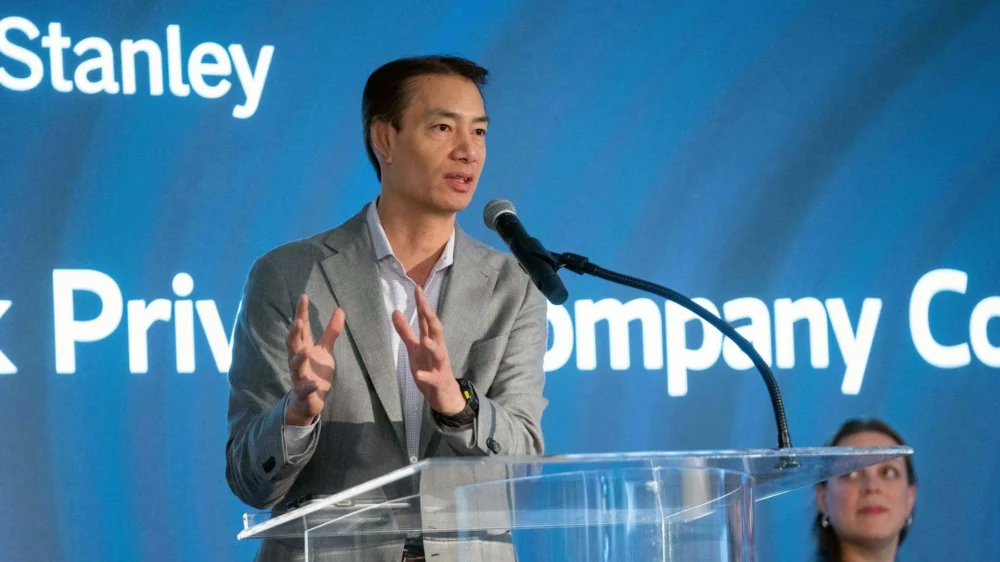
The annual Morgan Stanley Tech, Media, and Telecom (TMT) conference, a pivotal gathering for leaders and investors in the technology sector, this year served as a stark barometer for the accelerating impact of artificial intelligence. Unlike previous iterations, where AI discussions often centered on efficiency gains and incremental improvements, the 2026 conference unveiled a dramatic shift in investor sentiment: a heightened focus on AI’s potential to fundamentally redefine business models, create new market leaders, and render existing software paradigms obsolete. This profound re-evaluation was evident in the caliber of attendees, the nature of investor inquiries, and the strategic pronouncements from industry titans.
A Convergence of AI Architects and Industry Titans
The speaker lineup alone underscored the conference’s significance amidst the ongoing AI revolution. Dario Amodei, CEO of Anthropic, and Sam Altman, CEO of OpenAI – both prominent figures embroiled in discussions surrounding AI’s ethical development and its strategic implications for national security, including the recent "Pentagon drama" concerning AI integration – shared the stage. They were joined by Jensen Huang, the visionary CEO of NVIDIA, whose company has become the undisputed kingmaker of the AI hardware boom, and Satya Nadella, the transformative CEO of Microsoft, a leading investor in OpenAI and a champion of AI integration across enterprise software. Dozens of enterprise software CEOs also participated, each navigating the urgent task of convincing a skeptical investment community of their survival and relevance in an AI-dominated future. This convergence of AI’s leading architects and major enterprise players highlighted the immediate and pervasive challenges and opportunities facing the industry.
The Shifting Sands of AI Investment: From Efficiency to Existential Stakes
A key insight from the conference, articulated by David Chen, Morgan Stanley’s head of global technology investment banking, was the dramatic evolution in investor questioning from the previous year. In 2025, the conversation around artificial intelligence largely revolved around its application in trimming expenses – leveraging copilots and automation tools to shave a few percentage points off operating costs. This approach, Chen observed, has rapidly become "table stakes." Investors are no longer impressed by efficiency narratives; they now demand to know whether a company is an inherent beneficiary of AI’s transformative power or if its core business model is fundamentally threatened.
"I don’t think investors really wanted to hear about how people are being more efficient with AI," Chen stated, emphasizing the urgency of the shift. "They really, really wanted to hear, are you a beneficiary, or does AI threaten your overall business?" This pivot reflects a maturation in the market’s understanding of AI’s potential. It’s no longer just a tool for optimization but a force capable of reshaping entire industries and competitive landscapes. Companies, particularly those in the enterprise software sector, have felt this pressure acutely, having witnessed trillions of dollars in market capitalization evaporate in a short span earlier this year, signaling investor apprehension about their long-term viability.
Redefining the Software Moat in the Age of AI
Chen offered a critical framework for understanding which software companies possess a defensible "moat" against AI disruption. He drew a clear distinction between two categories:
- Deterministic Software: This category includes applications that perform precise, rule-based functions where accuracy is paramount. Examples include calculating payroll, sending invoices, or managing complex supply chains. In these domains, being "wrong by 2%" is unacceptable, and the underlying logic is often too critical and specific to be easily replicated or replaced by generative AI models. These companies, Chen argued, still maintain a robust competitive advantage. Their value lies in the reliability, precision, and regulatory compliance of their specialized functions.
- Public Data Organizers: This category encompasses companies whose primary function is to gather, organize, and present public data, often through user-friendly interfaces. These businesses, Chen suggested, are in serious trouble. Generative AI models, with their advanced capabilities in data synthesis, summarization, and natural language interaction, can increasingly perform these tasks with greater efficiency, lower cost, and often superior user experience. The "interface" itself, once a significant differentiator, becomes less relevant as AI agents can directly access and process information without human intermediation.
"AI doesn’t kill software," Chen asserted, providing a nuanced perspective. "It’s reshuffling it." This analogy suggests a profound reordering of the software industry, where value accrues to different layers and functionalities. Companies that enable complex, mission-critical operations with high stakes for error are likely to endure, while those primarily facilitating access to widely available information face an existential threat. This reshuffling demands a fundamental re-evaluation of product strategies, intellectual property, and customer relationships across the entire software ecosystem.
The Strategic Imperative: "Wartime, Not Peacetime" and Evolving Leadership
For companies finding themselves on the wrong side of this AI-driven reshuffling, Chen did not mince words, describing their current state as "wartime, not peacetime." This powerful metaphor conveys the urgency, the need for radical strategic shifts, and the potential for disruptive internal changes. In such an environment, business as usual is no longer an option; survival demands aggressive adaptation and often a complete reinvention of core operations.
An interesting implication of this "wartime" scenario, Chen observed, is a fundamental shift in leadership preferences at the board level. Boards are increasingly favoring product-oriented CEOs over traditional sales-and-marketing types. The rationale is clear: if a company needs to reinvent its backend infrastructure, re-architect its core products to be "AI-native," and deeply integrate new technological paradigms, it requires leadership with a profound understanding of software architecture, engineering, and product development. A CEO focused primarily on pipeline generation or market messaging, while valuable in stable times, may lack the technical acumen necessary to navigate such a profound technological overhaul. This trend signals a broader recognition that technological innovation and strategic product vision are now paramount for corporate survival in the AI era. Companies like Microsoft, under Satya Nadella, exemplify this shift, having pivoted from a sales-driven culture to one deeply rooted in engineering and product excellence.
SaaS to SaaaS: The Dawn of Agent-Centric Software

A profound conceptual shift capturing the essence of AI’s impact was coined by CNBC producer Jasmine Wu: the evolution from SaaS (Software as a Service) to SaaaS (Software for Agents as a Service). This idea, explored in a conversation with Box CEO Aaron Levie earlier in the week, suggests a future where the primary users of software are not humans interacting through graphical interfaces, but rather intelligent AI agents operating autonomously.
Levie articulated this vision, stating that "agents are now his new customer base." He projected that this "software for agents" business could become "10 times bigger than the existing one." The implications are monumental. Instead of designing user-friendly dashboards for human employees, software developers will increasingly focus on building robust APIs, modular components, and highly efficient backend services that AI agents can seamlessly access, interpret, and utilize to perform complex tasks. This means a shift from human-centric UI/UX design to machine-centric API design, emphasizing interoperability, data cleanliness, and computational efficiency.
For Box, a company traditionally focused on cloud content management for human collaboration, this could mean its platform evolves to allow AI agents to intelligently categorize, process, summarize, and route information without human intervention, becoming the "brain" or "nervous system" for automated workflows. Such a shift would revolutionize how enterprises manage data, automate processes, and derive insights, moving beyond simple automation to truly autonomous operations powered by AI. The software that survives and thrives, in this paradigm, will be the software designed for intelligent entities, not just their human counterparts.
The AI Infrastructure Conundrum: Peaking Capex and Emerging Bottlenecks
The aggressive buildout of AI infrastructure has been a significant driver of growth for the semiconductor and hardware industries. However, when asked about infrastructure spending levels for 2027, David Chen’s answer was "probably a similar level." This statement, though seemingly innocuous, carries significant implications. If AI capital expenditure from hyperscalers – the massive cloud providers like Microsoft Azure, Amazon Web Services, and Google Cloud, which are investing billions into AI chips and data centers – is indeed plateauing, it suggests that the initial, explosive growth phase of AI infrastructure spending may be approaching a peak.
This does not imply a decline in AI development, but rather a potential stabilization or more measured growth in the hardware buildout, possibly shifting focus from sheer volume to efficiency and specialization. The massive investments in advanced GPUs and specialized AI accelerators over the past few years have laid a substantial foundation. For instance, NVIDIA’s market cap surge has been directly tied to this demand. A plateau might signal a period of digestion and optimization for existing infrastructure, or a shift in where that capital is deployed.
Crucially, Chen also flagged persistent bottlenecks constraining the AI buildout: connectivity, compute, and energy.
- Connectivity: As AI models grow larger and distributed computing becomes more prevalent, the need for ultra-fast, low-latency interconnects within data centers and between geographically dispersed resources becomes critical. Companies developing advanced networking solutions, such as optical interconnects or novel fabric architectures, are poised to benefit.
- Compute: While current GPUs are powerful, the demand for even greater computational density and efficiency continues unabated. This drives innovation in specialized AI chips (ASICs), neuromorphic computing, and quantum computing, all aimed at pushing the boundaries of what’s possible for training and inference.
- Energy: Powering massive AI data centers consumes enormous amounts of electricity, raising concerns about sustainability and operational costs. Innovations in energy-efficient hardware, advanced cooling technologies (like liquid immersion cooling), and renewable energy integration are becoming increasingly vital.
These bottlenecks represent fertile ground for "next-generation companies in semiconductors and systems" that are focused on solving these fundamental challenges. Their success will be crucial for the continued, unconstrained growth of AI capabilities.
Sectoral Outlook: Cybersecurity as a Clear Beneficiary
Amidst the reshuffling, certain sectors emerge as clear beneficiaries, possessing inherent characteristics that provide strong competitive moats and align well with AI’s transformative power. Cybersecurity stands out prominently in this regard. The industry benefits from several factors:
- Regulatory Imperatives: Stringent data privacy and security regulations (e.g., GDPR, CCPA) create a non-negotiable demand for robust cybersecurity solutions across all industries.
- Ever-Evolving Threat Landscape: Cyber threats are constantly evolving in sophistication and volume, necessitating continuous innovation in defense mechanisms. AI itself is now a tool for both attackers and defenders, creating an arms race that favors those with advanced AI capabilities.
- Specialized Expertise: Cybersecurity requires highly specialized knowledge and continuous threat intelligence, making it difficult for general-purpose AI solutions to fully automate without deep domain expertise.
- Data Sensitivity: The highly sensitive nature of the data protected by cybersecurity solutions means errors are costly, reinforcing the need for deterministic, highly reliable systems that AI can augment but not fully replace in its current generative form.
AI enhances cybersecurity capabilities significantly, from automating threat detection and incident response to identifying subtle anomalies in network traffic and predicting potential vulnerabilities. As such, cybersecurity companies are uniquely positioned as AI beneficiaries rather than potential victims, poised for continued growth as AI integration expands the attack surface and necessitates more intelligent defense mechanisms.
The Unifying Thread: From Concept to Concrete Transformation
The overarching message emanating from the Morgan Stanley TMT conference was clear and unequivocal: AI has moved decisively past the conceptual stage of "this will be big" to the undeniable realization that "this is already big." The imperative for companies, investors, and leaders across the technology landscape is no longer to merely observe or incrementally adapt, but to demonstrate a proactive and fundamental embrace of AI. This demands not just tactical adjustments but strategic reinvention, redefining competitive advantages, reshaping leadership structures, and fundamentally altering how software is conceived, built, and consumed. The "reshuffling" of the software industry is not a future event but an ongoing transformation, challenging every enterprise to either lead the charge or risk being left behind in the relentless current of artificial intelligence.
About the Author