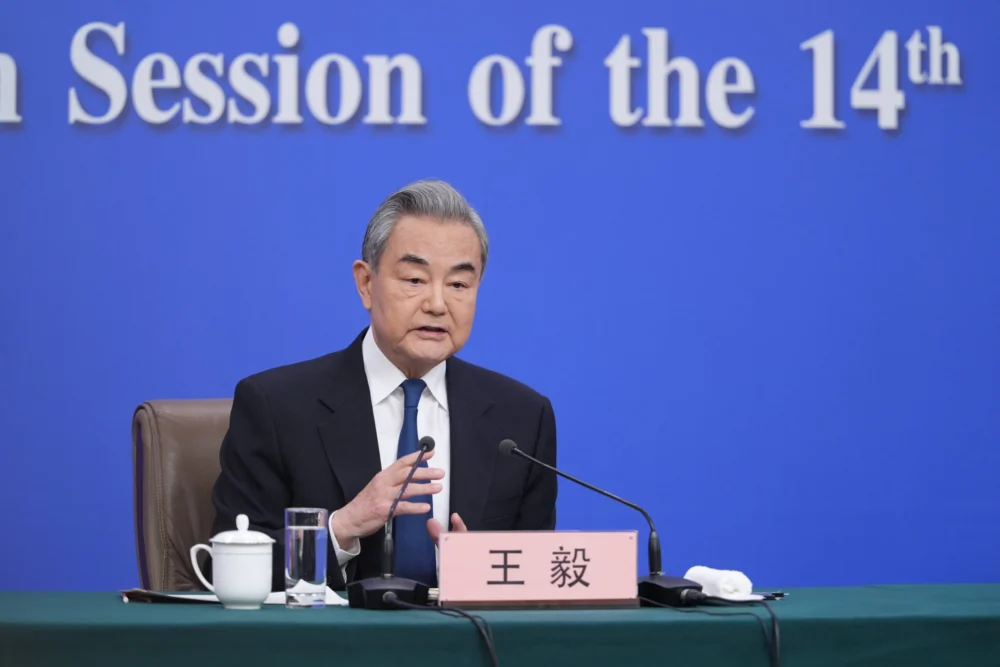
BEIJING – China’s Foreign Minister Wang Yi delivered a pivotal address on Sunday, emphasizing the critical importance of sustained interaction with the United States and confirming that extensive preparations are underway for a forthcoming summit between the leaders of the two global powers. His remarks, delivered during a high-profile press conference on the sidelines of the fourth session of the 14th National People’s Congress (NPC) on March 8, 2026, in Beijing, come at a moment of profound international tension, particularly concerning the escalating conflict in Iran and persistent disputes over trade tariffs.
"The agenda of high-level exchanges is already on the table," Wang stated in Mandarin Chinese, his words conveyed through an official translation, underlining the immediate diplomatic imperative. "What the two sides need to do now is make thorough preparations accordingly, create a suitable environment, manage the risks that do exist and remove unnecessary disruptions." This statement signals a deliberate and cautious approach from Beijing, acknowledging the complex landscape of bilateral relations while stressing the necessity of proactive engagement. Wang further warned against the perils of disengagement, asserting, "Turning our backs on each other would only lead to mutual misperception and miscalculation. Sliding into conflict or confrontation would only drag the whole world down." His words underscore the profound global stakes tied to the stability of the U.S.-China relationship, representing a significant diplomatic overture in a period marked by considerable strain.
Anticipation Builds for High-Stakes Summit
The diplomatic groundwork for the anticipated leader-level meeting was laid following an in-person encounter in South Korea last fall, where Chinese President Xi Jinping and U.S. President Donald Trump mutually indicated plans for reciprocal state visits. The immediate focus is on President Trump’s scheduled trip to China, slated for March 31 to April 2, 2026. If it proceeds as planned, this visit would mark the first by a sitting U.S. president to China since 2017, signifying a potentially crucial moment for recalibrating the intricate relationship between Washington and Beijing.
Despite the pronounced optimism from the Chinese side regarding the summit’s preparations, Beijing has yet to formally confirm the exact dates for President Trump’s arrival. Wang Yi, while not elaborating on the precise timeline, highlighted the historical significance of these high-level interactions, stating they have "provided [an] important strategic safeguard for the China-U.S. relationship to improve and move forward." This acknowledgment points to the belief within Chinese diplomatic circles that direct leadership engagement is paramount for stabilizing and advancing bilateral ties, particularly given the recent turbulence.
The Shadow of Geopolitical Crises: Iran and Beyond
The backdrop against which these diplomatic overtures are being made is heavily shadowed by a series of acute geopolitical crises, raising questions among analysts regarding the certainty of President Trump’s visit proceeding on schedule. Notably, the proposed dates for the trip would closely follow a period of intense military activity in the Middle East, specifically joint U.S.-Israeli attacks on Iran that commenced on February 28, 2026. These strikes resulted in the death of Iran’s Supreme Leader, Ayatollah Ali Khamenei, a development that sent shockwaves across the region and globally. Concurrently, the U.S. also announced the capture of Venezuelan leader Nicolas Maduro, adding another layer of international political volatility.

While Wang Yi meticulously avoided naming either individual in his Sunday remarks, his pronouncements clearly alluded to the profound implications of these events. He reiterated Beijing’s unwavering calls for an immediate ceasefire in the Iranian conflict, stating with solemn gravity, "This is a war that should not have happened. It is a war that does no one any good." This position underscores China’s consistent stance on regional stability and non-interference, particularly in conflicts that could destabilize global energy markets and foster broader geopolitical unrest.
In the immediate aftermath of the U.S.-Israeli strikes on Iran, Foreign Minister Wang Yi engaged in a flurry of diplomatic activity, holding phone calls with at least seven foreign ministers. These included critical discussions with his counterparts from Russia, Iran, and Israel, as detailed in official readouts. These urgent consultations highlight China’s efforts to position itself as a proponent of de-escalation and a diplomatic broker, albeit one navigating complex allegiances and national interests. The timing of these interventions, concurrent with the NPC session, underscores Beijing’s strategic intent to project its influence as a responsible global power amidst a deteriorating international security environment. The death of Ayatollah Khamenei, a figure who had governed Iran for decades, not only creates a power vacuum but also risks further destabilizing a region already prone to conflict, directly challenging global peace and potentially impacting China’s energy security and Belt and Road Initiative investments.
Navigating Economic Headwinds: Tariffs and Decoupling
Beyond the immediate geopolitical crises, the bilateral discussions between the U.S. and China are also inextricably linked to ongoing economic disagreements, most prominently the contentious issue of trade tariffs. In October of the preceding year, the two economic giants had reached a "fragile truce," agreeing to lower tariffs on each other’s goods to below 50% for a period of one year. This agreement marked a significant, albeit temporary, de-escalation from the height of tensions last spring, when duties had been ratcheted up to well over 100% in a tit-for-tat trade war that significantly disrupted global supply chains and impacted industries on both sides.
When questioned about President Trump’s characterization of U.S.-China relations as forming a new "G2" – implying a shared leadership role for the two countries in global affairs – Wang Yi firmly pushed back against the notion. Instead, he articulated China’s steadfast commitment to multipolarity, a vision of global governance where power is distributed among multiple major poles rather than concentrated in two or a single hegemonic entity. This stance reflects China’s broader diplomatic strategy of advocating for a more diversified international order and fostering partnerships with a wider array of nations.
Without explicitly naming the United States, Wang issued a pointed warning against protectionist economic policies, specifically "erecting tariff barriers and pushing [for] economic and technological decoupling." He likened such actions to "using kindling to put out a fire," a vivid metaphor implying that such measures would be self-defeating and ultimately harmful, stating, "You will only get burned." This strong rhetoric underscores Beijing’s deep concerns over continued efforts by Washington to limit China’s access to advanced technologies and restrict bilateral trade, which China views as detrimental to global economic stability and its own development trajectory.
The history of the U.S.-China trade war, which officially began in 2018, saw the imposition of tariffs on hundreds of billions of dollars worth of goods. While the "Phase One" trade deal in 2020 offered some respite, many tariffs remained in place. The current "fragile truce" is a testament to the ongoing economic interdependence that, despite political tensions, both nations acknowledge. Analysts frequently point to the immense bilateral trade volume, which even amidst tariffs, has remained substantial, albeit with shifting patterns as companies seek to mitigate risks. In 2025, despite the lingering trade barriers, bilateral trade figures reportedly hovered around the $600 billion mark, illustrating the deep economic linkages that persist. However, the push for "decoupling" in critical sectors like semiconductors, artificial intelligence, and telecommunications continues to fuel strategic competition, with both countries investing heavily in domestic capabilities and seeking to secure their respective supply chains.

China’s Vision for Global Governance: Rejecting the ‘G2’
Wang Yi’s unequivocal rejection of the "G2" concept is not merely a diplomatic nuance but a fundamental articulation of China’s evolving worldview. The idea of a "G2," initially proposed by some Western analysts and policymakers, suggests that the U.S. and China, as the world’s two largest economies and military powers, should jointly manage global issues. However, Beijing has consistently resisted this framing, perceiving it as an attempt to either constrain China within a U.S.-led order or to create an exclusive club that undermines the principles of multilateralism and sovereign equality.
China’s emphasis on multipolarity aligns with its broader foreign policy objectives, which advocate for a more representative and equitable international system. This vision is deeply intertwined with its promotion of international bodies like the United Nations, the Shanghai Cooperation Organization (SCO), and BRICS, where decision-making power is more diffused. By advocating for multipolarity, China seeks to foster an environment where emerging economies and developing nations have a stronger voice, thus challenging the traditional Western-dominated global order. This philosophical divergence profoundly impacts how the two nations approach issues ranging from climate change to global health and regional conflicts.
The Road Ahead: Challenges and Opportunities in Bilateral Relations
The upcoming visit by President Trump, if confirmed and executed, represents a critical juncture for U.S.-China relations. The convergence of high-level diplomatic efforts with profound geopolitical and economic challenges underscores the fragility and complexity of the current global landscape. A successful summit could potentially pave the way for de-escalation on several fronts, including a more stable framework for trade relations and coordinated efforts on global issues. Conversely, any misstep or failure to make substantive progress could exacerbate existing tensions, leading to increased mistrust and further fragmentation of the international order.
The ongoing annual parliamentary meeting in Beijing, where Wang Yi delivered his address, serves as a crucial platform for China’s top leadership, including President Xi Jinping, Premier Li Qiang, and Vice Premier He Lifeng, to deliberate on national policy and project a unified front to the world. The discussions and decisions made during this eight-day session, set to conclude on Thursday, will undoubtedly shape China’s diplomatic posture and economic strategies in the coming year.
For the United States, engaging with China, even amidst significant disagreements, remains a strategic imperative. The intertwined economies, shared global challenges like climate change and pandemics, and the potential for regional destabilization necessitate continued dialogue. However, Washington’s approach is often characterized by a dual strategy of competition and cooperation, seeking to maintain its strategic advantage while selectively engaging on issues of mutual interest.
The global community watches with bated breath, understanding that the trajectory of U.S.-China relations will profoundly influence international peace, economic stability, and the future of global governance. The willingness of both sides to engage in high-level diplomacy, despite deep-seated differences and an increasingly volatile world, offers a glimmer of hope that a path towards managed competition and selective cooperation, rather than outright confrontation, might still be pursued. The coming weeks, particularly leading up to the proposed Trump visit, will be crucial in determining whether this diplomatic opportunity can translate into tangible progress in one of the world’s most vital bilateral relationships.
About the Author