
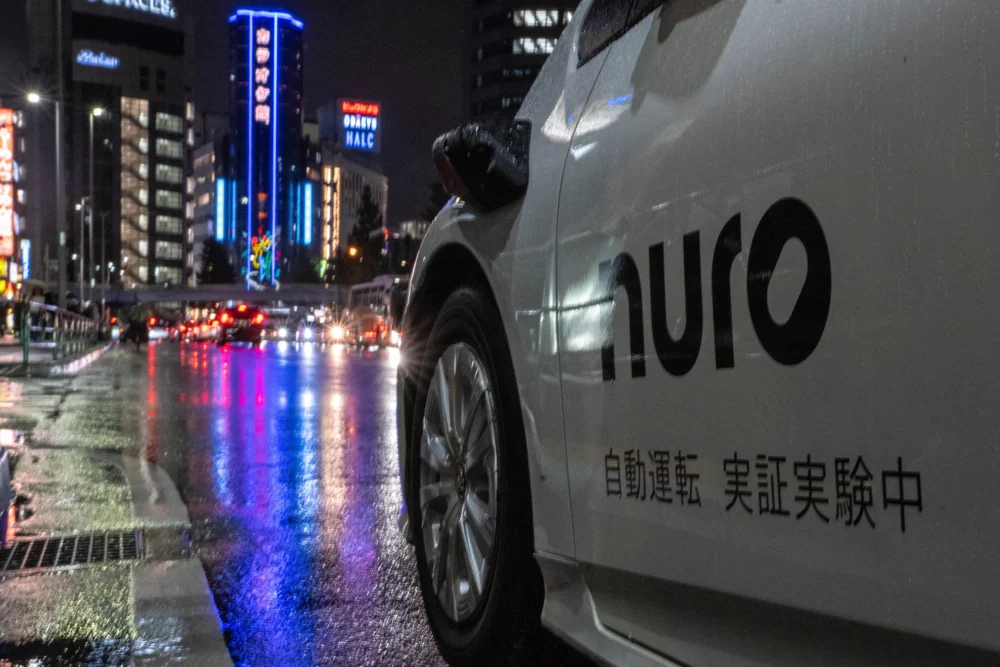
Silicon Valley-based autonomous vehicle startup Nuro, a company bolstered by investments from tech giants like Nvidia, Uber, and SoftBank, has commenced testing its cutting-edge self-driving technology on the public roads of Japan. This strategic move represents the first international foray for the ambitious company, which notably pivoted its business model approximately two years ago to focus on licensing its autonomous driving software.
The initial phase of testing involves Toyota Prius vehicles retrofitted with Nuro’s sophisticated self-driving software. Crucially, these vehicles are being operated with human safety operators present behind the wheel as a crucial backup measure. The testing began last month on the bustling public roads of Tokyo, a metropolis renowned for its complex traffic patterns and unique driving environment.
Navigating New Horizons: Challenges and Adaptations in Tokyo
Nuro has acknowledged that its operations in Japan present a distinct set of challenges that differ significantly from its domestic testing grounds. The company highlighted the necessity of adapting to varied driving styles, local traffic regulations, and the distinct infrastructure of Japan. A primary adjustment is the convention of driving on the left side of the road, a stark contrast to the right-side driving common in the United States. Furthermore, Tokyo’s notoriously dense traffic conditions require a heightened level of precision and predictive capability from the autonomous systems. The visual landscape of road signage and lane markings also presents a unique set of data points for the AI to process and understand.
To facilitate this expansion, Nuro established its presence in Tokyo with the opening of local offices last August. While the company has not disclosed the exact size of its test fleet in Japan, nor a specific timeline for when human safety operators might be phased out, its commitment to this international market is evident.
A Vision for Global Deployment
In a blog post detailing the commencement of its Japanese operations, Nuro expressed optimism about the future implications of its global testing efforts. The company articulated, "Our autonomous operations in Tokyo are the beginning of the compounding benefits of global deployment." This statement suggests a long-term strategy centered on leveraging diverse real-world data to enhance and refine its autonomous driving capabilities, with the ultimate goal of broader international implementation.
From Delivery Bots to Tech Licensing: Nuro’s Evolving Strategy
Nuro’s journey in the autonomous vehicle landscape began in 2016, founded by Dave Ferguson and Jiajun Zhu, both early engineers from Google’s pioneering self-driving car project. Their initial vision centered on developing and operating a fleet of low-speed, on-road delivery bots. This innovative concept quickly captured the attention of major investors. In 2019, the SoftBank Vision Fund made a substantial investment of $940 million into the startup, underscoring the significant potential perceived in Nuro’s delivery bot ambitions.
However, the path forward for Nuro, like many in the burgeoning autonomous vehicle sector, was not without its hurdles. The substantial costs associated with autonomous vehicle development, coupled with a broader trend of consolidation within the industry, led Nuro to reassess its operational strategy. This recalibration resulted in workforce reductions and a strategic pivot. In 2024, Nuro officially transitioned away from its low-speed bot development, opting instead to focus on licensing its proprietary autonomous driving technology to established automakers and mobility service providers, including ride-hailing and delivery companies.
The Power of "Zero-Shot" Autonomy: Nuro’s AI-Driven Approach
At the core of Nuro’s technology is its autonomy stack, which is built upon an end-to-end AI foundation model. This architecture is designed to enable the system to learn and improve continuously as it encounters new driving scenarios. Nuro refers to this innovative AI strategy as "zero-shot autonomous driving." This approach has allowed Nuro’s software to navigate public roads in Tokyo autonomously, even without prior explicit training on Japanese driving data, according to the company’s recent blog post.
This emphasis on a generalized AI model that can adapt to new environments echoes strategies employed by other leading AI developers in the autonomous driving space. Notably, the UK-based startup Wayve, which recently secured a significant $1.2 billion funding round with participation from Nvidia, Uber, and several major automakers, is also pursuing a similar end-to-end AI methodology for its self-driving software.
Prioritizing Safety Through Rigorous Testing
Despite the advanced nature of its AI-driven approach, Nuro maintains that safety remains its paramount concern. The company emphasizes that its broadly capable AI model is not developed in isolation from rigorous safety protocols. Nuro conducts extensive closed-course testing for each new release of its universal autonomy model. Performance is meticulously evaluated, and potential edge cases – rare or unusual scenarios that could challenge an autonomous system – are thoroughly tested using advanced simulation tools.
Once the autonomous vehicles are deployed on public roads, they operate in a "shadow mode." In this mode, Nuro’s software generates its driving decisions and predictions, but these commands are not directly transmitted to the vehicle’s controls. Instead, human drivers are in complete command of the vehicle’s operation. Nuro then meticulously compares the software’s proposed actions with the human driver’s actions. This process allows the company to analyze the system’s performance, identify any discrepancies, and determine when the autonomous system is sufficiently robust and reliable to operate independently on public roads.
Investor Confidence and Strategic Partnerships
Nuro’s innovative approach to self-driving software and its strategic pivot have continued to garner significant investor confidence. Last year, the company successfully raised $203 million in a Series E funding round, which was conducted in two tranches. This round saw participation from existing investor Baillie Gifford, as well as new investors including Icehouse Ventures, Kindred Ventures, Nvidia, and Pledge Ventures.
Uber, a major player in the mobility sector, also participated in Nuro’s funding. This investment is part of a broader strategic partnership and a multi-hundred-million-dollar commitment from Uber, which is also collaborating with electric car manufacturer Lucid on building a robotaxi service. This multifaceted support from prominent industry leaders underscores the perceived value and future potential of Nuro’s technology.
Broader Implications for the Autonomous Vehicle Industry
Nuro’s international expansion into Japan is a significant development that carries broader implications for the global autonomous vehicle industry. It signals a maturation of the sector, moving beyond purely domestic testing to tackling the complexities of diverse international markets. For Nuro, this move is a critical step in validating its "zero-shot" AI approach on a global scale and gathering invaluable data from varied driving environments.
The company’s strategic shift to licensing its technology also aligns with a growing trend in the AV industry, where pure operational plays have proven capital-intensive and challenging. By partnering with established automakers and mobility providers, Nuro can accelerate the deployment of its technology and focus its resources on core AI development.
The challenges presented by Japan’s unique road conditions, traffic density, and driving conventions will undoubtedly push Nuro’s AI to its limits, potentially leading to significant advancements. Success in this complex market could serve as a powerful testament to the adaptability and robustness of Nuro’s foundational AI model, paving the way for further global deployments and partnerships. The company’s ability to navigate these new complexities while maintaining its unwavering commitment to safety will be closely watched by competitors and industry observers alike.
About the Author





