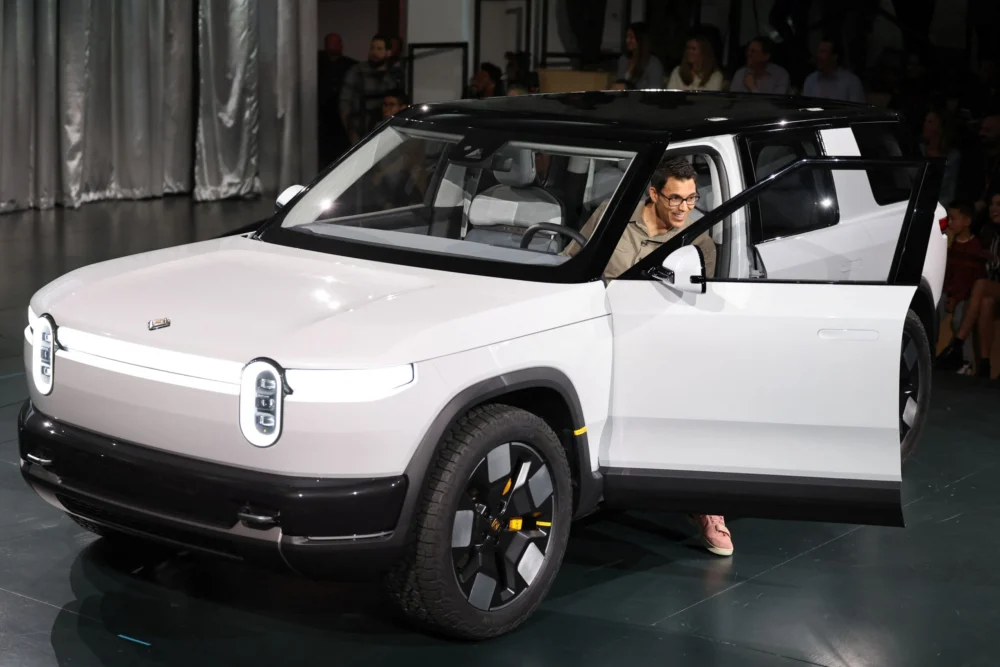
Rivian Automotive, the electric vehicle startup founded by RJ Scaringe, officially announced the spring 2024 launch of its highly anticipated R2 all-electric SUV, beginning with a specialized "Launch Package" model priced at approximately $58,000. This strategic unveiling marks a critical juncture for the company, which has faced significant financial headwinds and a cooling EV market. The initial R2 variant, a performance-oriented midsize SUV, is designed to offer a compelling blend of power, range, and advanced technology, featuring a 330-mile range, a dual-motor configuration, 656 horsepower, and 609 foot-pounds of torque, enabling a rapid 0-60 mph acceleration in as quick as 3.6 seconds. Crucially, this launch edition will also include "lifetime" access to Rivian’s Autonomy+ advanced driver-assistance system, positioning it squarely against market leaders in autonomous driving capabilities.
Rivian’s Strategic Bet on the R2: A "Make-or-Break" Vehicle
The R2 has long been touted as a transformative product for Rivian, a company that has grappled with billions of dollars in losses since its inception and observed a noticeable softening in demand for its current flagship models, the R1T pickup and R1S SUV, alongside its electric delivery vans. While the R1 series garnered initial acclaim for its distinctive design and off-road prowess, their premium price point, typically starting above $70,000, limited their market accessibility. The R2, from an aesthetic perspective, presents itself as a more compact iteration of the R1S, but beneath the surface, it represents a profound engineering overhaul. Rivian has meticulously re-engineered the vehicle’s software, electrical system, and componentry, aiming for enhanced manufacturing efficiency and, critically, improved profitability margins.
CEO RJ Scaringe has repeatedly assured investors that the R2 will serve as the inflection point for the company’s financial health, sales volume, and technological advancements. This includes a concerted effort to introduce hands-free, eyes-off driving capabilities, a direct challenge to the advanced driver-assistance systems offered by industry leader Tesla. Morgan Stanley analyst Andrew Percoco underscored the R2’s strategic importance, stating, "R2 is the key transition vehicle for Rivian to transform into a scaled auto manufacturer, which in turn helps drive operating leverage across the business (including R1)." This sentiment highlights the broader impact the R2 is expected to have on Rivian’s entire operational framework, not just its direct sales.
Pricing Strategy and Market Entry Timeline
The company’s initial reveal of the R2 in March 2024 generated considerable excitement, particularly due to the promised entry-level price point of $45,000. This aggressive pricing was seen as a direct move to tap into a broader consumer base and compete more effectively in the burgeoning mid-size electric SUV segment. However, Thursday’s announcement clarified a staggered rollout, with the more affordable $45,000 model not expected to be available until late 2027. This delay means that for the foreseeable future, prospective R2 buyers will be looking at the higher-priced Launch Package. This strategic decision, while potentially maximizing initial profit per unit, also means Rivian will miss out on the immediate opportunity to capture the budget-conscious segment that was initially enticed by the lower price point, potentially ceding ground to competitors already offering more affordable options.
The R2’s launch comes amidst a backdrop of increasing caution within the broader electric vehicle market. After several years of explosive growth, the pace of EV adoption has moderated, leading many automakers, including established giants like General Motors and Ford, to scale back their ambitious EV production targets or report significant losses in their electric vehicle divisions. Analysts have notably revised down their projections for EV market share growth in the coming years, reflecting a more realistic assessment of consumer readiness and infrastructural challenges.
Manufacturing Ambitions and Headwinds
Rivian’s manufacturing strategy hinges heavily on the R2. The vehicle is slated to anchor production at its existing facility in Normal, Illinois, which has been the site of its R1 and EDV production. Furthermore, the R2 is central to the long-term vision for Rivian’s ambitious, multibillion-dollar plant currently under construction in Georgia. This new facility is projected to boast a formidable annual production capacity of up to 400,000 vehicles, a testament to Rivian’s aspirations for large-scale manufacturing and market penetration. However, scaling production for complex electric vehicles has proven to be a formidable challenge for new entrants, often leading to delays and significant capital expenditure overruns.
Barclays analyst Dan Levy, in an August investor note, expressed reservations regarding the R2’s potential sales volume, citing "increasing uncertainty on R2’s volume outlook following the recent negative policy developments (i.e. $7.5k IRA credit expiration, reduced reg credits, tariff costs), with R2 likely launching in a period of weak US EV demand." This analysis points to a confluence of macroeconomic factors and regulatory shifts that could dampen consumer enthusiasm and affect the R2’s market performance.
Evolving Regulatory Landscape and Market Competition
The landscape for EV manufacturers has become increasingly complex due to changing federal regulations. Notably, the expiration of up to $7,500 in federal tax credits under the Inflation Reduction Act (IRA) for certain vehicles has removed a significant incentive for consumers. These credits were designed to stimulate EV purchases and manufacturing within North America, but their availability has been subject to evolving battery sourcing and assembly requirements, leading to uncertainty. Additionally, reduced regulatory credits and the potential for increased tariff costs could further impact Rivian’s profitability and pricing flexibility, making it harder to compete on cost.

In this challenging environment, the R2 is positioned to compete not only against other electric vehicles but also against traditional internal combustion engine (ICE) SUVs. Scaringe has explicitly stated this dual competitive strategy, recognizing that mass-market adoption requires convincing buyers to switch from gasoline-powered alternatives.
The most direct competitor in the EV space is undoubtedly the Tesla Model Y, which holds the distinction of being the bestselling EV globally. The R2 is comparable to the Model Y in several key metrics:
- Size: Both fall into the compact/mid-size SUV category.
- Range: The R2’s 330-mile range aligns closely with Model Y variants.
- Acceleration: The R2’s 0-60 mph in 3.6 seconds is competitive with performance versions of the Model Y.
- Pricing: The Model Y, however, starts at a more accessible price point of approximately $40,000, a significant advantage over the R2’s initial $58,000 launch package and even its promised $45,000 entry model, which is years away.
- Advanced Driving Systems: Tesla’s Autopilot and Full Self-Driving (FSD) capabilities are already well-established and widely available, offering a significant lead in real-world deployment and customer familiarity compared to Rivian’s nascent Autonomy+ system.
Scaringe, however, remains optimistic about the R2’s unique appeal. "R2 is an exceptional vehicle and I believe will be a game changer for our customers, our company and the industry," he remarked during a recent earnings call. He emphasized that the R2 extends the "adventure" experience delivered by the R1, but in a more compact form factor and, eventually, at a more attractive lower price point, suggesting a distinct brand identity that could differentiate it from purely utilitarian or performance-focused rivals.
Financial Outlook and Investor Sentiment
Rivian’s financial performance has been a persistent concern for investors. The company has consistently reported substantial losses as it invests heavily in R&D, manufacturing infrastructure, and scaling operations. For 2025, Scaringe characterized it as a "foundational year" for the company, laying the groundwork for future growth. He projected 2026 to be an "inflection point," suggesting a move towards improved financial metrics.
The company’s guidance for 2026 includes adjusted pretax losses estimated between $1.8 billion and $2.1 billion, with capital expenditures projected between $1.95 billion and $2.05 billion. These figures, while still representing significant outlays, compare to nearly $2.1 billion in adjusted pretax losses and $1.7 billion in capital expenditures recorded in the preceding year. The narrowing of projected losses and a slight increase in capital expenditure for growth indicate a strategic shift towards leveraging new production capabilities and cost efficiencies.
Investor sentiment surrounding Rivian has been volatile. Shares saw an uplift ahead of the R2 details, buoyed by an upgrade from TD Cowen to a "buy" rating, based on an in-depth analysis of demand trends for the new EV. This suggests that a segment of the market sees the R2 as a credible pathway to future success, despite the near-term financial challenges and market uncertainties. The R2’s ability to drive operating leverage and scale production efficiently will be paramount to validating this optimistic outlook.
Conclusion: A High-Stakes Bet for Rivian’s Future
The launch of the Rivian R2 is far more than just another vehicle introduction; it is a high-stakes gamble for the company’s long-term viability and its ambition to transition from a niche, premium EV manufacturer to a scaled, profitable automaker. While the R2’s initial performance-oriented, higher-priced launch edition may delay the broad market penetration initially envisioned, it strategically aims to capture a segment willing to pay a premium for advanced features and the distinct Rivian brand experience.
The success of the R2 will hinge on several critical factors: Rivian’s ability to ramp up production efficiently at its Illinois and future Georgia plants, its success in navigating a competitive and increasingly price-sensitive EV market, and its capacity to manage ongoing financial losses while demonstrating a clear trajectory towards profitability. As the broader EV industry grapples with moderated demand and evolving policy landscapes, the R2’s journey will serve as a compelling case study for the challenges and opportunities facing next-generation electric vehicle manufacturers. For Rivian, the R2 is not just a new model; it is the cornerstone of its strategic pivot and the defining test of its entrepreneurial vision.
About the Author