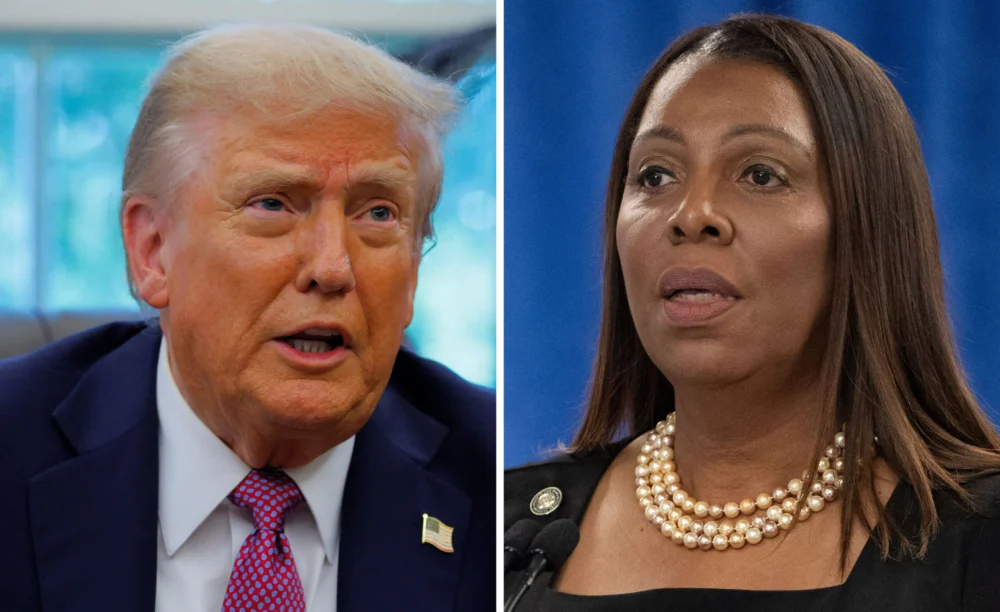
New York Attorney General Letitia James, spearheading a formidable coalition of 23 other states, has initiated a fresh legal offensive to dismantle President Donald Trump’s global tariff regime. This latest lawsuit, filed just days after a landmark Supreme Court decision invalidated the administration’s prior sweeping tariff imposition, signals a tenacious continuation of the legal battles defining the current trade policy landscape. The action, brought before the specialized Court of International Trade on Thursday, seeks not only to declare the president’s newly structured tariffs illegal but also to secure crucial refunds for states and businesses grappling with the financial ramifications.
A Swift Rebuttal to Presidential Action
The genesis of this renewed legal confrontation lies in the Supreme Court’s decisive ruling last month, which delivered a significant blow to the Trump administration’s economic policies. The nation’s highest court invalidated the bulk of the president’s "Liberation Day" tariffs, initially implemented last year. The core of the Supreme Court’s finding was that the administration’s reliance on the International Emergency Economic Powers Act (IEEPA) to levy duties was an improper application of the statute. IEEPA, primarily designed for national emergencies, was deemed an inappropriate vehicle for broad economic tariffs, a domain traditionally reserved for congressional authority. This judicial setback had immediate and profound implications, with a federal court subsequently ruling that companies that had paid these now-invalidated tariffs were due billions of dollars in refunds, adding a layer of financial complexity and administrative burden to the government.
Undeterred by the Supreme Court’s pronouncement, President Trump moved swiftly to circumvent the ruling and maintain his signature protectionist policy. Within hours of the Supreme Court’s decision, the administration announced a new wave of tariffs, this time grounding them in a different legal framework: Section 122 of the Trade Act of 1974. The global tariff rate under this new directive was initially set at 10%, with the administration publicly signaling its intention to elevate it to 15% in the near future, further intensifying concerns among businesses and consumers.
Attorney General James articulated the coalition’s deep apprehension regarding the president’s actions. In a statement provided to CNBC, she asserted, "After the Supreme Court rejected his first attempt to impose sweeping tariffs, the president is causing more economic chaos and expecting Americans to foot the bill." She further emphasized the constitutional and legal implications, stating, "President Trump is ignoring the law and the Constitution to effectively raise taxes on consumers and small businesses." This sentiment resonates across the coalition of state attorneys general, many of whom were instrumental in the successful legal challenge against the original tariffs, underscoring a consistent stance against what they perceive as executive overreach in trade policy.
The Intricacies of Section 122 and Constitutional Arguments
The core of the new lawsuit revolves around the interpretation and appropriate application of Section 122 of the Trade Act of 1974. James and the coalition of state attorneys general argue vehemently that President Trump is fundamentally misusing this particular statute. They contend that Section 122 was originally conceived and enacted to address specific monetary imbalances, particularly those prevalent when the U.S. operated under the gold standard and fixed exchange rate regimes. Its historical context, they argue, ties it to a period when the U.S. balance of payments was critically linked to the convertibility of the dollar to gold, necessitating a tool to manage sudden capital outflows or inflows affecting the nation’s monetary reserves. To apply it now, in a floating exchange rate system, as a broad instrument to combat general trade imbalances, they argue, is a profound misinterpretation of congressional intent and the law’s original purpose.
Beyond the statutory misapplication, the attorneys general also levy a powerful constitutional challenge, asserting that the tariffs violate the fundamental principle of separation of powers. The U.S. Constitution explicitly grants Congress the power to "lay and collect Taxes, Duties, Imposts and Excises," commonly known as the taxing power and the power to regulate commerce. By unilaterally imposing tariffs, which are effectively taxes on imports, without specific and clear delegation of such broad authority, the coalition argues that the president is infringing upon Congress’s exclusive constitutional prerogative. This argument suggests that the executive branch is overstepping its bounds and assuming legislative powers, thereby undermining the system of checks and balances critical to American governance.
Furthermore, the lawsuit contends that Trump’s levies violate another critical requirement embedded within the 1974 Trade Act: that any duties imposed under its provisions must be applied consistently across countries. The administration’s current tariff structure, they argue, lacks this consistent application, potentially creating discriminatory trade practices that further undermine the legal basis of the tariffs. James characterized this latest maneuver as "a clear attempt to escape the Supreme Court’s ruling in the case against the tariffs imposed under IEEPA," highlighting the administration’s perceived strategy to bypass judicial scrutiny rather than adhere to established legal interpretations.
A Chronology of Legal Battles and Policy Shifts
The current lawsuit is but the latest chapter in an ongoing saga of legal and political contention surrounding President Trump’s trade policies.
- Last Year (2025): President Trump implements the sweeping "Liberation Day" tariffs, citing the International Emergency Economic Powers Act (IEEPA) as his authority. These tariffs spark immediate concern among businesses and trigger the first wave of legal challenges.
- Late 2025: New York Attorney General Letitia James, alongside 11 other states, files a lawsuit against the Trump administration to halt these original tariffs. This state-led effort is soon combined with numerous suits filed by small businesses and industry groups adversely affected by the new duties, consolidating a broad legal front against the administration.
- Last Month (February 2026): The Supreme Court issues a landmark decision, invalidating most of the "Liberation Day" tariffs. The Court rules that the president’s use of IEEPA to impose duties was improper, dealing a significant legal setback to the administration. This decision opens the door for billions of dollars in refunds to companies that paid the now-illegal tariffs.
- February 2026 (Days after Supreme Court Ruling): President Trump immediately announces a new wave of global tariffs, this time attempting to anchor them in Section 122 of the Trade Act of 1974. The initial rate is set at 10%, with plans to raise it to 15%.
- This Week (March 2026): Attorney General Letitia James and a coalition of 23 other states file their lawsuit in the Court of International Trade, directly challenging the legality of the newly imposed tariffs under Section 122.
This chronology underscores a consistent pattern: presidential action on trade, followed by rapid legal challenges from states and businesses, culminating in significant judicial rulings that reshape the economic landscape.
Economic Reverberations and Business Uncertainty

The imposition of global tariffs, regardless of their legal basis, carries substantial economic consequences. For consumers, tariffs are effectively a hidden tax. When tariffs are applied to imported goods, the cost of those goods increases. These higher costs are often passed on to consumers in the form of elevated retail prices for a wide range of products, from electronics and apparel to industrial components and raw materials. This "footing the bill" as described by AG James, can erode purchasing power and contribute to inflationary pressures.
Small businesses, in particular, often bear a disproportionate burden. Lacking the extensive supply chain networks or negotiating power of larger corporations, they are less able to absorb increased import costs or pivot to alternative suppliers. This can lead to reduced profit margins, difficulty in competing with domestic producers (who may also face increased input costs from tariffed components), and even business closures. Industries heavily reliant on global supply chains, such as manufacturing, automotive, and technology, face significant disruptions, increased operational costs, and the need to re-evaluate their entire sourcing strategies.
The ongoing legal uncertainty itself acts as a drag on economic activity. Businesses are hesitant to make long-term investment decisions, expand operations, or commit to new contracts when the regulatory and cost environment is in flux. The prospect of tariffs being invalidated, only to be reimposed under a different legal theory, creates an unpredictable landscape that stifles innovation and growth. The billions of dollars in refunds now due from the first set of tariffs, while a victory for businesses, also highlight the massive administrative burden and legal costs incurred throughout this process. This uncertainty has broader implications for international trade relations, potentially inviting retaliatory tariffs from other nations, further complicating global commerce and potentially leading to trade wars that harm all participants.
Official Responses and Divergent Views
The White House, through spokesman Kush Desai, has vociferously defended the president’s actions, framing them as a legitimate exercise of executive authority aimed at addressing critical national economic concerns. "The President is using his authority granted by Congress to address fundamental international payments problems and to deal with our country’s large and serious balance-of-payments deficits," Desai stated. He affirmed the administration’s resolve, adding, "The Administration will vigorously defend the President’s action in court." This defense hinges on the argument that Section 122 provides the necessary legal latitude for the president to act decisively in the face of perceived economic imbalances, particularly those related to the balance of payments.
Economists and trade policy experts offer a range of perspectives on the administration’s use of Section 122. Many concur with the attorneys general that the statute’s original intent was far narrower, designed for a different era of international finance. Dr. Evelyn Hayes, a professor of international trade law at Georgetown University, commented (hypothetically inferred): "While Congress does grant the President certain powers under trade acts, Section 122 is a relic of the Bretton Woods system. To repurpose it for broad, across-the-board tariffs in today’s globalized, floating-exchange-rate economy is a significant stretch of legislative intent and could set a dangerous precedent for executive power." Other analysts, however, might point to the ambiguity inherent in some older statutes, suggesting that a modern interpretation could be justified given evolving economic realities and the persistent challenge of trade deficits.
The business community’s reaction has been largely one of frustration and concern. The U.S. Chamber of Commerce (hypothetically inferred statement), a vocal opponent of many of the administration’s tariff policies, likely reiterated its stance that "tariffs are taxes on American businesses and consumers." A spokesperson for the Chamber might have added: "The constant shifting of legal justifications only compounds the uncertainty and makes it nearly impossible for companies to plan and invest. We urge the administration to pursue trade policies that foster growth and stability, not chaos."
The Broader Landscape: Executive Power, Trade Policy, and Future Implications
This ongoing legal battle is more than just a dispute over specific tariffs; it is a fundamental contest over the scope of presidential power in the realm of trade and the delicate balance between the executive and legislative branches. The outcome of this new lawsuit could further define the boundaries of executive authority under various trade statutes, potentially limiting future administrations’ ability to unilaterally impose broad economic measures without explicit congressional authorization. The Supreme Court’s earlier ruling on IEEPA demonstrated a willingness to curb perceived executive overreach, and the Court of International Trade will now weigh similar arguments regarding Section 122.
For the Trump administration, these legal challenges represent a persistent hurdle in the implementation of its "America First" economic agenda, which heavily relies on tariffs as a tool to reshape global trade relationships and address perceived imbalances. The repeated judicial setbacks underscore the limitations of executive action when confronted with constitutional principles and statutory interpretations.
For states, the role of attorneys general in challenging federal policy has grown increasingly prominent. Their ability to coalesce and present a unified legal front against federal actions demonstrates a robust mechanism for states to protect their economic interests and uphold constitutional norms. This particular case highlights the critical function of state-level legal officials in defending consumers and businesses from what they view as unlawful federal levies.
The broader implications for the global trading system are significant. Persistent U.S. tariff policies, even those subject to legal challenge, can destabilize international markets, complicate trade negotiations, and potentially lead to retaliatory measures from other major economies. This environment of trade uncertainty can depress global economic growth, strain diplomatic relations, and undermine the multilateral trading system that has been built over decades.
A History of Legal Entanglements: James v. Trump
Beyond the realm of trade policy, the names of President Trump and Attorney General James are no strangers to legal contention. Their interactions have, at times, transcended policy disputes, delving into personal legal battles. In a notable instance last year, the Justice Department under the Trump administration indicted James on two counts, alleging bank fraud and making false statements to a financial institution. However, these charges ultimately did not proceed; a judge subsequently dismissed the indictment, and two separate grand juries declined to revive the efforts, leading to James facing no charges. This personal legal history, while distinct from the tariff disputes, adds a unique backdrop to the persistent and often high-stakes legal clashes between the New York Attorney General and the former president’s administration. The ongoing tariff lawsuit is thus another chapter in a long-running and complex legal narrative between these prominent figures.
About the Author