
Understanding your Cost Per Lead (CPL) is vital for the future of your business, a foundational metric that dictates the efficiency and effectiveness of your marketing investments. In today’s competitive landscape, generating quality leads is not an option but a necessity for sustainable growth, requiring strategic expenditure on marketing initiatives. The adage "you have to speculate to accumulate" holds true, but without a clear understanding of the actual cost involved in acquiring each potential customer, businesses risk misallocating resources and undermining their overall marketing efficacy. This is where the calculation and diligent tracking of Cost Per Lead become indispensable.
This comprehensive analysis will delve into the significance of CPL for optimizing business expenses, provide a clear methodology for its calculation, and offer actionable strategies for businesses aiming to reduce this crucial metric, thereby maximizing their return on marketing investment.
Defining Cost Per Lead: More Than Just a Number
Cost Per Lead (CPL) is a key performance indicator (KPI) in marketing that quantifies the total expenditure required to generate a single lead for a business. It represents the financial investment made to attract an individual who has demonstrated interest in a company’s products or services. The definition of a "quality lead" can vary depending on the marketing campaign and business objectives, but typically it refers to an individual who has taken a specific action indicating engagement, such as:
- Filling out a contact form on a website
- Downloading a piece of gated content (e.g., an ebook, whitepaper)
- Subscribing to a newsletter
- Requesting a demo or consultation
- Attending a webinar
CPL serves as a robust tool for evaluating the success of digital marketing endeavors. It allows businesses to assess the performance of individual campaigns across various channels, such as social media, search engine marketing, email marketing, and content marketing, or to gauge the overall efficiency of their entire marketing spend.
It is crucial to distinguish CPL from Cost Per Acquisition (CPA). While CPA measures the total cost of acquiring a paying customer or closing a sale, CPL focuses specifically on the expense associated with generating potential customers. This distinction is vital for understanding the entire customer journey and optimizing different stages of the sales funnel.
The Strategic Importance of Cost Per Lead
Marketing typically constitutes a significant portion of overall business expenditures. Therefore, meticulously measuring the effectiveness of these efforts and identifying avenues for spending optimization is paramount. Cost Per Lead is a cornerstone metric for tracking the performance of both sales and marketing campaigns.
By understanding the cost associated with generating each potential customer, businesses can allocate their marketing budgets and client management resources more strategically. This insight enables a comparative analysis of different channels and strategies, highlighting those with the highest return on investment (ROI) for increased investment, while simultaneously identifying underperforming or cost-ineffective approaches for potential discontinuation or revision.
Furthermore, when CPL data is analyzed in conjunction with other marketing metrics, such as conversion rates and customer lifetime value, businesses can gain deeper insights into the quality of leads being generated. A campaign might appear successful based on a low CPL, but if the leads generated are not converting into paying customers, the overall ROI can be significantly impacted. CPL analysis, therefore, helps in course-correcting marketing strategies, saving valuable time and financial resources.
Beyond performance metrics, CPL also plays a critical role in challenging assumptions. A large-scale, high-visibility campaign might generate substantial buzz and a high volume of leads, leading to an assumption of its effectiveness. However, a closer examination of CPL might reveal that a smaller, less conspicuous campaign, despite generating fewer leads, offers a superior ROI due to lower operational costs and higher lead quality.
Defining a "Good" Cost Per Lead: A Contextual Approach
The concept of a "good" Cost Per Lead is not universally defined and varies significantly across industries, business models, and market conditions. There is no single benchmark that applies to all companies. Instead, what constitutes a good CPL is contingent upon a multitude of factors, including:
- Industry: Highly competitive or niche industries, such as enterprise software, financial services, or specialized B2B sectors, often command higher CPLs due to the complexity of sales cycles, the specialized nature of target markets, and the higher perceived value of each lead. For instance, in the B2B software market, where deal values can be substantial, a CPL of several hundred dollars might be considered acceptable if the conversion rate is strong.
- Product or Service Value: The price point of a company’s offerings is a critical determinant. A CPL of $80 might be deemed excessive for a product priced at $20, but highly attractive for a service or product valued at $2,000. The profitability of each lead directly influences the acceptable CPL.
- Target Audience: The specificity and accessibility of the target audience influence CPL. Reaching highly specialized or niche audiences often requires more targeted and therefore potentially more expensive marketing efforts.
- Marketing Channels Used: Different marketing channels have inherent cost structures. Paid advertising platforms (e.g., Google Ads, LinkedIn Ads) often have higher direct costs compared to organic content marketing or SEO efforts, which can lead to a lower CPL over time.
- Lead Quality and Conversion Rates: A higher conversion rate of leads into paying customers can justify a higher CPL. If a marketing strategy consistently generates leads that are highly likely to convert, the initial acquisition cost becomes less of a concern.
- Customer Lifetime Value (CLV): The long-term revenue a customer is expected to generate is a crucial factor. A higher CLV can support a higher CPL, as the initial investment is offset by sustained future revenue.
Ultimately, a "good" CPL is one that is lower than the projected revenue or profit expected from an average lead. Conversely, a "bad" CPL results in a net loss, where the cost of lead generation exceeds the anticipated revenue from that lead. To determine this, businesses must accurately estimate their average customer spend and their conversion rates. Industry benchmarks can serve as a useful reference point, but internal analysis, considering factors like conversion rates and potential lifetime value, is essential for setting realistic and profitable CPL targets.
Calculating Your Cost Per Lead: A Step-by-Step Guide
Calculating Cost Per Lead is a straightforward process that requires meticulous tracking of marketing expenditures and lead generation numbers over a defined period. Consistency in the chosen time frame (e.g., monthly, quarterly, annually) is crucial for accurate comparison and trend analysis.
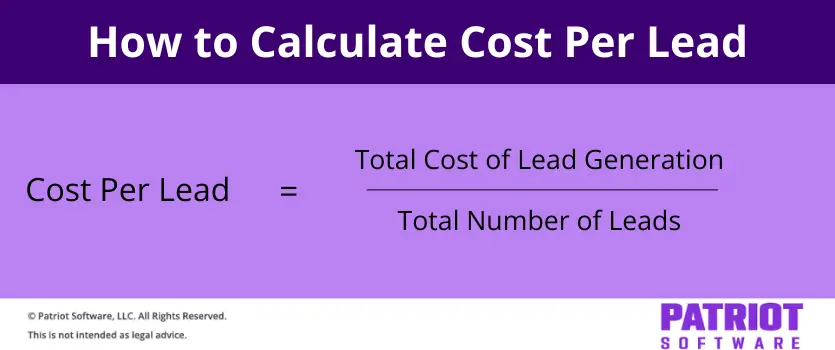
The Fundamental Formula:

Cost Per Lead = Total Cost of Lead Generation / Total Number of Leads
1. Calculating Total Costs of Lead Generation:
This involves aggregating all expenses directly attributable to marketing and lead generation efforts within the chosen time period. This encompasses:
- Advertising Spend: Costs associated with paid advertisements across all platforms (e.g., Google Ads, social media ads, print ads).
- Content Creation: Expenses related to producing blog posts, articles, videos, infographics, ebooks, and other marketing collateral.
- Software and Tools: Subscriptions to marketing automation platforms, CRM systems, SEO tools, analytics software, and design software.
- Agency Fees and Freelancer Costs: Payments to external marketing agencies, consultants, copywriters, designers, or SEO specialists.
- Salaries and Overhead for Marketing Teams: A portion of the salaries for in-house marketing staff and relevant operational overhead.
- Website and Landing Page Development/Maintenance: Costs associated with building, optimizing, and maintaining landing pages and website infrastructure designed for lead capture.
- Event Marketing Costs: Expenses related to trade shows, webinars, or other events where leads are generated.
It is often beneficial to categorize costs into inbound and outbound marketing efforts for a more nuanced understanding:
- Inbound Costs: Expenses related to attracting leads organically through content, SEO, social media, and website optimization.
- Outbound Costs: Expenses related to direct outreach, paid advertising, and promotional campaigns.
Example of Cost Breakdown:
Let’s consider a monthly calculation:
- Advertising Costs: $3,000 (Ad Spend) + $1,000 (Ad Management/Agency Fees) = $4,000
- Inbound Costs: $500 (Content Creation) + $300 (SEO Tools) + $700 (Freelance Writer) = $1,500
- Total Marketing Costs for the Month: $4,000 + $1,500 = $5,500
2. Calculating the Total Number of Leads:
This step involves accurately counting all the leads generated from all marketing activities during the same defined period. Leads can be categorized as:
- Inbound Leads: Visitors who organically found your website or content and converted (e.g., form submissions, ebook downloads, newsletter sign-ups).
- Outbound Leads: Individuals acquired through paid advertising campaigns, direct outreach, or other promotional efforts.
Example of Lead Calculation:
- Inbound Leads (from website forms, downloads): 300
- Outbound Leads (from paid ad campaigns): 200
- Total Leads for the Month: 300 + 200 = 500
3. Performing the CPL Calculation:
Using the example figures above:
Cost Per Lead = $5,500 / 500 leads = $11 per lead
Tools for Calculation:
While manual calculation is feasible, various tools can simplify this process:
- CPL Calculators: Online tools, such as Leadfeeder’s CPL Calculator, are readily available.
- Marketing Analytics Platforms: Google Analytics, Google Ads, Facebook Ads Manager, and other platform-specific dashboards provide data on campaign spend and lead generation metrics.
- CRM Systems: Customer Relationship Management systems can track lead sources and associated costs, providing a unified view.
- Accounting Software: Essential for accurately tracking all marketing-related expenses.
Leveraging Cost Per Lead for Strategic Advantage
Once calculated, CPL is not merely a number but a powerful tool for strategic decision-making. It enables businesses to:
- Compare Channel Performance: Evaluate the cost-effectiveness of different marketing channels. For example, if email marketing has a CPL of $5 and paid social media has a CPL of $25, it suggests that email marketing is more efficient for lead generation in this instance.
- Assess Campaign Efficacy: Determine which specific campaigns are delivering the best results for the money spent. This allows for the optimization or termination of underperforming campaigns.
- Identify Target Audience Profitability: Analyze CPL by different demographic segments or customer personas to understand which groups are most cost-effectively reached.
- Forecast and Budget Effectively: Use historical CPL data to forecast future lead generation costs and allocate marketing budgets more accurately.
- Optimize Marketing Spend: Identify areas where costs can be reduced without compromising lead quality or quantity.
Regularly monitoring CPLs over time is crucial. Trends can reveal seasonal fluctuations, the impact of new strategies, or the effects of changes in the competitive landscape. A consistent increase in CPL without a corresponding rise in lead quality or conversion rates signals a need for strategic re-evaluation.
Beyond overall CPL, businesses can calculate CPLs for specific segments:
- CPL by Channel: Differentiating between paid search, social media, email, content marketing, etc.
- CPL by Campaign: Analyzing individual campaigns within a channel.
- CPL by Target Audience Segment: Understanding costs for reaching different customer profiles.
- CPL for Inbound vs. Outbound Marketing: Comparing the efficiency of attraction-based versus direct outreach strategies.
Strategies for Reducing Cost Per Lead
Lowering CPL directly translates to increased marketing ROI and a more efficient use of business resources. The most effective approach involves not just reducing costs but enhancing the quality and relevance of leads generated.
1. Align Marketing Efforts with Business Needs
The appropriate marketing budget and strategy depend on a company’s size, market position, and revenue goals. Larger enterprises with higher revenue streams might justify higher overall ad spend, especially in competitive markets. Conversely, smaller businesses should begin with a conservative budget, meticulously analyzing campaign analytics to identify optimal times and strategies for scaling their efforts. Understanding your business’s capacity for investment and risk is the first step in setting realistic CPL targets.
2. Enhance Audience Targeting and Segmentation
Improving the precision of your target audience segmentation is a powerful method for increasing the number of qualified leads and reducing CPL. This involves leveraging data analytics to identify demographics, interests, and behaviors that correlate with higher conversion rates. Implementing retargeting campaigns for individuals who initially showed interest but did not convert can also be highly effective, bringing them back with tailored content and offers. Regularly refining your sales planning templates to reflect these insights ensures that sales and marketing efforts are aligned with the most promising customer segments.
3. Optimize Website and Landing Page Performance
A well-optimized website and high-converting landing pages are fundamental to improving organic reach and reducing CPL. Strategies include:
- Search Engine Optimization (SEO): Targeting long-tail keywords that indicate high purchase intent, consistently refreshing content, and optimizing content length and style to match competitor success.
- User Experience (UX): Improving website navigation, ensuring fast page loading speeds, and making content easily accessible.
- Landing Page Optimization: Crafting compelling headlines, clear calls-to-action (CTAs), and ensuring lead magnets offer genuine value.
- Form Optimization: Incorporating clarifying questions into sign-up forms can help pre-qualify leads and filter out those with less serious intent, thereby reducing the cost associated with unqualified inquiries.
4. Embrace A/B Testing for Continuous Improvement
A/B testing (or split testing) is indispensable for identifying which marketing elements resonate most effectively with your target audience. By testing variations of landing pages, ad creatives, email subject lines, and CTAs, businesses can determine what drives higher lead generation rates, consequently lowering CPL. Experimenting with different marketing channels and optimizing the timing of campaign deployments based on audience activity patterns can further enhance efficiency.
5. Leverage the Right Technology Stack
Automating manual tasks through appropriate software solutions can significantly boost lead generation efficiency. While there’s an initial investment in technology, the gains in human resource efficiency and scalability often lead to a lower CPL. Key tools include:
- Lead Generation Software: Platforms designed to identify and capture leads.
- Marketing Automation Tools: For managing email campaigns, social media posting, and lead nurturing workflows.
- CRM Systems: To manage lead data, track interactions, and facilitate sales follow-up.
- Analytics and Reporting Tools: For in-depth performance monitoring.
Ensuring that teams are adequately trained on these tools maximizes their impact and return on investment.
6. Implement Continuous Tracking and Analysis
Regularly calculating and analyzing CPL across all marketing activities is non-negotiable. Factors such as economic shifts, competitive pressures, and evolving consumer behavior can rapidly influence CPL. It is essential to view CPL in the broader context of other sales and marketing metrics, including conversion rates, Cost Per Acquisition (CPA), and overall ROI. Periodic customer satisfaction surveys can also provide valuable qualitative data to assess campaign success.
Conclusion: Mastering Cost Per Lead for Sustainable Growth
Calculating and understanding your Cost Per Lead is not merely an accounting exercise; it is a strategic imperative for optimizing business expenses and ensuring that marketing budgets are allocated to the most effective and profitable strategies. By meticulously factoring in all advertising costs, both inbound and outbound, and defining what constitutes a "good" or "bad" CPL within your specific business context, you can unlock significant efficiencies.
The tips outlined for reducing CPL – from refining audience targeting and optimizing digital assets to leveraging technology and embracing continuous analysis – provide a robust framework for streamlining marketing spend. In an era where every dollar counts, mastering your Cost Per Lead is a direct pathway to enhanced profitability and sustainable business growth.
About the Author