The struggle to preserve the Southern Resident orca population in the Pacific Northwest has entered a new technological era with the permanent installation of an advanced, AI-driven thermal imaging system at the entrance to Washington state’s Puget Sound. This system, affectionately nicknamed "Whale-E," represents a significant leap forward in marine conservation, offering a non-invasive way to track and protect one of the world’s most endangered marine mammal populations. Developed by WhaleSpotter and deployed by the Quiet Sound program, the technology utilizes artificial intelligence to identify the heat signatures of whales from miles away, providing real-time data to mariners to prevent ship strikes and mitigate the deafening underwater noise that disrupts the orcas’ ability to hunt and communicate.
The Critical State of the Southern Resident Population
The Southern Resident orcas—comprising the J, K, and L pods—are a unique population of killer whales that primarily inhabit the inland waters of the Salish Sea. Unlike their "Transient" or "Bigg’s" counterparts, which hunt marine mammals, the Southern Residents are specialized fish-eaters, with a diet consisting almost exclusively of Chinook salmon. As of early 2025, the population remains at a perilous low of just 74 individuals. This number is a stark reminder of the cumulative impacts of several decades of environmental degradation.

Conservationists point to a "three-pronged threat" that has pushed the species to the brink of extinction. First is the precipitous decline of Chinook salmon due to habitat loss and climate change, leaving the whales chronically malnourished. Second is the accumulation of persistent organic pollutants (POPs) in their blubber, which can lead to reproductive failure and immune system suppression. The third, and perhaps most immediate threat addressed by the new thermal technology, is the physical and acoustic presence of vessel traffic. Puget Sound is a vital corridor for global trade, hosting thousands of transits by tankers, container ships, and ferries every year. The noise generated by these vessels’ engines and propellers operates at frequencies that overlap with the orcas’ echolocation, effectively "blinding" them as they attempt to locate prey in the dark, murky depths.
The Mechanics of "Whale-E": AI and Thermal Detection
The WhaleSpotter system installed at Point Wilson represents a departure from traditional whale-tracking methods. Historically, researchers and maritime authorities have relied on two primary tools: visual observation by humans and hydrophones (underwater microphones). While effective, both have significant limitations. Human observers are restricted by daylight and weather conditions, while hydrophones require the whales to be vocalizing. If an orca is swimming silently or if the ambient noise from a nearby ship is too loud, the hydrophone may fail to detect its presence.
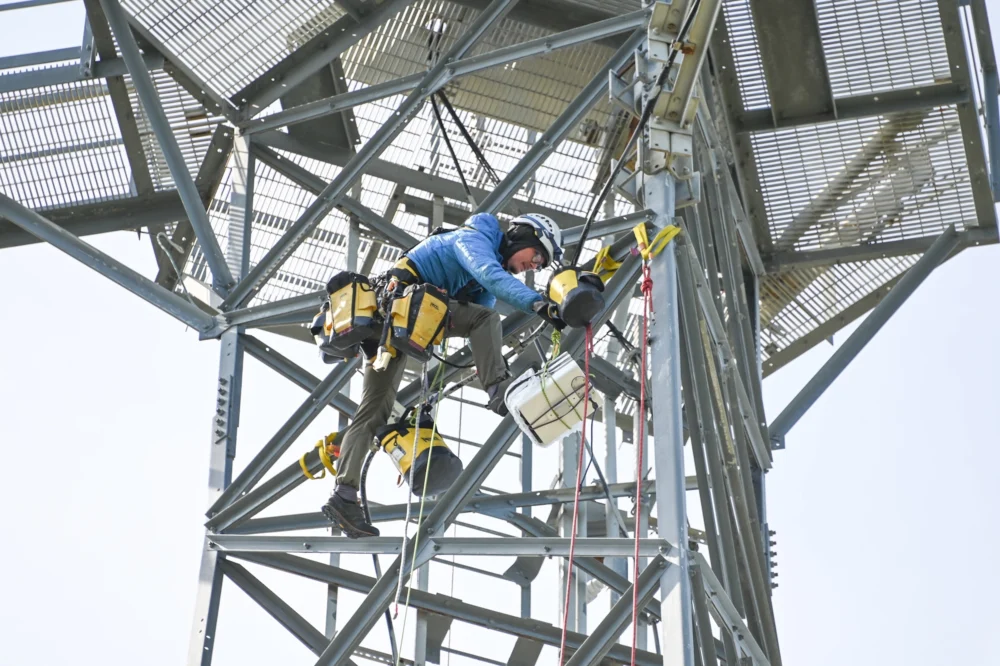
The thermal imaging camera fills these critical gaps. Mounted high on a U.S. Coast Guard radar tower, the camera scans the horizon for the "blow" or spout of a whale. Because the air exhaled by a whale is significantly warmer than the surrounding seawater and atmosphere, it appears as a distinct heat signature. The system’s range extends to approximately four nautical miles, allowing it to detect whales long before they are in immediate danger of a collision.

The "intelligence" of the system lies in its software. Trained on over a decade of data collected at the Woods Hole Oceanographic Institution, the AI has been taught to distinguish between the heat signature of a whale and other environmental factors, such as whitecaps, birds, or boat wakes. Daniel Zitterbart, WhaleSpotter’s co-founder and chief scientist, noted that at long distances, a whale might appear as only a few pixels on a screen. The AI’s ability to recognize these minute patterns is what makes the system a viable tool for maritime safety.
Operational Workflow and Human Verification
Despite the sophistication of the AI, the system maintains a "human-in-the-loop" protocol to ensure the highest levels of accuracy and to prevent "alert fatigue" among ship captains. When the AI identifies a potential whale signature, the footage is immediately transmitted to a network of professional marine mammal observers. These experts are available 24/7 to verify the sighting.
The efficiency of this process is remarkable. On average, a human expert confirms or rejects an AI alert within 34 seconds. Once a sighting is verified, the information is pushed to a variety of stakeholders, including the Washington State Ferries, commercial shipping pilots, and private vessel operators. This rapid turnaround allows captains to make informed decisions in real-time. According to Zitterbart, a captain receiving an alert two nautical miles away can often avoid a whale by changing their course by as little as one degree or by reducing speed to minimize engine noise.

The installation at Point Wilson is strategically placed at the entrance to Puget Sound, a bottleneck where shipping lanes converge. Gonzalo Banda-Cruz, the program manager for Quiet Sound, emphasized the immediate impact of the device. Following its installation, the camera recorded its first whale sighting within hours, proving its efficacy in a high-traffic environment.
A Chronology of Technological Evolution
The journey to the Point Wilson installation began in the laboratories of the Woods Hole Oceanographic Institution. Over ten years of research were dedicated to understanding the thermal signatures of various cetacean species. This research was essential because different whales have different "blow" patterns; a humpback’s spout looks different from that of an orca.
In 2019, WhaleSpotter began deploying its technology across the border in British Columbia, Canada. The Salish Sea is a transboundary ecosystem, and the success of the Canadian installations provided the proof of concept necessary to bring the technology to the United States. The 2025 installation at Point Wilson marks the first permanent U.S. site, but Quiet Sound and its partners view this as only the beginning of a larger network.

The project is a collaborative effort involving Quiet Sound—a program of the Washington Maritime Blue—the Port of Port Townsend, the U.S. Coast Guard, and various state and federal agencies. This coalition reflects a growing consensus that the protection of the Southern Residents is not just an ecological necessity but a corporate social responsibility for the maritime industry.
Broader Implications for Maritime Industry and Policy
The deployment of AI thermal imaging is part of a broader shift toward "smart" ocean management. As global shipping volumes continue to rise, the maritime industry is under increasing pressure to reduce its environmental footprint. While much of the focus has been on decarbonization, acoustic pollution is gaining traction as a critical regulatory issue.
In Puget Sound, Quiet Sound has already seen success with voluntary vessel slowdowns. When ships reduce their speed to 11-14 knots, the noise energy emitted into the water drops significantly. The data provided by the WhaleSpotter camera allows these slowdowns to be more targeted and effective. Instead of broad, seasonal mandates, authorities can request specific actions when whales are known to be in the vicinity.

Industry reactions have been largely positive, as technology like WhaleSpotter provides a data-driven way to balance commercial efficiency with conservation. For the state ferry system—the largest in the United States—having real-time "eyes" on the water is invaluable for passenger safety and environmental compliance.
However, challenges remain, particularly regarding financial sustainability. The hardware, AI maintenance, and 24/7 human monitoring require significant ongoing funding. Quiet Sound is currently seeking long-term partners to expand the camera network to other critical "choke points" in the sound, such as the waters near Vashon Island and the San Juan Islands.
Analysis: A Piece of the Global Conservation Puzzle
The success of the WhaleSpotter system in Puget Sound has implications far beyond the Pacific Northwest. Worldwide, ship strikes are a leading cause of death for many whale species, including the North Atlantic Right Whale, of which fewer than 360 remain. The ability to detect whales at night and in low-visibility conditions—times when they are most vulnerable to collisions—could be a game-changer for global cetacean conservation.

Furthermore, the integration of AI into wildlife management serves as a model for "AI for Good." By automating the tedious task of scanning the horizon, the technology allows human experts to focus on high-level decision-making and data analysis. The data collected by these cameras also provides researchers with a wealth of information on whale movement patterns, which can inform future policy decisions regarding shipping lanes and marine protected areas.
While the thermal camera cannot solve the problem of salmon depletion or chemical pollution, it addresses the most acute physical threats facing the Southern Residents today. By creating a "quiet" and "safe" corridor, the technology gives these 74 individuals a better chance at survival and, eventually, recovery.
As Daniel Zitterbart concluded, the technology is about "coexistence." The goal is not to stop human use of the ocean, but to use the best available tools to ensure that human activity does not come at the cost of an entire species. With "Whale-E" standing watch at Point Wilson, the Southern Resident orcas have a powerful new ally in their struggle to navigate an increasingly crowded and noisy world.
About the Author