A recent fundraising email disseminated by former President Donald Trump’s political action committee, Never Surrender Inc., has ignited a debate over political fundraising ethics, the use of sensitive national imagery, and the boundaries of offering exclusive access to donors. The email, which promised "private national security briefings" directly from the former president, prominently featured a solemn photograph from a dignified transfer ceremony for fallen U.S. service members, prompting questions about political decorum and the appropriate use of symbols of national sacrifice.
The email campaign, dispatched to potential donors earlier this week, extended an invitation to join a "National Security Briefing Membership." This exclusive membership, according to the PAC, would grant individuals access to "private national security briefings" and "unfiltered updates on the threats facing America" from Trump himself. The communication explicitly stated, "As a National Security Briefing Member, you’ll receive my private national security briefings, unfiltered updates on the threats facing America. The straight truth on border invasions, foreign adversaries, deep state sabotage, and every danger the fake news hides." It continued, "You’ll get the inside scoop DIRECT from me, President Trump, the leader who’s rebuilt the greatest military in history, and put America First like no one else." This messaging aims to leverage Trump’s past role as Commander-in-Chief and his often-stated critiques of mainstream media narratives to appeal to his base.
The Controversial Imagery: A Dignified Transfer at Dover
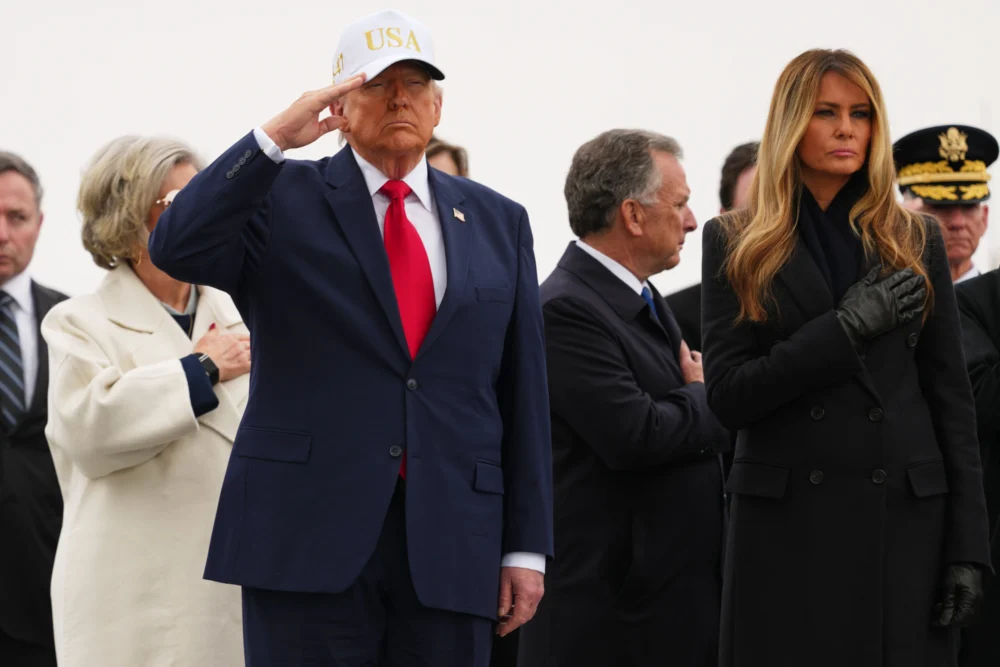
Central to the controversy is the inclusion of a black-and-white photograph depicting former President Trump saluting a transfer case during a dignified transfer ceremony. The photo, an official image originally taken by the White House, captures a profoundly somber moment at Dover Air Force Base in Delaware on March 7. This particular ceremony honored the U.S. service members killed in a recent incident in Kuwait. Dignified transfers are highly ritualized, private events designed to show the utmost respect and reverence for fallen military personnel as their remains are returned to American soil. These ceremonies are considered sacred by military families, veterans, and the public, representing a collective moment of national mourning and gratitude for ultimate sacrifice. The use of such an image, devoid of its original context of solemn remembrance and instead repurposed for a partisan fundraising appeal, has been widely characterized as a significant departure from established norms of political conduct.
Chronology of Events and Context
The timeline of events is crucial in understanding the implications of this fundraising appeal.
- March 7: The dignified transfer ceremony took place at Dover Air Force Base, honoring U.S. service members killed in Kuwait. The official White House photograph, later used in the fundraising email, was taken during this somber event.
- Following Weeks (Exact Date Undisclosed but "This Week"): Trump’s Never Surrender Inc. PAC sent out the fundraising email, featuring the aforementioned photograph and offering "private national security briefings." The timing suggests a rapid deployment of imagery from a recent, emotionally charged national event for political gain.
The incident in Kuwait, which led to the dignified transfer, involved U.S. service members whose lives were lost in the line of duty, often during operations related to maintaining stability in volatile regions. While the specific details of the incident itself are distinct from the fundraising email, the context of recent sacrifice amplifies the sensitivity surrounding the use of imagery from the subsequent memorial ceremony.
The Nature of Political Action Committees and Fundraising
Never Surrender Inc. is a political action committee (PAC) established to support Donald Trump’s political activities, including his potential future campaigns and his influence within the Republican Party. PACs are regulated under federal election law, primarily by the Federal Election Campaign Act (FECA), which governs the raising and spending of money in federal elections. These entities play a significant role in American politics, channeling funds from individuals and organizations to support candidates and causes.
Political fundraising often involves offering various levels of access or perceived influence to donors, ranging from exclusive dinners and photo opportunities to policy discussions with candidates or elected officials. The concept of "special access" for donors is not new, as noted by Daniel Weiner, director of the elections and government program at the Brennan Center for Justice. Historically, wealthy donors might receive invitations to intimate gatherings or policy discussions. However, the specific offer of "private national security briefings" from a former president, especially when tied to the imagery of fallen soldiers, introduces a unique set of ethical and legal considerations.
Legal and Ethical Boundaries: Classified Information and Norms
One of the primary legal questions raised by the offer of "private national security briefings" pertains to the potential disclosure of classified information. As a former president, Donald Trump retains certain levels of access to intelligence, though the extent and nature of this access are typically governed by protocols designed to protect national security. Daniel Weiner emphasized the clear legal boundary: "In this instance, obviously it would be a blatant violation of the law to disclose any sort of classified information or secret information to donors. But assuming that they’re not actually doing that, it’s hard to see that there’s anything illegal about any of this."
This distinction between illegal activity and a breach of norms is critical. While it would be illegal to disclose classified information to unauthorized individuals, the "briefings" could potentially be framed as high-level, unclassified discussions on foreign policy, border security, or other national security topics from Trump’s perspective. Such discussions, while potentially misleading in their framing as "national security briefings" typically associated with government officials, may not cross a legal threshold if no classified information is shared.
However, the ethical implications are profound. National security information, even when unclassified, is often sensitive and intended for public dissemination through official channels or for expert analysis, not as a perk for political donors. The offer creates a perception that access to insights on critical national security matters can be purchased, blurring the lines between public service and private political gain. This perception can erode public trust in government institutions and the integrity of national security processes.
Official Responses and Lack Thereof
When MS NOW reached out for comment, both the White House and the Pentagon declined to respond to inquiries regarding the fundraising email, the use of the dignified transfer photo, or what "private national security briefings" would entail. This lack of official comment is not uncommon, as government agencies typically refrain from engaging in partisan political debates or commenting on the fundraising activities of private political organizations. However, their silence underscores the sensitive nature of the issue and the potential political ramifications of such an endorsement or critique.
The absence of an immediate official condemnation or clarification from the Executive Branch or Department of Defense places the onus of judgment squarely on the public and political observers. While the government maintains a neutral stance on political campaigning, the use of military imagery, particularly from a dignified transfer, often elicits strong reactions from military families, veterans’ organizations, and the broader public who view such events as sacrosanct and beyond political exploitation.
Broader Impact and Implications: Eroding Norms and Public Trust
The use of imagery from a dignified transfer ceremony for political fundraising represents a significant ethical dilemma and a potential erosion of political norms. Dignified transfers are moments of national unity and sorrow, transcending political divides. They serve as a powerful reminder of the human cost of military service and the sacrifices made to protect national interests. Repurposing such an image for a partisan appeal can be seen as disrespectful to the fallen, their families, and the solemnity of the occasion.
Daniel Weiner’s observation that "To have that imagery used for partisan advertising and fundraising, that’s a bridge, you know, a new bridge that we’re crossing. But it’s more of a question of norms," highlights the core issue. While not explicitly illegal, such actions challenge the unwritten rules of political conduct that traditionally separate moments of national reverence from the often-contentious arena of political campaigning.
Implications for Veterans and Military Families: For veterans and Gold Star families (families who have lost a loved one in military service), the use of dignified transfer imagery can be particularly painful. These families often express a strong desire for their loved ones’ sacrifices to be honored in a manner free from political exploitation. The commodification of such an image for fundraising purposes can be perceived as an insult to their loss and the honor of their service member.
Impact on Political Discourse: This incident contributes to a broader trend of increasingly aggressive and norm-breaking political tactics. When political figures blur the lines between national symbols and partisan appeals, it can further polarize public discourse and diminish the shared understanding of what constitutes respectful political engagement. It risks desensitizing the public to the profound significance of military sacrifice and the sanctity of national memorialization.
Future of Fundraising and Donor Access: The offer of "private national security briefings" also sets a precedent that could redefine the boundaries of donor access. If such offers become commonplace, they could create an expectation that critical insights into governance and national security are available to those who can afford them, rather than being disseminated through appropriate public or governmental channels. This could further entrench the influence of money in politics and raise questions about transparency and accountability.
Conclusion
The fundraising email from Donald Trump’s Never Surrender Inc. PAC, combining the promise of "private national security briefings" with the poignant image from a dignified transfer ceremony, has opened a multifaceted discussion. While the legality of offering such briefings may depend on whether classified information is shared, the ethical and normative implications are undeniable. The use of a solemn military tribute for partisan fundraising challenges deeply held societal values regarding respect for fallen service members and the sanctity of national symbols. As political campaigns continue to innovate in their fundraising strategies, this incident underscores the ongoing tension between aggressive political ambition and the preservation of crucial ethical boundaries and public trust. The broader impact on political decorum, the perception of military sacrifice, and the future of donor access will likely continue to be debated long after this specific fundraising appeal has run its course.
About the Author