Global metal markets experienced a dramatic downturn on Thursday, March 20, 2026, as investor anxieties escalated over the potential economic fallout from the ongoing U.S.-Iran war. A sharp surge in oil prices, directly attributed to the escalating conflict, ignited fears of resurgent inflation and a looming global recession, prompting a widespread sell-off across precious and industrial metals. The bellwether commodities, often seen as indicators of economic health or safe havens during uncertainty, instead found themselves caught in a maelstrom of macroeconomic headwinds, leading to significant losses for gold, silver, copper, and palladium.
The latest plunge saw gold, traditionally a refuge in times of crisis, shed nearly 6% of its value, while silver, its volatile counterpart, plummeted by a steeper 8%. The contagion quickly spread to industrial metals vital for global manufacturing and infrastructure: copper, often dubbed "Dr. Copper" for its perceived ability to diagnose economic trends, fell 2%, and palladium, a critical component in catalytic converters and electronics, saw a substantial 5.5% decline. This broad-based market reaction underscores a profound shift in investor sentiment, moving from an initial geopolitical risk premium to a more pervasive concern about the fundamental health of the global economy.
Geopolitical Undercurrents and the Energy Shock
The immediate catalyst for Thursday’s market upheaval was the continued escalation of the U.S.-Iran conflict, which began to intensify in late 2025 and early 2026. Tensions, simmering for years, boiled over following a series of regional maritime incidents and proxy engagements, culminating in direct military confrontations that threatened key global energy supply routes. The Strait of Hormuz, a critical chokepoint for a significant portion of the world’s oil supply, became a flashpoint, driving crude oil prices to unprecedented levels. On March 19, just a day before the metal market sell-off, oil prices spiked dramatically after reports confirmed Iranian strikes on a vital Qatari liquefied natural gas (LNG) facility, exacerbating global supply worries. Brent crude, the international benchmark, soared past $120 per barrel, a level not seen since the height of the 2022 energy crisis following Russia’s invasion of Ukraine.
This rapid and sustained increase in energy costs immediately translated into heightened inflation fears. Economists and market analysts began to warn of a renewed inflationary cycle, potentially undoing the hard-won progress made by central banks worldwide in taming price pressures over the preceding years. The prospect of "sticky" inflation, fueled by expensive energy, quickly became the dominant narrative, overshadowing other market considerations.
Precious Metals’ Paradox: Gold Loses its Safe-Haven Luster
The sharp decline in gold and silver, particularly gold, presented a perplexing paradox to many market observers. Historically, gold has served as a quintessential safe-haven asset, attracting capital during periods of geopolitical instability and economic uncertainty. Its non-sovereign nature and intrinsic value are often seen as a hedge against currency debasement and inflation. However, the current crisis has seen this traditional relationship falter, at least in the short term.
The sell-off in gold and silver intensified on Thursday, but these precious metals had already been trending downwards since the onset of the U.S.-Iran war. The primary reason for this unusual behavior lies in the market’s expectation of how central banks, particularly the U.S. Federal Reserve, would respond to persistent inflation. Surging oil prices created concerns that inflation would reignite, compelling central banks to maintain higher interest rates for longer, or even to hike them further. Higher interest rates diminish the appeal of non-yielding assets like gold and silver, as investors can achieve better returns from interest-bearing alternatives such as government bonds.
Peter Boockvar, Chief Investment Officer at One Point BFG Wealth Partners, articulated this sentiment clearly: "The risks to inflation taking away the Fed rate cuts that were priced in, and seeing interest rate increases across the world, and real rates rising, that has been the drag on gold." Real rates, which are nominal interest rates adjusted for inflation, are a key factor in determining gold’s attractiveness. When real rates rise, the opportunity cost of holding gold increases, leading investors to reallocate capital. On Thursday, the U.S. 10-year Treasury yield, a benchmark for long-term interest rates, briefly crossed 4.300%, signaling market expectations for sustained higher rates and further eroding gold’s relative appeal.
Adding to gold’s woes was a strengthening U.S. dollar. In times of global uncertainty and rising U.S. interest rates, the dollar often benefits from its status as the world’s primary reserve currency and a safe-haven asset itself. A stronger dollar makes dollar-denominated commodities like gold more expensive for holders of other currencies, further dampening demand and contributing to price declines.
Industrial Metals: A Barometer for Global Economic Health
Beyond the precious metals, the slump in industrial metals like copper and palladium painted an even starker picture of growing recession fears. Unlike gold and silver, which respond to monetary policy and investor sentiment, industrial metals are directly tied to manufacturing, construction, and technological advancements. Their prices are a direct reflection of global industrial demand.
Copper, for instance, is ubiquitous in modern infrastructure and electronics, found in everything from household wiring and plumbing systems to advanced electronic devices and renewable energy technologies. Its widespread application makes it a highly sensitive indicator of economic growth. A sustained decline in copper prices is almost universally interpreted by analysts as a signal of slowing economic activity, hence its "Dr. Copper" moniker.
Similarly, palladium is crucial for the automotive industry, particularly in catalytic converters that reduce harmful emissions, and also finds applications in dentistry and electronics. A drop in palladium prices often reflects weakening global auto production or a broader downturn in industrial output.
While these industrial metals initially showed some resilience after the war’s onset, primarily due to existing supply chain constraints and an initial lack of clear demand destruction, that stability has now evaporated. The market’s focus has decisively shifted from supply-side concerns to demand-side worries, with a growing consensus that prolonged high energy prices will inevitably lead to a significant contraction in global economic growth.
The Specter of Stagflation: A Divisive Debate
The escalating economic concerns have brought the dreaded term "stagflation" back into market discourse. Stagflation, a portmanteau of stagnation and inflation, describes an economic condition characterized by slow economic growth, high unemployment, and rising prices. It represents a particularly challenging scenario for policymakers, as traditional tools to combat inflation (higher interest rates) can exacerbate unemployment and slow growth, while measures to stimulate growth (lower interest rates) can worsen inflation.
Wall Street consensus has increasingly leaned towards the view that the longer the U.S.-Iran war persists and oil prices remain elevated, the greater the risk of triggering a "demand destruction" phase. This phase implies that consumers and businesses, faced with persistently higher energy and input costs, will significantly alter their spending and investment habits, leading to a broad economic slowdown. As Peter Boockvar noted, "On the industrial metal side… people are now really worried about the recession risks."
However, not all economists are convinced that a full-blown stagflationary environment is imminent. Ed Yardeni, president of Yardeni Research, offered a more optimistic perspective in a Tuesday note, arguing that "oil shocks are less likely to trigger the kind of sustained stagflation seen in the past, particularly during the 1970s." He referenced the economic consequences of the 1973 OPEC embargo, which led to a decade of stagflation, but highlighted that more recent energy shocks, such as Russia’s invasion of Ukraine in 2022, while causing significant oil price spikes and inflation, did not ultimately lead to a global recession.
This sentiment was echoed by Federal Reserve Chair Jay Powell in a press conference on Wednesday. While acknowledging the inflationary pressures from the energy market, Powell stated, "I would reserve the term stagflation for a much more serious set of circumstances," suggesting that the current situation, while challenging, does not yet meet the criteria for such a severe economic state. The debate highlights the complexity of the current economic environment and the divergent interpretations of market signals and historical precedents.
Forward Outlook: Recovery Prospects and Long-Term Considerations
The immediate future for metal markets remains heavily intertwined with the geopolitical landscape. For industrial metals, a significant stabilization or recovery in prices is unlikely until there is a clear de-escalation or resolution of the U.S.-Iran conflict. An end to the war would likely alleviate oil supply fears, temper inflation expectations, and reduce the probability of a deep recession, thereby boosting industrial demand.
For gold, however, the path to recovery might be more nuanced and less dependent on the immediate cessation of hostilities. Peter Boockvar suggests that gold could rebound as the market’s focus shifts back to the escalating global sovereign debts and deficits. Gold has historically performed well as a "debasement trade," acting as a store of value when governments increase their debt burdens and central banks expand their money supplies, potentially eroding the purchasing power of fiat currencies. The substantial military spending associated with the U.S.-Iran war could further exacerbate these deficits, creating a long-term bullish case for gold even amidst short-term volatility.
Christian Mueller-Glissmann, head of asset allocation research at Goldman Sachs, further supported gold’s long-term potential in a Thursday note. He posited that "In case of a continued stagflationary shock, especially if real yields are declining, we would expect more support for Gold prices due to investor demand for real assets and FX diversification." This perspective suggests that if the stagflationary fears do materialize and central banks eventually pivot to supporting growth, leading to lower real interest rates, gold could once again shine as a preferred asset.
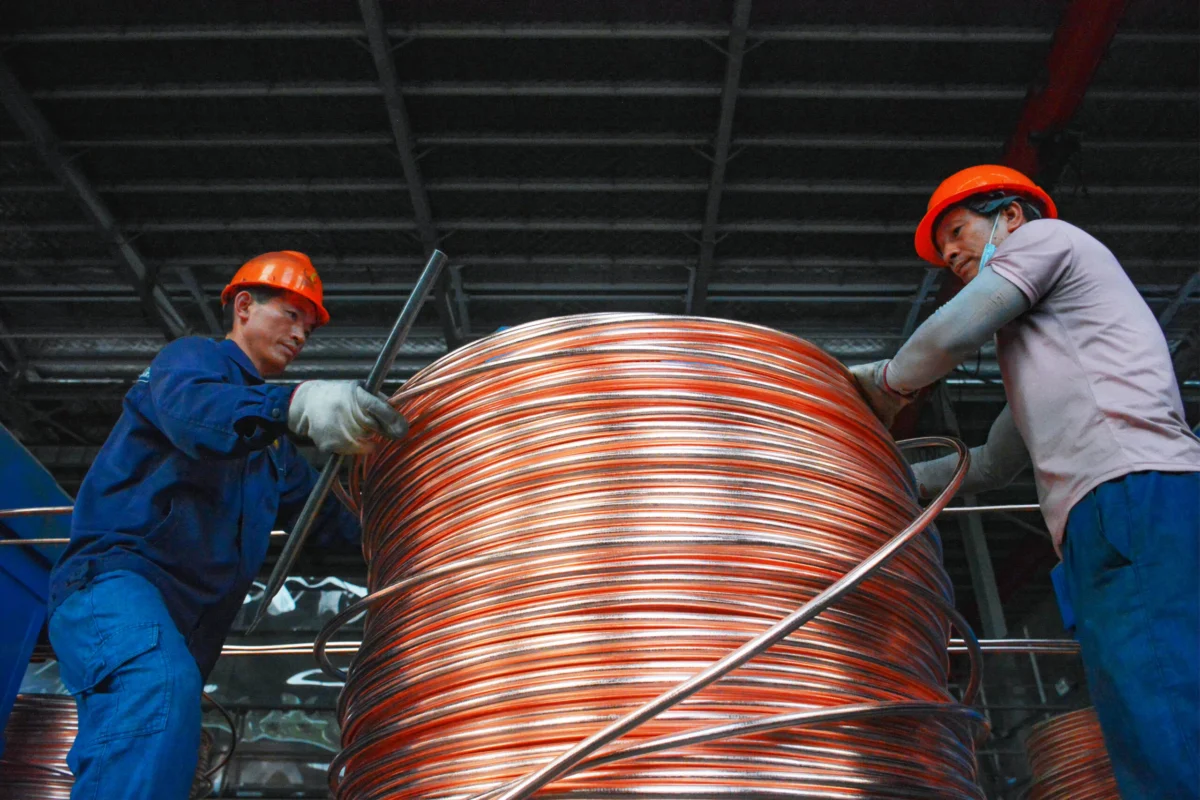
The long-term trajectory of industrial metals also incorporates factors beyond immediate demand. The image captured in Yuexi County, Anhui Province, China, on July 11, 2025, showing workers rolling copper rods made from recycled copper, offers a glimpse into evolving supply dynamics. The increasing emphasis on recycling and sustainable production methods for critical materials like copper could introduce new variables into global supply chains and pricing models, influencing market resilience and future price stability regardless of geopolitical events.
Broader Implications for the Global Economy
The current turmoil in metal markets has far-reaching implications for the global economy. For manufacturing sectors, particularly those reliant on copper (electronics, construction, renewable energy) and palladium (automotive), sustained high prices for inputs combined with weakening demand could severely impact profitability and investment. Companies across various industries may face tough decisions regarding production cuts, hiring freezes, and delayed expansion plans, contributing to a broader economic slowdown.
Central banks globally face a precarious balancing act. The U.S. Federal Reserve, having recently navigated a period of aggressive rate hikes, now confronts the renewed threat of inflation from energy prices, potentially forcing it to maintain its hawkish stance longer than anticipated. Other major central banks, such as the European Central Bank and the Bank of England, are grappling with similar dilemmas, caught between fighting inflation and preventing a recession in their respective economies. The coordinated global effort to manage inflation and stabilize growth, crucial for market confidence, is now under severe strain.
The ongoing U.S.-Iran war, therefore, is not merely a regional conflict but a global economic disruptor, demonstrating the intricate and often unpredictable connections between geopolitics, energy markets, monetary policy, and commodity prices. As investors and policymakers navigate this volatile landscape, the sharp decline in metal prices serves as a stark reminder of the fragile state of global economic stability and the profound impact of geopolitical tensions on financial markets worldwide. The coming months will be critical in determining whether the current downturn is a temporary blip or the harbinger of a more prolonged period of economic uncertainty and market recalibration.
About the Author