The increasing prevalence of remote workforces and geographically dispersed operations has thrust the complexities of U.S. time zones into the spotlight, creating what some humorously refer to as "time zone fatigue." For businesses with employees, clients, or vendors spread across the nation, a clear understanding of these temporal divisions is no longer a mere convenience but a critical operational necessity. This comprehensive guide delves into why time zones matter, outlines the various U.S. time zones, explains the intricacies of Daylight Saving Time (DST), and offers practical strategies for businesses to navigate these differences effectively.
The Pervasive Impact of Time Zones on Business Operations
In today’s hyper-connected business landscape, the concept of a single, localized workday is rapidly becoming obsolete. The rise of remote work, accelerated by global events and technological advancements, means that teams, partners, and clients can be located thousands of miles apart, each operating under a different celestial rhythm. According to recent surveys, a significant percentage of full-time U.S. employees now work from home, a trend that has normalized and, in many cases, solidified the need for asynchronous and cross-time zone collaboration.
This geographical diversity directly impacts fundamental business processes:
- Client and Customer Interactions: A customer in New York might be placing an order at 9 AM EST, while a support team in Los Angeles is just starting their day at 6 AM PST. Mismanaging these times can lead to missed opportunities, frustrated customers, and a negative perception of service availability.
- Vendor and Supplier Coordination: Procuring supplies, managing inventory, or coordinating with manufacturing partners often requires synchronous communication. A vendor in Chicago might close for the day at 5 PM CST, while a business owner in Seattle is still looking to place a crucial order at 3 PM PST.
- Internal Team Collaboration: Scheduling meetings, setting project deadlines, and ensuring timely communication among remote teams is a constant challenge. A marketing team spread across California, Texas, and Florida needs a structured approach to ensure everyone is aligned, regardless of their local clock.
- Logistics and Supply Chain Management: The timely movement of goods and services is heavily influenced by time zones. Shipping schedules, delivery windows, and operational hours for distribution centers must be meticulously coordinated to avoid delays and added costs.
- Financial Transactions and Reporting: Many financial operations, including stock market trading and interbank transfers, operate on strict time schedules that are tied to specific time zones. Failure to adhere to these can result in missed trading opportunities or penalties.
The economic implications of ignoring time zone differences can be substantial. A study by the National Bureau of Economic Research highlighted how even small shifts in coordinated work times can impact productivity and economic output. For businesses, this translates to potential revenue loss, increased operational costs due to errors or delays, and a damaged brand reputation.
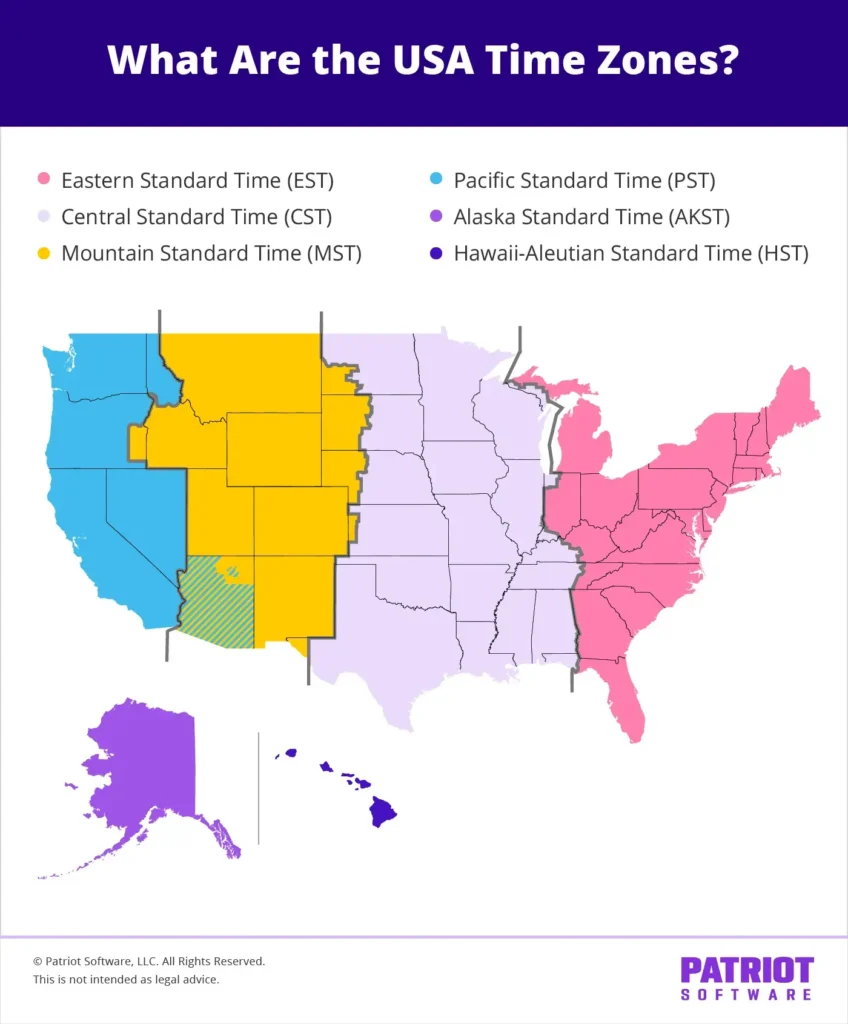
Understanding the Six U.S. Time Zones
The United States, spanning a vast continental expanse, is divided into six primary time zones. These zones are designed to ensure that local solar noon (when the sun is highest in the sky) is roughly around 12:00 PM in each region, maximizing the utility of daylight.
-
Eastern Standard Time (EST): This is the easternmost time zone in the contiguous United States. It encompasses states along the Atlantic coast and extends westward.
- Offset: UTC-5
- Example States: Maine, New Hampshire, Vermont, Massachusetts, Rhode Island, Connecticut, New York, New Jersey, Pennsylvania, Delaware, Maryland, Virginia, West Virginia, North Carolina, South Carolina, Georgia, and parts of Florida and Ohio.
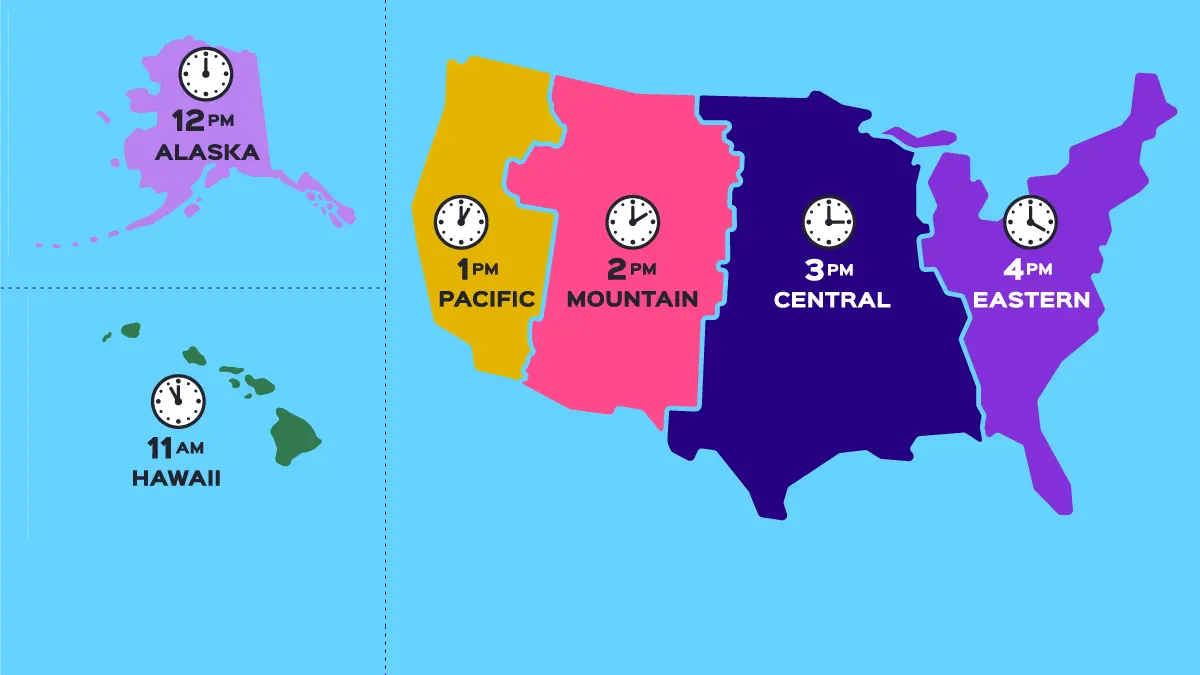
- Time Difference Example: When it is 12:00 PM EST, it is 9:00 AM PST.
-
Central Standard Time (CST): Located west of the Eastern Time Zone, CST covers a significant portion of the central United States.
- Offset: UTC-6
- Example States: Alabama, Arkansas, Illinois, Iowa, Louisiana, Minnesota, Mississippi, Missouri, Oklahoma, Wisconsin, and parts of Florida, Indiana, Kansas, Michigan, Nebraska, North Dakota, South Dakota, Tennessee, and Texas.
- Time Difference Example: When it is 12:00 PM EST, it is 11:00 AM CST.
-
Mountain Standard Time (MST): This zone is situated west of the Central Time Zone. Notably, it is one of the zones where Daylight Saving Time practices can cause confusion.
- Offset: UTC-7
- Example States: Arizona (with exceptions), Colorado, Idaho (western part), Montana, New Mexico, North Dakota (western part), South Dakota (western part), Texas (western part), Utah, and Wyoming.
- Time Difference Example: When it is 12:00 PM EST, it is 10:00 AM MST.
-
Pacific Standard Time (PST): This is the westernmost time zone in the contiguous United States, covering the West Coast.
- Offset: UTC-8
- Example States: California, Nevada (most of), Oregon (most of), Washington, and parts of Idaho.
- Time Difference Example: When it is 12:00 PM EST, it is 9:00 AM PST.
-
Alaska Standard Time (AKST): This zone covers the vast majority of Alaska.
- Offset: UTC-9
- Time Difference Example: When it is 12:00 PM EST, it is 8:00 AM AKST.
-
Hawaii-Aleutian Standard Time (HST): This zone includes Hawaii and the western Aleutian Islands of Alaska. Hawaii does not observe Daylight Saving Time.
- Offset: UTC-10
- Time Difference Example: When it is 12:00 PM EST, it is 7:00 AM HST.
It is important to note that several states, such as Florida, Indiana, Michigan, and Texas, span more than one time zone, with specific counties or regions adhering to different times. This adds another layer of complexity that businesses must account for.
The Complicating Factor: Daylight Saving Time (DST)
Daylight Saving Time, a practice observed in most of the United States, further complicates the management of time zones. DST involves advancing clocks by one hour during the spring ("spring forward") and reverting them by one hour in the fall ("fall back"). The intention behind DST, which originated in the early 20th century, was to extend daylight into the evening hours during warmer months, thereby reducing the need for artificial lighting and potentially conserving energy.
- Timeline of DST: In the U.S., DST typically begins on the second Sunday in March and concludes on the first Sunday in November, resulting in a period of approximately 34 weeks where clocks are advanced.
- Exceptions to DST: Not all U.S. states observe DST. Hawaii and most of Arizona (excluding the Navajo Nation) remain on their standard time year-round. This creates a dynamic shift in the time difference between these states and those observing DST. For instance, the time difference between Ohio (EST) and Arizona (MST) is typically three hours during DST. However, when Ohio falls back to EST and Arizona remains on MST, the time difference narrows to two hours.
- The Debate Over DST: The practice of DST has been a subject of ongoing debate. Proponents argue for its energy-saving benefits and alignment with natural light patterns, while critics point to potential disruptions in sleep patterns, increased health risks, and minimal actual energy savings. Several states have introduced legislation to either make DST permanent or to opt out of the practice altogether. As of early 2026, federal legislation to make DST permanent has been proposed but has not yet been enacted, leaving the future of the practice uncertain.
Managing the Temporal Divide: Strategies for Business Success
Effectively managing operations across different U.S. time zones requires proactive planning and clear communication protocols. Here are essential strategies for businesses to adopt:
-
Establish Clear Communication Protocols:
- Specify Time Zones: Always explicitly state the time zone when scheduling meetings, setting deadlines, or communicating event times. For example, "The meeting is at 2:00 PM EST (11:00 AM PST)."
- Use a Universal Time Reference: Consider adopting Coordinated Universal Time (UTC) or a single designated time zone (e.g., the company’s headquarters time zone) as a default for internal communications and deadlines, especially for globally distributed teams.
- Calendar Integration: Utilize calendar tools that automatically adjust meeting times based on attendees’ local time zones. Many popular platforms offer this feature.
-
Leverage Technology:
- Time Zone Converters: Keep readily accessible online time zone converters or utilize built-in features in operating systems and communication apps.
- Collaboration Platforms: Employ project management and communication tools (e.g., Slack, Microsoft Teams, Asana, Trello) that often display team members’ current local times, facilitating smoother coordination.
- Time and Attendance Software: For businesses with hourly employees, time and attendance systems that can accurately track work hours across different zones are crucial for payroll and compliance.
-
Develop a Time Zone Awareness Culture:
- Educate Your Team: Ensure all employees understand the basics of U.S. time zones and the implications of DST.
- Designate Time Zone Liaisons: In larger organizations, consider appointing individuals in different time zones to act as points of contact for cross-time zone coordination.
- Flexible Scheduling: Where possible, offer flexibility in work hours to accommodate employees in different zones, particularly for collaborative tasks. This might involve staggering meeting times or allowing for asynchronous work on certain projects.
-
Optimize Business Processes:
- Customer Service Hours: Clearly define and communicate customer service operating hours, taking into account the time zones of your primary customer base. Consider offering extended hours or 24/7 support if feasible.
- Vendor Relationship Management: Establish clear expectations with vendors regarding response times and communication windows, acknowledging their respective time zones.
- Project Management: When planning projects, factor in potential delays caused by time zone differences, especially for tasks requiring real-time input or approval from individuals in disparate locations.
Charts for Clarity: Visualizing U.S. Time Zones
To aid in understanding, here are two charts that categorize U.S. states by their respective time zones. It is important to remember that some states may have areas that fall into multiple time zones.
Chart 1: States by Time Zone
| Eastern Standard Time (EST) | Central Standard Time (CST) | Mountain Standard Time (MST) | Pacific Standard Time (PST) | Alaska Standard Time (AKST) | Hawaii-Aleutian Standard Time (HST) |
|---|---|---|---|---|---|
| Connecticut | Alabama | Arizona (most) | California | Alaska | Hawaii |
| Delaware | Arkansas | Colorado | Idaho (northern) | ||
| D.C. | Florida (western) | Idaho (southern) | Nevada (most) | ||
| Georgia | Illinois | Kansas (western) | Oregon (most) | ||
| Maine | Indiana (western) | Montana | Washington | ||
| Maryland | Iowa | Nebraska (western) | |||
| Massachusetts | Kentucky (western) | New Mexico | |||
| New Hampshire | Louisiana | North Dakota (western) | |||
| New Jersey | Michigan (western) | South Dakota (western) | |||
| New York | Minnesota | Texas (El Paso, Hudspeth) | |||
| North Carolina | Mississippi | Utah | |||
| Ohio | Missouri | Wyoming | |||
| Pennsylvania | Oklahoma | ||||
| Rhode Island | Tennessee (western) | ||||
| South Carolina | Texas (most) | ||||
| Vermont | Wisconsin | ||||
| Virginia | |||||
| West Virginia |
Note: States marked with asterisks () or described as having "western" or "most" parts may have areas that fall into different time zones. Always verify specific regional times.*
Chart 2: States Alphabetically by Time Zone(s)
| State | Time Zone(s) |
|---|---|
| Alabama | Central Standard Time |
| Alaska | Alaska Standard Time |
| Arizona | Mountain Standard Time (most of the state) |
| Arkansas | Central Standard Time |
| California | Pacific Standard Time |
| Colorado | Mountain Standard Time |
| Connecticut | Eastern Standard Time |
| Delaware | Eastern Standard Time |
| D.C. | Eastern Standard Time |
| Florida | Eastern Standard Time, Central Standard Time |
| Georgia | Eastern Standard Time |
| Hawaii | Hawaii-Aleutian Standard Time |
| Idaho | Mountain Standard Time, Pacific Standard Time |
| Illinois | Central Standard Time |
| Indiana | Eastern Standard Time, Central Standard Time |
| Iowa | Central Standard Time |
| Kansas | Central Standard Time, Mountain Standard Time |
| Kentucky | Central Standard Time, Eastern Standard Time |
| Louisiana | Central Standard Time |
| Maine | Eastern Standard Time |
| Maryland | Eastern Standard Time |
| Massachusetts | Eastern Standard Time |
| Michigan | Eastern Standard Time, Central Standard Time |
| Minnesota | Central Standard Time |
| Mississippi | Central Standard Time |
| Missouri | Central Standard Time |
| Montana | Mountain Standard Time |
| Nebraska | Central Standard Time, Mountain Standard Time |
| Nevada | Pacific Standard Time, Mountain Standard Time |
| New Hampshire | Eastern Standard Time |
| New Jersey | Eastern Standard Time |
| New Mexico | Mountain Standard Time |
| New York | Eastern Standard Time |
| North Carolina | Eastern Standard Time |
| North Dakota | Central Standard Time, Mountain Standard Time |
| Ohio | Eastern Standard Time |
| Oklahoma | Central Standard Time |
| Oregon | Pacific Standard Time, Mountain Standard Time |
| Pennsylvania | Eastern Standard Time |
| Rhode Island | Eastern Standard Time |
| South Carolina | Eastern Standard Time |
| South Dakota | Central Standard Time, Mountain Standard Time |
| Tennessee | Central Standard Time, Eastern Standard Time |
| Texas | Central Standard Time, Mountain Standard Time |
| Utah | Mountain Standard Time |
| Vermont | Eastern Standard Time |
| Virginia | Eastern Standard Time |
| Washington | Pacific Standard Time |
| West Virginia | Eastern Standard Time |
| Wisconsin | Central Standard Time |
| Wyoming | Mountain Standard Time |
Frequently Asked Questions About U.S. Time Zones
- What are the main time zones in the United States?
The primary time zones are Eastern, Central, Mountain, and Pacific. Alaska and Hawaii-Aleutian are also distinct zones. - Why do different time zones exist?
Time zones were established to align local time with daylight patterns, ensuring that noon generally occurs around the sun’s highest point in the sky in each region. This historical practice aims to optimize the use of natural light. - How many time zones are there in the United States?
There are six distinct time zones across the U.S. and its territories. Four of these are within the contiguous United States (Eastern, Central, Mountain, and Pacific). - How can businesses effectively manage employees working across different time zones?
Businesses can mitigate confusion by clearly stating time zones in all communications, utilizing scheduling software that auto-adjusts for local times, providing equivalent time displays for various zones, and employing collaboration tools that automatically show team members’ current time zones. - What is Daylight Saving Time (DST)?
DST is the practice of advancing clocks by one hour in the spring and setting them back by one hour in the fall, primarily to make better use of daylight during warmer months. - Do all U.S. states observe Daylight Saving Time?
No. Hawaii and most of Arizona do not observe DST. - What tools are beneficial for teams operating across different time zones?
Time and attendance software, advanced project management platforms, and integrated communication tools are invaluable for synchronizing efforts and minimizing temporal misunderstandings among dispersed teams.
Conclusion
In an era defined by distributed workforces and global connectivity, mastering the nuances of U.S. time zones is not merely an administrative task but a strategic imperative for business success. By understanding the temporal landscape, embracing technological solutions, and fostering a culture of time zone awareness, companies can transform potential challenges into opportunities for enhanced efficiency, improved collaboration, and stronger relationships with employees, vendors, and customers alike. Proactive management of these temporal differences ensures that businesses can operate seamlessly across the nation, regardless of where their team members or partners are located.
About the Author