
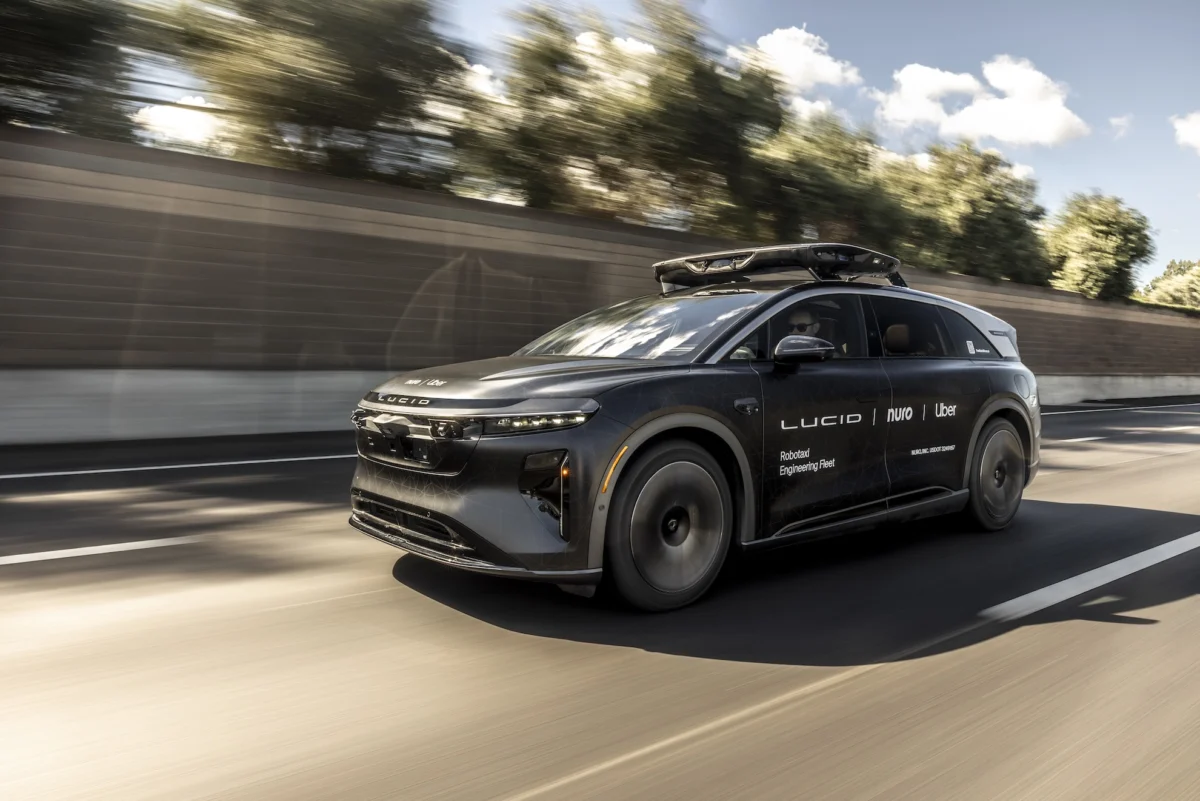
Select Uber employees are now experiencing the future of urban mobility firsthand, participating in an internal pilot program for autonomous rides in Nuro-equipped Lucid Gravity SUVs throughout San Francisco. This crucial testing phase, as announced by Nuro in a blog post on Monday, represents a significant step forward in Uber’s ambitious plans to launch a public robotaxi service later this year. While these rides are not yet available to the general public, they signal substantial progress since Uber’s substantial investment in Nuro and Lucid was revealed in July 2025.
The vehicles currently operating in San Francisco are functioning in fully autonomous mode, with a human safety operator present in the driver’s seat as a backup measure. This internal testing allows Uber and Nuro to meticulously evaluate the integrated autonomous driving system, the performance of the Lucid Gravity vehicle in real-world urban environments, and the overall rider experience. A key focus of these trials is the intricate process of passenger pickups and drop-offs, a notoriously complex challenge for autonomous ride-hailing services.
This development underscores the accelerated pace of the partnership between Uber, Lucid, and Nuro, a collaboration that has been in motion for over a year. In July 2025, Uber announced a strategic alliance and a multi-million dollar investment, injecting $300 million into Lucid and committing to purchasing at least 20,000 of Lucid’s new Gravity SUVs over the next six years. These vehicles are specifically being outfitted with Nuro’s advanced autonomous driving technology, powered by Nvidia’s cutting-edge Drive AGX Thor computing platform.
The Technology Underpinning the Robotaxi
The Lucid Gravity robotaxi, first unveiled in January, is a testament to sophisticated engineering, designed to navigate complex urban landscapes with precision. It is equipped with a suite of advanced sensors essential for its autonomous capabilities. High-resolution cameras provide a comprehensive visual understanding of the surroundings, while solid-state lidar sensors offer accurate depth perception and object detection, even in varying light conditions. Radars complement these sensors by detecting objects at longer ranges and through adverse weather. This integrated sensor array allows the self-driving system to build a detailed, real-time model of its environment, enabling safe and efficient operation.
Beyond its investment in Lucid, Uber also made a significant, though undisclosed, "multi-hundred-million dollar" investment in Nuro, the company responsible for developing the autonomous driving system. This dual investment highlights Uber’s commitment to securing both the hardware (vehicles) and the software (autonomous technology) necessary for its future robotaxi fleet.
A Phased Rollout and Future Projections
The ultimate vision is for Uber to own and operate a premium robotaxi service, likely with operational support from third-party providers. Production of these specially modified Lucid Gravity vehicles is slated to commence in late 2026, as indicated in a regulatory filing submitted last year. This timeline suggests that the internal testing currently underway is a critical precursor to the broader rollout.
Nuro has been systematically preparing its autonomous technology for real-world deployment. The company successfully completed closed-course testing of the autonomous Lucid Gravity SUVs and initiated public road testing late last year. Currently, Nuro’s engineering fleet comprises 100 Lucid Gravity SUVs outfitted with its self-driving system. These vehicles are actively engaged in gathering extensive real-world data and conducting autonomous driving tests across multiple U.S. cities and states, building a robust dataset to refine its algorithms and ensure safety and reliability.
Strategic Partnership and Multimillion-Dollar Commitments
The genesis of this advanced robotaxi initiative can be traced back to the strategic partnership announced in July 2025. Uber’s substantial financial commitment served as a strong validation of the potential of this collaboration. The agreement to purchase a significant volume of Lucid Gravity SUVs not only provides Lucid with a substantial order book but also ensures a consistent supply of the specialized vehicles required for Uber’s burgeoning autonomous fleet.
The investment in Nuro further solidifies Uber’s dedication to Nuro’s pioneering work in autonomous delivery and ride-hailing. Nuro, founded by former Google self-driving car engineers, has been a leader in developing purpose-built autonomous vehicles, initially focusing on goods delivery with its R2 and R3 platforms. The extension of its technology to passenger vehicles like the Lucid Gravity marks a significant evolution for the company.
The Significance of Employee Pilot Programs
The internal employee testing program is a standard and crucial practice in the development of autonomous vehicle technology. It allows companies to:
- Gather Real-World Performance Data: Employees provide valuable feedback on the vehicle’s performance in diverse real-world scenarios, including traffic, weather conditions, and road infrastructure.
- Test the Integrated System: The pilot program evaluates how the vehicle’s hardware, software, and operational systems work in unison under actual usage conditions.
- Refine the Rider Experience: Feedback on comfort, interface, and the overall journey is critical for ensuring a positive customer experience once the service is publicly available.
- Identify Edge Cases: Employees are likely to encounter a wider range of situations than during controlled testing, helping to identify and address "edge cases" – unusual or challenging scenarios that autonomous systems may not have encountered before.
- Validate Operational Procedures: Testing pickup and drop-off protocols in a live environment is paramount for seamless service delivery.
Nuro’s blog post emphasized that these employee rides are instrumental in assessing the "autonomy stack, vehicle, and rider experience" in a live operating environment. This iterative process of testing, feedback, and refinement is essential for building trust and ensuring the safety and reliability of the autonomous system before it is exposed to the general public.
Broader Implications for Urban Mobility and the Gig Economy
The successful deployment of Uber’s robotaxi service, powered by Lucid vehicles and Nuro’s autonomous technology, has the potential to profoundly reshape urban transportation. If scaled effectively, it could lead to:
- Increased Accessibility and Affordability: Autonomous vehicles could potentially reduce operational costs, leading to more affordable ride-hailing services. This could benefit a wider demographic, including those in underserved areas or individuals who cannot afford personal vehicle ownership.
- Reduced Congestion and Environmental Impact: A more efficient autonomous fleet, coupled with optimized routing, could contribute to reduced traffic congestion. The transition to electric vehicles like the Lucid Gravity also aligns with broader environmental sustainability goals.
- Shifts in the Gig Economy: The introduction of robotaxis represents a significant potential shift away from human drivers in the ride-hailing sector. This raises important questions about the future of work for Uber drivers and the broader implications for the gig economy. Uber has historically relied on a vast network of independent contractors, and the integration of autonomous vehicles could necessitate a re-evaluation of its labor model.
- Urban Planning and Infrastructure: The widespread adoption of autonomous vehicles may influence urban planning decisions, requiring adjustments to infrastructure such as dedicated lanes, charging stations, and communication networks.
The Road Ahead
The current phase of employee testing is a critical, yet early, stage in the long journey toward widespread autonomous ride-hailing. While the public launch is anticipated later this year, the success of this pilot program will be closely watched. The partnership between Uber, Lucid, and Nuro represents a significant investment and a bold vision for the future of transportation, aiming to integrate advanced technology into the fabric of daily urban life. The coming months will be crucial in determining the pace and scope of this transformative endeavor.
The involvement of Nuro, a company with a strong track record in autonomous systems, and Lucid, known for its luxury electric vehicles, creates a compelling proposition. The Lucid Gravity, in particular, offers a premium platform that aligns with Uber’s aspirations for a high-quality robotaxi service. As production ramps up and testing continues, the visibility of these sensor-laden Lucid Gravity SUVs on San Francisco’s streets will likely increase, offering a glimpse into a future where autonomous mobility is a common reality. The ability of these vehicles to reliably navigate complex urban environments, handle passenger interactions, and maintain a high standard of safety will be the ultimate determinants of their success.
About the Author





