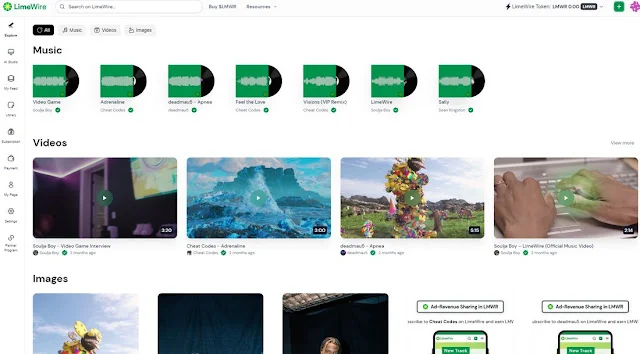
The landscape of digital content creation is undergoing a radical shift as legacy brands find new life in the era of artificial intelligence. LimeWire, a name once synonymous with the peer-to-peer file-sharing revolution of the early 2000s, has successfully completed its transition into a sophisticated AI-powered content publishing platform. This transformation represents more than a simple rebranding; it is a strategic pivot toward the "Creator Economy 2.0," where generative AI tools are inextricably linked with blockchain-based monetization and ownership. By offering a comprehensive suite for image generation and planning expansions into music and video, LimeWire is positioning itself as a central hub for creators who seek to bridge the gap between creative output and financial sustainability.
The Historical Evolution: From File-Sharing to AI Studio
To understand the current iteration of LimeWire, one must look back at its complex history. Founded in 2000 by Mark Gorton, the original LimeWire operated on the Gnutella network and became one of the most popular file-sharing programs in the world. However, its history was marred by legal battles with the Recording Industry Association of America (RIAA), leading to a permanent injunction and its eventual shutdown in 2010.
The brand remained dormant until 2022, when entrepreneurs Julian and Paul Zehetmayr acquired the rights to the LimeWire name. Unlike the original founders, the Zehetmayr brothers envisioned a platform that would respect intellectual property while empowering creators through modern technology. The initial relaunch focused on a marketplace for Non-Fungible Tokens (NFTs), but as the AI revolution took hold in 2023, the platform evolved into the LimeWire AI Studio. This chronology marks a significant shift from a platform that once challenged the music industry to one that now partners with major artists like Deadmau5, Soulja Boy, and Sean Kingston to pioneer new forms of digital expression.
Technical Infrastructure of the LimeWire AI Studio
The core of the current LimeWire experience is its AI Image Generation suite. Rather than relying on a single proprietary model, LimeWire has adopted a multi-model approach, allowing users to leverage the strengths of various industry-leading technologies. The platform currently integrates:
- Stable Diffusion 2.1 and XL: Known for their open-source flexibility and high-quality photorealistic outputs.
- DALL-E 2 and DALL-E 3: OpenAI’s powerful models that excel in following complex descriptive prompts and generating artistic variations.
- Proprietary Developments: LimeWire has signaled that it is actively developing its own internal AI models to provide unique aesthetics and capabilities not found on other platforms.
The user interface is designed to accommodate both novice creators and professional designers. Users can input text prompts and select from a variety of design styles, including cinematic, digital art, pixel art, anime, and analog film. Advanced settings allow for the adjustment of samplers, guidance scales, and quality levels, providing a granular level of control over the final output.
The Convergence of AI and Blockchain: Automatic NFT Minting
One of the most distinctive features of the LimeWire ecosystem is its seamless integration with blockchain technology. In traditional AI art platforms, the transition from a generated image to a tradable asset is often manual and cumbersome. LimeWire automates this process through a "create-to-mint" workflow.
When a creator publishes a piece of content on the LimeWire Studio, the platform automatically mints the asset as an NFT on either the Polygon or Algorand blockchains. These networks were chosen for their low transaction costs (gas fees) and high energy efficiency, addressing common criticisms regarding the environmental impact of digital assets.
This automation serves several purposes:
- Proof of Ownership: Every creation is timestamped and linked to the creator’s wallet, providing an immutable record of origin.
- Scarcity and Value: By turning images into NFTs, creators can limit the number of copies or offer exclusive ownership to fans.
- Royalty Enforcement: LimeWire’s smart contracts are programmed to pay creators a 2.5% royalty on all secondary market trades. This ensures that as an artist’s popularity grows, they continue to benefit from the appreciation of their earlier works.
Monetization Models and the LMWR Token
LimeWire has introduced a multi-faceted revenue model that distinguishes it from social media giants like Instagram or TikTok, where ad revenue sharing is often reserved for the top 1% of creators. On LimeWire, the monetization is democratized through three primary channels:
Ad Revenue Sharing
LimeWire distributes up to 70% of all ad revenue generated from views of a creator’s content back to the creator. This creates a passive income stream for users who generate high-engagement AI art, music, or videos. The transparency of this model is a significant draw for digital artists who have grown disillusioned with the opaque algorithms of traditional social platforms.
Subscription-Based Access
Creators have the option to set up "subscriber-only" feeds. This allows them to offer exclusive content, behind-the-scenes looks, or high-resolution downloads to their most dedicated fans in exchange for a monthly fee. This model mirrors successful platforms like Patreon but integrates the added value of digital collectibles.
The LMWR Cryptocurrency
The economic engine of the platform is the LMWR token, an ERC-20 utility token. All revenue shares, royalties, and subscription earnings are paid out in LMWR. The token is currently traded on major global exchanges, including Kraken, ByBit, and UniSwap, providing creators with a liquid asset that can be converted to fiat currency or other cryptocurrencies. Furthermore, users can spend LMWR within the platform to purchase additional credits for AI generation, creating a circular economy.
Comprehensive Pricing and Tiered Accessibility
To cater to a global audience, LimeWire utilizes a credit-based system with various subscription tiers. This structure allows casual users to experiment with AI for free while providing robust resources for professional power users.
- Free Tier: Provides 10 credits daily, allowing for approximately 20 image generations. Free users receive a 50% ad revenue share but face slower generation speeds and public-only posting.
- Basic Plan ($9.99/mo): Increases capacity to 1,000 credits and 2,000 image generations. This tier is designed for hobbyists looking to build a small portfolio.
- Advanced Plan ($29/mo): Offers 3,750 credits and a 60% ad revenue share, catering to growing influencers.
- Pro and Pro Plus Plans ($49 – $99/mo): These tiers offer the highest revenue share (70%), up to 22,500 image generations, and a "Pro" badge that enhances visibility within the community. Subscriptions at this level also remove all advertisements for the user and provide full creation history logs.
Future Roadmap: Expansion into Music and Video
While image generation is the current flagship service, LimeWire’s roadmap indicates an ambitious expansion into generative audio and video. The company aims to provide tools that allow musicians to generate beats, melodies, and full tracks using AI, which can then be published as NFT music.
This expansion is particularly poignant given LimeWire’s history. By enabling AI music generation, the platform is coming full circle—moving from a place where music was shared without permission to a place where music is created, owned, and monetized legally. Industry analysts suggest that this move could position LimeWire as a formidable competitor to both traditional streaming services and emerging AI music startups.
Analysis of Implications for the Creative Industry
The re-emergence of LimeWire as an AI powerhouse carries several implications for the broader tech and art sectors. First, it demonstrates the "second life" potential of legacy internet brands. By leveraging brand recognition among Gen X and Millennials and combining it with Gen Z’s interest in AI and Web3, LimeWire has bypassed the difficult "brand awareness" phase that most startups face.
Second, the platform addresses the "attribution crisis" in generative AI. By utilizing blockchain to mint content at the moment of creation, LimeWire provides a solution to the problem of AI-generated content being easily scraped and reused without credit.
However, the platform also exists within a controversial space. The use of AI to generate art remains a point of contention among traditional artists who worry about copyright infringement in training sets. LimeWire’s reliance on models like Stable Diffusion means it is part of a larger conversation regarding how AI models are trained and whether original artists are being compensated. LimeWire’s move toward proprietary models may be an attempt to gain more control over this narrative and ensure a more ethical sourcing of training data.
Conclusion
LimeWire has successfully navigated a transition that few expected, evolving from a cautionary tale of the dot-com era into a vanguard of the AI and Web3 movement. By integrating multi-model AI generation with automated blockchain minting and a transparent ad-revenue sharing model, it offers a compelling value proposition for the modern creator.
As the platform rolls out its music and video tools, its impact on the digital landscape is likely to grow. For creators, LimeWire represents a shift toward a more equitable internet where the tools of production and the mechanisms of distribution are housed under one roof. Whether LimeWire can maintain its momentum in the face of stiff competition from AI giants like Adobe and Midjourney remains to be seen, but its unique combination of nostalgia, cutting-edge tech, and creator-centric economics has undoubtedly secured its place in the current technological zeitgeist. Participants in the creator economy are encouraged to monitor the platform’s development, as its success could serve as a blueprint for the future of digital content monetization.
About the Author