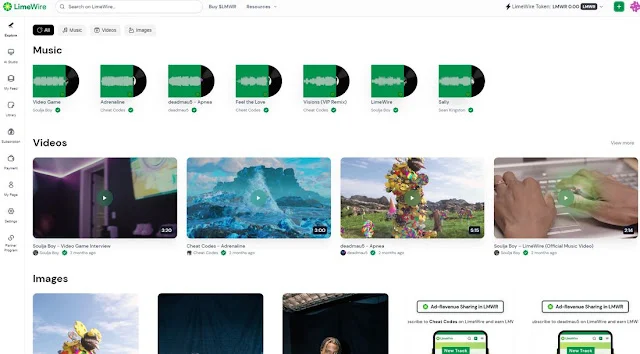
The digital landscape is witnessing a significant pivot as LimeWire, a brand once synonymous with the early 2000s peer-to-peer file-sharing era, completes its transformation into a sophisticated generative Artificial Intelligence (AI) content publishing platform. This strategic evolution represents more than a mere rebranding; it marks the emergence of a comprehensive ecosystem designed to bridge the gap between AI-driven creativity and blockchain-based monetization. By integrating advanced machine learning models with decentralized finance (DeFi) principles, LimeWire is positioning itself as a central hub for the next generation of digital creators, offering tools that range from high-fidelity image generation to automated Non-Fungible Token (NFT) minting and revenue-sharing protocols.
The Historical Transformation: From P2P to AI Studio
To understand the current trajectory of LimeWire, one must look back at its origins and subsequent dissolution. Originally launched in 2000, LimeWire was a leading Gnutella-based file-sharing client that dominated the early digital music scene. However, following a protracted legal battle with the Recording Industry Association of America (RIAA), the platform was served with a permanent injunction in 2010, leading to its total shutdown. For over a decade, the brand remained dormant until it was acquired by entrepreneurs Paul and Julian Zehetmayr.
The new leadership recognized the untapped potential of the brand’s name recognition and reimagined it for the Web3 and AI era. In 2022, the platform was relaunched not as a tool for sharing existing files, but as a studio for creating new ones. This transition reached its zenith with the launch of the LimeWire AI Studio, a platform that democratizes access to powerful generative models while providing a structured path to commercialization. The current iteration of LimeWire operates on a fundamental premise: every user should be able to create, own, and profit from digital content without needing deep technical expertise in either coding or complex artistic software.
Technical Architecture and AI Model Integration
The cornerstone of the LimeWire AI Studio is its multi-model approach to image generation. Unlike platforms that lock users into a single proprietary engine, LimeWire provides a versatile interface that supports several of the industry’s leading generative models. This includes Stable Diffusion 2.1, Stable Diffusion XL (SDXL), and OpenAI’s DALL-E 2. This variety allows creators to select the specific aesthetic and technical parameters that best suit their vision.
For instance, Stable Diffusion XL offers high-resolution outputs with complex lighting and composition, while DALL-E 2 is often favored for its ability to interpret nuanced natural language prompts. LimeWire enhances these base models with a suite of user-friendly tools, including customizable samplers, guidance scales, and style presets. Users can pivot between diverse artistic movements such as cinematic realism, digital art, pixel art, anime, and analog film aesthetics with a single click. Furthermore, the platform is currently developing its own proprietary AI model, which aims to provide a unique visual signature exclusive to LimeWire users, further differentiating it from competitors like Midjourney or Canva.
The Convergence of AI and Blockchain: Automated NFT Minting
A distinguishing feature of the LimeWire ecosystem is its seamless integration with blockchain technology. In the traditional creator economy, moving a piece of digital art from a creation tool to a marketplace often involves multiple steps, including setting up digital wallets, paying "gas" fees, and navigating complex minting processes. LimeWire eliminates these barriers by automating the minting process.
When a creator finishes an image in the AI Studio, they are given the option to publish their work directly to the LimeWire community. Upon publication, the platform automatically mints the content as an NFT on either the Polygon or Algorand blockchain. These networks were chosen for their high throughput and low environmental impact compared to the Ethereum mainnet. This process secures the creator’s ownership and establishes a verifiable digital lineage for the artwork.
Once minted, the content can be categorized as "Public" or "Subscriber-only." Public posts are discoverable by the wider LimeWire community and can be traded on the internal marketplace. Subscriber-only posts, conversely, allow creators to build a "paywalled" community, offering exclusive digital collectibles to their most dedicated followers. This dual-path approach provides a flexible framework for both brand discovery and direct-to-fan monetization.
Economic Incentives and the LMWR Tokenomics
The financial engine of LimeWire is built upon a revenue-sharing model that is significantly more aggressive and creator-centric than traditional social media platforms. The ecosystem utilizes the LMWR token, LimeWire’s native cryptocurrency, to facilitate transactions and reward participation.
The monetization strategy is three-fold:
- Ad Revenue Sharing: LimeWire distributes 70% of all ad revenue generated from views of a creator’s content back to the creator. This provides a passive income stream for users whose AI-generated images, music, or videos gain viral traction or consistent engagement.
- NFT Royalties: In the secondary market, creators are entitled to a 2.5% royalty on every subsequent trade of their minted NFTs. This ensures that as an artist’s reputation grows and their early works appreciate in value, they continue to benefit financially from that growth.
- Subscription Models: Creators can set up monthly subscription tiers, allowing them to earn consistent revenue from fans who want access to exclusive AI content and community features.
The LMWR token serves as the primary medium for these payouts. Earnings are distributed monthly, and the tokens can be traded on major global cryptocurrency exchanges, including Kraken, ByBit, and UniSwap. Additionally, tokens can be reinvested into the platform to purchase "credits," which are used to power more advanced AI prompts and high-resolution generations.
Strategic Market Positioning and Industry Adoption
LimeWire’s pivot has already attracted significant attention from the mainstream entertainment industry. High-profile artists, including Deadmau5, Soulja Boy, and Sean Kingston, have utilized the platform to release NFT-based music and visual content. This adoption by established figures serves as a proof-of-concept for the platform’s ability to handle professional-grade digital assets.
In the broader context of the AI market, LimeWire is positioning itself as a "one-stop-shop." While many AI tools focus solely on the generation aspect, LimeWire addresses the entire lifecycle of a digital asset: generation, hosting, distribution, and monetization. This holistic approach is particularly appealing to "solopreneurs" and digital artists who may lack the resources to manage multiple subscriptions for generation, minting, and marketing.
Future Roadmap: Expanding into AI Music and Video
While the current focus of the LimeWire AI Studio is predominantly on image generation, the company has released a comprehensive roadmap detailing its expansion into audio and video. The upcoming AI music generation tools are expected to allow users to create full tracks, loops, and samples based on text prompts, which can then be published as NFT music.
This expansion is particularly poignant given LimeWire’s history with the music industry. By providing a legal, monetized framework for AI-generated music, the platform is effectively coming full circle—moving from a brand that once challenged the music industry’s copyright models to one that provides artists with new tools to protect and profit from their intellectual property. The video generation tools, slated for a subsequent release, will likely utilize similar prompt-based logic to create short-form content, further solidifying LimeWire’s role in the burgeoning AI-driven social media landscape.
Pricing Structures and Accessibility
LimeWire employs a tiered subscription model designed to accommodate everyone from casual hobbyists to professional design studios. The platform offers a free entry point, providing users with 10 credits daily (sufficient for approximately 20 image generations) and a 50% share of ad revenue.
For more intensive users, the premium tiers offer scaled benefits:
- Basic ($9.99/month): Provides 1,000 credits, early access to new models, and a 50% ad revenue share.
- Advanced ($29/month): Increases capacity to 3,750 credits and a 60% ad revenue share.
- Pro ($49/month): Offers 5,000 credits and a 70% ad revenue share.
- Pro Plus ($99/month): Designed for power users, offering 11,250 credits and the maximum 70% revenue share.
All premium plans remove advertisements for the user and provide a "Pro" profile badge, which enhances social proof within the community marketplace.
Broader Implications and Fact-Based Analysis
The emergence of the LimeWire AI Studio is a microcosm of a larger shift in the digital economy. As generative AI lowers the barrier to entry for high-quality content creation, the value of "creation" itself is being recalibrated. In a world where an AI can generate a masterpiece in seconds, the value shifts toward curation, community, and verifiable ownership.
LimeWire’s reliance on the Polygon and Algorand blockchains addresses the "provenance" issue that plagues AI art. By automatically minting content, the platform provides a solution to the criticism that AI art is easily replicated and lacks "soul" or value. Furthermore, the 70% ad revenue share model challenges the status quo of platforms like Instagram or X (formerly Twitter), which typically retain a much larger portion of the value generated by their creators.
However, the platform faces challenges. The legal landscape regarding the copyright of AI-generated images remains in flux in many jurisdictions, including the United States. While LimeWire provides the tools for ownership via NFTs, the underlying legal copyright of an AI-generated image is still a subject of intense judicial debate. Additionally, the volatility of the LMWR token and the broader cryptocurrency market remains a factor for creators who rely on the platform for stable income.
Despite these hurdles, LimeWire’s trajectory suggests a robust future. By combining the viral potential of AI with the structural integrity of blockchain, it has created a unique niche. It is no longer a relic of the past, but a forward-looking infrastructure for the digital renaissance. As it expands into music and video, LimeWire is set to become a formidable competitor in the creative software industry, proving that even the most controversial brands can find new life through technological innovation.
About the Author