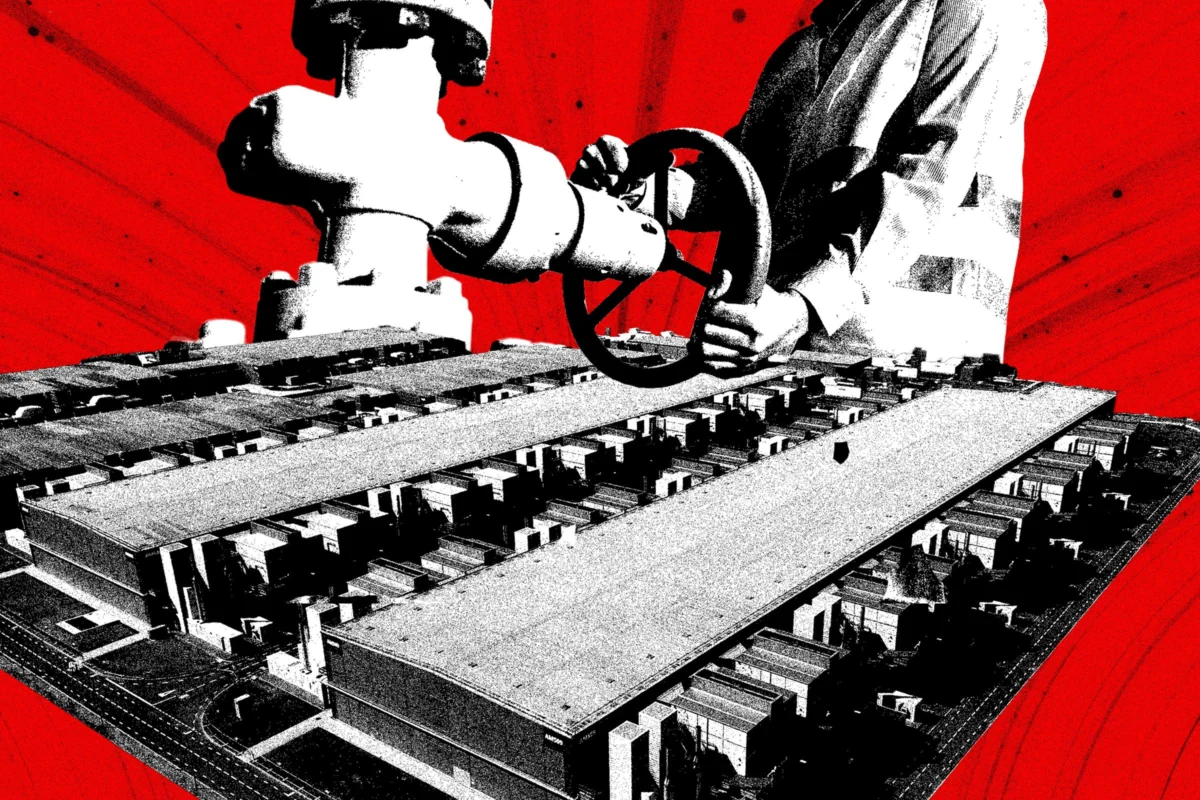
The global energy landscape is witnessing an unprecedented convergence as the rapid expansion of artificial intelligence (AI) provides a significant new market for the fossil fuel industry. While the world’s major oil and gas companies have recently reported multibillion-dollar quarterly profits—driven largely by high crude prices resulting from geopolitical instability in the Middle East—a secondary, domestic driver is emerging: the massive power requirements of data centers. As tech giants like Microsoft and Meta race to scale their AI capabilities, they are increasingly turning to natural gas infrastructure to meet energy demands that existing electrical grids are currently unable to satisfy.
This alliance between Silicon Valley and the energy sector represents a pivot in the decarbonization narrative. For years, tech companies have positioned themselves as leaders in the transition to renewable energy. However, the sheer scale of energy required for generative AI—which consumes significantly more electricity than traditional computing—has forced a reconciliation with traditional energy sources. This shift is providing a "lifeline" to the natural gas industry, ensuring that pipelines, gas-fired power plants, and extraction facilities remain central to the American economy for decades to come.
The Convergence of AI Demand and Fossil Fuel Infrastructure
Data centers are rapidly becoming a primary driver for both electricity and natural gas demand in the United States. According to a recent report by BloombergNEF, the surge in data center construction, combined with other industrial needs, could necessitate a 36 percent increase in U.S. natural gas production by the mid-2030s. Ashish Sethia, the global head of commodities and energy at BloombergNEF, notes that the industry is seeing a clear pattern: new data center announcements are increasingly clustering around established gas pipeline corridors.
The primary reason for this trend is the "grid bottleneck." The traditional U.S. electrical grid is currently plagued by long wait times for interconnection, sometimes spanning several years. For tech companies operating in a hyper-competitive AI environment, waiting for the grid is not an option. Consequently, they are opting for "behind-the-meter" or "islanded" power solutions. These involve building dedicated gas-fired power plants directly on-site or adjacent to data centers, bypassing the public utility grid entirely.
Case Study: Williams and the Ohio Data Center Corridor
Williams, one of the largest natural gas infrastructure companies in the U.S., has moved aggressively to capitalize on this trend. While perhaps less of a household name than Chevron or ExxonMobil, Williams operates a vast network of pipelines that handle approximately one-third of the natural gas used in the U.S. for power generation and heating.
The company has recently pivoted toward a highly profitable data-center services model. In 2023, Williams announced the construction of a dedicated power plant and pipeline infrastructure in Ohio specifically to serve a data center. More recently, in mid-July, the company announced a $5.34 billion investment in its data center ventures, backed by the private equity giant KKR.
Currently, Williams is developing six behind-the-meter gas plants across the country. Four of these projects are located in Ohio and are designed to serve Meta’s expanding data center footprint. To support these facilities, Williams is constructing a nine-mile natural gas pipeline through an Ohio suburb. Chad Zamarin, President of Williams, indicated during a May earnings call that the company intentionally "overbuilt the capacity" of this pipeline. The goal is for the infrastructure to serve as an "energy artery" that can support additional data centers as the region’s tech corridor grows.
Case Study: Chevron and Microsoft’s Texas Mega-Project
While Williams is focusing on regional infrastructure, Chevron is pursuing a project of even greater scale. On the heels of reporting its highest quarterly profits in six years, Chevron highlighted a massive partnership with Microsoft in its recent investor disclosures.
Chevron is currently constructing a 2.67-gigawatt gas-fired power plant in Texas dedicated to Microsoft’s data center operations. For perspective, a single gigawatt can power roughly 750,000 homes; this project represents a massive concentration of energy generation for a single industrial customer. The two companies have signed a 20-year power purchase agreement (PPA), a long-term commitment that ensures the gas plant will remain operational and profitable well into the 2040s.
This project, known as the Kilby project, has also sought local economic incentives. In April, reports surfaced that the project had applied for millions of dollars in school district tax breaks in Texas. These incentives were finalized by state authorities in late July, further subsidizing the fossil-fuel-powered expansion of the tech industry. Jeff Gustavson, President of Chevron New Energies, stated that this project provides a "repeatable model" for future data center customers, citing the inability of the public grid to keep up with the demands of "hyperscalers."
Chronology of the AI-Energy Shift
The timeline of this shift illustrates how quickly the tech industry’s energy strategy has evolved:
- 2021–2022: Tech giants reinforce "Net Zero" commitments, focusing primarily on wind and solar PPAs.
- Late 2022: The launch of ChatGPT and other generative AI models triggers an arms race in data center construction.
- Early 2023: Reports emerge of "grid saturation" in data center hubs like Northern Virginia and Ohio, with utilities warning of multi-year delays for new power connections.
- Late 2023: Williams and Chevron begin formalizing "behind-the-meter" gas strategies to offer tech companies immediate, reliable power.
- Mid-2024: Massive capital allocations are announced, including Williams’ $5.34 billion venture and Chevron’s 2.67-GW Microsoft deal. Permit applications reveal the massive scale of projected emissions.
Environmental Implications and Climate Data
The environmental impact of this trend is substantial. According to permit applications, just five of the gas-fired power plants currently being developed by Williams and Chevron could emit up to 21 million tons of greenhouse gases annually. This is roughly equivalent to the total annual carbon emissions of the entire nation of Guatemala.
Specifically, Williams’ four Ohio plants could emit 9.6 million tons of CO2 equivalent per year. This volume is comparable to the emissions of 22 average-sized natural gas plants, according to EPA data. While Williams’ spokesperson Alex Schott stated that the facilities are designed to operate below permitted limits—potentially by as much as two-thirds—the sheer scale of the infrastructure represents a long-term commitment to carbon-intensive energy.
Similarly, the Chevron-Microsoft plant in Texas could produce over 11.5 million tons of emissions annually. While Chevron representatives have suggested the possibility of adding renewable generation or carbon capture technology in the future, the current priority is "reliable capacity" through natural gas.
Environmental advocates have expressed alarm at these developments. Lukas Shankar-Ross, Deputy Director at Friends of the Earth, described the tech-oil alliance as a "lifeline" to an industry that needs to be phased out. He noted that if the public grid eventually transitions to renewables while a "private grid" of gas-fired plants remains dedicated to tech companies, it could create a bifurcated energy system that undermines national climate goals.
The Economic and Political Context
The move toward gas-powered data centers is also influenced by political and economic pressures. As utility bills rise for residential consumers—partly due to the infrastructure upgrades needed to support data centers—a national backlash has begun to form. By building their own power plants, tech companies can mitigate their impact on consumer electricity prices and avoid being blamed for local rate hikes.
Furthermore, the current political climate in the U.S. has shown a shift toward prioritizing "energy abundance" to maintain a competitive edge in AI over global rivals like China. The Trump administration and various state-level governments have actively encouraged tech companies to bring their own power solutions to the table to ensure the U.S. remains the leader in AI development without straining the public infrastructure.
Analysis of Broader Implications
The long-term implications of this trend are twofold. First, it signals a period of "carbon lock-in." When companies like Microsoft and Chevron sign 20-year agreements for gas power, they are making a financial and operational commitment that makes it difficult to transition to cleaner alternatives before the infrastructure has reached its end-of-life. These plants are long-term assets that will likely outlast several presidential administrations and shifting political winds.
Second, the trend highlights the current limitations of renewable energy for high-uptime industrial needs. AI training requires a constant, "always-on" power supply (baseload power) that wind and solar cannot yet provide without massive advancements in battery storage. Until those technologies mature and become cost-effective at scale, natural gas is being positioned as the only viable bridge for the AI boom.
Whether these massive plants will eventually be connected to the public grid remains a critical question. Chevron has indicated it may connect its Microsoft plant to the Texas grid after 2030 to export surplus power. However, with the current backlog in interconnection applications, these "islanded" facilities may remain private energy enclaves for the foreseeable future, serving the needs of the world’s wealthiest tech corporations while the broader transition to green energy proceeds at a slower pace on the public grid.
In conclusion, the AI revolution is not just a software or hardware phenomenon; it is a massive energy event. The partnership between companies like Williams, Chevron, Meta, and Microsoft demonstrates that for the time being, the future of artificial intelligence is inextricably linked to the continued extraction and combustion of natural gas. As the demand for computing power grows, the fossil fuel industry has found a robust and reliable customer in the very sector once thought to be its primary successor.
About the Author