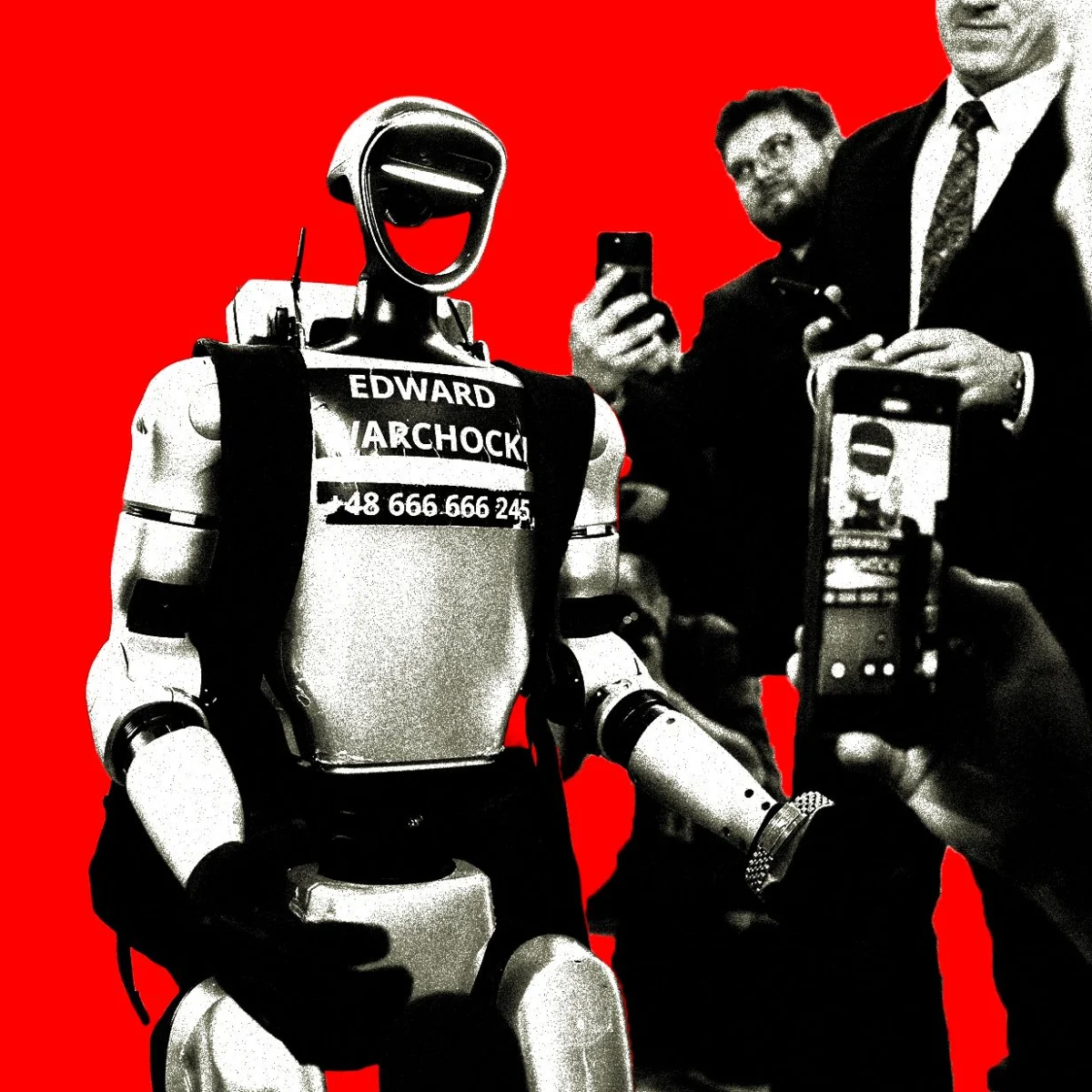
When Edward Warchocki engages in conversation, he projects the persona of an average citizen—emotionally resonant, approachable, and remarkably adept at forming social bonds. This description, provided by his creator Bartosz Idzik, stands in stark contrast to the physical reality of Warchocki: a four-foot-tall humanoid robot currently navigating the urban landscapes of Poland. While the machine’s aluminum limbs and hollowed-out facial structure initially elicited apprehension from the public, the integration of advanced linguistic capabilities has transformed a 40-kilogram assembly of sensors and actuators into a global social media phenomenon.
The evolution of Edward Warchocki serves as a primary case study in the burgeoning "humanoid influencer" sector. This movement, which has gained significant momentum through 2025 and into early 2026, represents a pivotal shift in the robotics industry. It marks the transition from robots as strictly industrial or laboratory-bound tools to robots as consumer-facing personalities. As these machines become more affordable and capable, they are increasingly integrated into the fabric of daily life, appearing in parliaments, sports arenas, and religious sites across the globe.
The Genesis of a Digital Personality
The project began approximately six months ago when Idzik, a software developer, and his colleague Radosław Grzelaczyk decided to acquire a humanoid robot from China. They named the unit "Edward Warchocki," a name derived from Grzelaczyk’s dog, Eddie, and the Polish verb "warczeć" (to growl), chosen for its phonological similarity to traditional Polish surnames.
In its initial deployment, the robot lacked vocal capabilities, leading to visible discomfort and fear among pedestrians. Recognizing that physical movement alone was insufficient for social integration, Idzik utilized his software background to link the robot’s hardware to a large language model (LLM). This modification allowed the robot to process and generate live conversations in Polish, fundamentally altering its reception.
Once equipped with a "voice" and a simulated personality, the robot’s popularity surged. The mechanical unit transitioned from an object of suspicion to a local celebrity. Its activities have since ranged from the mundane to the surreal: hiking mountain trails, wading in lakes, and engaging in discussions with Polish parliamentarians. In April 2026, a video of the robot—outfitted with a backpack and a Rolex watch—successfully dispersing a sound of wild boars in Warsaw went viral, amassing millions of views and contributing to a total social media reach of over 4 billion views across various platforms.
The Unitree G1: The Hardware Behind the Trend
While the personalities of these robots differ by region, the underlying hardware is remarkably consistent. Most prominent humanoid influencers, including Edward Warchocki, are built on the Unitree G1 platform. Manufactured by Unitree Robotics, a Chinese firm based in Hangzhou, the G1 has emerged as the industry standard for accessible humanoid technology.
The G1 stands roughly the size of a child and features a distinctive ring of blue light around its face. Its limbs are constructed from lightweight aluminum, providing a balance of durability and agility. The model has demonstrated a versatile range of physical capabilities, appearing on televised talent competitions, performing martial arts, engaging in simulated boxing matches, and even attempting domestic tasks such as cooking.
The robot’s success is attributed to its "Model Predictive Control" and advanced balance algorithms, which allow it to navigate uneven terrain, perform parkour-like maneuvers, and recover from physical impacts. However, its most significant feature is not its physical prowess but its price point and availability. Unlike many Western competitors whose robots remain in the prototyping stage or carry price tags exceeding six figures, Unitree has successfully commoditized the humanoid form.
Global Proliferation and Cultural Adaptation
The "clanker" phenomenon—a slang term adopted by social media users to describe these robots—is not limited to Poland. In Austin, Texas, a G1 known as "Rizzbot" has gained notoriety for its flirtatious interactions with passersby. In New York, "Bart Robot" became a symbol of local celebration, breakdancing with fans following a championship win by the Knicks. In Miami, the "Brickell Clanker" became a fixture of the World Cup celebrations, frequently changing jerseys to match the winning teams.
The cultural adaptability of the G1 platform is further evidenced by its integration into religious and traditional practices. In Japan and South Korea, G1 units have been "ordained" as monks in experimental ceremonies exploring the intersection of technology and spirituality. In Dubai, the robots have been observed participating in prayer at local mosques, reflecting a global trend of testing the boundaries of robot-human social norms.
Financial Disclosures and Market Dominance
Unitree’s commercial trajectory underscores the speed of this technological adoption. The company is scheduled to go public on the Chinese stock market in late May 2026. Recent financial disclosures revealed a robust fiscal performance that distinguishes Unitree from its competitors.
In 2025, Unitree reported shipping 5,511 humanoid units to customers worldwide. This figure is significant because it represents units delivered to "real-world" customers rather than research institutions or internal testing facilities. The average sales price for these units was reported at less than $25,000, a figure that has disrupted the traditional robotics market.
Furthermore, the company achieved profitability for the first time in the 2025 fiscal year. Notably, 43 percent of Unitree’s total sales originated from outside of China, signaling a strong international demand for affordable humanoid platforms. This global footprint suggests that despite geopolitical tensions and trade barriers, the appetite for consumer robotics is transcending national borders.
The Cost of Entry: Logistics, Tariffs, and Variations
For individual creators looking to enter the humanoid influencer space, the path to ownership is often more complex than the base price suggests. On the official Unitree website, the entry-level G1 is listed at $13,500. However, for buyers in the United States and Europe, the final cost is significantly higher due to shipping fees, import taxes, and distributor markups.
In the United States, distributors typically list the base G1 at approximately $19,000. However, the base model has limitations; it lacks sophisticated dexterous hands and is restricted in terms of hardware modifications. Many professional creators, such as 24-year-old Jake Cooperstein of Miami, opt for the more advanced U5 variation.
The U5 is marketed primarily toward educational and research buyers, offering greater customization and more robust components. This version carries a much higher price tag, often exceeding $66,000. Despite the cost, the demand for these high-end units remains steady as creators seek to differentiate their "influencers" through unique physical capabilities and more responsive AI integrations.
Analysis of the "Real Job" Dilemma
Despite the viral success and commercial viability of humanoid influencers, a critical question remains: When will these robots transition from entertainment to economically productive labor? While the G1 can perform impressive stunts and hold conversations, its utility in traditional work environments—such as assembly lines, janitorial services, or elder care—is still being evaluated.
Current limitations include:
- Battery Life: Most consumer-grade humanoids have an operational window of 2 to 4 hours, which is insufficient for a standard work shift.
- Reliability: While the robots are agile, they are prone to mechanical failure when subjected to the repetitive, high-intensity movements required in manufacturing.
- Safety Regulations: Integrating 40-kilogram mobile machines into human workspaces requires rigorous safety certifications that are still being developed in many jurisdictions.
However, the "influencer" phase of humanoid robotics is not merely a distraction. It serves as a massive, decentralized beta test. Every viral video and street interaction provides Unitree and other manufacturers with invaluable data on how these machines interact with unpredictable human environments. The revenue generated from these "clout-seeking" tasks is currently funding the R&D necessary to develop the next generation of robots—those that may eventually hold down "real jobs."
Broader Implications and Public Sentiment
The rise of robots like Edward Warchocki indicates a shift in the "uncanny valley" phenomenon. As these machines become more conversational and "emotional," the public’s initial fear is often replaced by curiosity and even affection. This psychological shift is essential for the eventual mass adoption of home robotics.
Industry experts suggest that China’s current lead in this sector is due to its established supply chain for electronics and its willingness to move products from the lab to the market quickly. As Bartosz Idzik noted, the global robotics community is now looking toward Chinese innovations for cues on how to achieve mass-market appeal.
As Unitree prepares for its IPO and the number of humanoid influencers continues to grow, the year 2026 may be remembered as the era when the world stopped looking at robots as science fiction and started seeing them as neighbors, entertainers, and eventually, colleagues. Whether they are chasing boars in Warsaw or dancing in New York, these "clankers" are no longer just machines; they are the forerunners of a new social and economic reality.
About the Author