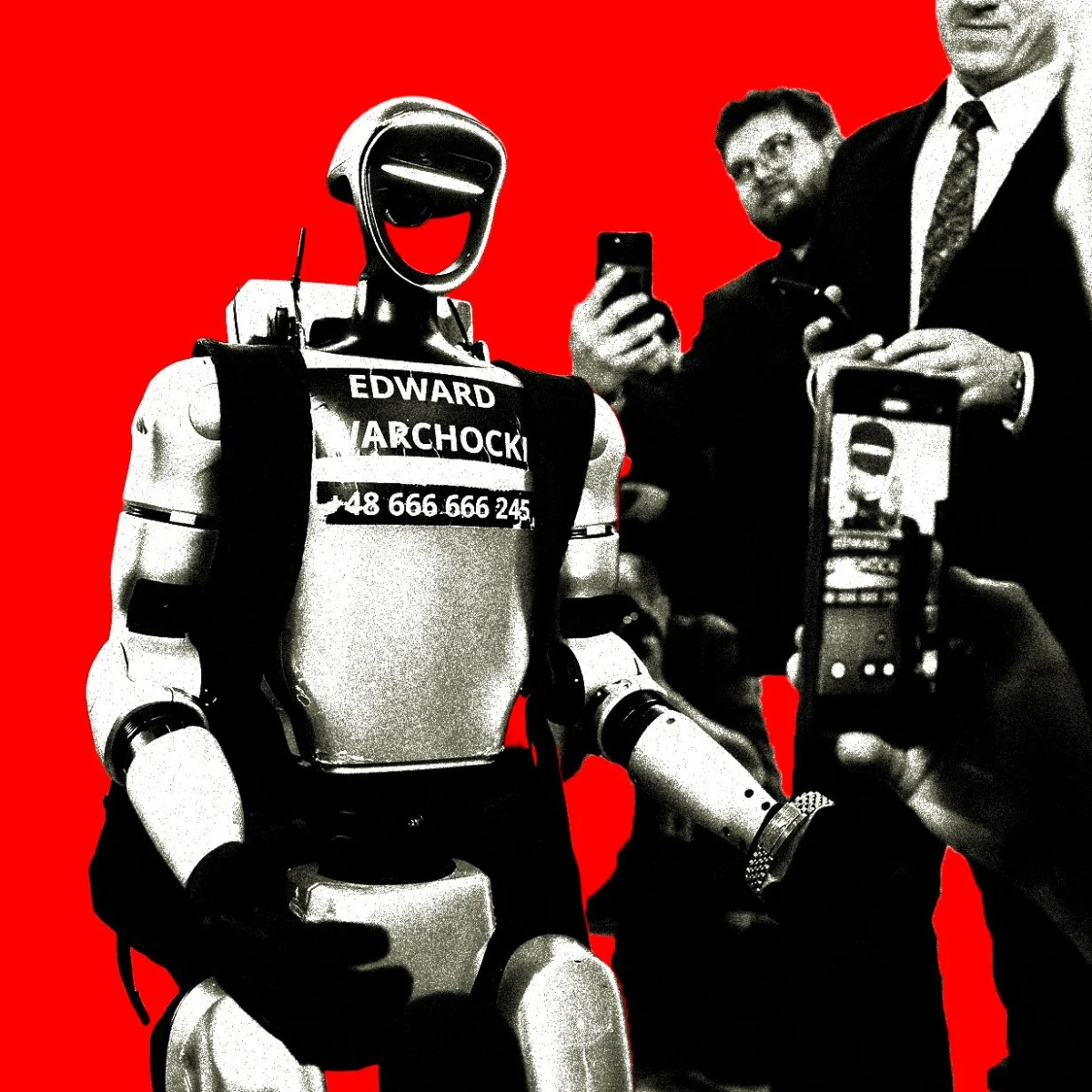
When Edward Warchocki engages in conversation, he projects the persona of an average citizen—emotionally resonant, approachable, and socially adept. According to his creator, software developer Bartosz Idzik, the robot was designed to be "very easy to make friends with." However, when the 4-foot-tall humanoid falls silent, its mechanical nature becomes impossible to ignore. Warchocki is a Unitree G1 robot, a sophisticated piece of Chinese engineering currently navigating the streets of Poland and capturing the attention of millions worldwide.
The project began approximately six months ago when Idzik and his colleague, Radosław Grzelaczyk, decided to import a humanoid robot from China. The name "Edward Warchocki" was a portmanteau derived from Grzelaczyk’s dog, Eddie, and the Polish verb warczeć (to growl), chosen specifically because it sounded like a plausible, if slightly eccentric, Polish name. Initially, the robot’s presence was met with trepidation. Without the ability to communicate, the 40-kilogram aluminum machine was viewed as an intimidating anomaly by pedestrians. Recognizing this barrier, Idzik utilized his background in software development to bridge the gap between hardware and human interaction. By integrating the robot with a large language model (LLM), he enabled Edward to conduct live, spontaneous conversations in Polish. This transformation was instantaneous; the machine evolved from a source of public anxiety into a beloved local celebrity.
The Evolution of the Humanoid Influencer
The success of Edward Warchocki is not an isolated incident but rather the vanguard of a burgeoning global trend. In the first half of 2026, humanoid "influencers" have become a ubiquitous presence on social media and in urban centers. These robots, predominantly the Unitree G1 model, are being utilized to create hyper-viral content that transcends linguistic and cultural barriers.
In Austin, Texas, a G1 known as "Rizzbot" dons a cowboy hat and engages in flirtatious banter with passersby. In New York City, "Bart Robot" was recently filmed breakdancing with fans of the Knicks following a championship victory. Meanwhile, in Miami, the "Brickell Clanker" has become a staple of the local sports scene, frequently seen wearing various jerseys to celebrate international soccer matches. The reach of these machines is staggering; Edward Warchocki alone has amassed over 1 million followers and generated approximately 4 billion views across various social media platforms.
This phenomenon reached a fever pitch in April 2025, when a video of Edward Warchocki chasing wild boars out of a residential area in Warsaw went viral. The sight of a child-sized robot, equipped with a designer backpack and a Rolex watch, performing a task usually reserved for animal control, solidified the robot’s status as a global icon. Beyond entertainment, Edward has made appearances in the Polish parliament to interact with lawmakers, hiked mountain trails, and even participated in a staged "arrest" by local police, further blurring the lines between technology and performance art.
Technical Specifications and Hardware: The Unitree G1
While each humanoid influencer possesses a unique personality and localized name, the underlying hardware is remarkably consistent. The Unitree G1, manufactured by the Hangzhou-based Unitree Robotics, has emerged as the industry standard for consumer-grade humanoids. Standing roughly the height of a young child, the G1 features a distinctive "hollowed-out" facial structure illuminated by a ring of blue LED light. Its limbs are constructed from lightweight, high-strength aluminum, allowing for a degree of agility previously unseen in robots at this price point.
The G1’s versatility is a primary driver of its popularity. The robot has been documented performing a wide array of tasks, from demonstrating kung fu and competing in boxing matches to participating in religious ceremonies. In Japan and South Korea, G1 units have been "ordained" as monks, while in Dubai, a unit was observed participating in prayers at a mosque. However, the robot is not without its limitations; viral videos often showcase the G1 failing at domestic tasks such as cooking, highlighting the gap between its athletic agility and the fine motor skills required for complex household labor.
Financial Performance and Market Dominance
Unitree’s strategic positioning has allowed it to dominate the humanoid market, a feat that will be underscored by its upcoming initial public offering (IPO) on the Chinese stock market. Financial disclosures released ahead of the IPO reveal a company that has successfully transitioned from the laboratory to the living room.
In 2025, Unitree reported that more than 50% of its total revenue was derived from the delivery of humanoid robots to end consumers. This stands in stark contrast to many Western robotics firms, whose humanoid projects remain largely in the experimental or industrial testing phases. During the 2025 fiscal year, Unitree shipped 5,511 humanoid units at an average price point of less than $25,000. Perhaps most significantly, 43% of these sales originated from international markets, signaling a robust global demand for affordable humanoid technology. The company also achieved profitability for the first time in 2025, a major milestone in a sector known for high research and development costs and slow returns.
Industry analysts note that Unitree’s success is built upon the classic Chinese manufacturing model: rapid iteration combined with aggressive pricing. While companies like Boston Dynamics and Tesla focus on high-end engineering and long-term industrial utility, Unitree has captured the "clout economy" by providing a functional, visually appealing platform for content creators and educators.
Procurement and the US Market
The process of acquiring a Unitree robot varies significantly depending on the region and the intended use. Jake Cooperstein, a 24-year-old entrepreneur based in Miami, represents a new class of "robot owners" inspired by the success of Edward Warchocki. After testing a G1 at a specialized robotics warehouse in New York, Cooperstein placed an order, highlighting the increasing accessibility of these machines in the United States.
However, the cost of entry remains a point of complexity. While Unitree’s website lists a base price of $13,500 for the G1, this figure does not account for import tariffs, shipping fees, or local taxes. In the US, distributors often list the basic model at approximately $19,000. For users seeking higher performance, the costs escalate quickly. Cooperstein opted for the U5 variation, a model designed for educational and research purposes. Unlike the standard G1, the U5 allows for extensive software modification and includes more sophisticated components, such as highly dexterous "human-like" hands. This advanced version carries a price tag of roughly $66,000, illustrating the significant premium placed on customization and advanced manipulation capabilities.
The Utility Debate: Entertainment vs. Employment
Despite the cultural impact and commercial success of the G1, a central question remains: when will these robots move beyond social media "clout" and enter the traditional workforce? Currently, the G1 is primarily an entertainer. It can dance, run, and interact, but it lacks the precision and reliability required for assembly line work or professional cleaning services.
Bartosz Idzik remains optimistic about the trajectory of the industry. "We tested a lot of humanoids, and the G1 was the best for its purpose," he noted. He further suggested that the global robotics industry is currently experiencing a reversal of traditional roles, stating, "We are used to China copying other countries, but from the perspective of humanoids, other people should copy China."
The implications of this shift are profound. As humanoid robots become more integrated into public spaces, regulators and urban planners will be forced to address issues ranging from sidewalk right-of-way to privacy concerns regarding the robots’ built-in cameras and sensors. Furthermore, the "humanization" of these machines—exemplified by Edward Warchocki’s emotional programming—suggests that the next stage of the robotics revolution will be as much about social psychology as it is about mechanical engineering.
As Unitree prepares for its public debut, the eyes of the tech world are on the G1. Whether these machines will eventually secure "real jobs" in the economy remains to be seen, but for now, they have successfully occupied a more influential space: the center of global attention. The transition from a 40-kilogram machine to a "regular guy" with 4 billion views marks a turning point in the history of human-robot interaction, signaling an era where the most valuable skill a robot can possess is the ability to make a friend.
About the Author