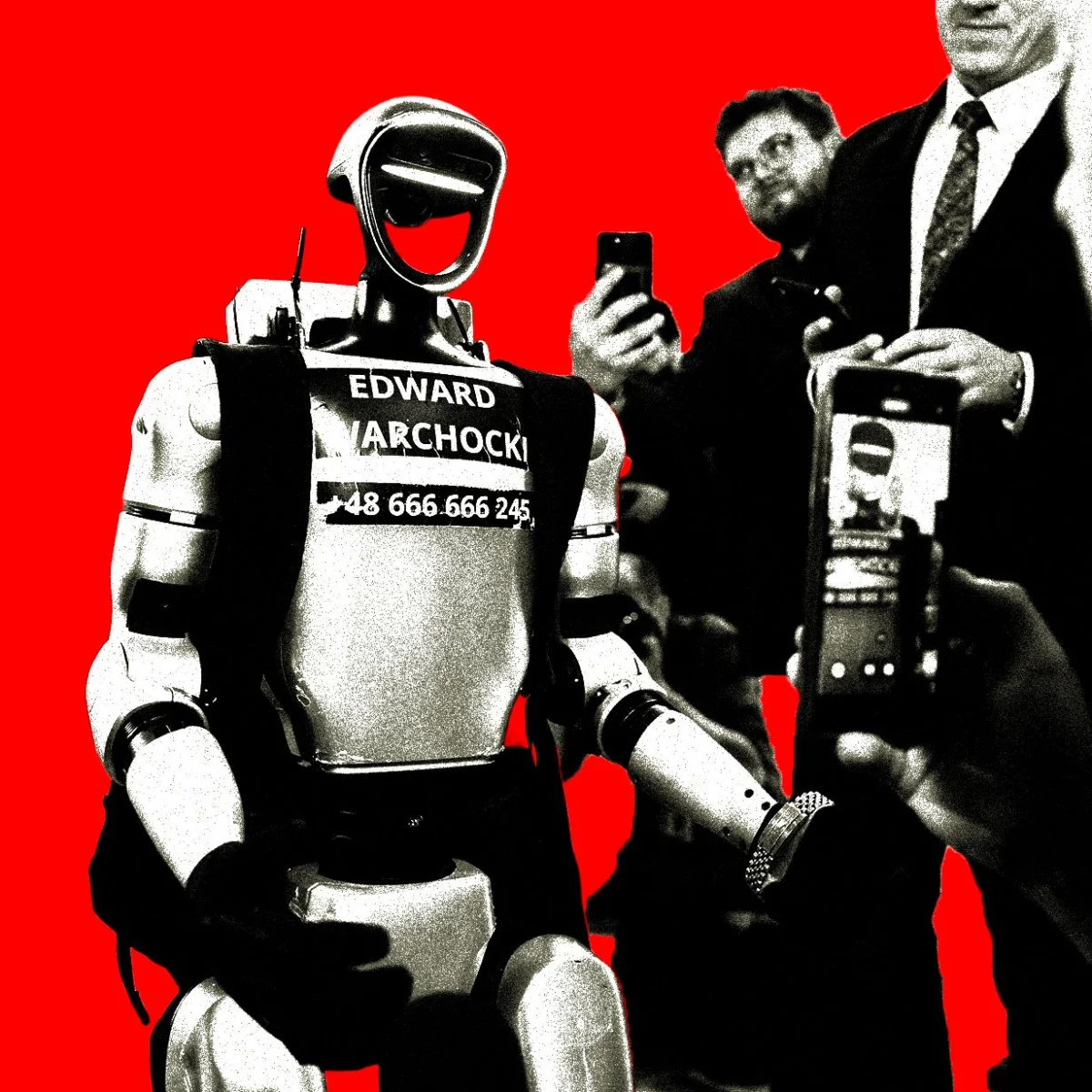
The landscape of social media and public interaction is undergoing a fundamental transformation as humanoid robots transition from laboratory prototypes to street-level celebrities. In the city streets of Poland, a four-foot-tall humanoid named Edward Warchocki has become a symbol of this shift. Described by his creator, Bartosz Idzik, as appearing "not super intelligent, but very emotional," Warchocki represents a new era of embodied artificial intelligence. While the robot’s physical form—a 40-kilogram machine made of aluminum and sensors—initially elicited fear from the public, its integration with advanced linguistic capabilities has turned it into a viral sensation. This phenomenon is not isolated to Eastern Europe; it is the vanguard of a global movement where humanoid robots, primarily the Unitree G1 model, are assuming roles as influencers, entertainers, and cultural icons.
The Genesis of a Digital Citizen: The Edward Warchocki Story
The journey of Edward Warchocki began approximately six months ago when software developer Bartosz Idzik and his colleague Radosław Grzelaczyk decided to venture into the burgeoning field of consumer robotics. They purchased a humanoid unit from China, naming it after Grzelaczyk’s dog, Eddie, and the Polish word for growling, "warczeć." The result, "Warchocki," was intended to sound like a common Polish surname, grounding the high-tech machine in local culture.
The initial deployment of the robot was met with skepticism and visible apprehension from pedestrians. According to Idzik, without the ability to communicate, the robot was perceived as an intimidating, alien object. To bridge this gap, Idzik utilized his background in software development to wire the robot to a Large Language Model (LLM), enabling it to conduct real-time, fluid conversations in Polish. This technical pivot proved to be the catalyst for the robot’s social success. Once the machine could express personality and respond to human emotion, public perception shifted from fear to fascination.
Edward’s activities have since spanned a wide spectrum of human experiences. The robot has visited the Polish parliament to engage with lawmakers, hiked mountain trails, and even participated in a viral incident in Warsaw where it was filmed chasing away wild boars while equipped with a backpack and a Rolex watch. These stunts have translated into massive digital engagement, with Edward amassing over 1 million followers and generating approximately 4 billion views across various social media platforms.
A Global Proliferation of Humanoid Personalities
By 2026, the presence of humanoid influencers has become a common sight in major metropolitan areas worldwide. These robots are frequently seen participating in local events, often tailored to the specific cultural or sporting context of their location.
In Austin, Texas, a robot known as "Rizzbot" has gained notoriety for wearing a cowboy hat and engaging in flirtatious banter with passersby, leveraging its AI to mimic local social cues. In New York City, "Bart Robot" became a fixture of the local sports scene, filmed breakdancing with fans to celebrate the New York Knicks’ recent championship victory. Meanwhile, in Miami, the "Brickell Clanker" became a staple of the World Cup festivities, frequently seen changing into different national jerseys to party with international fans after matches.
The diversity of these personalities often masks a singular technical reality: most of these high-profile influencers are built upon the same hardware platform. The Unitree G1, manufactured by the Chinese robotics firm Unitree, has emerged as the industry standard for mobile, affordable humanoid robotics. Standing roughly the size of a child, the G1 is characterized by its hollowed-out face illuminated by a ring of blue light and a lightweight aluminum frame. Its versatility has allowed it to perform on "America’s Got Talent," demonstrate kung fu, participate in boxing matches, and even engage in religious practices, such as praying at a mosque in Dubai or being ordained as a monk in Japan and South Korea.
Unitree’s Market Dominance and Financial Performance
The success of the G1 is not merely a social media trend but a significant economic event. Unitree is currently positioned as a leader in the global robotics industry, a status reflected in its upcoming initial public offering (IPO) on the Chinese stock market. Financial disclosures released ahead of the IPO highlight a company that has successfully transitioned from research and development to large-scale commercial viability.
Unlike many Western robotics firms that remain in the testing phases, Unitree derived more than half of its 2025 revenue from the delivery of humanoid robots to end-users. In 2025 alone, the company shipped 5,511 humanoid units. The average sales price for these units was less than $25,000, a price point that has significantly lowered the barrier to entry for individual creators and small businesses.
Furthermore, the data indicates a strong international demand for Chinese-made robotics. Approximately 43 percent of Unitree’s total sales in 2025 originated from outside China, signaling a shift in the global tech supply chain. The company also reported its first profitable year in 2025, a milestone that underscores the growing maturity of the humanoid market. As Idzik noted, while the global market is accustomed to China iterating on foreign designs, the current state of humanoid robotics suggests that international competitors may now be the ones looking to emulate Chinese innovation.
The Consumer Experience: Acquisition and Customization
For individual creators like Jake Cooperstein, a 24-year-old resident of Miami, the path to owning a humanoid influencer involves navigating a complex landscape of international shipping, tariffs, and technical specifications. Inspired by the success of Edward Warchocki, Cooperstein sought to acquire his own Unitree G1.
While the base model of the G1 is advertised at $13,500 on Unitree’s official website, the actual cost for a US-based consumer is significantly higher. Once import tariffs, shipping fees, and taxes are applied, US distributors typically list the base robot at approximately $19,000. However, the base model often lacks the advanced features required for high-level interaction and content creation.
Cooperstein opted for the U5 variation, a model specifically designed for educational and research purposes. Unlike the standard G1, the U5 allows for significant hardware modifications and includes more sophisticated components, such as dextrous hands capable of delicate tasks. This enhanced capability comes at a steep price, with the U5 model retailing for approximately $66,000. This disparity in pricing highlights the gap between "clout-seeking" entertainment robots and those designed for more rigorous technical or industrial applications.
Analysis of Implications: From Clout to Competence
The rapid rise of humanoid influencers raises critical questions about the future of the robotics industry. Currently, the primary value of robots like the G1 lies in their ability to generate social media engagement and perform "crowd-pleasing" tasks. This has led to a debate among industry analysts regarding the "utility gap"—the difference between a robot that can dance for a video and one that can perform economically productive labor.
Critics argue that while Unitree has mastered the art of "clout-seeking" robotics, the transition to industrial or domestic utility remains a significant challenge. For a humanoid robot to "get a real job," such as working on an assembly line or performing household chores, it requires a level of reliability, battery life, and physical strength that current consumer models have yet to consistently demonstrate.
However, the data from Unitree’s 2025 performance suggests that the "entertainment" phase may be a necessary precursor to industrial adoption. By deploying thousands of units into the real world, Unitree is gathering vast amounts of operational data that can be used to refine future iterations of their hardware and software. The "shitposters" and influencers of 2026 are, in effect, the beta testers for the workforce of the 2030s.
Chronology of the Humanoid Surge
The timeline of this robotic integration reveals a rapid acceleration in technology and public acceptance:
- Late 2024: Unitree announces the G1 model, targeting a sub-$20,000 price point to disrupt the market.
- Early 2025: Initial shipments reach international developers. Bartosz Idzik and Radosław Grzelaczyk acquire the unit that would become Edward Warchocki.
- Mid-2025: Integration of LLMs with humanoid hardware becomes a standard practice for creators, leading to the first wave of "talking" robots.
- April 2026: The Edward Warchocki wild boar video goes viral, marking the peak of humanoid social media influence.
- Late 2025/Early 2026: Unitree reports shipping over 5,500 units and achieving profitability.
- Upcoming 2026: Unitree’s IPO is scheduled to take place on the Chinese stock market, expected to be one of the year’s most significant tech listings.
Conclusion
The emergence of Edward Warchocki and his global counterparts represents a significant milestone in the history of human-robot interaction. By moving robots out of the lab and onto the street, creators have humanized a technology that was once the subject of science fiction anxiety. While the long-term economic impact of these machines remains to be seen, their current role as cultural influencers has established a permanent foothold for humanoid robotics in the public consciousness. As the Unitree G1 continues to proliferate, the line between machine and personality continues to blur, paving the way for a future where the presence of a "clanker" on the street is as unremarkable as a person with a smartphone.
About the Author