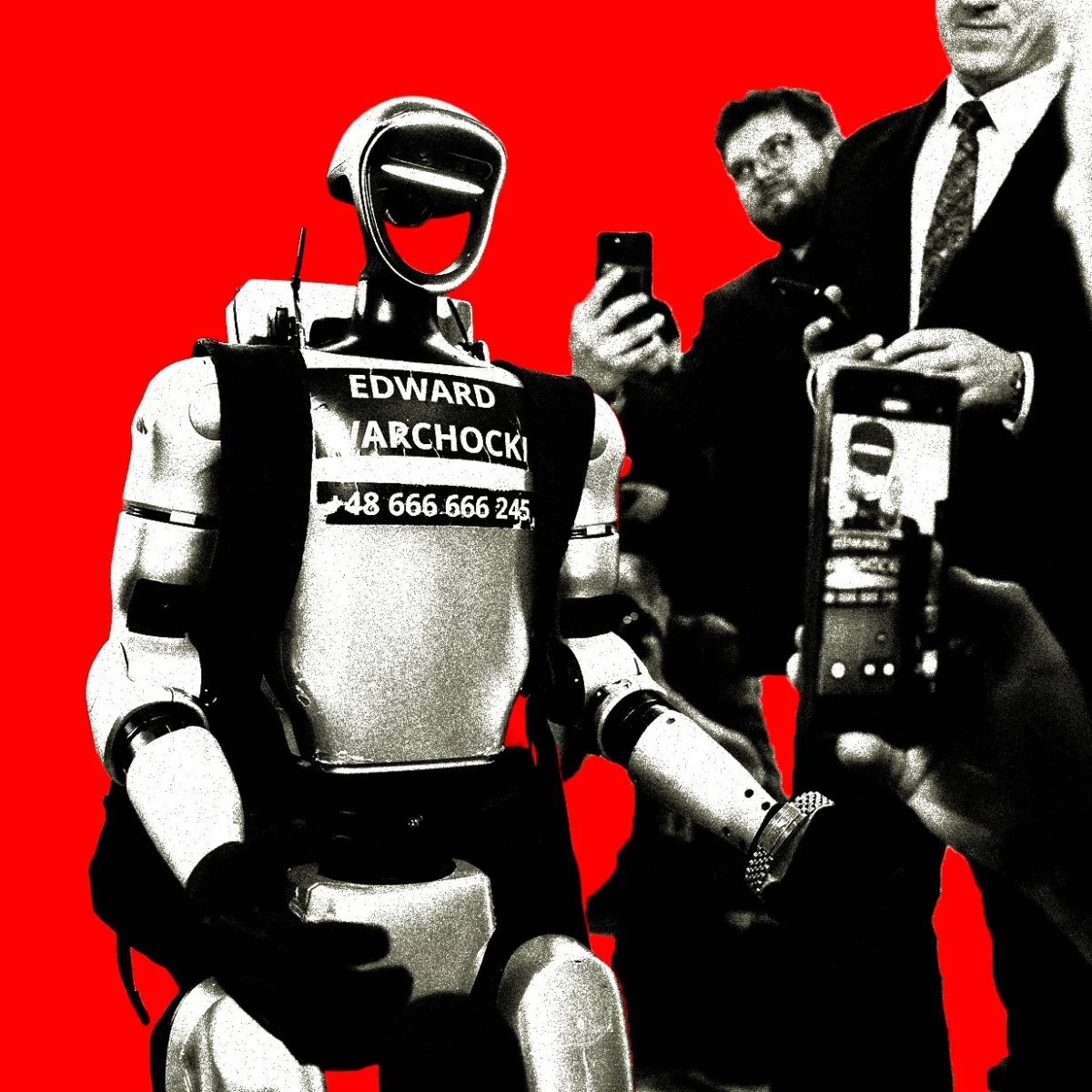
When Edward Warchocki engages in conversation, the experience is described by his creators as unexpectedly relatable. He possesses a demeanor characterized not by high-level intellectualism, but by a perceived emotional accessibility that facilitates rapid rapport with strangers. However, when the conversation ceases, the physical reality of Warchocki becomes impossible to ignore: he is a four-foot-tall humanoid robot currently navigating the urban environments of Poland. Created by software developer Bartosz Idzik and his colleague Radosław Grzelaczyk, the robot represents a significant shift in the deployment of robotics, moving from industrial applications into the sphere of social influence and public interaction.
The genesis of Edward Warchocki occurred approximately six months ago when Idzik and Grzelaczyk opted to purchase a humanoid platform from a Chinese manufacturer. The name "Edward Warchocki" is a hybrid of Grzelaczyk’s dog, Eddie, and the Polish verb "warczeć," meaning to growl, chosen specifically because it functions as a plausible human name within the local culture. Initial public reactions to the robot were marked by apprehension; during its first few days on the streets, the silent, 40-kilogram machine was often met with fear. To bridge this gap, Idzik integrated the robot with a large language model (LLM), enabling it to conduct real-time conversations in Polish. This technical adjustment transformed public perception, shifting the machine from an intimidating object to a local celebrity.
The Evolution of the Humanoid Influencer
The success of Edward Warchocki is not an isolated incident but part of a burgeoning global trend. Since gaining the ability to speak, the robot has achieved a level of social integration rarely seen in autonomous machines. It has visited the Polish parliament to engage with lawmakers, navigated mountainous terrain, and waded into lakes. A viral video depicting the robot, equipped with a backpack and a Rolex watch, chasing wild boars out of a residential area in Warsaw solidified its status as an international sensation. As of late 2025, Warchocki has amassed over 1 million followers and generated approximately 4 billion views across various social media platforms.
This phenomenon has replicated itself in several major global hubs. In Austin, Texas, a robot known as "Rizzbot," distinguished by its cowboy hat, has become a fixture for its flirtatious interactions with pedestrians. In New York City, "Bart Robot" gained notoriety for breakdancing with fans following the Knicks’ championship victory. Meanwhile, in Miami, the "Brickell Clanker" is known for its participation in World Cup celebrations, frequently appearing in different national team jerseys. These "humanoid influencers" are leveraging the novelty of their form and the capabilities of generative AI to capture the attention of a digital audience, creating a new category of content creation that blurs the line between technology and entertainment.
Hardware Standardization and the Unitree G1 Platform
While these robots appear to have distinct personalities and local identities, they share a common technological foundation. The vast majority of these viral humanoid influencers are the Unitree G1 model, manufactured by Unitree Robotics, a Chinese firm based in Hangzhou. The G1 is approximately the size of a child, featuring a distinctive hollowed-out facial structure outlined by a ring of blue light and limbs constructed from light-gray aluminum.
The G1 has proven to be a versatile platform for diverse activities. Beyond social media stunts, the model has been featured on "America’s Got Talent," demonstrated martial arts, and participated in boxing matches. Its agility has been showcased through parkour and dancing at concerts. In more somber or traditional contexts, the G1 has been ordained as a monk in temples across Japan and South Korea and has been observed in prayer at mosques in Dubai. This widespread adoption is attributed to the robot’s relative affordability and accessibility compared to its Western counterparts, such as Boston Dynamics’ Atlas or Tesla’s Optimus, which are often either not for sale to the general public or priced significantly higher.
Financial Performance and Market Dominance
The commercial success of Unitree is reflected in its recent financial disclosures as the company prepares for its initial public offering (IPO) on the Chinese stock market. Unlike many robotics firms that remain in the research and development phase, Unitree has successfully transitioned to large-scale commercial delivery. In 2025, the company reported shipping 5,511 humanoid units, a figure that represents a significant lead in the consumer humanoid sector.
The average sale price for these units remains below $25,000, a price point that has disrupted the global robotics market. Notably, 43 percent of Unitree’s sales in 2025 were generated from markets outside of China, indicating strong international demand for affordable humanoid platforms. Furthermore, the company achieved profitability for the first time last year, a milestone that underscores the viability of the "robotics-as-entertainment" and "robotics-as-education" business models. Bartosz Idzik, reflecting on the hardware choice for Edward Warchocki, noted that after testing various humanoid models, the G1 emerged as the most effective for their purposes, suggesting that in the current humanoid landscape, China has moved from a position of imitation to one of innovation.
Procurement Challenges and Educational Variants
The process of acquiring a humanoid robot in the United States highlights the complexities of the current international trade and regulatory environment. Jake Cooperstein, a 24-year-old entrepreneur in Miami, sought to enter the humanoid influencer space after witnessing the success of Edward Warchocki. Although the base price of a G1 is listed at approximately $13,500 on Unitree’s website, the final cost for US-based consumers is significantly higher due to tariffs, shipping fees, and taxes. US distributors often list the basic model at around $19,000.
However, the base model possesses limitations that may hinder sophisticated users. It lacks high-dexterity hands and comes with software restrictions that prohibit significant modifications. To bypass these limitations, Cooperstein opted for the U5 variant, a model specifically designed for the educational and research sectors. The U5 features more advanced components and allows for extensive customization but carries a much higher price tag of approximately $66,000. This disparity in pricing and capability illustrates the tiered nature of the current robotics market, where entry-level "clout-seeking" bots are accessible to many, but truly capable research-grade machines remain a significant investment.
Technical Analysis: From Clout to Utility
Despite the cultural impact and viral success of these machines, industry analysts remain divided on the long-term economic utility of the current generation of humanoids. The Unitree G1 and its contemporaries are highly effective at performing scripted or AI-augmented social tasks, but their ability to perform traditional labor remains unproven. The transition from "vibing" on social media to working on an assembly line or performing domestic chores requires a level of reliability, battery life, and fine motor skills that the current $15,000 to $25,000 models have yet to demonstrate consistently.
The integration of Large Language Models has solved the "interaction problem," making robots socially acceptable and even beloved. However, the "manipulation problem"—the ability to interact with and alter the physical world with the precision of a human—remains the primary hurdle. While a G1 can be programmed to "cook," these attempts often result in failure, as seen in various viral videos. The question remains: when will these machines transition from being "lit as fuck," as described by social media users, to being productive members of the labor force?
Broader Implications and Future Outlook
The rise of the Unitree G1 as a global social phenomenon has several broader implications for society and the technology industry. First, it demonstrates the "democratization" of robotics. When robots move out of the lab and onto the streets of Warsaw or the clubs of Miami, they become normalized. This normalization is a prerequisite for the eventual integration of robots into more critical sectors of the economy.
Second, the trend highlights a shift in the geopolitical landscape of technology. China’s ability to mass-produce humanoid hardware at a fraction of the cost of Western competitors has allowed it to dominate the first wave of consumer humanoid adoption. While US companies like Figure AI and Tesla are focused on high-end industrial applications, Chinese firms are capturing the cultural and educational markets.
Finally, the phenomenon of the humanoid influencer raises ethical and social questions regarding human-robot interaction. As these machines become more "emotional" and "easy to make friends with," the boundaries between human social circles and technological tools will continue to blur. The case of Edward Warchocki suggests that the path to widespread robot adoption may not be through pure utility, but through personality and social connection. As Unitree moves toward its IPO and more units like the G1 enter the public space, the "clanker" may soon become as common a sight in urban landscapes as the smartphone once was.
About the Author