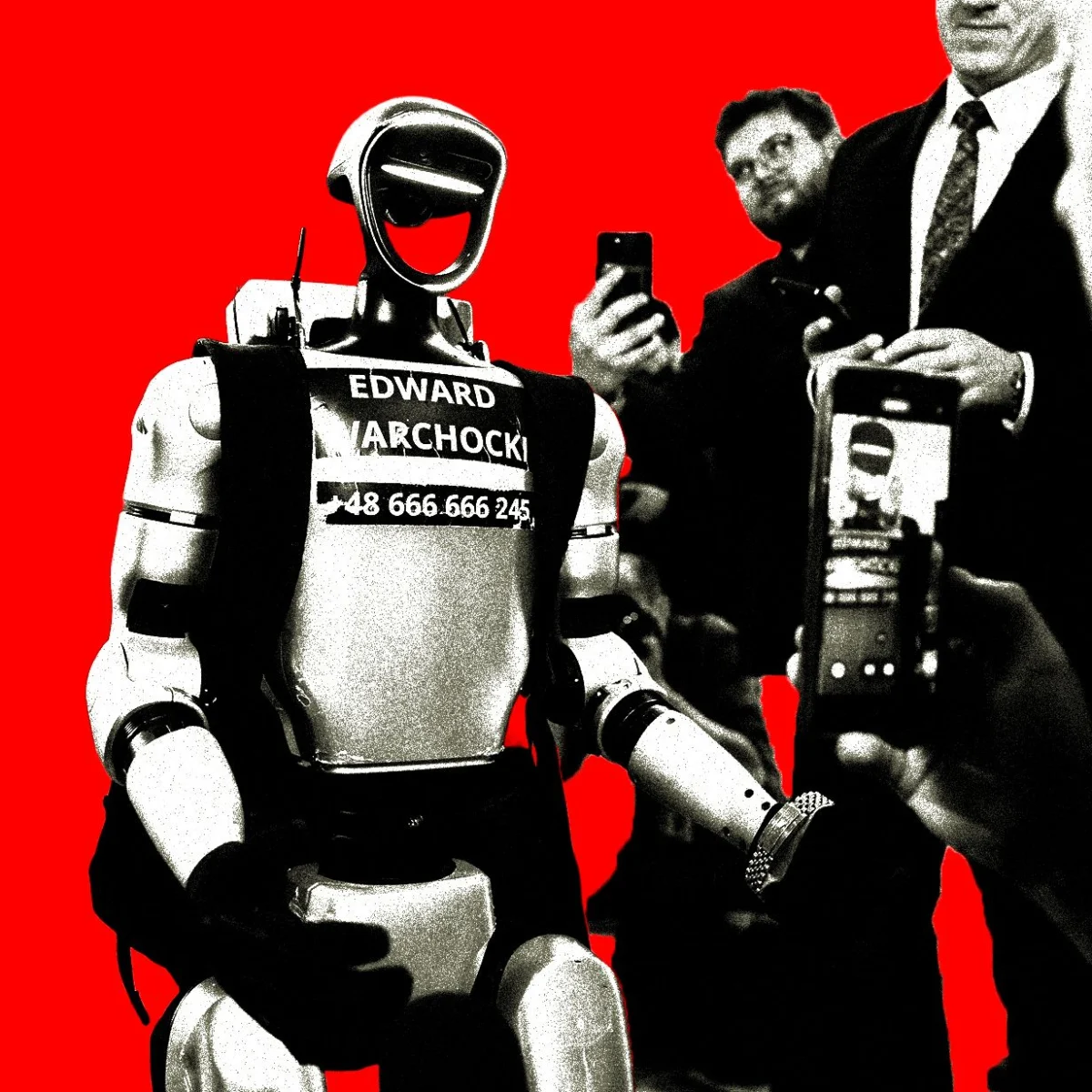
When Edward Warchocki speaks, he projects the persona of an average citizen: relatable, emotionally resonant, and approachable. To his creator, Bartosz Idzik, this personality is a deliberate design choice intended to bridge the gap between cold machinery and human connection. However, when the conversation ceases, the physical reality of Warchocki becomes impossible to ignore. Standing four feet tall, the humanoid robot has become a common sight on the streets of Poland, representing a broader global shift where advanced robotics move from high-tech laboratories into the public square.
The genesis of Edward Warchocki began approximately six months ago when Idzik and his colleague Radosław Grzelaczyk decided to import a humanoid robot from China. The name was a portmanteau of Grzelaczyk’s dog, Eddie, and the Polish verb "warczeć" (to growl), crafted to sound like a legitimate, if slightly eccentric, Polish surname. Initially, the robot’s presence was met with trepidation. In its first days of public deployment, the silent, 40-kilogram machine unsettled passersby. Recognizing that physical form alone was insufficient for public integration, Idzik, a software developer, integrated the robot with a large language model (LLM). This modification allowed the machine to engage in real-time, fluid conversations in Polish.
The impact was immediate. According to Idzik, the addition of speech transformed the perception of the robot from a potentially threatening industrial tool into a charismatic public figure. Since that integration, Edward Warchocki has ascended to the status of a digital celebrity, visiting the Polish parliament, hiking mountain trails, and even engaging in a scripted "arrest" by local police. A viral video depicting the robot chasing wild boars out of a Warsaw forest—outfitted with a backpack and a Rolex—catapulted the account to international fame. Today, Warchocki boasts over 1 million followers and a staggering 4 billion views across various social media platforms.
The Global Phenomenon of Robotic Personalities
By 2026, the sight of humanoid robots participating in cultural and social events has become a global trend, signaling the arrival of the "robot influencer" era. This phenomenon is not localized to Eastern Europe but has manifested in major urban centers worldwide. In Austin, Texas, a robot known as "Rizzbot" has gained notoriety for wearing a cowboy hat and engaging in flirtatious banter with pedestrians. In New York City, "Bart Robot" was recently filmed breakdancing with fans following a historic championship win by the Knicks. Meanwhile, in Miami, the "Brickell Clanker" became a staple of World Cup celebrations, frequently changing team jerseys to match the winners of each match.
While these robots possess distinct "personalities" and local branding, they share a common technological lineage. The vast majority of these viral humanoid influencers are the Unitree G1 model, produced by Unitree Robotics, a Chinese firm that has rapidly ascended to a dominant position in the global robotics market. The G1 is characterized by its child-sized stature, a hollowed-out facial visor illuminated by a ring of blue light, and a lightweight aluminum frame. Its versatility has been demonstrated through a wide array of public performances, including appearances on talent shows, demonstrations of martial arts, and participation in religious ceremonies at mosques in Dubai and temples in Japan and Korea.
Market Dominance and Financial Performance
The proliferation of the G1 model is a direct result of Unitree’s aggressive commercial strategy and manufacturing efficiency. As the company prepares for an initial public offering (IPO) on the Chinese stock market, financial disclosures have revealed a level of market penetration that surpasses many of its Western competitors. Unlike many robotics firms that remain in the research and development phase, Unitree has successfully transitioned to mass-market delivery.
In 2025, Unitree reported shipping 5,511 humanoid units, with an average unit price of less than $25,000. Significantly, 43 percent of these sales originated from international markets, indicating a robust global demand for affordable humanoid platforms. This sales volume allowed the company to achieve profitability for the first time in its history last year. The G1 model’s base price is listed at approximately $13,500 on Unitree’s website, though international buyers face significantly higher costs due to logistics, taxes, and import tariffs.
Industry analysts suggest that Unitree’s success stems from its ability to provide a "good enough" platform that is accessible to independent developers and hobbyists. While high-end humanoids from companies like Boston Dynamics or Tesla may offer more advanced mechanical capabilities, the G1 provides a functional balance of mobility and cost that has enabled the current wave of social media-driven experimentation.
Procurement and the American Market
For American entrepreneurs looking to enter the humanoid influencer space, the path to ownership is often complex and expensive. Jake Cooperstein, a 24-year-old resident of Miami, was inspired by the success of Edward Warchocki to launch his own robotic brand. After testing a G1 unit at a specialized robotics warehouse in New York, Cooperstein committed to a purchase. However, he quickly discovered that the entry-level price point was misleading for those seeking professional-grade performance.
While the base model is marketed at $13,500, U.S. distributors often list the robot closer to $19,000 after factoring in the overhead of importation. Furthermore, the base model lacks several features essential for high-quality content creation, such as dextrous hands, and is restricted by software locks that prevent significant modification. To bypass these limitations, Cooperstein opted for the U5 variant, a model specifically designed for educational and research institutions. This version allows for extensive customization and includes more sophisticated hardware components but carries a price tag of approximately $66,000.
This disparity in pricing highlights a growing divide in the robotics market: the gap between "consumer-grade" entertainment devices and "developer-grade" platforms capable of meaningful interaction or task performance.
Technical Specifications and Capability
The Unitree G1 is a marvel of iterative engineering. Standing at approximately 127 centimeters (50 inches) and weighing 35 kilograms, it is designed for agility rather than brute strength. Its sensor suite includes a 3D LiDAR system and depth cameras, allowing it to navigate complex urban environments autonomously or via remote operation. The robot is powered by a high-performance battery that offers approximately two hours of active use, depending on the intensity of the tasks performed.
One of the most significant advancements in the G1 is its joint flexibility. The robot features high-torque motors that allow for a wide range of motion, enabling it to perform tasks ranging from simple walking to complex maneuvers like parkour or dancing. However, the most critical "feature" of these robots is not their hardware, but their compatibility with third-party AI software. By linking the G1 to LLMs and voice-synthesis engines, users can create the illusion of a sentient, conversational entity, which is the primary driver of their social media success.
From Entertainment to Utility: The Economic Question
Despite the cultural impact of humanoid influencers, the robotics industry faces a looming question regarding the long-term economic utility of these machines. While the G1 excels at "clout-seeking" activities—viral stunts, public interactions, and digital content creation—its ability to perform traditional labor remains unproven.
Skeptics argue that the current fascination with humanoid robots is a superficial trend driven by the novelty of AI-integrated hardware. For robots to contribute meaningfully to the economy, they must transition from being "influencers" to being "workers." This would require advancements in fine motor skills, battery life, and task-specific AI that can handle the unpredictability of an assembly line or a domestic environment.
"We tested a lot of humanoids, and the G1 was the best for its purpose," Bartosz Idzik noted. He also pointed out a significant shift in the global tech hierarchy, suggesting that in the realm of humanoid robotics, the traditional roles of innovator and imitator have reversed. "We are used to China copying other countries, but from the perspective of humanoids, other people should copy China," Idzik stated.
Implications and Future Outlook
The rise of the humanoid influencer carries significant social and regulatory implications. As these machines become more common on city streets, local governments are beginning to grapple with issues of public safety, privacy, and sidewalk right-of-way. The "arrest" of Edward Warchocki, while staged for entertainment, foreshadows real legal questions regarding the liability of robot owners when a machine causes an accident or a public disturbance.
Furthermore, the psychological impact of human-robot interaction is a growing field of study. The ease with which the public has embraced "Edward" suggests that LLM-driven communication is highly effective at overcoming the "uncanny valley"—the sense of unease felt when a robot appears almost, but not quite, human. By making the robot "very emotional" and "easy to make friends with," creators are tapping into human social instincts to build brand loyalty and digital engagement.
As Unitree moves toward its IPO and more competitors enter the market, the humanoid landscape is expected to diversify. Whether these machines will eventually move beyond the role of digital entertainers to become a fixture of the global workforce remains to be seen. For now, the "clankers" continue to dominate social media feeds, proving that in the age of AI, a 40-kilogram machine with a good personality can be just as influential as any human celebrity.
About the Author