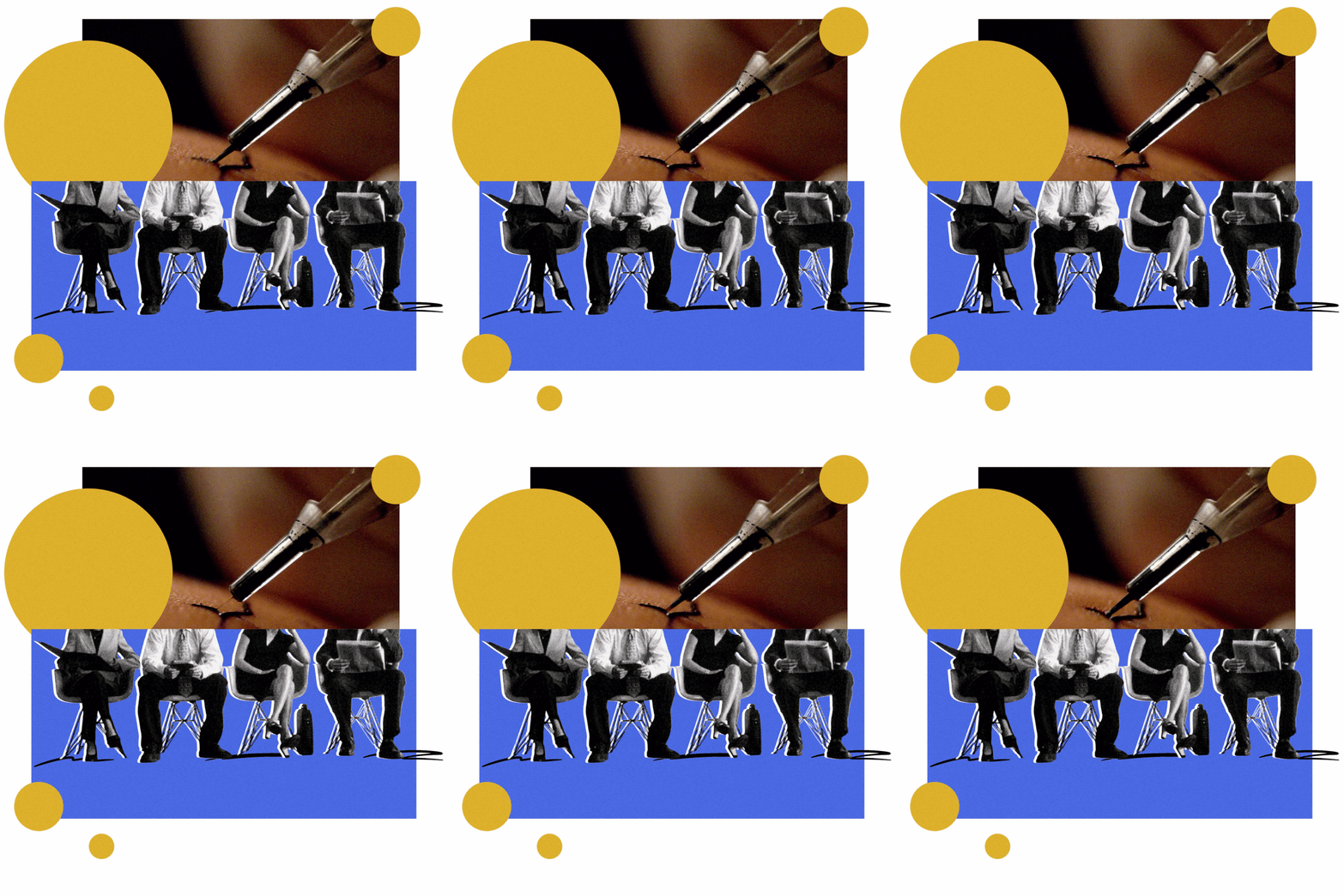
The landscape of Silicon Valley recruitment has long been characterized by unconventional methods, ranging from complex logic puzzles to high-stakes social engineering. However, a recent incident involving Jordan Zietz, the 24-year-old founder of the AI startup LemonLime, has pushed the boundaries of "startup culture" into a realm that many critics describe as ethically precarious. In late July, following a Y Combinator Startup School event, Zietz hosted a party that would eventually ignite a firestorm of criticism across professional networking platforms and social media. The controversy centered on a LinkedIn post in which Zietz claimed to have offered "instant interviews" to any attendee willing to receive a tattoo from a professional artist stationed at the event. This intersection of permanent physical modification and professional opportunity has sparked a broader debate regarding power dynamics, corporate ethics, and the increasingly desperate state of the technology job market.
The Genesis of the Controversy: From Party to Viral Post
The sequence of events began in late July during the festivities surrounding Y Combinator’s Startup School, a prominent program for aspiring entrepreneurs. Zietz, whose startup LemonLime provides AI solutions tailored for small businesses, sought to create a memorable impression on potential recruits and the broader tech community. He hired a professional tattoo artist for the afterparty and subsequently took to LinkedIn to share the results of the evening. In his original post, Zietz stated that he "offered an instant interview to anyone who got a LemonLime tattoo," noting that seven individuals ultimately opted to go under the needle.
The reaction from the professional community was almost instantaneous and overwhelmingly negative. Within hours, the post was flooded with thousands of comments and shares. Critics characterized the move as a "textbook display of predatory corporate behavior" and a "gross abuse of power." The sentiment was echoed on X (formerly Twitter), where screenshots of the LinkedIn post went viral. One widely shared response captured the prevailing mood of the tech workforce: "The job market cannot be this cooked that kids have to get permanent tattoos to get interviews." This reaction highlighted a deep-seated anxiety among job seekers who perceived the stunt not as a fun "culture fit" exercise, but as an exploitation of the current economic climate where high-paying tech roles are increasingly scarce.
Clarification and the Founder’s Defense
In the wake of the intense backlash, Jordan Zietz sought to clarify the nature of the event and the specifics of the "tattoo-for-interview" offer. Speaking in an interview with WIRED, Zietz argued that the public perception of the event—fueled in part by his own provocative social media language—did not accurately reflect the reality of the evening. According to Zietz, no one was "permanently branded" with the LemonLime corporate logo against their will or as a strict prerequisite for employment.
Zietz explained that while the tattoo artist provided "flash" designs featuring lemons and limes, attendees were free to choose any design they desired. At least one attendee later confirmed on social media that she received a personal tattoo unrelated to the startup and emphasized that she was not a job seeker. Furthermore, Zietz maintained that the offer of an interview was not exclusive to those who received tattoos. He claimed that he told partygoers that getting inked was not a requirement for a job and that, in practice, almost any attendee who expressed a genuine interest in a conversation about a role was granted an interview. "A decent amount of people who got tattoos never wanted to even take us up on any offer to chat," Zietz noted, suggesting that many were simply drawn to the novelty of a free tattoo.
Despite these clarifications, Zietz admitted that the optics of the situation were problematic. He acknowledged that his original LinkedIn post was designed to be "half-and-half" earnest—a deliberate attempt to signal a specific, "out there" company culture. He intended the tattoo station to serve as a litmus test for cultural alignment, forcing potential candidates to make a quick judgment call: did they find the unconventional atmosphere exhilarating or repulsive? From Zietz’s perspective, those who were genuinely deterred by the presence of a tattoo station would likely not thrive in the "eccentric" environment he is attempting to build at LemonLime.
A Pattern of Eccentricity: The Profile of Jordan Zietz
To understand the LemonLime controversy, one must look at the history of its founder. Jordan Zietz has long cultivated a persona defined by disruption and high-energy stunts. During his time as a student at Stanford University, Zietz gained notoriety as the "Stanford Tree," the university’s unofficial mascot. His tenure in the role ended in suspension after he unfurled a banner during a televised football game that read "Stanford Hates Fun," a protest against what he perceived as the university’s overly restrictive social policies.
This penchant for the theatrical followed him into his entrepreneurial ventures. Prior to founding LemonLime, Zietz co-founded Confetti, a social media platform. His recruitment strategies for that venture were equally unconventional; last year, he revealed on LinkedIn that part of the hiring process for software engineers involved conducting interviews while skydiving. Zietz views these methods as essential for identifying candidates who possess the "eccentricity" and risk tolerance required for early-stage startup work. He maintains a philosophy of "never asking anyone to do something I would not do myself." To underscore this point, Zietz recently received his second LemonLime-themed tattoo—the actual corporate logo—on his shoulder, adding to a collection that includes a dinosaur doodle and a thigh tattoo that reads "This Is The Correct Knee."
The Macroeconomic Context: A "Cooked" Job Market
The intensity of the backlash against Zietz cannot be understood in a vacuum. It is a direct reflection of the current state of the technology sector. Following the "hiring binge" of the pandemic era, the years 2023 and 2024 have been defined by massive layoffs and a significant contraction in venture capital funding. According to data from Layoffs.fyi, hundreds of thousands of tech workers have been displaced over the last 18 months, leading to a hyper-competitive environment where hundreds of qualified applicants often vie for a single position.
In this climate, the power imbalance between employers and employees has shifted dramatically back toward the corporation. For many observers, Zietz’s "tattoo for an interview" stunt felt like a cruel parody of this imbalance. While Zietz may have viewed it as a lighthearted "culture" exercise, a workforce weary of instability viewed it as a "loyalty test" that demanded physical permanence in exchange for the mere possibility of a paycheck. The phrase "the job market is cooked" has become a common refrain among Gen Z and Millennial workers, signaling a belief that the traditional meritocracy has been replaced by a system that rewards performative loyalty and "hustle culture" to an extreme degree.
Ethical Implications and the "Culture Fit" Trap
The LemonLime incident raises significant questions about the ethics of "culture fit" in modern hiring. For decades, tech companies have used the concept of culture fit to build cohesive teams, but critics argue it is often used as a cloak for exclusionary practices or, in this case, as a justification for unprofessional demands. By using a tattoo station as a filtering mechanism, Zietz essentially created a scenario where personal bodily autonomy was linked—even if only symbolically—to professional access.
Ethicists point out that even if the tattoos were "optional," the inherent power dynamic of a founder offering a career-altering opportunity at a social event creates a coercive environment. In a high-stakes industry like AI, where being an early employee at a successful startup can lead to generational wealth, the pressure to "fit in" and show "commitment" can lead individuals to make choices they might otherwise avoid. The "branding" of employees, whether literal or figurative, represents a blurring of the line between a person’s private identity and their corporate utility.
Broader Impact on the Startup Ecosystem
The fallout from the LemonLime controversy may serve as a cautionary tale for other founders within the Y Combinator ecosystem and beyond. While "growth hacking" and viral marketing are prized skills in the startup world, the incident demonstrates that there is a fine line between being "edgy" and being perceived as exploitative. The backlash suggests that the public’s patience for "founder worship" and unconventional antics is waning, particularly when those antics appear to come at the expense of worker dignity.
However, from a purely branding perspective, some might argue that Zietz achieved his goal. LemonLime, a relatively unknown startup in a sea of AI companies, became a household name in tech circles overnight. For a certain subset of the "move fast and break things" crowd, the controversy might even act as a magnet, attracting individuals who pride themselves on being outsiders and who view the "corporate" outrage as proof that LemonLime is truly disruptive.
Conclusion: The Future of LemonLime and Recruitment Ethics
As Jordan Zietz prepares to release a high-production video of himself receiving the LemonLime logo tattoo, the conversation surrounding his recruitment methods continues to evolve. While he has successfully clarified that the "mandatory" nature of the tattoos was a misinterpretation of his social media bravado, the underlying tension remains. The incident has exposed a raw nerve in the tech industry, highlighting the friction between a founder’s desire for an "eccentric" culture and a workforce’s demand for professional respect and stability.
In the long term, the success of LemonLime will likely depend more on its AI technology than its tattoo-based marketing. However, the legacy of the "tattoo party" will remain a significant case study in the history of Silicon Valley recruitment. It serves as a stark reminder that in an era of viral social media and economic uncertainty, the way a company treats its potential employees is just as much a part of its brand as its logo—whether that logo is printed on a business card or tattooed on a shoulder. The debate over where "culture" ends and "predatory behavior" begins is far from over, and LemonLime has ensured it will be at the center of that discussion for the foreseeable future.
About the Author