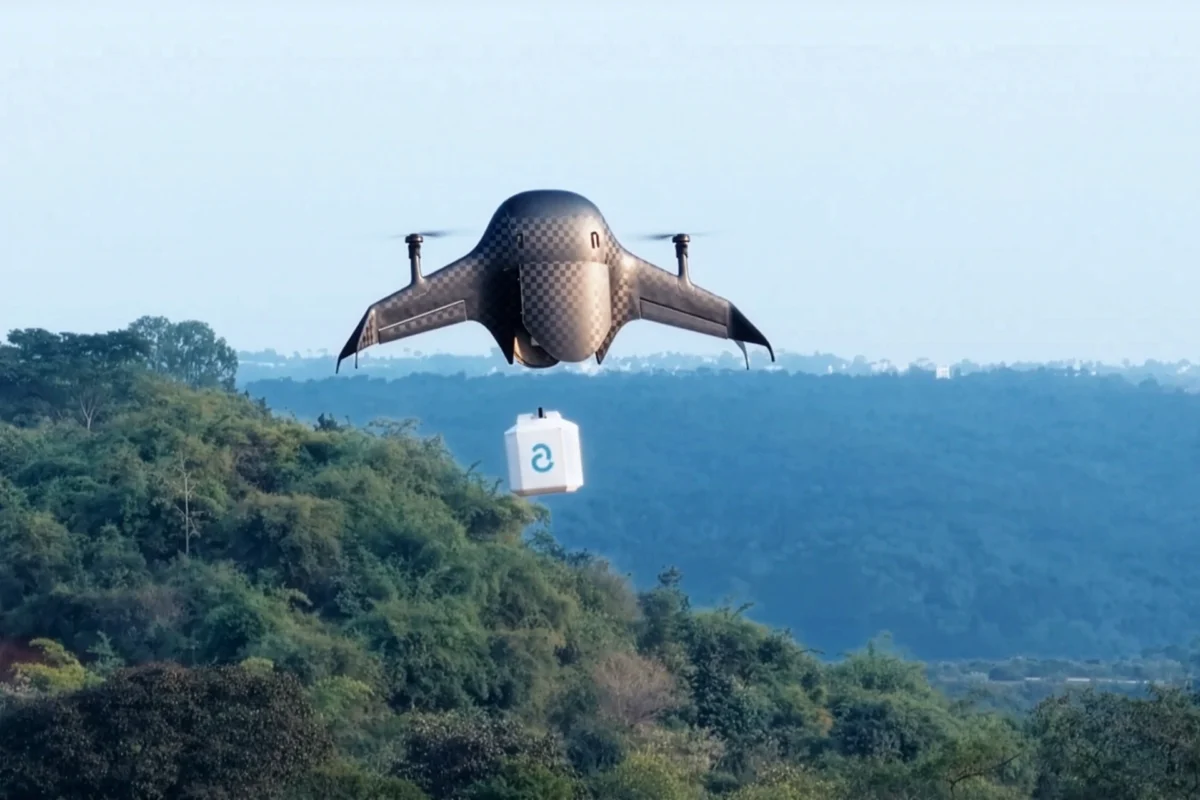
Airbound, an ambitious Indian startup aiming to make aerial goods transportation as cost-effective as traditional trucking, has successfully raised $37 million in a significant Series A funding round. This substantial infusion of capital, spearheaded by Greenoaks with crucial participation from prominent investors including DoorDash, Lachy Groom, Lightspeed, and Humba Ventures, underscores the growing confidence in the company’s vision for the future of logistics. The funding comes less than a year after Airbound garnered $8.65 million in its seed round, bringing the total capital raised by the three-year-old company to nearly $50 million. This financial momentum is poised to accelerate Airbound’s development and deployment of autonomous drones designed to disrupt the established norms of cargo transport.
The burgeoning field of drone delivery, while showing promise, has faced significant hurdles in matching the sheer scale and versatility of road-based trucking. Startups like Airbound are at the forefront of addressing this gap, presenting a compelling argument that drones can offer faster and more economical solutions for specific types of cargo. Airbound’s unique approach centers on a fundamental redesign of the aircraft itself, with the explicit goal of achieving cost parity with ground transportation. This innovation is driven by the understanding that conventional aircraft expend considerable energy simply supporting their own weight, an inefficiency that dramatically increases the cost of flight, particularly for lighter payloads.
At the heart of Airbound’s strategy is the development of vertical-flight drones engineered to be lighter than the cargo they carry. Founder and CEO Naman Pushp articulated this philosophy in a recent interview, highlighting a significant departure from traditional aerial vehicle design. The company’s current flagship drone, the TRT, exemplifies this principle, weighing approximately 3.3 pounds and capable of carrying a payload of around 2.2 pounds. This remarkable payload-to-weight ratio is a testament to the innovative engineering at play. Looking ahead, Airbound is developing a next-generation drone that is projected to weigh about 6.6 pounds and boast an impressive carrying capacity of up to 11 pounds, a substantial increase that will broaden the scope of potential applications.
A key design element enabling this efficiency is the drones’ rocket-like, tail-sitter configuration. This allows for vertical takeoff and landing in an upright position, eliminating the need for runways and facilitating operations in diverse environments. The drone then transitions to horizontal flight, optimizing speed and range. Pushp emphasized that this vertical takeoff and landing capability will be a consistent feature, even as the company scales up to larger aircraft, ensuring adaptability and reducing infrastructure dependency. "We want to build towards a world where everything has cost parity with trucking," Pushp stated, underscoring the audacious yet achievable ambition driving the company’s technological advancements.
Airbound’s operational track record, though relatively nascent, is already demonstrating the practical viability of its technology. Since its founding in 2023, the company has successfully completed over 13,000 autonomous flights across the southern Indian cities of Bengaluru and Guntur. A particularly impactful collaboration has been with the Indian hospital network Narayana Health. In this partnership, Airbound’s drones are instrumental in transporting diagnostic samples between healthcare facilities, a critical function that can significantly impact patient care timelines.
The efficiency gains are stark when comparing aerial and terrestrial transport for these medical samples. On a typical Narayana Health route, spanning approximately 2.5 miles, Airbound’s drones complete the journey in around seven minutes. In contrast, the same samples would take three to five hours to be transported by truck, a delay that accounts for the time required to accumulate sufficient samples for a road trip and the inherent inefficiencies of ground traffic. This substantial time reduction is not merely a matter of convenience; it represents a tangible improvement in the speed of medical diagnosis and treatment. The existing partnership is set to expand with Narayana Health’s new Banashankari hospital in Bengaluru. This facility has been designed without an on-site diagnostic lab or blood bank, explicitly relying on Airbound’s drone network to connect with centralized medical resources, a pioneering move that highlights the transformative potential of drone logistics in healthcare infrastructure.
Charting a Course for a Three-City Drone Network
Airbound’s aspirations extend far beyond individual medical deliveries. The company is actively working to establish a comprehensive drone delivery network that will connect three major cities within the state of Andhra Pradesh. This ambitious undertaking has already secured an agreement with the state government, with a long-term objective of facilitating 10,000 flights per day across various sectors, including retail, e-commerce, and healthcare. To achieve this scale, Airbound anticipates requiring between 250 and 1,000 aircraft, contingent on route lengths, though Pushp projects the lower end of this estimate to be more likely, indicating efficient route planning and operational optimization.
The agreement with the Andhra Pradesh government, while significant, does not involve direct government contracts or subsidies. Instead, the state is collaborating with Airbound on developing the necessary regulatory framework to enable the operation of such an extensive drone network. Airbound’s revenue model is predicated on providing delivery services to businesses that will utilize the network for their logistical needs. This approach positions Airbound as a crucial infrastructure provider, enabling a new era of rapid and efficient delivery services.
The Indian drone landscape is becoming increasingly competitive, with other domestic startups like Skye Air Mobility and TSAW Drones also actively building aerial logistics businesses. Established drone manufacturers such as Garuda Aerospace have also explored delivery use cases. However, Airbound distinguishes itself with its strategic focus: building the foundational aircraft that other logistics networks can eventually adopt, rather than solely aiming to become the largest delivery operator. Pushp articulated this vision by drawing an analogy to the aviation industry: "That’s the Boeing role – the aircraft airlines everywhere rely on, not the airline itself." This positions Airbound as a potential original equipment manufacturer (OEM) for the burgeoning drone delivery ecosystem.
The company’s commitment to in-house development is evident in its 43,000-square-foot facility in Bengaluru, where it designs and manufactures its aircraft, including the airframe and other critical core systems. While specific production capacity figures and the total number of aircraft built remain undisclosed, Pushp expressed confidence that manufacturing will not be a bottleneck as Airbound scales its operations.
Navigating Regulatory Hurdles and Future Growth
Despite the technological advancements and strategic partnerships, the primary challenge facing Airbound, and indeed the entire drone delivery industry, is regulation. Securing approvals for beyond visual line of sight (BVLOS) operations is paramount. This certification is crucial for enabling drones to fly beyond the direct sight of an operator, a prerequisite for establishing large-scale delivery networks. The current regulatory landscape, while evolving, has presented a significant hurdle, limiting Airbound’s ability to translate its operational flights into substantial commercial revenue. Consequently, the startup remains broadly pre-revenue, despite employing a dedicated team of over 150 professionals.
Pushp’s long-term perspective is evident in his statement: "The goal is to be a giant in a few decades, not to make revenue as soon as we can." This indicates a strategic commitment to foundational development and market positioning, prioritizing sustainable growth over immediate profitability. The recent Series A funding round is a critical enabler of this long-term vision, providing the resources to overcome regulatory challenges, further refine its technology, and expand its operational footprint.
The implications of Airbound’s success could be far-reaching. A cost-effective and scalable drone delivery network has the potential to revolutionize supply chains, particularly in regions with challenging terrain or underdeveloped road infrastructure. For healthcare, it promises faster access to essential medical supplies and faster diagnostics. In e-commerce, it could lead to same-day or even same-hour deliveries for a wider range of goods, transforming consumer expectations. The company’s focus on building the underlying technology also suggests a potential role in empowering other businesses to establish their own drone delivery services, fostering a more decentralized and resilient logistics ecosystem. As Airbound continues to navigate the complexities of regulation and technological scaling, its journey offers a compelling glimpse into the future of goods transportation, one that is increasingly defined by the silent hum of autonomous aerial vehicles.
About the Author