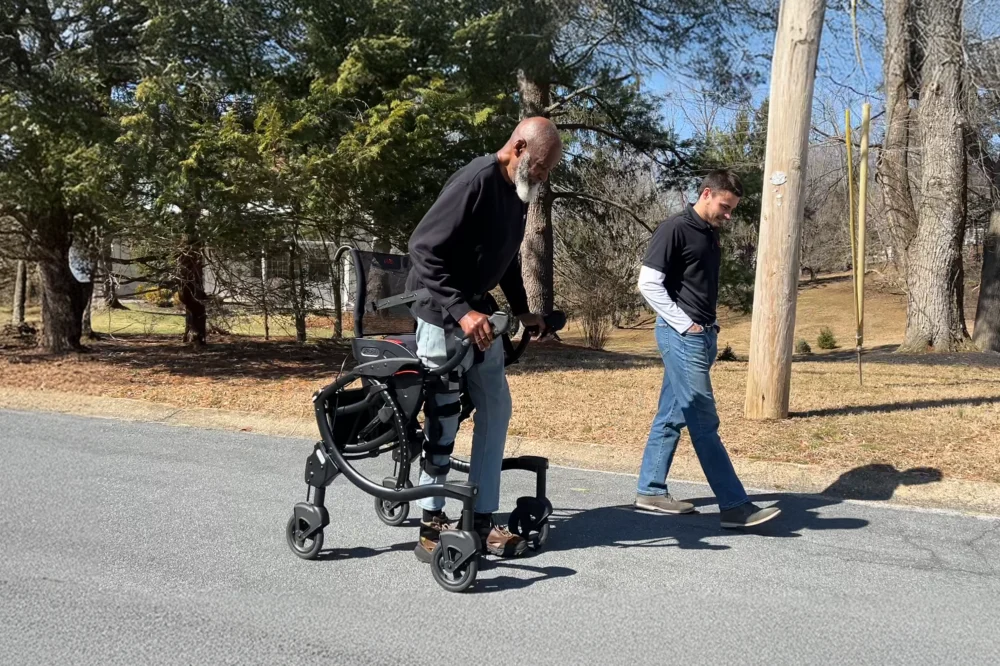
In the United States, more than 5.5 million individuals rely on mobility devices to navigate their daily lives, according to data from the Centers for Disease Control and Prevention (CDC) and various disability advocacy groups. For many of these individuals, the transition between different stages of mobility—moving from a standard walker to a manual wheelchair, or from a wheelchair to a power scooter—represents a significant physical, emotional, and financial challenge. The Zeen, a revolutionary mobility device developed by Exokinetics, aims to eliminate the need for multiple pieces of equipment by offering a hybrid solution that functions as a chair, a walker, and a standing frame. By utilizing sophisticated motorless technology, the Zeen addresses a critical "gap" in the assistive technology market, providing users with the ability to sit, stand, and walk within a single, integrated framework.
The Engineering Heritage of the Zeen
The origins of the Zeen are rooted in the world of high-end cinematography rather than traditional medical manufacturing. The device was conceived by Garrett Brown, the Academy Award-winning inventor of the Steadicam. Introduced in the 1970s, the Steadicam revolutionized filmmaking by allowing camera operators to move smoothly through scenes while the camera remained stabilized on a sophisticated vest-and-arm system. Brown’s invention utilized a complex arrangement of springs and pivots to isolate the camera from the operator’s body movements, a principle that would later serve as the foundation for the Zeen.
The inspiration for the Zeen came from a personal place: Brown observed his aging father struggling with the limitations of existing mobility aids. His father required the stability of a chair but the independence of a walker, yet no single device allowed him to transition between these states safely and without significant exertion. Brown realized that the same air piston and counterbalance technology used to stabilize heavy cinema cameras could be adapted to support the human body.

Unlike most modern "active" mobility aids, the Zeen does not rely on electric motors or heavy battery packs. Instead, it utilizes high-performance air pistons—similar to those found in high-end office chairs but significantly more robust—to provide "lift assist." This technology allows the device to be customized to a user’s specific height and weight, providing five levels of lift strength. The result is a device that can lift and lower a person’s full body weight while keeping their center of gravity stable, allowing for a seamless transition from a seated position to a full standing gait.
Addressing a Growing Mobility Crisis
The demand for innovative mobility solutions is underscored by a 2023 report from the Disability Rights Education and Defense Fund (DREDF), which highlighted a pervasive dissatisfaction among mobility device users. According to the report, approximately 32 percent of surveyed individuals expressed frustration with the inability of their current equipment to meet both home-based and community-based needs. Common complaints included the excessive size of power wheelchairs, the high cost of maintenance for motorized units, and the mechanical unreliability of entry-level scooters.
Furthermore, the DREDF report noted that many users are forced to "gear up" with multiple devices—a walker for short distances within the home, a manual wheelchair for longer excursions, and perhaps a specialized lift for getting in and out of bed. This "equipment clutter" not only creates storage issues in residential environments but also imposes a heavy financial burden on families, as insurance providers often refuse to cover more than one primary mobility device every five years.
The Zeen’s multi-use design directly challenges this paradigm. By acting as a fall-prevention device, an assisted sit-to-stand trainer, a posterior-support walker, and a transport chair, it consolidates four or five separate functions into one frame. This versatility is particularly beneficial for individuals with progressive conditions, such as multiple sclerosis or Parkinson’s disease, where mobility needs can fluctuate significantly from day to day or even hour to hour.

Economic Implications and the Burden of Care
One of the most significant barriers to mobility for many Americans is the astronomical cost of associated infrastructure. For many power wheelchair users, a standard vehicle is insufficient, requiring the purchase of a wheelchair-accessible van (WAV). According to industry data from BraunAbility, a new accessible van can cost between $45,000 and $80,000, while even used models often command prices upwards of $30,000.
Exokinetics CEO Rick Sherak notes that the Zeen has the potential to alter this economic equation. In one documented case, a family was able to sell their accessible van and return to using a standard SUV after the primary user transitioned to the Zeen. Because the Zeen can be folded and does not require a heavy-duty ramp for loading, it reduces the need for specialized transportation infrastructure. For a population that already faces higher-than-average healthcare costs, the ability to bypass the "accessible vehicle tax" represents a significant improvement in quality of life.
The impact also extends to caregivers. Traditional mobility transitions—moving a patient from a chair to a walker—are a primary cause of musculoskeletal injuries among home health aides and family members. By providing a mechanical "lift" through its air pistons, the Zeen reduces the physical strain on the caregiver. It allows the user to initiate the standing process independently or with minimal guidance, fostering a sense of autonomy while protecting the physical health of the support network.
Psychological Impact: The "In-Between" Stage
Perhaps the most profound impact of the Zeen is psychological. In the clinical world, there is a recognized "gray area" of mobility: the stage where an individual is no longer safe using a traditional walker but is not yet ready to commit to a full-time wheelchair. For many, the move to a wheelchair is seen as a final surrender of independence, often leading to a sedentary lifestyle that accelerates physical decline.

"That in-between stage is where people often fall, lose confidence, or stop moving altogether," Sherak explained. The Zeen was designed to bridge this gap by allowing users to remain upright and active. Because the user is supported through the hips and buttocks, the fear of falling—a major psychological barrier to exercise for the elderly—is significantly mitigated. This allows users to "coast" when they are tired and "walk" when they have the energy, maintaining muscle tone and cardiovascular health longer than they might in a traditional seated chair.
Institutional Adoption and the Veterans Affairs Contract
The utility of the Zeen has caught the attention of major institutional players, most notably the U.S. Department of Veterans Affairs (VA). In July 2025, Exokinetics was awarded a contract with the VA Federal Supply Schedule, a move that significantly expands access to the device for the millions of veterans living with service-related mobility challenges.
Veterans often present with complex mobility needs resulting from traumatic brain injuries, spinal cord damage, or the long-term effects of heavy physical service. The VA’s adoption of the Zeen suggests a shift toward "gait-positive" technology—solutions that prioritize keeping the patient upright and mobile whenever possible. Under this contract, veterans can be evaluated for a Zeen through their physical therapy teams within the VA medical system, removing the financial "out-of-pocket" barriers that often prevent individuals from accessing high-end assistive technology.
Environmental Sustainability and Medical Waste
Beyond the immediate benefits to users, the Zeen addresses a growing concern regarding the sustainability of medical equipment. In Massachusetts alone, the REquipment program—which refurbishes and redistributes used medical gear—reported that it diverted 45 tons of equipment from landfills in 2023. Much of this waste consists of specialized chairs and walkers that users outgrew or found unsuitable for their changing needs.

The Zeen’s modular design offers a more sustainable alternative. Because it is adjustable and uses replaceable mechanical components rather than complex electronics, the device has a longer functional lifespan. For pediatric users, the Zeen can be adjusted as the child grows, requiring only small mechanical tweaks or spring replacements rather than the purchase of an entirely new unit. This "grow-with-the-user" philosophy reduces the environmental footprint of mobility assistance and ensures that fewer high-value materials end up in the waste stream.
Future Outlook for Assistive Technology
The success of the Zeen reflects a broader trend in the "AgeTech" and "MedTech" sectors toward mechanical simplicity and user-centric design. While the industry has seen a surge in robotic exoskeletons and AI-powered wheelchairs, these high-tech solutions often remain prohibitively expensive and difficult to maintain for the average consumer. The Zeen’s reliance on "analog" physics—leveraging air pressure and gravity—provides a blueprint for how innovation can be both sophisticated and accessible.
As the global population ages, the demand for devices that support "aging in place" will only increase. Solutions like the Zeen, which allow individuals to maintain their independence within their existing homes without massive renovations, are likely to become the gold standard in rehabilitative care. By focusing on the "human" element of mobility—the desire to stand eye-to-eye with others and move under one’s own power—Exokinetics is not just selling a device; it is offering a new perspective on what it means to live with limited mobility.
The integration of the Zeen into the VA system and its growing popularity among civilian users suggest a future where the line between "walker" and "wheelchair" continues to blur. As technology continues to evolve, the primary metric of success will remain the same: the ability of an individual to move through the world with dignity, safety, and a sense of unencumbered freedom.
About the Author