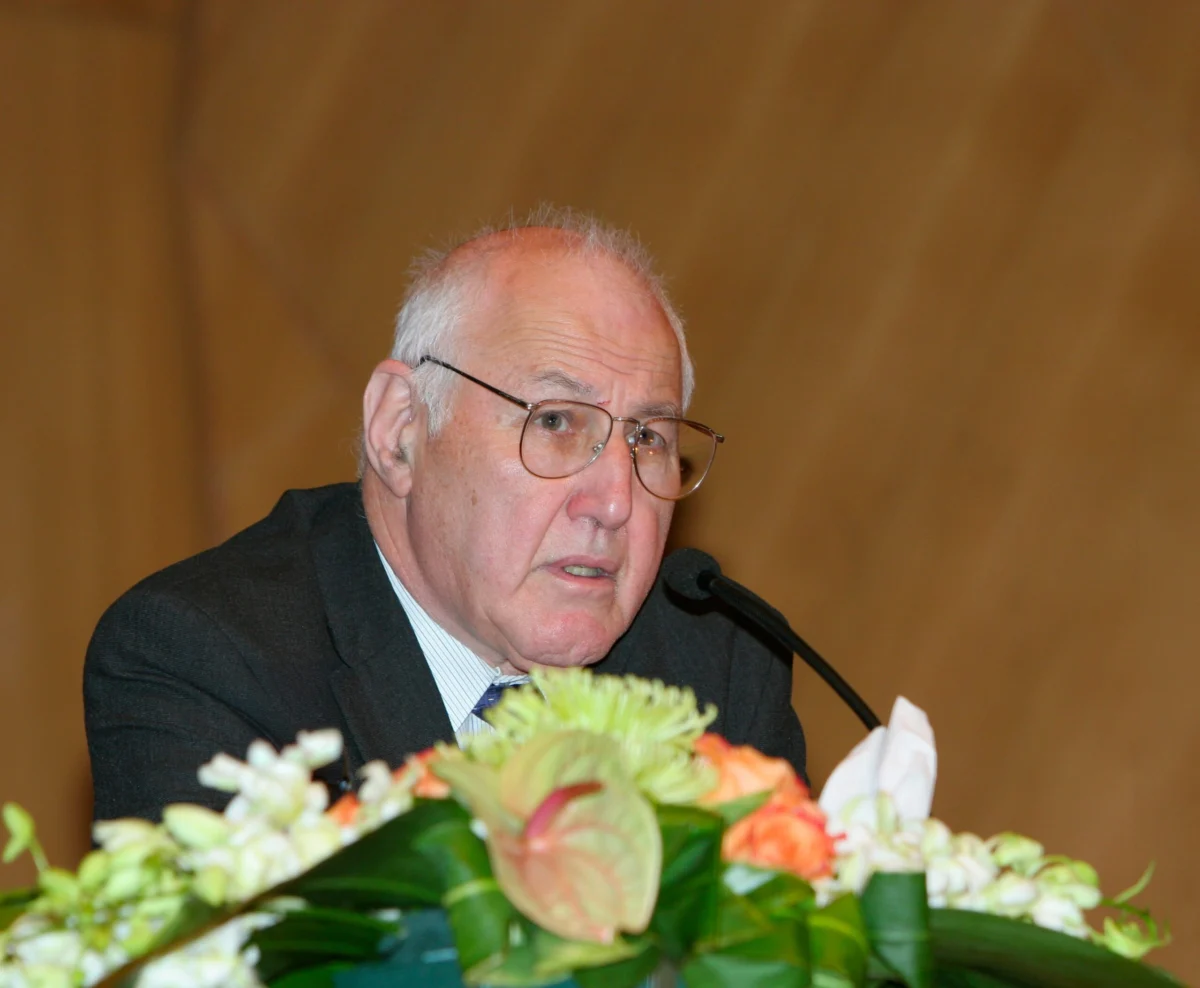
The global legal and financial communities are mourning the passing of Sir Roy Goode, an Emeritus Professor of Law at the University of Oxford and a Fellow of the British Academy, whose work fundamentally reshaped the landscape of international commercial law. Recognized as one of the most influential legal minds of the 20th and 21st centuries, Sir Roy’s contributions provided the intellectual scaffolding for modern trade finance, international arbitration, and the harmonization of commercial standards across borders. His death marks the end of an era for the International Chamber of Commerce (ICC), where he served as a cornerstone of the organization’s efforts to standardize global banking and trade practices.
As a distinguished figure in the field of international commercial law, Sir Roy was widely recognized for his exceptional contribution to the development of legal frameworks that facilitate the seamless movement of capital and goods worldwide. For the ICC, Sir Roy played a pivotal role as the Chair of the ICC Global Commercial Law and Practice Commission and was a founding member of the ICC Task Force on Guarantees. His intellectual leadership was instrumental in advancing the ICC’s work in trade finance, particularly in the development of globally recognized banking rules that remain the industry standard for financial institutions and legal practitioners in nearly every jurisdiction.
A Career Defined by Harmonization and Intellectual Rigor
Sir Roy Goode’s career was characterized by a rare ability to bridge the gap between abstract legal theory and the practical requirements of global commerce. Born in 1933, his journey into the upper echelons of legal academia was somewhat unconventional; he practiced as a solicitor for 17 years before transitioning into the academic sphere. This practical foundation informed his later work, allowing him to approach complex legal problems with a focus on "commercial common sense," a quality frequently cited by his colleagues.
In 1971, he was appointed to the Crowther Committee on Consumer Credit, which led to the landmark Consumer Credit Act of 1974 in the United Kingdom. This early success set the stage for a prolific academic career. He founded the Centre for Commercial Law Studies (CCLS) at Queen Mary University of London in 1980, an institution that has since become a global leader in commercial law education. Later, he moved to the University of Oxford, where he served as the Norton Rose Professor of English Law and became a Fellow of St. John’s College.
Throughout his tenure at Oxford and his involvement with the ICC, Sir Roy’s work helped shape the understanding and application of demand guarantees worldwide. He famously described these instruments as "abstract payment undertakings," a term that highlights their independence from the underlying contract and their central role in providing security in international trade. His scholarship in this area culminated in his role as the pre-eminent author and co-author of several leading ICC publications, most notably the "Guide to the Uniform Rules for Demand Guarantees" (URDG 758).
Chronology of a Legal Titan: Key Milestones
To understand the breadth of Sir Roy Goode’s impact, one must look at the timeline of his major contributions to international law:
- 1971–1974: Played a critical role in the reform of UK credit laws, leading to the Consumer Credit Act.
- 1980: Founded the Centre for Commercial Law Studies (CCLS) at Queen Mary University of London, pioneering the specialized study of commercial law.
- 1982: Published the first edition of "Goode on Commercial Law," which is universally regarded as the definitive text on the subject.
- 1990: Appointed Norton Rose Professor of English Law at the University of Oxford.
- 2001: Acted as a primary architect of the Cape Town Convention on International Interests in Mobile Equipment, a treaty that revolutionized the financing of aircraft, railway rolling stock, and space assets.
- 2010: Oversaw the revision of the Uniform Rules for Demand Guarantees (URDG 758), which streamlined international guarantee practices.
- 2020s: Continued to provide guidance to the ICC Banking Commission and UNIDROIT on the digital transformation of trade law.
Supporting Data: The Economic Impact of Harmonized Law
The significance of Sir Roy’s work is not merely academic; it has profound economic implications. Trade finance is the lifeblood of the global economy, with the World Trade Organization (WTO) estimating that 80% to 90% of global trade relies on trade finance, including letters of credit and guarantees.
The URDG 758, which Sir Roy helped refine, is currently utilized in over 160 countries. By providing a standardized set of rules, the URDG reduces legal costs and minimizes the risk of litigation in multi-billion dollar infrastructure and trade projects. Before such harmonization, disputes arising from conflicting national laws regarding bank guarantees often led to years of litigation and significant financial loss.
Furthermore, the Cape Town Convention, for which Sir Roy was a leading expert and official commentator, has had a measurable impact on the aviation industry. According to data from the Aviation Working Group, the convention has helped reduce the cost of credit for aircraft acquisitions by providing a stable international legal framework for the repossession of assets in the event of default. This has enabled airlines in developing nations to modernize their fleets at lower costs, contributing to global connectivity.
Tributes from the Global Legal Community
The passing of Sir Roy Goode has elicited a wave of tributes from the organizations and individuals he influenced. Within the ICC, the loss is felt deeply, as his guidance shaped the organization’s policy direction for decades.
Tomasch Kubiak, ICC Policy Manager, remarked on the personal and professional legacy Sir Roy leaves behind. "Sir Roy will be remembered not only for his unparalleled expertise, but also for his generosity, intellectual rigour and steadfast commitment to excellence," Kubiak stated. "His legacy will continue to shape ICC’s work and the global trade finance community for years to come."
Georges Affaki, Chair of the ICC Banking Commission Legal Committee, echoed these sentiments, highlighting Sir Roy’s unique ability to unify different legal traditions. "Sir Roy was one of the towering legal minds of our age. For more than 35 years, we worked together on ICC, UNIDROIT and UNCITRAL projects. I never ceased to admire his gift for making all legal traditions speak the same language of commercial common sense."
Other practitioners have noted that Sir Roy was a "lawyer’s lawyer," a man who could navigate the intricacies of the English common law while simultaneously drafting civil law-friendly international treaties. His mentorship has produced a generation of lawyers who now occupy high-ranking positions in the judiciary, international organizations, and top-tier law firms.
Brief Analysis: The Future of Trade Finance Without Sir Roy
The death of Sir Roy Goode comes at a time when the field of international commercial law is undergoing its most significant transformation since the mid-20th century. The shift toward digital trade, the use of blockchain in supply chains, and the development of Electronic Trade Documents (ETDs) are the new frontiers of the industry.
Sir Roy was a proponent of adapting legal frameworks to meet these technological changes. His work on the "functional equivalence" of paper and electronic documents laid the groundwork for current legislative efforts, such as the UK’s Electronic Trade Documents Act 2023. The challenge for the ICC and other bodies like UNCITRAL (United Nations Commission on International Trade Law) will be to maintain the "Goode standard" of intellectual rigour as they move into uncharted digital territory.
His absence will be felt in the ongoing efforts to harmonize laws regarding digital assets. Sir Roy’s methodology—focusing on the underlying commercial reality rather than formalistic labels—will remain the gold standard for future law-making. The "abstract payment undertaking" concept he championed is currently being adapted to accommodate smart contracts and automated payment triggers in decentralized finance (DeFi).
Broader Impact and Implications for Global Commerce
Sir Roy’s influence extended far beyond the walls of Oxford or the meeting rooms of the ICC. He was a frequent consultant for UNIDROIT (the International Institute for the Unification of Private Law), where he helped draft instruments that govern everything from international leasing to the factoring of receivables.
His contribution to the development of international legal instruments helped create a "lex mercatoria" (merchant law) for the modern age. This body of law allows businesses to operate with a degree of certainty that would be impossible if they had to rely solely on disparate national legal systems. For developing economies, Sir Roy’s work provided a template for modernizing their commercial codes, thereby attracting foreign investment and integrating into the global marketplace.
The ICC has confirmed that it will continue to uphold the principles Sir Roy established. His authoritative texts, including "Goode and McKendrick on Commercial Law" and "Goode on Principles of Corporate Insolvency Law," will remain essential reading for anyone entering the field. These works are not merely textbooks; they are practitioners’ manuals that solve real-world problems in insolvency, secured transactions, and credit law.
As the international legal community reflects on his life, the consensus is clear: Sir Roy Goode did more than just write about the law; he built the systems that allow the modern world to trade with confidence. The ICC extends its deepest condolences to Mr. Goode’s family, friends, and colleagues, acknowledging that while the man has passed, his "abstract payment undertakings" and the commercial common sense he championed will endure for generations.
About the Author