
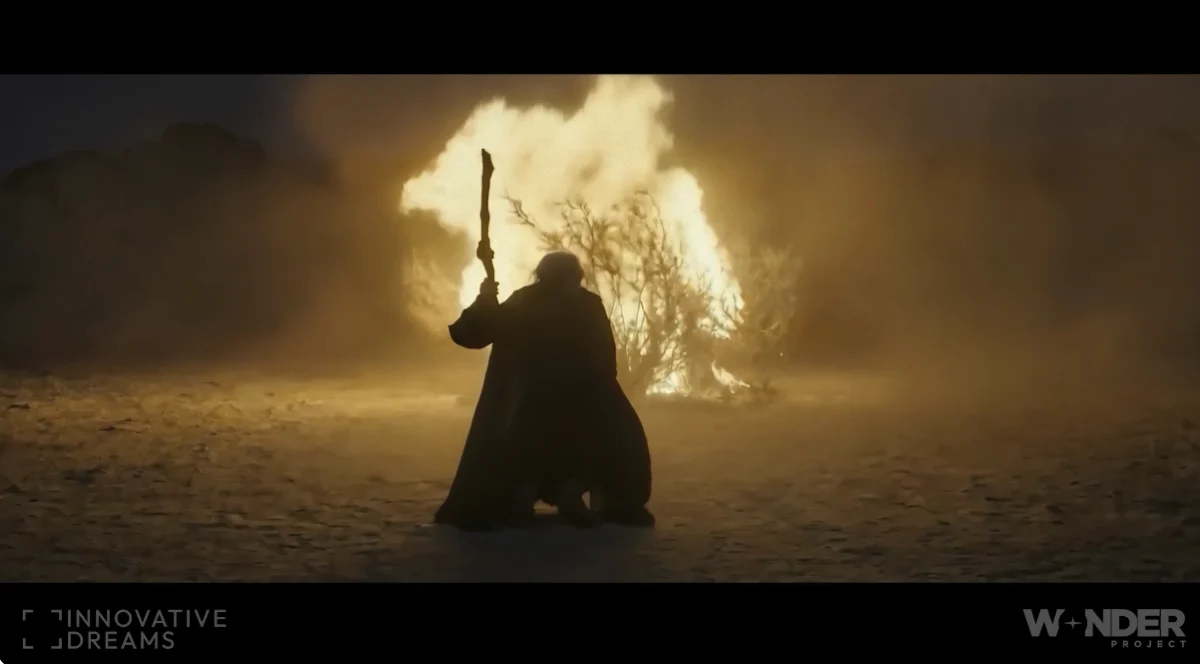
AI video generation startup Luma has unveiled its new production company, Innovative Dreams, a strategic venture forged in collaboration with Wonder Project, a streaming service renowned for its production of religious and faith-based films and television series, available on Amazon Prime. This pioneering initiative marks a significant step in integrating advanced AI capabilities into the film production pipeline, aiming to redefine creative possibilities and operational efficiencies within the industry. The partnership’s inaugural project, "The Old Stories: Moses," a compelling dramatization of the biblical narrative, is slated for release this spring on Prime Video and boasts the participation of acclaimed British actor Ben Kingsley in a leading role.
Genesis of Innovative Dreams: A Fusion of AI and Filmmaking Expertise
Innovative Dreams is positioned as a cutting-edge production services company designed to empower established filmmakers and studios with the transformative potential of artificial intelligence. The company’s operational model envisions a synergistic environment where seasoned creative professionals, including those from director Jon Erwin’s esteemed team, collaborate seamlessly with Luma’s innovative creative technologists. This interdisciplinary approach aims to bring ambitious and complex cinematic visions to fruition.
According to a social media post by Luma on Thursday, the core philosophy behind Innovative Dreams revolves around real-time collaboration facilitated by Luma Agents. These sophisticated AI tools, recently introduced by Luma, are engineered to manage comprehensive creative workflows across text, image, video, and audio. The envisioned workflow allows creative teams to dynamically adjust elements such as sets, props, and lighting, and even incorporate footage of human actors, all within a live production setting. This represents a departure from traditional post-production processes, where such modifications often occur much later in the filmmaking lifecycle. Luma emphasizes that this AI leverage offers not merely speed and cost reductions but a tangible enhancement in the quality and feasibility of creative outcomes, stating, "This is the leverage of AI – not just faster or cheaper, but better than what came before."
A Shifting Landscape: AI Startups Embrace Production
The establishment of Innovative Dreams by Luma is part of a broader trend within the AI startup ecosystem, where companies are increasingly transitioning from solely providing tools to actively engaging in content production. This strategic pivot underscores the growing confidence in AI’s capacity to not only assist but also to lead creative endeavors.
Last week, AI startup Higgsfield announced the launch of its own original series, commencing with a 10-minute science fiction episode. This move further illustrates the industry’s evolving dynamics, with AI companies demonstrating their ability to produce narrative content. Similarly, Wonder Studios, a London-based creative studio backed by OpenAI, is reportedly working on a documentary in conjunction with Campfire Studios, signaling a growing appetite for AI-driven content creation across various genres.
The Economic Imperative: Reimagining Hollywood’s Blockbuster Model
The timing of Luma’s announcement coincides with a provocative statement made by Cristóbal Valenzuela, co-founder and co-CEO of competitor Runway. Speaking at a recent industry event, Valenzuela suggested that film studios should reallocate the substantial budgets of single blockbuster films, often exceeding $100 million, towards producing a larger volume of content – potentially 50 films – utilizing AI. His rationale is that this approach could significantly increase the probability of discovering a breakout hit, thereby mitigating the high-risk, high-reward nature of traditional tentpole filmmaking.
Luma founder and CEO Amit Jain has echoed this sentiment, articulating a vision where generative AI addresses the escalating production costs that have historically constrained filmmaking. Jain posits that AI can accelerate production timelines, reduce expenditures, and enhance overall efficiency without compromising artistic quality. This perspective forms the bedrock of Luma’s strategic partnership with Wonder Project, highlighting a shared belief in AI’s transformative economic and creative potential for the film industry.
Wonder Project: Faith-Based Storytelling Meets AI Innovation
Wonder Project, established in 2023, is spearheaded by director Jon Erwin and former Netflix executive Kelly Hoogstraten. Their stated mission is to cater to a global audience with an interest in faith-based and values-driven narratives. The company’s inaugural project, "House of David," a series exploring the life of King David, premiered on Amazon Prime in 2025, underscoring their commitment to producing high-quality religious content.
The specific focus of Innovative Dreams remains an area of keen interest. While the initial partnership is with Wonder Project, it is currently unclear whether the production company will exclusively concentrate on faith-based content or broaden its scope to encompass a wider array of genres. TechCrunch has reached out to Luma and Wonder Project for clarification on the long-term strategic direction of Innovative Dreams.
A promotional video released by Luma detailing the partnership features Jon Erwin explaining the revolutionary "real-time hybrid filmmaking" process that Innovative Dreams will employ. This innovative method integrates elements of performance capture, reminiscent of the technology used in films like "Avatar," with virtual production techniques, akin to those seen in "The Mandalorian." The key differentiator, Erwin highlights, is the execution of these complex processes live and at a reduced cost, facilitated by Luma’s advanced AI tools.
Deconstructing Hybrid Filmmaking: Performance Capture and Virtual Production
Performance capture is a sophisticated technique that allows for the digital translation of an actor’s movements and facial expressions into animated characters. Actors perform in controlled environments, often utilizing motion-capture suits and facial markers, which record their nuanced performances. These recordings are then meticulously mapped onto digital avatars, breathing life into virtual characters with remarkable fidelity.
Virtual production, on the other hand, places actors directly on set, frequently in front of expansive LED screens. These screens display dynamic, real-time rendered environments, often generated through game engines. This immersive approach allows actors to interact with their digital surroundings instantaneously, blending the physical and virtual worlds during the actual filming process, thereby enhancing realism and directorial control.
Luma’s AI tools, according to Erwin, enable a significant advancement in these methodologies. They allow for the seamless integration of human actors into photorealistic digital scenes, regardless of the actor’s physical location during filming. Furthermore, Luma’s technology can even generate entirely new digital faces, creating the illusion of a different character while accurately replicating the original actor’s movements and emotional nuances. This capability opens up unprecedented avenues for visual storytelling and character creation.
Industry Convergence and Future Implications
The foray of AI companies into content production, as exemplified by Luma and Higgsfield, suggests a paradigm shift in how visual media will be conceived and created. The convergence of AI development with direct creative output signifies a maturation of the technology, moving beyond theoretical applications to tangible, narrative-driven projects.
The discourse surrounding AI’s role in filmmaking, amplified by figures like Valenzuela and Jain, points towards a future where the economics of film production are fundamentally reshaped. The potential for AI to democratize filmmaking, enabling smaller studios and independent creators to produce content previously only accessible to major studios, is a significant implication. This could lead to a more diverse and vibrant cinematic landscape, with a wider range of stories reaching audiences.
However, this evolution also raises important questions about the future of traditional filmmaking roles, the definition of authorship in AI-assisted creations, and the ethical considerations surrounding the use of AI in generating realistic imagery and performances. As Luma’s Innovative Dreams embarks on its ambitious journey, its success will likely be a bellwether for the broader impact of artificial intelligence on the future of storytelling and the global film industry. The collaboration with Wonder Project, a company dedicated to a specific audience niche, provides a controlled yet impactful proving ground for Luma’s advanced AI production capabilities, with the potential for wider applications to follow. The industry will be watching closely as "The Old Stories: Moses" unfolds, offering the first glimpse into this new era of AI-powered cinematic creation.
About the Author





