
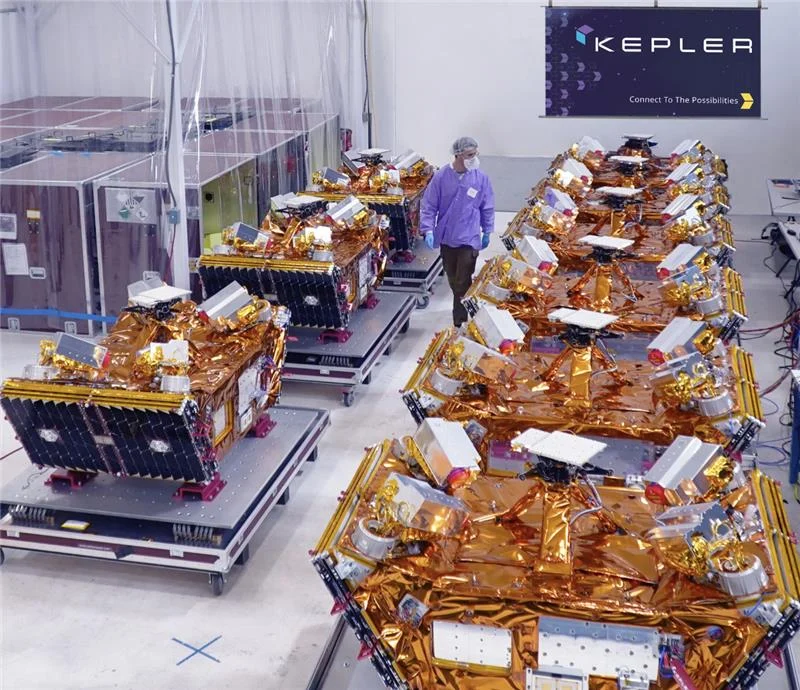
The dream of massive data centers in orbit, capable of rivaling their terrestrial counterparts, remains largely in the realm of future aspirations, likely not materializing at scale until the 2030s. However, a significant shift is occurring in the interim: the burgeoning business of orbital compute, focusing on processing data closer to its source in space. This near-term evolution is being spearheaded by companies like Kepler Communications, which has launched the largest compute cluster currently in orbit, and Sophia Space, a startup poised to test novel space computer software on Kepler’s network.
Kepler Communications, a Canadian firm, has made significant strides in establishing this nascent orbital compute infrastructure. In January, the company launched its latest payload, comprising 10 operational satellites equipped with approximately 40 Nvidia Orin edge processors. These processors, designed for efficient, low-power computation, are interconnected via advanced laser communication links, forming a distributed compute network in space. This deployment represents a pivotal step in moving computational power from ground-based facilities to the orbital environment.
The strategic advantage of such a system lies in its ability to perform "edge processing" – analyzing data where and when it is collected. This approach is crucial for applications requiring rapid responsiveness and immediate insights, a stark contrast to the latency inherent in transmitting all data back to Earth for processing. For sectors like defense, where real-time threat detection and missile defense systems are paramount, this capability is not just beneficial but essential. Kepler has already demonstrated a space-to-air laser link in a demonstration for the U.S. government, highlighting the potential for secure and rapid data transfer and processing for defense applications.
Kepler CEO Mina Mitry articulates a clear vision for the company, positioning it not as a traditional data center provider, but as a foundational infrastructure layer for a variety of space-based applications. "We want to be a layer that provides network services for other satellites in space, or drones and aircraft in the sky below," Mitry stated. This broad approach underscores the ambition to create a versatile orbital ecosystem. The company currently serves 18 customers, a testament to the growing demand for such services.
One of Kepler’s newest partners, Sophia Space, is developing a unique approach to orbital computing with its passively cooled space computers. This innovation directly addresses one of the most significant technical hurdles for large-scale orbital data centers: managing the heat generated by powerful processors. Traditional terrestrial data centers rely on extensive active cooling systems, which are heavy, power-intensive, and prohibitively expensive to deploy and maintain in the vacuum of space. Sophia’s passively cooled solutions aim to overcome this challenge, paving the way for more sustainable and cost-effective high-performance computing in orbit.
The partnership between Kepler and Sophia is designed to be a crucial de-risking exercise for Sophia ahead of its first planned satellite launch in late 2027. The collaboration will involve uploading Sophia’s proprietary operating system to one of Kepler’s satellites and attempting to configure and launch it across six GPUs on two separate spacecraft. This is a foundational task in terrestrial data center operations but represents a novel and complex undertaking in the orbital environment. The success of this test will validate Sophia’s software and its ability to function reliably within a distributed space-based compute network.
For Kepler, this partnership serves to further validate the utility and robustness of its orbital network. While the company currently handles data uploaded from the ground or collected by hosted payloads on its own satellites, the evolution of the sector points towards a future where Kepler acts as a central hub, interconnecting and providing processing services for a multitude of third-party satellites. Mitry notes that satellite companies are increasingly designing future assets with this model in mind, recognizing the advantages of offloading computationally intensive tasks, such as processing data from synthetic aperture radar (SAR) sensors.
This focus on distributed, edge processing differentiates Kepler and Sophia from larger players and ambitious startups like SpaceX, Blue Origin, Starcloud, and Aetherflux. These entities are primarily focused on developing massive, centralized orbital data centers utilizing powerful, data center-style processors. Mitry argues for a different philosophy, emphasizing distributed GPUs optimized for inference tasks rather than a single, hyper-powerful GPU dedicated to training. "Because we have the belief it’s more inference than training, we want more distributed GPUs that do inference, rather than one superpower GPU that has the training workload capacity," Mitry explained. "If this thing consumes kilowatts of power and you’re only running at 10% of the time, then that’s not super helpful. In our case, our GPUs are running 100% of the time." This perspective suggests a focus on continuous, efficient computation for specific, often real-time, tasks.
The implications of this shift towards orbital edge compute are far-reaching. Beyond defense applications, such as the U.S. military’s development of a new missile defense system reliant on satellite-based threat detection, the potential extends to scientific research, Earth observation, and even commercial ventures. High-resolution imaging satellites, for instance, can benefit from on-board processing to extract key information, reducing the volume of raw data that needs to be transmitted. This not only conserves bandwidth but also accelerates the dissemination of actionable intelligence.
The broader context for the development of orbital compute infrastructure is also shaped by terrestrial challenges. Recent discussions and actions, such as Wisconsin’s ban on new data center construction and similar legislative proposals in Congress, highlight growing concerns about the environmental impact and resource demands of large-scale data centers on Earth. Sophia CEO Rob DeMillo points to these trends as a potential catalyst for the adoption of space-based alternatives. "There’s no more data centers in this country," DeMillo mused. "It’s gonna get weird from here." This sentiment suggests that limitations on Earth could accelerate innovation and investment in orbital solutions, making the concept of data centers in space not just a technological advancement, but a pragmatic necessity.
Timeline of Key Developments:
- January [Year of Article – assumed to be 2026 or later based on future predictions]: Kepler Communications launches its largest orbital compute cluster, featuring approximately 40 Nvidia Orin edge processors across 10 satellites connected by laser communications.
- [Date of Sophia Space announcement – Monday preceding article publication]: Kepler Communications announces Sophia Space as its newest customer, with Sophia set to test its novel orbital computer software on Kepler’s constellation.
- Late 2027 (Planned): Sophia Space plans its first satellite launch, with the Kepler partnership serving as a crucial pre-launch validation.
- 2030s (Projected): Large-scale orbital data centers, similar to those envisioned by major space players, are expected to begin appearing.
- Ongoing: Kepler Communications continues to expand its customer base and demonstrate the utility of its orbital network for various applications, including defense.
Supporting Data and Context:
- Nvidia Orin Edge Processors: These processors are known for their power efficiency and performance in AI and edge computing applications, making them suitable for the constrained environment of space. While specific performance metrics for the orbital cluster are not detailed, their selection indicates a focus on distributed, efficient processing.
- Laser Communications: The use of laser communication links between Kepler’s satellites is crucial for high-bandwidth, low-latency data transfer within the orbital cluster, enabling effective distributed computing.
- Passively Cooled Systems: Sophia Space’s development of passively cooled computers addresses a critical bottleneck. Terrestrial data centers can consume significant amounts of power for cooling systems, often exceeding the power required for computation itself. Eliminating or minimizing active cooling in space is essential for reducing mass, power consumption, and operational complexity.
- Market Trends: The increasing demand for real-time data analysis across various sectors, from defense to scientific research, is driving the development of orbital compute capabilities. The global space industry is experiencing significant growth, with substantial investments in satellite technology and related services.
Analysis of Implications:
The strategic partnership between Kepler Communications and Sophia Space signifies a tangible step toward realizing the potential of orbital computing. By focusing on edge processing and novel cooling solutions, these companies are carving out a critical niche in the evolving space economy. Their approach prioritizes distributed, efficient computation, which may prove more immediately viable and cost-effective than the large-scale, centralized data center models currently being pursued by some industry giants.
The implications of successful orbital edge compute extend to enhanced national security, accelerated scientific discovery, and the development of new commercial services. As the cost of launching payloads into orbit continues to decrease and the demand for real-time data processing grows, companies that can provide robust and efficient computational infrastructure in space will be well-positioned for significant growth. The growing terrestrial challenges associated with data center development further bolster the attractiveness of space-based alternatives, potentially creating a unique market dynamic where orbital solutions become increasingly competitive. The "weirdness" DeMillo alludes to may well be the dawn of a new era of distributed, space-based computing.
About the Author





