The burgeoning field of AI-powered search engines and generative AI models presents both unprecedented opportunities and complex challenges for businesses aiming to maintain and enhance their online visibility. In this evolving landscape, tools designed to measure and optimize AI answer engine representation (AEO) are becoming indispensable. This in-depth comparison evaluates two prominent platforms, Scrunch and Peec AI, examining their methodologies, feature sets, pricing, and overall suitability for businesses at different stages of maturity in their AEO strategies. The analysis aims to distinguish verified facts from vendor claims, providing a clear picture for decision-makers.
The core of this evaluation lies in understanding how Scrunch and Peec AI approach the critical task of measuring a brand’s presence, sentiment, and citation across a growing array of AI models and answer engines. Key areas of comparison include measurement capabilities, reporting depth, engine coverage, optimization strategies, pricing structures, governance features, and the alignment with varying levels of team maturity.
Scrunch vs. Peec AI At a Glance
The fundamental differences between Scrunch and Peec AI become most apparent when considering three key aspects: the scope of their offerings, the accessibility of their platforms, and their respective governance frameworks.
Quick-Scan Checklist
Choose Scrunch if your team needs:
- Page-level site auditing for AI crawler accessibility and content quality.
- Agentic content delivery capabilities to actively shape AI bot ingestion.
- SOC 2 Type II certification for enterprise-grade security compliance.
- Persona-based prompt segmentation for nuanced AI response analysis.
- Integration within the Sitecore DXP ecosystem.
Choose Peec AI if your team needs:
- A more accessible entry point for early-stage AEO value demonstration.
- In-depth citation analytics with detailed source categorization and gap analysis.
- Extensive engine coverage on standard plans, including Gemini and Claude.
- A strong offering for agencies managing multiple client accounts.
- A budget-friendly solution starting below $250 per month.
Neither tool is a strong fit if your team needs:
- Direct, causal revenue attribution from AEO metrics.
- Built-in content generation capabilities (both tools provide recommendations, not creation).
- A complete replacement for traditional SEO tooling; AEO complements, not substitutes.
- Real-time, agentic delivery to AI crawlers without prior content optimization efforts.
Feature and Positioning Comparison
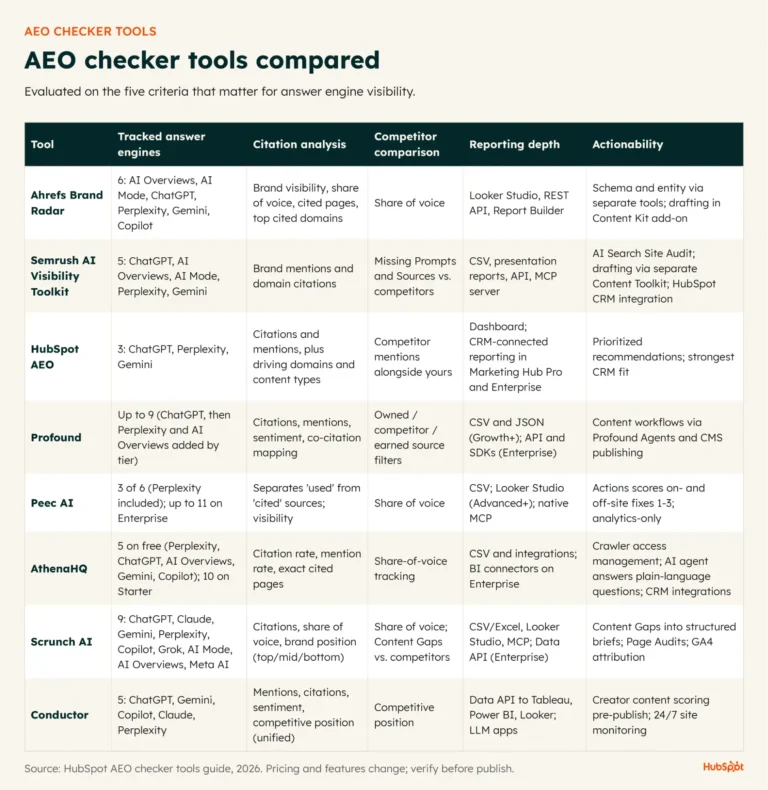
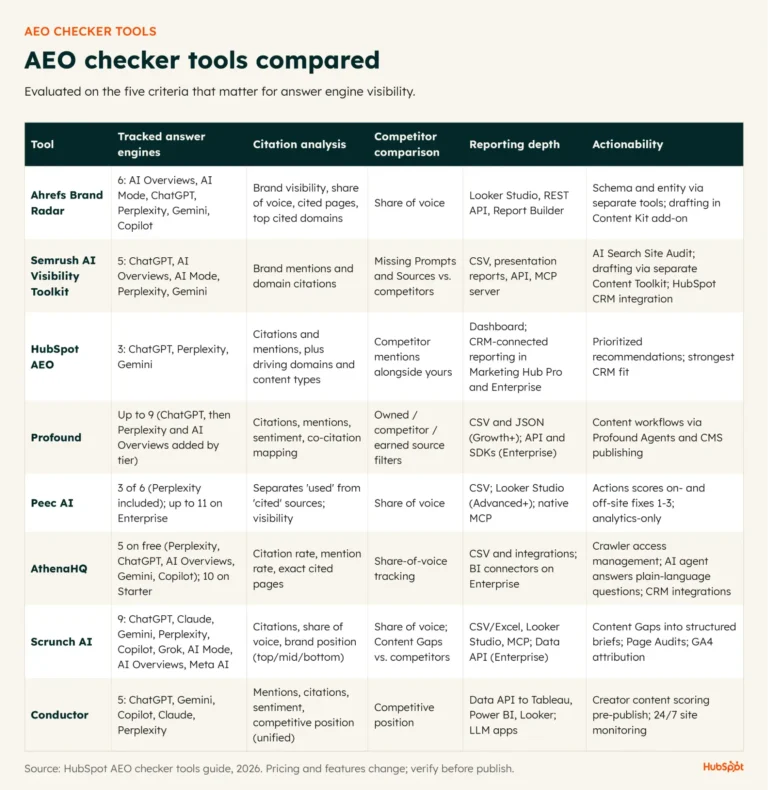
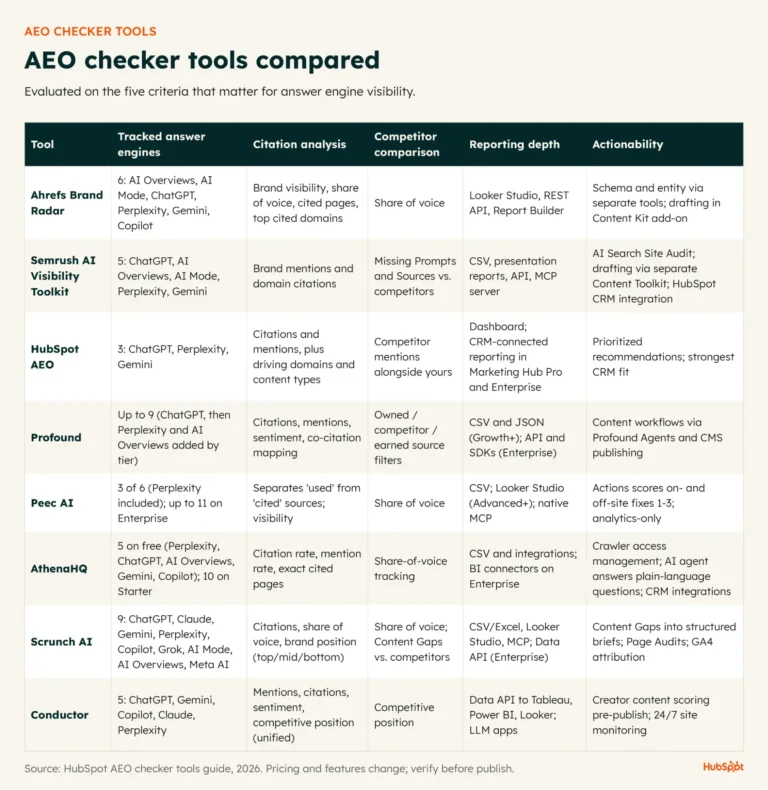
On Engine Coverage: A significant differentiator emerges in the breadth of AI engines covered. Peec AI offers broader coverage on its standard plans, including engines like Gemini and Claude, which are crucial for many businesses. Scrunch, conversely, reserves its most comprehensive nine-engine list for its premium Enterprise plan, necessitating a higher investment for teams requiring extensive engine monitoring. It is imperative for prospective users to verify the specific engines included at each pricing tier before committing to a contract.
Scrunch vs. Peec AI By Team Maturity
The optimal choice between Scrunch and Peec AI is heavily influenced by a team’s level of maturity in its AI-driven initiatives, its internal capacity for execution, and its tolerance for risk.
Stage 1: Early — Establishing a Baseline
For teams in their nascent stages of AEO adoption, characterized by infrequent manual prompt checks, limited dedicated ownership (one to two individuals), and leadership seeking directional data before allocating substantial budget, the primary needs are rapid self-serve setup, transparent pricing, flexible seat licensing, and outputs that quickly highlight source gaps and visibility trends.
Peec AI emerges as the stronger contender for this early-stage phase. Its Starter plan provides access to 50 prompts across three chosen AI models, unlimited users, daily tracking, and one project. The self-serve signup process eliminates the need for sales calls, and the platform’s "Actions" feature immediately surfaces opportunities within earned and owned media. In contrast, Scrunch’s entry price point of $250-$300 per month can be a significant hurdle for teams still proving the ROI of AEO. Furthermore, Scrunch’s advanced audit and optimization capabilities often require dedicated execution resources that early-stage teams may not possess.
The signal to advance from this stage is typically the accumulation of 30 days of trend data, clear identification of engine gaps, and the initiation of at least one content or SEO action based on citation data.
Stage 2: Scaling — Moving From Measurement to Action
As AEO initiatives mature, teams begin to see measurable referral traffic or pipeline influence stemming from their efforts. Dedicated ownership becomes more pronounced, with a focus on tracking prompts, documenting competitive gaps, and understanding why specific pages are not being cited by AI models. The essential requirements at this stage include source and citation analytics at domain and URL levels, prioritization of competitive gaps, multi-project support, and a robust reporting infrastructure to brief stakeholders effectively.
At the scaling stage, the Scrunch versus Peec AI decision sharpens, with both platforms offering distinct advantages. Peec AI’s Pro and Advanced tiers introduce multi-country tracking, integration with data visualization tools like Looker Studio, and a detailed Gap Analysis feature that identifies competitor-cited sources by domain, subdomain, and URL. The unlimited user model remains a significant benefit as brand, content, and PR stakeholders are brought into the AEO process.
However, Peec AI falls short in site auditing capabilities. Scrunch, on the other hand, provides a crucial site auditing layer that identifies structural issues impacting AI crawler visibility and offers ranked optimization recommendations. The trade-off here is Scrunch’s higher pricing structure and the requirement for greater internal execution capacity to leverage its advanced features. Neither tool at this stage offers native integration with CRM or marketing execution pipelines.
The benchmark for advancing to the next stage includes establishing a recurring AEO review cadence, integrating citation data into content and PR decisions, and seeing leadership inquire about the direct correlation between visibility and revenue.
Stage 3: Advanced — Governance, Agentic Delivery, and Organizational Scale
For advanced teams, AEO is a defined discipline involving multi-engine monitoring, dedicated ownership, stringent compliance protocols, access controls, and workflow integrations as core purchasing requirements. The critical needs are SOC 2 compliance, Single Sign-On (SSO), Role-Based Access Control (RBAC), API access, multi-brand/multi-country coverage, and a clear strategy for actively shaping AI agent ingestion from the site.
Scrunch is positioned more strongly for this enterprise level. Its offerings include SOC 2 Type II compliance, RBAC, SAML/OIDC SSO, a developer-grade API, and the Agentic Experience Platform (AXP), collectively forming a more comprehensive enterprise stack. Peec AI’s Enterprise tier, supporting up to 13 LLMs, SSO, role-based permissions, API access, and unlimited projects, becomes a formidable competitor at this level, particularly for advanced teams prioritizing deep multi-engine monitoring over site auditing or agentic delivery.
Scrunch vs. Peec AI: Approach and Methodology
A meaningful divergence between Scrunch and Peec AI lies in their data collection methodologies, though neither platform publishes exhaustive technical specifications. Both operate as closed-source, hosted solutions. The comparisons drawn here are based on publicly available information from their respective FAQ pages, documentation, terms of use, and AI instruction pages.
Data Collection
Scrunch employs a hybrid approach, utilizing browser automation alongside official platform APIs to simulate real user interactions across various platforms. The collected responses are cross-validated against a continuously updated dataset. AI models, such as OpenAI and Google Vertex AI, are employed to analyze responses for sentiment, topic classification, and named entities, with contractual assurances that user data will not be used for model training.
Peec AI primarily collects data by interacting directly with the web interfaces of each platform, mirroring the user experience rather than relying solely on backend APIs. ChatGPT is tracked natively via UI simulation across all plans, while the OpenAI Search API is treated as a distinct data source, often as an add-on. For geographic coverage, Peec AI states its use of dedicated infrastructure in over 80 countries, a methodological point that warrants direct inquiry for teams prioritizing multi-market accuracy.
It is crucial to acknowledge that AEO measurement is inherently probabilistic. Large Language Models (LLMs) are non-deterministic, meaning the same prompt can yield different citations across sessions. Therefore, tracking directional trends over 30-60 day windows is generally more reliable than acting on single data points.
Data Structuring and Core Metrics
Scrunch normalizes responses into four per-response metrics: presence, position, sentiment (positive/negative/neutral), and citations. These metrics aggregate into key performance indicators such as brand presence rate, competitive presence share, citation share by ownership category, and trends over time. Individual responses are preserved for auditability, allowing any aggregate score to be traced back to its underlying data. Scrunch also calculates an "Influence Score" per source, derived from unique prompts multiplied by citation percentage, to prioritize outreach targets.
Peec AI utilizes a consistent four-dimensional model across all engines: Visibility (percentage of responses where the brand appears), Share of Voice (brand mentions divided by all tracked brand mentions), Position (average ranking, where lower is better), and Sentiment (scored from 0-100). The Share of Voice formula is explicitly documented, highlighting that high visibility doesn’t always equate to high Share of Voice if competitors are more frequently mentioned. Position rankings encompass all detected brands, including untracked competitors, providing a true competitive ranking.
Sources and citations are formally distinguished. Sources are defined as all URLs accessed by an AI, while citations are those explicitly referenced in the answer text. Sources are further classified into five categories: Editorial, Corporate, User-Generated Content (UGC), Reference, and the brand’s own website, with each category mapping to specific actionable insights.
Monitoring Cadence
Scrunch refreshes new prompts daily for the initial 14 days, then defaults to a 72-hour refresh cycle, with on-demand refresh capabilities available. Peec AI maintains a daily tracking cadence on all standard plans (Starter through Advanced), with a weekly-optional cadence for Enterprise clients. For teams monitoring active campaigns or fast-moving market categories, Peec AI’s default daily refresh offers a more up-to-date perspective.
Diagnostics
A significant differentiator lies in diagnostic capabilities. Scrunch offers a page-level "Deep AI Audit" that assesses four scored dimensions: Access Controls, Content Delivery, Content Quality, and Content Alignment. Each dimension provides a checklist of passed and failed checks with specific remediation steps. These audits are point-in-time snapshots and require manual re-triggering after page updates. The Starter plan includes five audits per month, with the Growth plan offering ten.
Peec AI does not provide page-level auditing. Its "Crawlability" feature checks robots.txt against over 40 AI bots, and "Crawl Insights" integrates with server logs via eight CDN integrations to display actual bot traffic by type, URL, and intent. These features focus on access and traffic diagnostics rather than content quality audits.
Recommendations
Scrunch surfaces optimization opportunities through two primary gap types: competitive gaps (where competitors are cited but the brand is not) and content gaps (prompts yielding no matching page on the domain). Recommendations are filterable by persona, topic, funnel stage, and platform. The platform does not currently generate or publish content, though this is slated for its 2026 roadmap.
Peec AI’s "Actions" feature, included on all paid plans, clusters citation sources into content-type groups, assigns a Relative Opportunity Score (1-3, based on model citation frequency and competitive gap), and provides step-by-step guidance organized into "Earned," "Owned," and "Impact" tabs. Actions focus on identifying opportunities for earned media, optimizing owned content, and understanding broader impact, but do not involve content generation, a deliberate choice to preserve brand voice and human judgment. The practical distinction is that Scrunch’s recommendations lean towards on-site content and technical structure, while Peec AI’s focus is on earned coverage and external authority.
Agentic Delivery
Scrunch distinguishes itself with its Agentic Experience Platform (AXP), which detects AI retrieval bots, strips JavaScript and rendering overhead, restructures content into clean semantic HTML, and delivers this optimized version to the bot. This occurs at the CDN layer, leaving the human-facing site unaffected and without requiring canonical site changes. Peec AI currently lacks an equivalent agentic delivery mechanism; its crawl features are diagnostic in nature.
Scrunch vs. Peec AI: Monitoring Coverage and Citation Tracking
Engine Coverage
As of September 2026, Scrunch’s FAQ lists eight active platforms: ChatGPT, Claude, Gemini, Perplexity, Google AI Mode, Google AI Overviews, Microsoft Copilot, and Grok. However, the self-serve Starter tier is limited to four engines: ChatGPT, Perplexity, Google AI Overviews, and Copilot. Access to Claude, Gemini, Meta AI, and Google AI Mode requires an upgrade to the Enterprise plan.
Peec AI, in contrast, includes six engines on every standard plan: ChatGPT, AI Overviews, AI Mode, Perplexity, Gemini, and Copilot. Claude Sonnet/Haiku, OpenAI Search API, DeepSeek, Qwen, Grok, and Mistral are available as add-ons or on the Enterprise plan, supporting up to 13 LLMs. At the self-serve entry tier, Peec AI offers broader engine coverage by default, a significant advantage for teams needing to monitor a wider array of AI models without immediately escalating to enterprise-level pricing.
![Scrunch vs. Peec AI: Choosing the right AEO tool [2026]](https://53.fs1.hubspotusercontent-na1.net/hubfs/53/Copy%20of%20Featured%20Images_Blog%20Title%20Templates%20(8).png)
Prompt Model
Scrunch’s prompt allowance is shared across all active engines; tracking a single prompt across four engines consumes four prompt slots. The Starter plan includes 350 custom prompts, 1,000 industry prompts, three personas, and five page audits. Personas enable teams to compare AI responses for different buyer types against the same prompt.
Peec AI’s plans allow users to select three models from the six default engines, with the prompt budget applying exclusively to those chosen engines. The Starter plan provides 50 prompts, unlimited users, and one project. A "Prompt Volume" score (1-5) indicates the relative demand for each tracked topic, aiding in prompt allocation prioritization.
Visibility Metrics
Both platforms track presence, position, sentiment, and citation share. Peec AI provides explicit metric formulas, such as its Share of Voice calculation and how position rankings account for untracked competitors. Scrunch preserves individual response text for auditability, allowing any aggregate score to be traced. Neither tool publicly details its sentiment classification methodology, so these metrics should be treated as directional signals.
Citation Tracking
Scrunch categorizes citations as brand-owned, competitor, or third-party. The aggregate ownership split is visible in the dashboard, with URL-level citation details accessible via the responses API. An Influence Score helps prioritize outreach to sources.
Peec AI formally separates sources (all URLs accessed) from citations (URLs explicitly referenced). Its five source categories (Editorial, Corporate, UGC, Reference, Own website) each map to a documented action. Gap Analysis highlights competitor-cited sources missed by the brand, ranked by Gap Score and detailed by domain, subdomain, and URL. Query Fanouts reveal background searches performed by models, uncovering topic clusters not yet addressed by a brand’s content or PR program.
Exports and BI Access
Scrunch offers three API endpoints (query, responses, agent traffic) on its Enterprise plan, with 90-day historical windows. API billing is per AI response collected. Its Marketing Cloud Platform (MCP) connects to various AI tools. A native Looker Studio connector is not documented on standard plans.
Peec AI provides CSV export on all plans, a Looker Studio connector on the Advanced tier, and API and MCP on the Enterprise tier. Its MCP connects to several AI tools, with write/delete actions requiring organizational owner confirmation.
Scrunch vs. Peec AI: Auditing and Optimization
What "Auditing" Means in Each Product
A significant divergence exists in how Scrunch and Peec AI define and implement auditing. Scrunch’s "Deep AI Audit" is a page-level diagnostic that scores URLs across four dimensions: Access Controls, Content Delivery, Content Quality, and Content Alignment, providing specific remediation steps. These audits are point-in-time and require manual re-triggering.
Peec AI does not offer page-level auditing. Its "Crawlability" feature checks robots.txt against AI bots, and "Crawl Insights" analyzes server logs for bot traffic. These are diagnostics for access and traffic, not content quality or alignment.
Recommendations
Scrunch’s "Insights" view identifies competitive and content gaps, offering recommendations with suggested fixes. These are filterable by persona, topic, funnel stage, and platform.
Peec AI’s "Actions" feature clusters citation sources, scores them by relative opportunity, and provides step-by-step guidance in "Earned," "Owned," and "Impact" tabs. "On-Page Actions" address owned page gaps, while "Off-Page Actions" cover external sources requiring PR or community engagement.
Content-Gap Analysis
Scrunch defines content gaps as prompts with no matching page on the brand’s domain, focusing on on-site deficiencies. Its audit helps identify pages visited by bots but not cited, or those with structural issues.
Peec AI defines content gaps at the source level, identifying external sources where competitors are cited but the brand is not. This focuses on external presence needs. A comprehensive AEO strategy often requires addressing both on-site and external content gaps.
Execution Support
Scrunch’s "Optimizer" analyzes audited pages, suggests optimization targets, and recommends related content. Coupled with AXP, optimized versions can be delivered directly to AI crawlers. Without AXP, it provides actionable suggestions for human-facing pages.
Peec AI’s "Actions" provide specific guidance for on-page and off-page interventions, detailing what to write or restructure for owned gaps and recommended outreach strategies for external gaps. Neither tool generates or publishes content. The execution resources required differ: Scrunch may necessitate developers or CMS editors for technical fixes and content writers for quality adjustments, while Peec AI might require PR or community managers for outreach and content writers for owned gaps.
Scrunch vs. Peec AI: Agentic Delivery Layers
What Agentic Content Delivery Means
Agentic content delivery represents an advanced approach where tools proactively shape what AI agents ingest from a domain, rather than simply measuring and recommending. This involves intercepting autonomous agent crawlers at the CDN layer. The goal is to influence the content AI models consume from a website, moving beyond passive measurement to active signal shaping.
How Scrunch’s AXP Works
Scrunch’s AXP functions as middleware at the CDN layer. It detects AI retrieval bots, strips JavaScript and rendering overhead, restructures content into clean semantic HTML, and delivers this optimized version to the bot. The human-facing site remains unchanged. This feature offers fine-grained control over rules for blocking, redirecting, or stripping scripts, along with a change log and a preview of bot-facing versus human-facing HTML. AXP integrates with major CDNs like Cloudflare and Akamai. Peec AI currently lacks a direct equivalent to this agentic delivery functionality.
Benefits, Risks, and Overhead
The primary benefit of AXP is ensuring parseable content for AI agents on JavaScript-heavy or slow-loading sites, potentially avoiding costly CMS-level rebuilds. However, it does not guarantee improved citations and does not affect traditional search engine indexing. The overhead involves integrating with the CDN or DNS layer, typically requiring expertise beyond the marketing team. It is most suitable for teams that have confirmed AI bot visits without citations and have exhausted content-level interventions.
Scrunch vs. Peec AI: Pricing and Plan Structure
-
Scrunch Pricing: Brands can choose from Starter ($250-$300/mo), Growth ($417-$500/mo), and custom Enterprise plans. Agency plans are also available. A 7-day free trial of the Starter plan is offered. A critical note is that prompt allowances are shared across all active engines, significantly impacting effective prompt coverage. Engine coverage varies by plan, with more advanced engines gated behind the Enterprise tier. Enterprise-only features include SSO, API access, SOC 2 compliance, and nine-engine coverage.
-
Peec AI Pricing: Brands can opt for Starter (~$95/mo), Pro (~$245/mo), Advanced (~$495/mo), and custom Enterprise plans. Agency plans are structured with credit-based systems. Enterprise-only features include access to all 13 LLMs, API, MCP, and SSO. Notably, CSV export and optimization recommendations are available on all plans, with Looker Studio integration starting at the Advanced tier.
A direct cost comparison necessitates evaluating specific needs regarding prompt counts, engine requirements, seat numbers, and governance necessities, rather than relying solely on entry-level prices.
Scrunch vs. Peec AI: Attribution and Integrations
A significant caveat in AEO tooling is that direct, causal revenue attribution remains elusive. AI interactions within enterprise environments or offline deployments generate signals that tracking platforms cannot capture. Both Scrunch and Peec AI acknowledge this limitation and do not claim full revenue attribution. Their integrations primarily focus on enabling data export for analysis within other business intelligence tools or marketing platforms.
Scrunch vs. Peec AI: Security and Governance
Both platforms offer security features to protect data. Scrunch’s Enterprise plan includes SOC 2 Type II certification, SAML/OIDC SSO, and RBAC, catering to stringent enterprise security requirements. Peec AI also offers SSO and role-based permissions on its Enterprise tier, with an ongoing SOC 2 certification process. The availability and verification of SOC 2 compliance can be a decisive factor for organizations with strict procurement protocols.
Which should you choose: Scrunch vs. Peec AI?
Choose Peec AI when:
- Early-to-scaling teams proving AEO value: Transparent pricing, self-serve onboarding, and unlimited seats reduce friction.
- Agencies managing multiple clients: Unlimited seats and dedicated agency plans offer flexibility.
- Primary need is citation analytics depth: Detailed source categorization and gap analysis are robust.
- Gemini and Claude coverage is essential at entry-level: Included on standard plans.
- Budget is below $250/month: Starter plan offers comprehensive features at a lower cost.
- SOC 2 is not yet a hard procurement requirement: In-progress certification may suffice.
Choose Scrunch when:
- Page-level site auditing is required: Deep AI Audit is a unique diagnostic capability.
- SOC 2 Type II is a hard procurement requirement: Verified certification offers immediate compliance.
- Agentic content delivery is a strategic objective: AXP provides a direct intervention capability.
- Integration within the Sitecore DXP ecosystem is desired: Native integration is supported.
- Persona-level prompt segmentation is crucial: Explicitly built into the data model.
Qualified Scenarios Where Neither Is Clearly Better
- Scaling teams needing both on-site auditing and deep multi-engine monitoring: May require a multi-tool approach or consideration of broader platforms.
- Mid-market teams evaluating Claude or Gemini: May face a price step with both tools, though Peec AI’s step is less significant.
Or Choose a Workflow-Native Alternative With HubSpot AEO
A significant gap in both Scrunch and Peec AI is their limited integration with CRM and marketing execution workflows. HubSpot AEO addresses this by natively connecting AI visibility data to the CRM context.
HubSpot AEO tracks brand visibility, sentiment, share of voice, citation analysis, and provides prioritized recommendations across ChatGPT, Gemini, and Perplexity. The free "AI Search Grader" offers a one-time visibility snapshot.
The key advantage of HubSpot AEO within Marketing Hub Pro and Enterprise is its ability to use CRM context to inform prompt suggestions and link recommendations directly to HubSpot’s execution tools, streamlining the recommendation-to-execution loop. This consolidation can be particularly beneficial for teams already invested in the HubSpot ecosystem.
When to Consider HubSpot AEO:
- Team already uses HubSpot as its marketing and CRM platform.
- Priority is connecting visibility data to existing workflows.
- Budget constraints favor consolidation on existing platform spend.
- Early-stage teams seeking a free baseline with the AI Search Grader.
HubSpot AEO is less ideal when deep page-level auditing, agentic delivery, or extensive engine coverage beyond ChatGPT, Gemini, and Perplexity are primary requirements.
Frequently Asked Questions About Scrunch vs. Peec AI
Do I need an agentic delivery layer to improve AI visibility?
No, most teams improve AI visibility through monitoring, content creation, and earned authority. Agentic delivery, like Scrunch’s AXP, addresses specific technical challenges with AI bot content parsing, typically after content and outreach efforts have been maximized.
How do I connect AI visibility to pipeline and revenue?
While direct attribution is challenging, teams can track AI referral sessions, measure conversion rates, and build a directional case for AI-influenced pipeline. Tracking trends over 60-90 day windows provides a more reliable indicator than point-in-time readings.
What if our AEO program is in its early stages with limited resources?
Start with measurement using tools like Peec AI or HubSpot AEO’s free trials. Focus on identifying key citation gaps and targeting external sources through existing PR or content outreach before investing heavily in new tools or strategies.
How quickly can we see value from these tools?
Monitoring data is available within 24 hours, but actionable insights and trend identification typically emerge after 30 days. Measurable changes from content or technical interventions may take 60-90 days to materialize.
Can I keep my existing SEO stack and add AEO without re-platforming?
Yes, AEO platforms complement traditional SEO tools. They address different aspects of online visibility—AI agent behavior versus traditional search engine rankings. Most mature AEO programs operate alongside established SEO toolsets, integrating insights at the content and reporting layers.
About the Author