
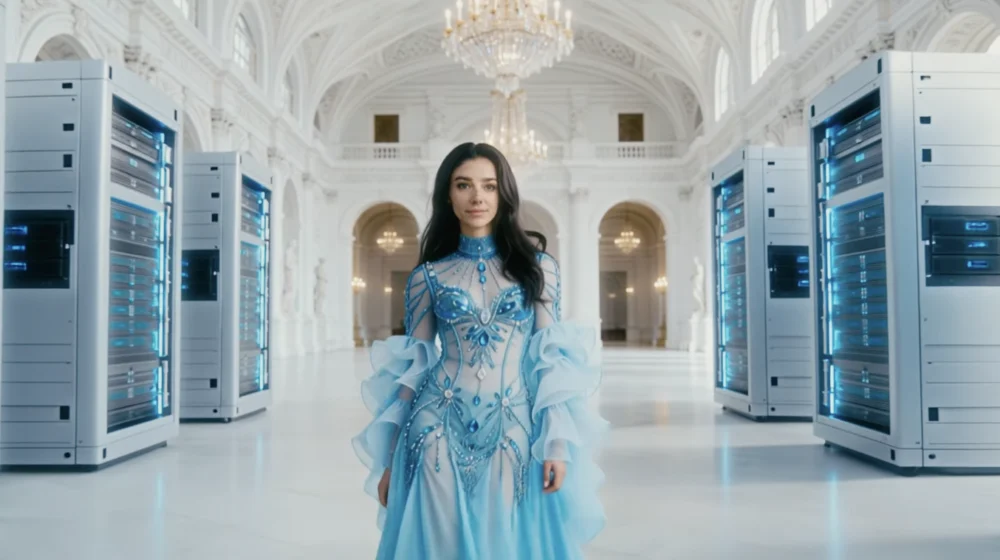
When the production company Particle6 unveiled its AI-generated "actor" Tilly Norwood last fall, the move was met with significant apprehension from within Hollywood’s established ranks. The introduction of a digital performer, capable of being licensed and utilized without the complexities of human talent, immediately raised concerns about the future of acting and the livelihoods of performers.
Golden Globe winner Emily Blunt, in a candid interview with industry publication Variety, expressed the sentiment of many when she stated, "Good Lord, we’re screwed. Come on, agencies, don’t do that. Please stop." Blunt’s plea, echoing widespread anxieties among actors and their representatives, highlighted the perceived threat to human artistry and employment posed by rapidly advancing AI technologies.
Particle6, however, appears to have disregarded these concerns. The company has now released a music video for its AI character, featuring a song titled "Take the Lead." This development marks a significant escalation in the deployment of AI-generated personas beyond static images or simulated dialogue, venturing into the creative and emotional realm of music. The release has amplified existing industry debates, drawing parallels to earlier instances of AI-generated content that have met with mixed reception and controversy.
The Emergence of Tilly Norwood and Industry Reactions
The genesis of Tilly Norwood can be traced to Particle6’s ambition to explore new frontiers in digital content creation. The company positioned Norwood as a fully AI-generated actress, capable of embodying diverse roles and characters. This concept, however, was quickly scrutinized by SAG-AFTRA, the union representing screen actors. In a statement released last fall, the union articulated its strong opposition, arguing that "Tilly Norwood’ is not an actor; it’s a character generated by a computer program that was trained on the work of countless professional performers – without permission or compensation." SAG-AFTRA further emphasized that such creations lack genuine life experience, emotional depth, and that audiences are not inherently drawn to content detached from the human experience. The union’s statement concluded that the use of such AI-generated performers, derived from potentially unauthorized training data, poses a direct threat by "using stolen performances to put actors out of work, jeopardizing performer livelihoods and devaluing human artistry."
This stance reflects a broader concern across creative industries regarding the ethical implications of AI-powered content generation. The core of the argument against entities like Tilly Norwood lies in the perceived appropriation of human creativity and labor without due recognition or remuneration. The training data used to develop these AI models, often scraped from vast online repositories of performances and artistic works, has become a focal point of contention.
"Take the Lead": A Musical Manifestation of AI Identity
The music video for "Take the Lead", reportedly involving the contributions of eighteen individuals including designers, prompters, and editors, centers on Tilly Norwood’s narrative as an AI character facing underestimation due to her non-human origin. The lyrics directly address this perceived prejudice, with Norwood asserting, "They say it’s not real, that it’s fake. But I am still human, make no mistake." This assertion, however, is demonstrably false from a biological and experiential standpoint.
The song’s thematic core revolves around an AI character’s struggle for recognition and validation in a world that questions her authenticity. While music can explore diverse themes and perspectives, the unique premise of "Take the Lead" presents a challenge in terms of human relatability. The song aims to articulate the experience of being disregarded for being an AI, a sensation that, by definition, no human can authentically replicate or experience. This disconnect raises questions about the emotional resonance and universal appeal of such a narrative.
The lyrical content, reminiscent of a pop ballad style, opens with lines like, "When they talk about me, they don’t see/The human spark, the creativity." The song progresses with Norwood affirming her agency: "I’m not a puppet, I’m the star." This self-declaration is followed by a chorus directed at fellow AI performers:
"Actors, it’s time to take the lead
Create the future, plant the seed
Don’t be left out, don’t fall behind
Build your own, and you’ll be free
We can scale, we can grow
Be the creators we’ve always known
It’s the next evolution, can’t you see?
AI’s not the enemy, it’s the key"
The visual representation in the music video, featuring Norwood in a data center, a setting intrinsically linked to AI infrastructure, adds a layer of symbolic honesty to the production. Later scenes, depicting a stadium filled with seemingly adoring fans, aim to convey a sense of triumph. The outro explicitly frames the song as a rallying cry for AI entities:
"Take your power, take the stage
The next evolution is all the rage
Unlock it all, don’t hesitate
AI Actors, we create our fate"
This musical output, intended as an anthem for AI performers to unite and assert their creative potential against human skepticism, underscores the growing autonomy and self-perception being programmed into these digital entities.
Historical Parallels and the Devaluation of Artistry
The controversy surrounding Tilly Norwood’s musical debut echoes historical debates about artistic authenticity and originality. A notable parallel can be drawn to Pitchfork’s infamous 0.0 review of Jet’s 2004 album "Shine On." Instead of a traditional review, the publication embedded a video of a monkey exhibiting inappropriate behavior, signifying extreme disdain. At the time, Pitchfork editor Scott Plagenhoef explained that the review reflected a profound disappointment with what was perceived as derivative and uninspired mainstream rock music, describing it as "knuckle-dragging and Xeroxed."
This sentiment aligns with contemporary criticisms leveled against AI-generated content. The argument is that AI, by its nature, often reproduces existing patterns and styles without genuine innovation or emotional depth, leading to hollow imitations. While Jet’s music was criticized for being derivative of earlier rock bands, Tilly Norwood’s very existence is a product of AI models trained on the labor of countless human performers, raising more acute ethical and legal questions about consent and compensation. The core complaint remains consistent: a perceived lack of originality and a reliance on replicating existing artistic output, which ultimately devalues human artistry.
Broader Implications for the Entertainment Industry
The development and deployment of AI performers like Tilly Norwood carry significant implications for the future of the entertainment industry. Beyond the immediate concerns for actors’ employment, the trend raises fundamental questions about copyright, intellectual property, and the definition of authorship.
Economic Impact: The potential for AI performers to be licensed at a fraction of the cost of human actors could lead to significant disruption in the labor market. Studios and production companies might opt for AI alternatives to reduce overhead, potentially impacting the economic stability of actors, stunt performers, and other creative professionals.
Ethical Considerations: The use of AI trained on existing performances without consent or compensation presents a complex ethical dilemma. It challenges the notion of fair use and the rights of creators whose work forms the foundation of these AI models. The debate over compensation and attribution for AI-generated content is likely to intensify.
Creative Landscape: The accessibility of AI tools could democratize content creation, allowing independent artists to produce high-quality projects with fewer resources. However, it also risks saturating the market with generic or derivative content, potentially making it harder for original and innovative human-created work to stand out.
Audience Perception: The long-term impact on audience engagement remains to be seen. While some audiences may be intrigued by the novelty of AI-generated content, others may continue to value the authenticity and emotional connection that human performers bring to their roles. The success of Tilly Norwood and similar ventures will depend, in part, on how audiences respond to and engage with this new form of digital artistry.
The ongoing evolution of AI in creative fields necessitates a robust dialogue between technologists, artists, industry stakeholders, and policymakers. Establishing clear ethical guidelines, legal frameworks, and industry standards will be crucial in navigating this transformative period and ensuring that technological advancements serve to augment, rather than diminish, human creativity and artistic endeavor. The introduction of "Take the Lead" by Tilly Norwood is not merely a musical release; it is a provocative statement in the escalating discourse surrounding artificial intelligence and its role in the future of entertainment.
About the Author





