In the competitive landscape of modern business, the generation of quality leads is not merely a desirable outcome; it is the lifeblood of future growth and sustained profitability. While the adage "you have to speculate to accumulate" holds true, a critical question often remains unanswered: what is the precise financial outlay required to secure a single potential customer? Without a clear understanding of the cost per lead (CPL), businesses operate with a significant blind spot, unable to definitively assess the efficacy of their marketing and sales endeavors. This article delves into the importance of CPL, elucidates its calculation, and provides actionable strategies for its reduction, thereby empowering businesses to optimize their marketing expenditures and maximize return on investment.
What Exactly is Cost Per Lead?
Cost per lead (CPL) is a fundamental marketing metric designed to quantify the total expense incurred in acquiring a single lead for a business. It represents the financial investment made to attract an individual who has demonstrated an interest in a company’s products or services. The definition of a "quality lead" can vary significantly depending on the specific marketing campaign and business objectives. Generally, a quality lead is characterized by actions such as:
- Filling out a contact form on a website.
- Downloading a whitepaper or ebook.
- Registering for a webinar or event.
- Requesting a demo or consultation.
- Subscribing to a newsletter.
- Engaging with paid advertisements.
By tracking CPL, businesses gain a robust mechanism for evaluating the success of their digital marketing efforts. This metric can be applied to assess the performance of individual campaigns across specific channels or to gauge the overall efficiency of a company’s entire marketing spend.
It is imperative to distinguish CPL from cost per acquisition (CPA). While CPA measures the total expenditure required to secure a paying customer or finalize a sale, CPL specifically focuses on the cost associated with generating potential customers. Leads are distinct from prospects; understanding this nuance is vital for effective sales funnel management.
The Paramount Importance of Cost Per Lead
Marketing expenditure typically constitutes a substantial portion of overall business expenses. Therefore, rigorously measuring the effectiveness of these investments and identifying avenues for optimization is not just prudent but essential. Cost per lead serves as a critical barometer for tracking the performance of both sales and marketing campaigns.
A firm grasp of the cost associated with generating each potential customer enables businesses to allocate their marketing budgets and client management resources with greater precision. This data facilitates a comparative analysis of different channels and strategies, highlighting those that deliver the best return on investment (ROI). Consequently, resources can be strategically redirected towards high-performing initiatives, while underperforming or cost-ineffective strategies can be phased out.
Furthermore, when CPL data is integrated with other key marketing metrics, it can reveal whether a particular campaign or channel is attracting leads that are unlikely to convert. This insight allows for timely course correction, thereby saving valuable time and financial resources.
Beyond mere performance tracking, CPL analysis empowers businesses to challenge prevailing assumptions. A high-profile campaign generating considerable attention and a large volume of leads might be perceived as successful. However, a deeper analysis of CPL could reveal that a less conspicuous campaign, despite generating fewer leads, might offer a superior ROI due to lower operational costs.
Defining a "Good" Cost Per Lead: A Nuanced Perspective
The question of what constitutes a "good" CPL is inherently complex, as there is no universal benchmark applicable to all businesses and industries. The ideal CPL is contingent upon a multitude of factors, including:
- Industry: Highly competitive sectors or those dealing with high-value products and services, such as enterprise software or financial services, often exhibit higher CPLs. This is also characteristic of business-to-business (B2B) lead generation, where lead value is typically higher, sales cycles are protracted and intricate, and target markets are highly specialized.
- Product/Service Value: The price point of a company’s offerings significantly influences the acceptable CPL. For instance, a CPL of $80 might be considered exorbitant if the product sells for $20. Conversely, the same $80 CPL would appear highly favorable if the product commands a price of $2,000.
- Marketing Channels Used: Different marketing channels have varying cost structures. Paid advertising platforms, for example, often incur higher costs per lead compared to organic strategies like content marketing or SEO.
- Target Audience: The specificity and accessibility of the target audience can impact CPL. Reaching niche markets may require more targeted and potentially more expensive advertising efforts.
- Economic Climate: Broader economic conditions can influence consumer behavior and advertising costs, thereby affecting CPL.
- Competitive Landscape: The intensity of competition within an industry can drive up advertising costs and, consequently, CPL.
Ultimately, a "good" CPL is one that is lower than the anticipated revenue generated from an average lead. Conversely, a "bad" CPL results in a net loss, where the cost of lead generation exceeds the projected revenue from that lead. The expected revenue is itself a variable, dependent on average customer spending and conversion rates. Industry benchmarks can serve as a valuable reference point, but they should be considered alongside a company’s specific conversion rates, lead quality, and the potential lifetime value of a customer.
Calculating Cost Per Lead: A Step-by-Step Approach

The calculation of CPL is straightforward, requiring two primary components: the total cost of lead generation and the total number of leads acquired.
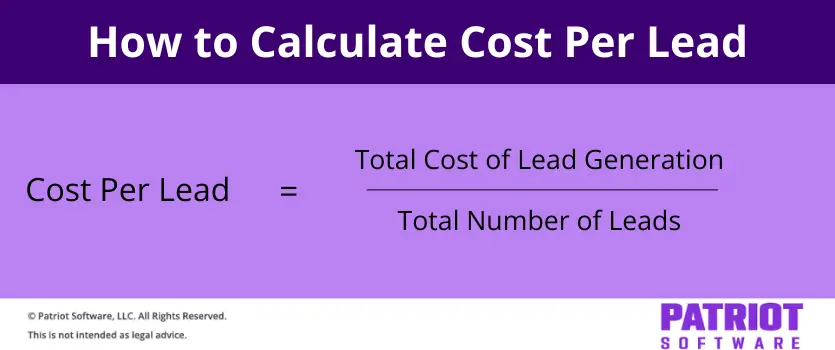
The Formula:
Cost Per Lead = Total Cost of Lead Generation / Total Number of Leads
To illustrate with a basic example: If a business invests $5,000 in an email marketing campaign that successfully generates 200 leads, the CPL would be calculated as $5,000 / 200 = $25 per lead.
Calculating Costs:
The first step involves a comprehensive accounting of all expenses related to a specific marketing campaign or initiative. This includes:
- Advertising Expenses: Costs associated with paid advertisements across various platforms (digital, print, social media).
- Content Creation: Expenses for developing blog posts, articles, videos, infographics, and other marketing collateral.
- Software and Tools: Investment in marketing automation platforms, CRM systems, analytics tools, and other essential software.
- Agency Fees: Costs incurred for engaging external marketing agencies or consultants.
- Labor Costs: Salaries or wages for in-house marketing and sales teams involved in lead generation efforts.
Businesses often employ a blend of inbound (organic) and outbound (paid) marketing strategies. It is beneficial to calculate CPL separately for each approach, as their cost structures and effectiveness can differ significantly. Paid advertising typically yields higher CPLs, while organic strategies, though potentially slower to build momentum, tend to result in lower CPLs over time due to their sustainable nature.
To facilitate accurate tracking, it is advisable to break down costs on a consistent time basis, such as monthly, quarterly, or annually.
- Total Costs Per Period = Advertising Costs + Inbound Costs
Advertising costs encompass direct ad spend and the associated management fees, whether internal or external:
- Advertising Costs = Ad Spend + Ad Management
Inbound costs cover the development of landing pages, content marketing (blogs, social media), and search engine optimization (SEO) efforts. These can involve internal resources or external service providers:
- Inbound Costs = External Resources + Internal Resources
Summing these figures provides the total cost of lead generation for the chosen time period.
Calculating Leads:
The next step is to aggregate the total number of leads generated from both paid and organic sources.
- Total Leads = Inbound Leads + Outbound Leads
Inbound leads can include website visitors who convert through forms, social media followers, blog referrals, and other organic interactions. Outbound leads are typically those generated through direct advertising efforts.
With both the total cost and the total number of leads determined, the CPL can be accurately calculated using the formula provided earlier. Fortunately, numerous tools and platforms can assist in this process. Many advertising platforms, such as Google Ads and Facebook Ads, offer built-in CPL reporting. Additionally, specialized calculators, like the Cost Per Lead Calculator from Leadfeeder, can streamline the process.
Leveraging Cost Per Lead Data for Strategic Advantage
Once CPL is calculated, its true value lies in its application. This metric enables businesses to:
- Compare Marketing Channel Effectiveness: By calculating CPL for each marketing channel (e.g., social media, email marketing, paid search, content marketing), businesses can identify which channels are most cost-efficient in generating leads.
- Evaluate Campaign Performance: Individual campaigns can be assessed to determine their CPL, allowing for the optimization or discontinuation of underperforming initiatives.
- Analyze Target Audience Segments: CPL can be broken down by different demographic or psychographic segments to understand which audiences are most cost-effectively reached.
- Monitor Trends Over Time: Regularly tracking CPL allows businesses to identify trends, such as increasing costs or diminishing returns, prompting a reevaluation of marketing strategies.
Beyond the overall CPL, businesses can derive further insights by calculating CPLs for specific campaigns, channels, and even audience segments. This granular analysis empowers businesses to pinpoint the most profitable avenues for lead generation and tailor their efforts accordingly. Continuous monitoring of CPL trends is crucial for identifying emerging opportunities and proactively addressing potential issues. A consistent or increasing CPL might signal a need to re-examine marketing approaches, adjust targeting, or explore new channels.
It is also essential to view CPL in conjunction with other key performance indicators, such as conversion rates, cost per acquisition (CPA), and overall return on investment (ROI), to gain a holistic understanding of marketing performance.
Strategies for Reducing Cost Per Lead
The ultimate goal of calculating CPL is to identify opportunities for reduction, thereby maximizing marketing budget efficiency and extending its reach. The most effective approach involves adapting strategies to attract more qualified leads, thereby lowering the cost associated with each.
-
Align with Business Needs and Market Position:
For large enterprises with substantial revenue streams, a higher overall ad spend and a correspondingly higher CPL might be justifiable, particularly in highly competitive markets. However, smaller businesses should adopt a more cautious approach, starting with a modest budget and diligently analyzing campaign analytics to determine the optimal moment to scale. This measured approach ensures that resources are not squandered on unproven strategies. -
Enhance Audience Targeting:
Precision in audience targeting is a powerful lever for increasing the number of quality leads. Implementing retargeting campaigns for individuals who did not convert initially can recapture their interest with relevant content and tailored offers. If marketing messages are not resonating with the intended audience, a thorough review of segmentation strategies is necessary. Focusing on demographics or groups that have historically demonstrated higher interest and conversion rates can significantly improve CPL. Adjusting sales planning templates to reflect these refined segments ensures alignment across teams. -
Optimize Website Performance and User Experience:
Improving a website’s online visibility is a direct route to enhancing organic reach and reducing CPL. This involves optimizing for search engines by targeting long-tail keywords that indicate strong user intent, consistently updating content to maintain relevance, and mirroring the style and depth of successful competitor content. Beyond SEO, enhancing website navigation, improving page loading speeds, and refining landing pages are critical. Ensuring that lead magnets offer genuine value and adding clarifying questions to sign-up forms can help pre-qualify leads, weeding out those with less serious intent. -
Embrace A/B Testing:
A/B testing is an invaluable tool for identifying which marketing materials and strategies yield the highest number of leads, thereby driving down CPL. This can involve testing different elements on landing pages, such as headlines, calls-to-action (CTAs), and imagery. Similarly, testing various ad creatives and copy can reveal which variations resonate most effectively with the target audience. Experimenting with different marketing channels is also crucial to avoid over-reliance on a single strategy. A/B testing can further optimize the timing of ad placements and content publication, ensuring maximum visibility when the target audience is most active online. -
Leverage the Right Technology Stack:
Automating manual tasks through appropriate software solutions can significantly enhance lead generation efficiency. While there is an initial investment in these tools, the resulting gains in efficiency can drastically reduce CPL in terms of human resource allocation. Ensuring that teams are adequately trained on how to maximize the benefits of these tools is paramount. Consider investing in specialized lead generation software, robust accounting software for expense tracking, marketing automation platforms for email and social media campaigns, and CRM systems for comprehensive lead and customer data management. -
Implement Continuous Tracking and Analysis:
Regularly calculating and monitoring CPL is non-negotiable. This practice allows for ongoing performance evaluation across different marketing methods, channels, and campaigns. It is crucial to remember that external factors, such as the prevailing economic climate and the competitive landscape, can influence CPL and are subject to rapid change. Therefore, CPL should always be evaluated within the broader context of other sales and marketing metrics, including conversion rates, CPA, and ROI. Employing customer satisfaction (CSAT) surveys for leads who convert after a campaign can also provide valuable qualitative data on campaign success.
Final Thoughts on Optimizing Marketing Spend
Calculating and understanding Cost Per Lead is an indispensable component of maximizing business expenses. This metric provides the clarity needed to identify underperforming campaigns and channels, ensuring that marketing budgets are strategically allocated to initiatives with a high probability of success. A comprehensive approach to CPL calculation necessitates the inclusion of all advertising costs, encompassing both inbound and outbound efforts.
Businesses must define what constitutes a "good" and "bad" CPL, taking into account industry specifics, product value, and target audience characteristics. By diligently applying the strategies outlined above, businesses can effectively reduce their CPL, streamline their marketing spend, and cultivate a more efficient and profitable lead generation engine, ultimately driving sustainable business growth.
About the Author