The digital search environment is undergoing a profound transformation, shifting from a list of clickable links to synthesized, AI-generated answers. This evolution necessitates a new approach to online visibility, one that focuses on how brands are represented within these AI responses. An Answer Engine Optimization (AEO) checker serves as a crucial tool in this new paradigm, indicating whether a brand is mentioned in the AI-generated answers that users increasingly rely on. Platforms like ChatGPT, Perplexity, and Google’s Gemini, along with AI Overviews, are becoming primary sources of information, meaning that visibility once achieved through traditional search engine rankings can now be obscured within an answer that bypasses direct website visits.
The core function of an AEO checker is to identify which queries surface a brand’s content, which ones inadvertently favor competitors, and where AI engines may misrepresent a brand. These tools offer varying methodologies for achieving this, each providing a unique lens through which to understand AI-driven visibility. This guide delves into the operational mechanics of AEO checkers, outlines manual methods for assessing visibility across prominent AI platforms, and provides a comparative analysis of leading AEO tools to aid in selecting the most suitable solution for adapting to this dynamic new era of search.
What is Answer Engine Optimization (AEO)?
Answer Engine Optimization (AEO) is the strategic discipline dedicated to enhancing the frequency and accuracy with which a brand’s presence is reflected in AI-generated responses. This shift in user behavior, where individuals pose questions to AI chatbots and artificial intelligence systems and act upon the provided answers without necessarily clicking through to source links, fundamentally alters the search landscape. The advent of AI Overviews by Google in May 2024, which synthesizes information from multiple sources into a direct answer at the top of search results, exemplifies this trend.
AEO operates in tandem with Search Engine Optimization (SEO). While SEO aims to improve a website’s ranking within a list of search results, AEO focuses on ensuring that a brand is not only cited but also accurately represented within the AI’s synthesized response. The two disciplines are complementary; robust SEO practices, including clear content structure, authority signals, and reliable primary sources, remain foundational for AI engines to identify and trust content for citation. The ability of AI systems to parse and trust content is paramount, favoring clearly structured web pages, direct answers to user queries, and claims supported by verifiable evidence.
![AEO checker tools that measure answer engine visibility [2026]](https://53.fs1.hubspotusercontent-na1.net/hubfs/53/aeo-checker-1-20260903-3858273.webp)
The Role and Functionality of an AEO Checker
An AEO checker provides critical insights into a brand’s visibility within answer engines. It meticulously measures this visibility and then translates these findings into actionable recommendations for improvement. Key functions include:
- Brand Mention Tracking: Identifying instances where a brand’s name or products are explicitly mentioned in AI-generated answers.
- Citation Analysis: Determining whether AI responses link back to the brand’s content as a source.
- Competitor Benchmarking: Analyzing competitor presence and citation within AI answers for similar queries.
- Content Gap Identification: Pinpointing areas where a brand is absent or underrepresented in AI responses.
- Misinformation Detection: Flagging instances where AI engines inaccurately represent a brand or its offerings.
- Prioritization of Actions: Ranking identified issues based on their potential impact, suggesting content updates, schema corrections, and entity improvements.
These checkers offer a structured approach to diagnosing and rectifying visibility challenges, transforming raw data into a strategic roadmap for enhanced AI presence.
Manual AEO Checks: Navigating Google AI Overviews
Initially, assessing visibility within Google’s AI Overviews (AIOs) requires a manual approach, involving direct query execution within a live search session. Google’s AIOs are designed to appear only when the system determines that a summary offers significant value beyond traditional search results, meaning they do not trigger for every query. Furthermore, the content of AIOs can fluctuate between search sessions, underscoring the importance of conducting multiple checks. When an AIO is generated, it prominently displays inline citations, indicating the sources it drew upon. These citations are typically presented adjacent to the relevant text, with desktop hover previews revealing the source website.
Step 1: Defining Key Queries
The initial step involves compiling a comprehensive list of critical queries. This list should encompass brand-specific terms, branded product names, and common informational questions that prospective buyers frequently ask. Each query should be executed in a signed-out or incognito browsing session to ensure unbiased results. During this process, three key data points should be meticulously recorded:
- AIO Appearance: Whether an AI Overview is generated for the query.
- Brand Citation: Whether the brand’s domain appears among the inline source links within the AIO.
- Claim Accuracy: The specific claim made by the AI overview, noting any inaccuracies or misrepresentations.
Step 2: Interpreting the Results
The recorded data should then be analyzed to identify patterns. A comparison between queries that trigger AIOs and cite the brand versus those that trigger AIOs but cite competitors is crucial. The latter category represents a "content gap" – an opportunity for improvement. Given the dynamic nature of AIOs, a single instance of absence should prompt further investigation rather than be definitively interpreted as a permanent loss of visibility.
![AEO checker tools that measure answer engine visibility [2026]](https://no-cache.hubspot.com/cta/default/53/9dd5e54b-fbef-4dd0-bc44-1689feb1ea18.png)
Step 3: Building a Reporting Framework
To establish a reliable record of performance, each AIO result should be documented with screenshots, including the query, date, and geographical location. Relying solely on Google Search Console’s standard Performance report is insufficient, as it aggregates AI Overview activity under the general "Web" search type without specific breakdown. While Google has introduced a dedicated generative AI performance report, its initial rollout was limited, primarily reporting impressions to a subset of sites.
Pro Tip: While manual checks are feasible for a limited set of queries, they are not scalable for larger datasets. The frequent updates to AI Overviews make manual sampling unreliable at scale. Dedicated AEO checkers automate this process, capturing and logging all AI Overview results automatically. The subsequent sections will highlight tools equipped with this capability.
Manual Citation Checks: ChatGPT and Perplexity
Both ChatGPT and Perplexity provide citations within their responses, making manual checks feasible by reviewing each answer for brand mentions and linked sources. Perplexity, by default, attaches citations to virtually every answer, directly linking to the source content, and also displays a dedicated panel listing all sources used.
ChatGPT, when utilizing web search, also presents inline citations, with additional sources listed in a dedicated panel below the generated response.
Step 1: Executing Practical Citation Checks
Using the previously defined branded and informational queries, the following should be assessed:
![AEO checker tools that measure answer engine visibility [2026]](https://53.fs1.hubspotusercontent-na1.net/hubfs/53/aeo-checker-2-20260903-852936.webp)
- Source Citation: Whether the brand’s domain appears within the cited sources.
- Brand Mention: Whether the brand is explicitly named within the AI-generated text.
It is important to recognize that a citation and a mention represent distinct forms of visibility and achievement.
Step 2: Optimizing Prompts for Retrieval
ChatGPT’s web search functionality is triggered when a query requires up-to-date information or when web search is manually selected. To ensure that your content is discoverable, framing prompts with direct, current questions—such as "best [category] tools for [specific use case]”—is recommended. This encourages the AI to access live sources that can then be inspected.
Step 3: Logging Results and Translating Gaps into Actionable Tasks
The sources utilized by AI engines can vary significantly between queries. Therefore, executing each prompt multiple times across fresh sessions is crucial for comprehensive analysis. For each run, meticulously record the AI engine used, the prompt itself, the date, whether the brand was cited or mentioned, and any competitor domains that appeared. This detailed log will reveal inconsistencies, such as a citation appearing in one session but not another, or being present in Perplexity but absent in ChatGPT. Each absence should be treated as a task. When a competitor is cited and your brand is not, it signifies a need to revise the content or structure related to that specific query, followed by re-testing after publication.
Key Criteria for Selecting an AEO Checker
While manual AEO checks are valuable for initial assessments and small-scale analyses, their scalability is limited. For continuous and automated monitoring of AI answer engine visibility, investing in AEO checking software is essential. The following criteria should guide the selection process:
- AI Engine Coverage: The tool should support monitoring across major AI platforms like ChatGPT, Perplexity, Gemini, and Google AI Overviews.
- Citation and Mention Tracking: The ability to differentiate between direct citations (links) and brand mentions within AI responses is critical.
- Competitor Analysis: Robust features for tracking competitor visibility and identifying their strategies within AI answers.
- Actionable Insights and Recommendations: The tool should provide clear, prioritized recommendations for improving AI visibility, going beyond mere data reporting.
- Integration Capabilities: Seamless integration with existing marketing and CRM platforms for a unified view of performance and customer journeys.
- Data Visualization and Reporting: Intuitive dashboards and customizable reports that clearly communicate AEO performance trends.
- Scalability and Automation: The capacity to handle large volumes of queries and data, with automated tracking and regular updates.
- Accuracy and Reliability: Consistent and dependable data collection from AI engines.
- User-Friendliness: An intuitive interface that is easy to navigate and understand for marketing teams.
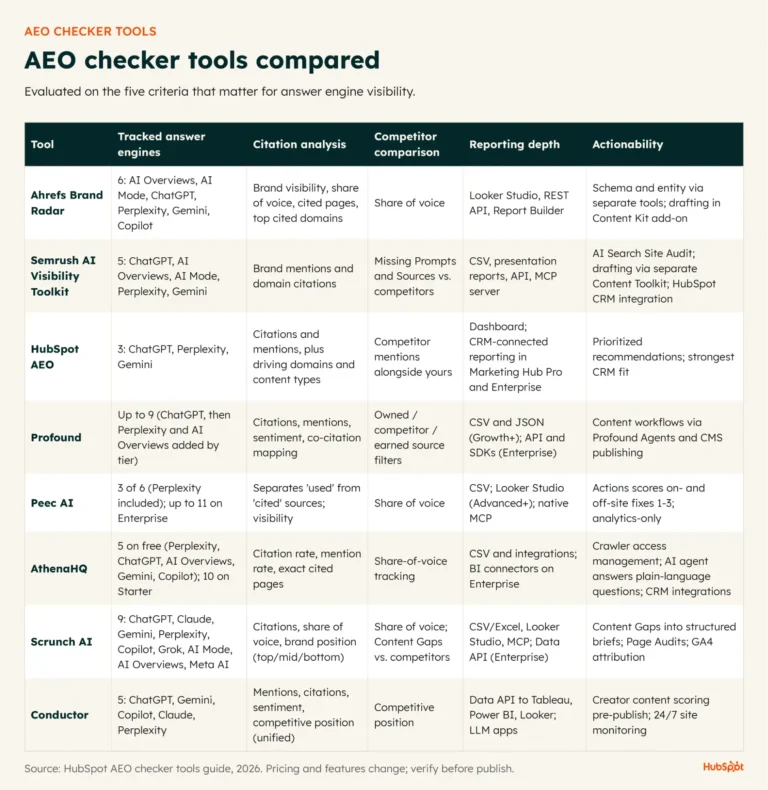
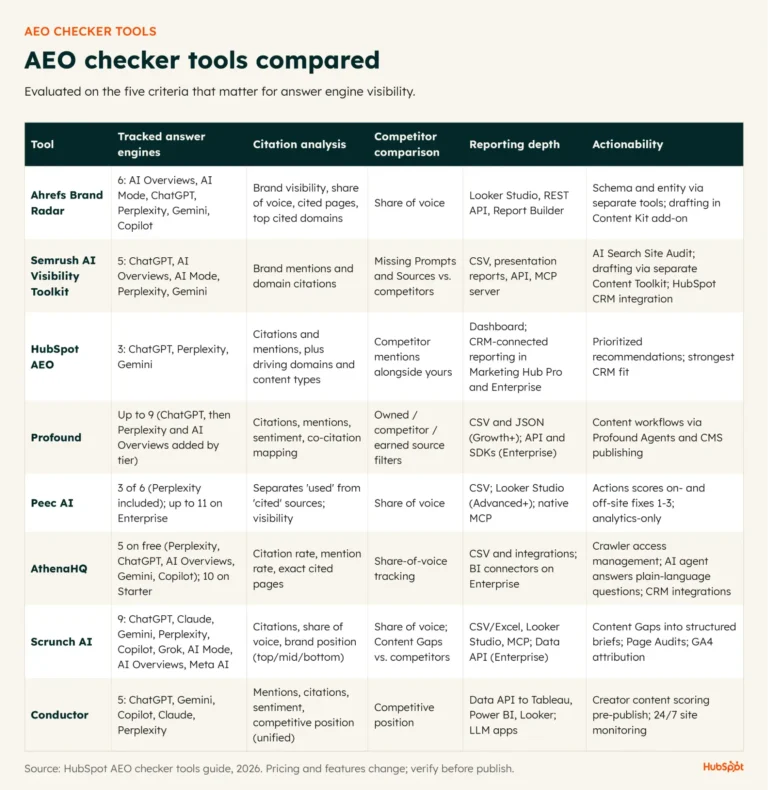
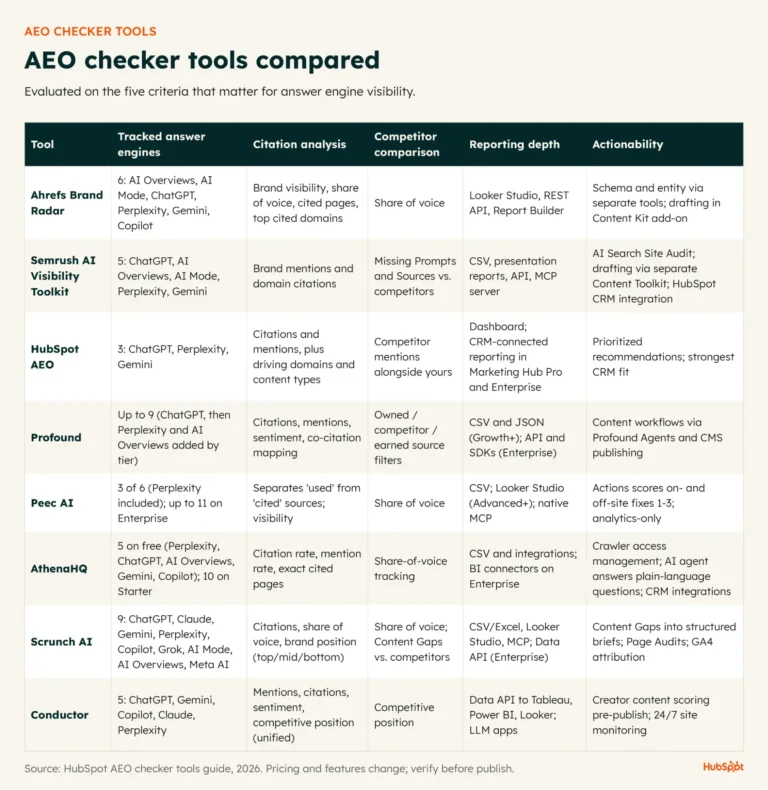
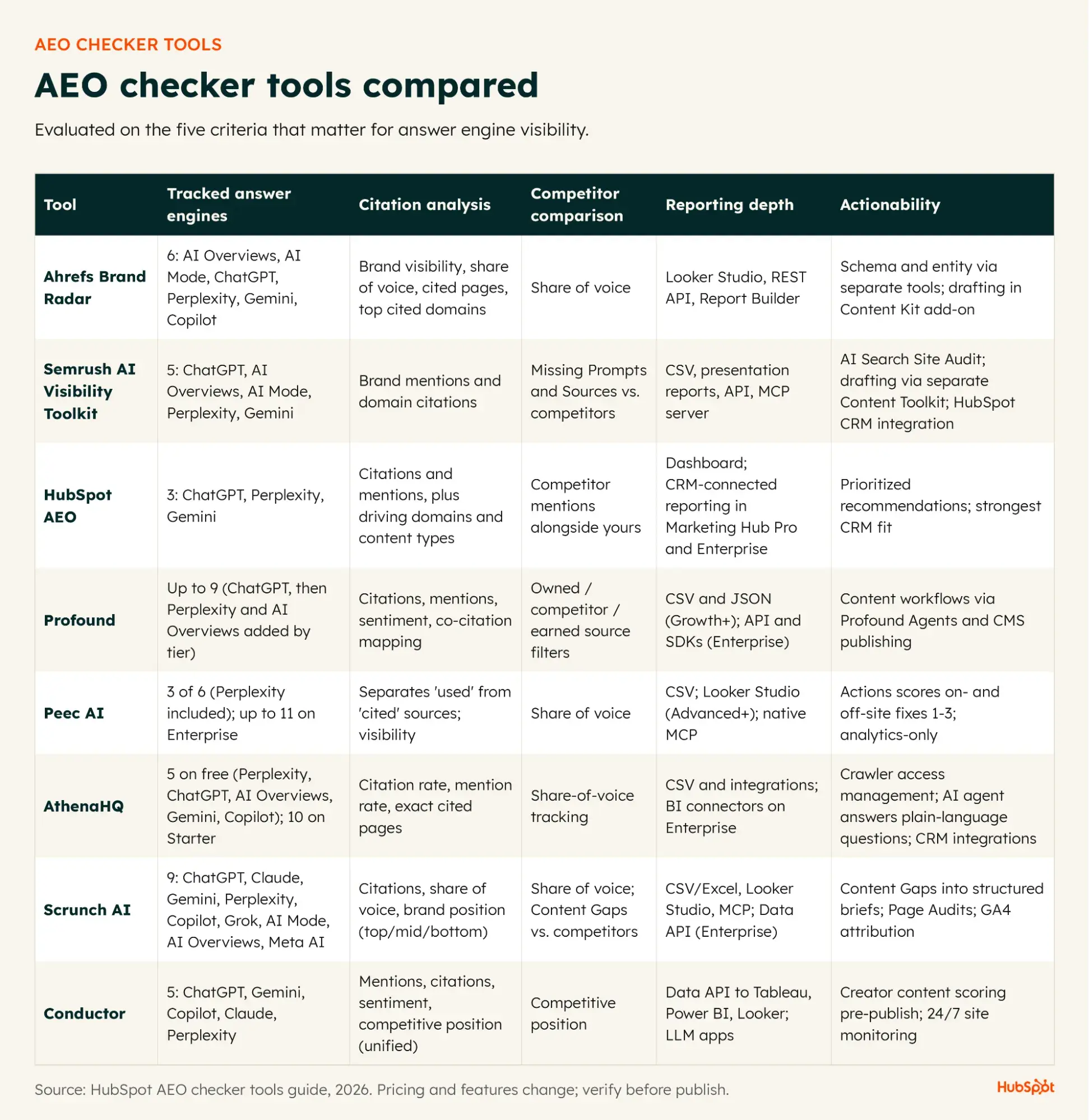
HubSpot’s AEO tool offers comprehensive tracking across ChatGPT, Perplexity, and Gemini, coupled with prioritized recommendations. For a complimentary initial assessment, the AI Search Grader provides a snapshot of how answer engines currently represent a brand.
![AEO checker tools that measure answer engine visibility [2026]](https://53.fs1.hubspotusercontent-na1.net/hubfs/53/aeo-checker-3-20260903-8904553.webp)
Top AEO Checker Tools: A Comparative Overview
The market offers a range of AEO checker tools, each with distinct strengths and features. These can be broadly categorized based on their primary focus:
Tools with AI Overviews Tracking
- Ahrefs Brand Radar: This tool leverages real search queries rather than synthetic prompts, with AI Overviews forming its most extensive index. It allows users to track brand mentions and citations across Google’s AI Overviews, providing insights into brand visibility and competitor activity.
- Semrush AI Visibility Toolkit: Within Semrush’s Organic Research, the AI Visibility Toolkit identifies ranking keywords that already trigger AI Overviews. This enables prioritization of content optimization efforts for pages that are close to appearing in AI summaries.
Tools with ChatGPT Citation Detection
- HubSpot AEO: HubSpot’s AEO solution monitors both citations (direct links to a brand’s domain) and mentions (brand names appearing without links) within ChatGPT responses. It also analyzes the domains and content types that drive visibility for both the brand and its competitors.
- Profound: This tool extends beyond basic citation detection to offer contextual analysis. It includes sentiment scoring of mentions, flagging of prompts that result in uncited answers, and a breakdown of citations by source type (owned, competitor, or earned media).
Tools with Perplexity Monitoring
- Peec AI: Peec AI is a specialized analytics tool that delivers clean, focused data specifically for Perplexity performance. It provides insights into how a brand is represented within Perplexity’s search results.
- AthenaHQ: AthenaHQ offers Perplexity monitoring across all its plans, including a free tier. It also features a conversational assistant to help users interpret the data.
Tools for Schema and Entity Readiness
- Scrunch AI: Scrunch AI focuses on the technical readiness of web pages for AI crawlers, assessing whether AI bots can successfully access and render content.
- Conductor: Conductor combines continuous technical monitoring with a content scoring mechanism, helping to ensure that content is optimized for both human users and AI systems.
Key AEO Metrics for Performance Tracking
Once an AEO checker is operational, several key metrics are vital for evaluating improvements in brand visibility:
- Brand Visibility Score: A composite score reflecting the overall presence of a brand in AI answers, considering mentions and citations.
- Citation Coverage: The percentage of AI responses that link back to the brand’s website.
- Mention Frequency: The number of times a brand is named within AI-generated content.
- Competitor Share of Voice: The proportion of AI answer space occupied by competitors compared to the brand.
- AI-Referred Traffic: The volume of website traffic originating from AI answer engines.
- Branded Search Lift: An increase in branded search queries potentially influenced by AI visibility.
These metrics should be viewed as trends over time. Consistent tracking over weeks and months provides more reliable insights than isolated data points. Monitoring citation coverage alongside brand visibility, and using proxies like AI-referred traffic and branded search lift, helps to quantify the impact of AI visibility, particularly in scenarios where direct clicks are not generated.
Integrating Measurement and Action with HubSpot
While many AEO checkers excel at diagnosis, they often leave the implementation of fixes to the user. HubSpot offers a more integrated approach, particularly within its Marketing Hub Professional and Enterprise tiers. HubSpot AEO, available as a standalone product or as part of these tiers, transforms visibility data into actionable recommendations. It guides users on what content to create or update and where to focus outreach efforts, providing clear rationales.
HubSpot AEO, priced at $50 per month, includes tracking, prompt suggestions, citation analysis, and prioritized recommendations. For a more comprehensive solution, Marketing Hub Professional and Enterprise integrate these capabilities with CRM data. This integration allows for prompt and recommendation suggestions informed by customer relationship management data. The Content Agent feature, currently in public beta, can generate research-backed first drafts of content in the brand’s voice with a single click. These drafts are then available within HubSpot’s content editor for team review and refinement before publishing via Content Hub or Marketing Hub. The generation process utilizes HubSpot Credits, with an estimated cost of $10 per blog post.
![AEO checker tools that measure answer engine visibility [2026]](https://53.fs1.hubspotusercontent-na1.net/hubfs/53/aeo-checker-4-20260903-6212698.webp)
Because this workflow is built upon the Smart CRM, traffic referred from AI tools is recorded as a distinct source, directly linked to contacts and deals generated. This allows AEO reporting to be integrated seamlessly with the broader sales and marketing funnel. Acknowledging a limitation, answer engines often resolve queries without sending a click. While HubSpot can attribute any AI traffic that does result in a click-through, visibility that does not convert into a session may not register as direct pipeline revenue. Therefore, it is essential to interpret visibility scores and referral revenue as related but distinct performance indicators. HubSpot AEO represents a logical progression for businesses seeking to automate and continuously refine their AI visibility strategy beyond manual checks.
Frequently Asked Questions About AEO Checkers
How often should an AEO check be performed?
The frequency depends on the method used. For manual checks, multiple sessions per query are recommended due to the variability of AI responses. Automated checkers can provide daily or weekly refreshes to capture this volatility, while monthly snapshots may obscure critical fluctuations.
Is AEO the same as AI search optimization?
While often used interchangeably, AEO is the more precise term. Answer Engine Optimization specifically addresses improving a brand’s presence in AI-generated answers from platforms like ChatGPT, Perplexity, and Gemini. It is advisable to standardize on the term AEO.
Can citations in ChatGPT and Perplexity be reliably tracked?
Yes, with a caveat. Both platforms offer source citations, making individual responses auditable. However, results vary between sessions. Reliability is achieved through repetition: executing each prompt multiple times across fresh sessions and analyzing patterns rather than single instances.
Do AEO checkers replace traditional SEO tools?
No. AEO checkers and SEO tools measure different aspects of online presence. AEO tools monitor citations and mentions within AI answers, while SEO tools focus on rankings, keywords, and backlinks. Given that strong SEO underpins the crawlability and authority signals that AI engines rely on, running both types of tools concurrently is recommended.
About the Author