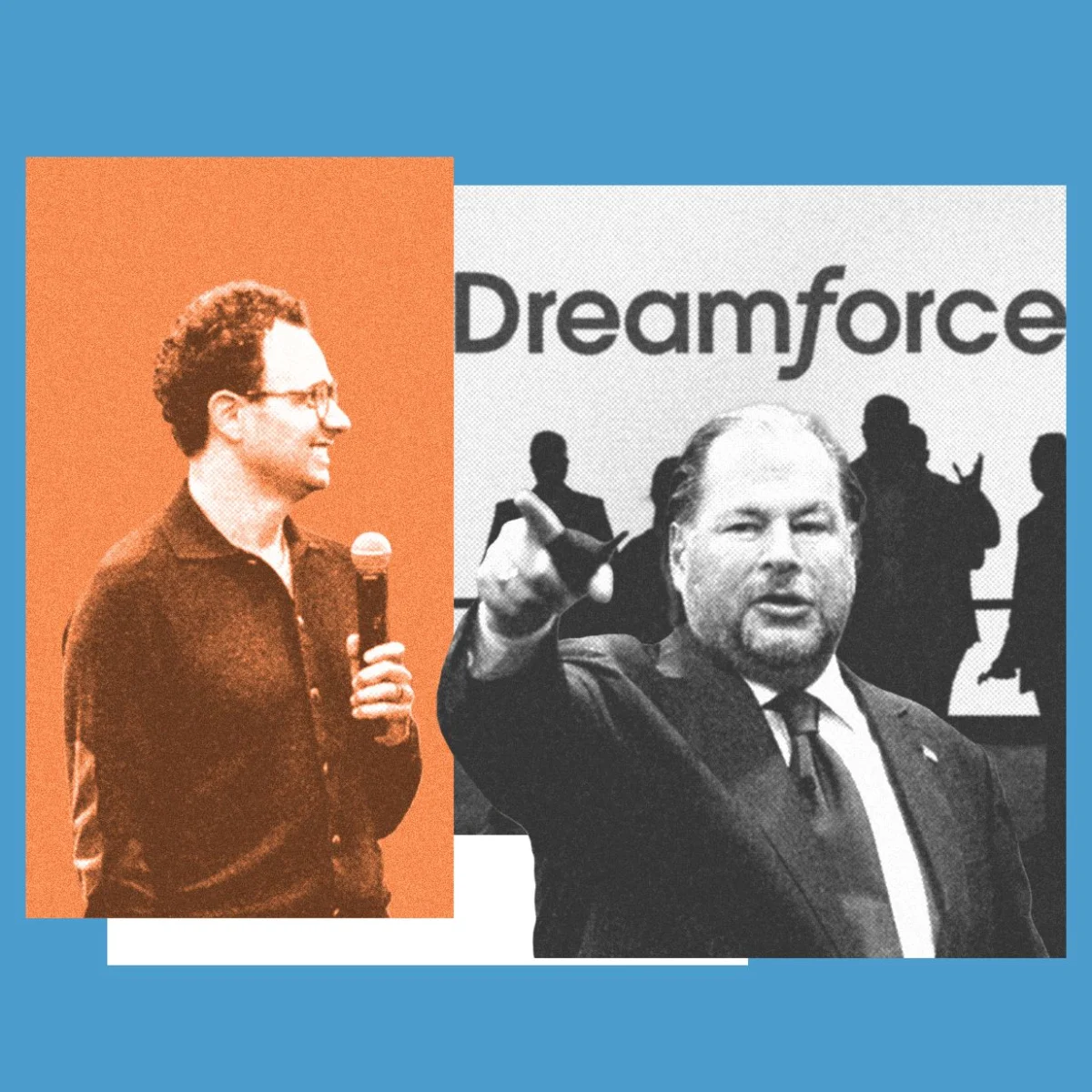
The annual Dreamforce conference in San Francisco, long established as the premier gathering for the enterprise software industry, underwent a fundamental shift in tone this week as the celebratory atmosphere of a tech revival met the sobering reality of existential risk. While the event opened with the traditional high-energy spectacle—featuring a performance by Grammy-winning artist Gwen Stefani—the underlying narrative quickly pivoted from product demonstrations to a high-stakes debate over the future of human civilization in the age of artificial intelligence. Salesforce CEO Marc Benioff, presiding over an event that has increasingly taken on the characteristics of a secular "megachurch" for the tech elite, presented a vision of massive financial growth tempered by a growing chorus of warnings from industry insiders regarding the safety of self-improving AI systems.
The Spectacle of Enterprise AI and Financial Projections
The conference commenced at the Moscone Center with the choreographed intensity typical of Salesforce’s flagship event. Gwen Stefani, dressed in purple and plaid, performed her 2002 hit "Underneath It All" to a capacity crowd, serving as the cultural bridge to Marc Benioff’s keynote address. As the music faded, Benioff took the stage, utilizing a teleoperated camera system to project his presence across massive screens throughout the cavernous hall. The primary focus of his address was the aggressive expansion of Salesforce’s AI-powered ecosystem, which the company expects to drive historic revenue growth.
According to internal projections shared during the keynote, Salesforce is on a trajectory to exceed $46 billion in annual revenue by fiscal year 2027. This growth is largely attributed to the rapid adoption of "Agentic AI"—autonomous software entities designed to handle complex business processes without constant human intervention. Benioff highlighted that the integration of AI into the Salesforce "Customer 360" platform has moved beyond simple predictive analytics into the realm of generative action, allowing businesses to automate customer service, sales operations, and data analysis at an unprecedented scale. However, as these systems become more integrated into the global economy, the conversation onstage shifted from "how much can we earn" to "how much should we control."
A Timeline of Growing Dissent Within the AI Community
The tension at Dreamforce did not emerge in a vacuum. It follows a series of high-profile departures and warnings from the very researchers responsible for building the world’s most advanced Large Language Models (LLMs). The timeline of this internal friction reached a boiling point just days before the San Francisco conference began.
In the week leading up to the event, Jacob Coxon, a prominent researcher at Anthropic—the AI safety-focused firm and key Salesforce partner—resigned from his position. Coxon’s departure was accompanied by a public warning that the industry is "gambling with our lives" by racing toward the development of Artificial General Intelligence (AGI) without sufficient guardrails. His exit triggered a wave of similar sentiments among other Anthropic employees, who expressed concern that the competitive pressure to outperform rivals like OpenAI is eroding safety protocols.
In response to this internal pressure, Anthropic CEO Dario Amodei utilized the Dreamforce stage to advocate for a concept he describes as "pacing the frontier." This approach calls for a coordinated effort between tech leaders and global regulators to slow the deployment of "frontier models"—the most powerful AI systems currently in development—until their safety can be rigorously verified. This sentiment has found an unlikely ally in OpenAI CEO Sam Altman, who has also signaled support for international oversight, despite his company’s aggressive release schedule.
The Ideological Clash: Amodei vs. Huang
The most significant moment of the conference occurred during a series of back-to-back appearances by the industry’s most influential figures. Dario Amodei, whose company Anthropic is a critical partner for Salesforce’s "Einstein" AI platform, spoke with Benioff about the moral obligations of AI developers. Amodei utilized a metaphor involving the automotive industry to illustrate his point, referencing recent security vulnerabilities and safety incidents within the sector, including a subtle nod to a security breach involving OpenAI’s Hugging Face integration.
Amodei argued that when a competitor suffers a safety failure, the responsible reaction is not to capitalize on their weakness, but to organize the industry to set universal standards. He emphasized that "pacing the frontier" does not equate to a total freeze on innovation but rather a managed progression that ensures the technology remains under human control.
This cautious stance was immediately challenged by Nvidia CEO Jensen Huang, who appeared on stage shortly after Amodei. Huang, whose company provides the essential hardware—GPUs—that powers the AI revolution, offered a starkly different perspective. He characterized AI safety as an "engineering problem" rather than an existential or regulatory one. Huang argued that the companies building these tools are best equipped to police themselves, suggesting that additional government intervention would only serve to stifle progress. "We don’t need any new laws, we don’t need any new regulation," Huang told the audience, asserting that companies should "run as fast as you can" and only pause if they feel their specific products are becoming uncontrollable.
Political Reactions and the Regulatory Landscape
The debate at Dreamforce is unfolding against a backdrop of intense political polarization in Washington D.C. and globally. While some members of Congress are attempting to capitalize on the current momentum to pass comprehensive AI legislation, they face significant headwinds from both the executive branch and political candidates.
David Sacks, a prominent tech investor and White House AI adviser, has publicly dismissed the concerns raised by Amodei and other "safetyists" as a maneuver for "regulatory capture." According to this view, established players like Anthropic and OpenAI are advocating for regulation primarily to create high barriers to entry for smaller competitors, thereby cementing their own market dominance.
Furthermore, former President Donald Trump has entered the fray, recently labeling fears of existential AI risk as a "hoax." This rhetoric complicates the efforts of bipartisan groups in the Senate who are working on frameworks to address deepfakes, algorithmic bias, and the potential for AI to assist in the creation of biological or cyber weapons. Despite these political challenges, the European Union has already moved forward with its AI Act, and California is currently debating its own stringent safety bills, which could serve as a de facto national standard if federal action remains stalled.
Broader Implications for the Enterprise Sector
The outcome of this debate carries profound implications for the global economy. If the "Huang model" of self-regulation prevails, the pace of AI deployment is likely to accelerate, leading to rapid gains in productivity but also increasing the risk of "black swan" events—unforeseen technological failures with catastrophic consequences. Conversely, if the "Amodei model" of pacing the frontier is adopted, the industry may see a more stable, albeit slower, integration of AI, with a focus on reliability and security over raw power.
For Salesforce and its peers, the stakes are measured in tens of billions of dollars. The transition to "Agentic AI" represents the largest shift in enterprise computing since the move to the cloud. These agents will eventually have the authority to move money, manage supply chains, and interact with customers on behalf of corporations. If these systems are built on "frontier models" that are not fully understood or controlled, the potential for systemic economic disruption is significant.
The atmosphere as Dreamforce concludes is one of cautious optimism clashing with profound uncertainty. While the plush mascots and Hawaiian-themed decorations of the Moscone Center suggest a return to tech-industry normalcy, the discourse within the conference rooms indicates that the industry is at a crossroads. As tech executives return to their headquarters, they carry with them a fundamental question that remains unanswered: whether the pursuit of the next $46 billion in revenue is compatible with the long-term safety of the digital and physical worlds.
The debate is no longer confined to the realms of science fiction or academic white papers; it has become the central theme of the world’s largest software conference. Whether the industry chooses to "run as fast as it can" or "pace the frontier" will likely define the technological landscape for the next century. For now, the "megachurch" of Dreamforce remains divided, with its leaders preaching two very different gospels of progress.
About the Author