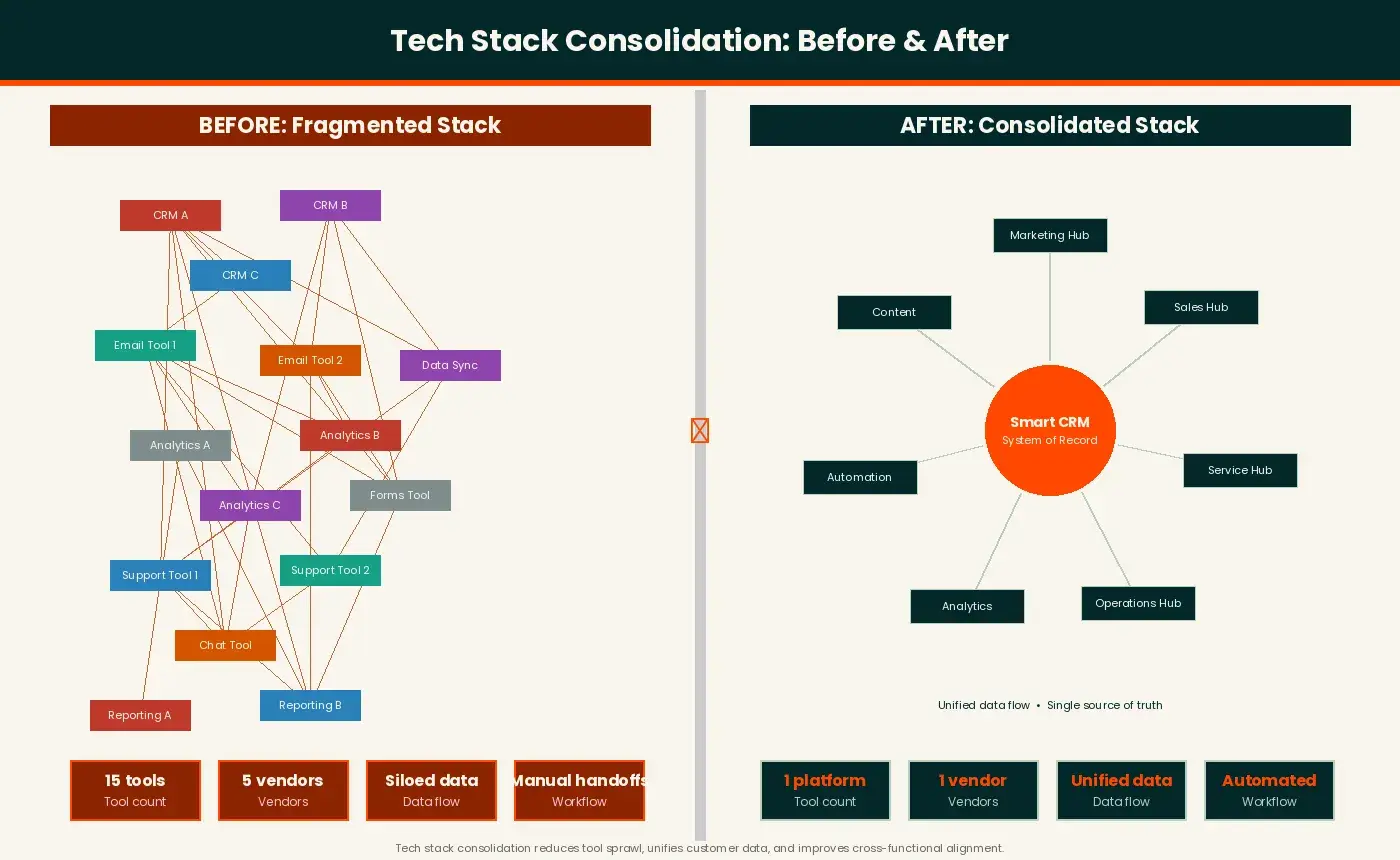
Tech stack consolidation, a strategic initiative focused on reducing the number of software tools an organization utilizes and standardizing operations on a more integrated and streamlined set of systems, is emerging as a critical imperative for businesses seeking to optimize efficiency, enhance data integrity, and drive sustainable growth. This process transcends mere cost-cutting, aiming to create a unified operational environment where data flows seamlessly across departments, empowering customer-facing teams with a single source of truth and enabling automation across the entire customer journey. The bedrock of successful tech stack consolidation lies in establishing a robust Customer Relationship Management (CRM) system as the central "system of record," a platform that consolidates customer data, orchestrates workflows, and serves as the ultimate authority for every team interacting with clients.
The rationale behind this strategic shift is multifaceted, extending far beyond the immediate financial benefits of reducing subscription costs. As businesses increasingly rely on digital tools to manage operations, the proliferation of specialized software, often referred to as "tool sprawl," can lead to fragmented data, redundant functionalities, and significant integration challenges. A consolidated tech stack addresses these issues at their root, fostering a more cohesive and effective operational framework. According to recent industry analyses, the increasing adoption of cloud-based software, while offering flexibility, has also contributed to an unmanaged expansion of tools, leading to higher overall spending and increased complexity for IT departments. Gartner has previously highlighted that software spending continues to rise even as organizations adopt more tools, underscoring the need for strategic consolidation rather than simply adding more solutions.
The core benefit of tech stack consolidation is the unification of customer data. When a single CRM system captures every interaction, from initial website visits through to customer renewals and support inquiries, teams are no longer burdened with reconciling conflicting definitions of customer status or engaging in time-consuming data reconciliation before critical business reviews. This unified data environment accelerates reporting cycles, enables seamless automation across the entire customer lifecycle, and significantly enhances the customer experience by equipping employees with the complete context of each customer interaction. For a broader understanding of what constitutes a modern, integrated technology stack, insights from leading brands reveal a trend towards platform-based solutions that offer comprehensive functionality rather than a disparate collection of single-purpose tools.
While cost savings are a tangible outcome, they are often secondary to the more profound operational gains. The reinvestment of freed-up resources and improved operational efficiency into core business functions, such as product development or customer acquisition, yields greater long-term returns. This strategic reinvestment is crucial for maintaining a competitive edge in rapidly evolving markets.
The Crucial Juncture for Tech Stack Consolidation
Identifying the opportune moment for tech stack consolidation is paramount. Several indicators signal that an organization has reached a point where such a strategic initiative is not merely beneficial but operationally necessary. These include:
- Significant Data Silos: When different departments operate with disparate datasets, leading to inconsistent reporting and a lack of a holistic customer view.
- High Operational Overhead for Integrations: The continuous effort and resources dedicated to making various software tools communicate with each other.
- Redundant Functionality Across Tools: The presence of multiple software solutions performing similar tasks, leading to confusion and wasted investment.
- Difficulty in Generating Unified Reports: When generating comprehensive reports requires manual data aggregation from numerous sources.
- Employee Frustration with Tool Switching: When staff frequently toggle between applications to complete their tasks, impacting productivity and morale.
- Inconsistent Customer Experience: When customers receive different levels of service or information depending on which department they interact with.
- Unforeseen Costs from Shadow IT: The emergence of departmental software purchases made outside of central IT oversight, leading to uncontrolled spending and security risks.
When three or more of these conditions are met, tech stack consolidation moves from being a desirable enhancement to an essential operational fix. The trigger is not a specific number of tools, but rather the point at which the collective friction generated by the existing technology stack outweighs the utility of the individual tools themselves.
Transformative Benefits Across the Business Landscape
The impact of a well-executed tech stack consolidation resonates across all facets of an organization:
- Marketing: A unified martech stack liberates marketing teams from the burden of data discrepancies, allowing them to focus on strategic campaign development and execution. Improved attribution modeling becomes possible when all customer touchpoints feed into a single platform. Automation of nurture campaigns, lead scoring, and customer lifecycle adjustments becomes more effective and holistic across the entire marketing funnel. This shift allows for more precise targeting and a deeper understanding of campaign ROI.
- Sales: Sales representatives benefit immensely from operating within a single CRM environment. They can access a prospect’s complete history, including past interactions, purchase behavior, and ongoing deals, without needing to navigate multiple applications. Pipelines, activity logs, sales sequences, and customer notes are all centralized, leading to more informed sales conversations and improved forecasting accuracy due to the completeness of underlying data.
- Customer Service: Support teams gain immediate access to a comprehensive customer record, including purchase history, previous support interactions, and active sales opportunities, directly within their helpdesk interface. This streamlined access facilitates faster issue resolution, reduces the need for customers to repeat information, and enhances overall customer satisfaction. Proactive support becomes more feasible when service agents have a full view of the customer’s journey.
- Operations, Finance, and IT: Vendor consolidation simplifies procurement processes, reduces the overall attack surface for cybersecurity threats, and allows finance departments to more accurately reconcile software spend against actual utilization. Operations teams can redirect their efforts from maintaining complex, custom integrations towards higher-value strategic initiatives. This also leads to more efficient resource allocation and better contract management.
A Strategic Roadmap for Tech Stack Consolidation
Successful tech stack consolidation requires a structured, step-by-step approach, often beginning with a thorough audit of the existing technology landscape. Skipping this foundational phase can lead to misinformed decisions and incomplete transformations.
Step 1: Audit Your Current Stack
The initial phase involves a comprehensive inventory of every tool currently in use, including those acquired outside of central IT procurement (shadow IT) or by individual departments. For each tool, detailed documentation should include:
- Tool Name and Vendor: Clear identification of the software and its provider.
- Primary Functionality: A concise description of what the tool does.
- Department(s) of Use: Which teams or individuals rely on the tool.
- Annual Cost: The financial investment associated with the software.
- Renewal Date: Critical for strategic planning and contract management.
- Data Flow and Integrations: How the tool interacts with other systems and what data it shares or receives.
- Utilization Metrics: Evidence of actual usage, not just licenses purchased.
- Ownership: The individual or team responsible for the tool’s management and performance.
The key artifact from this step is a master tool inventory that provides a clear overview of all software assets, their associated costs, renewal timelines, utilization rates, and interdependencies.
Step 2: Prioritize Categories and Identify Quick Wins
With a comprehensive inventory in hand, tools should be grouped by functional category (e.g., CRM, marketing automation, project management, communication). Within these categories, the focus shifts to identifying:

- Redundant Tools: Software solutions that perform overlapping functions.
- Underutilized Tools: Applications with low adoption rates that may not justify their cost or complexity.
- Opportunities for Consolidation: Areas where a single platform could effectively replace multiple existing tools.
- Quick Wins: High-impact, low-complexity consolidations that can be implemented rapidly to build momentum and demonstrate early success.
Prioritizing these areas allows for a phased approach, building confidence and freeing up budget for more complex migrations.
Step 3: Define the System of Record and Data Standards
Before making decisions about which tools to keep or retire, it is crucial to define where customer data will reside. Establishing a CRM as the primary system of record means:
- Centralized Customer Data: All contact, company, deal, and ticket information is housed within the CRM.
- Unified Customer View: Every team has access to a consistent and complete profile of each customer.
- Source of Truth for Workflows: The CRM powers automated processes and data-driven decisions across departments.
Complementary to this, data standards must be established. This includes defining consistent field naming conventions, clear lifecycle stage definitions for customers, and robust deduplication rules. These standards ensure data quality and predictability, preventing degradation during and after the migration process.
Step 4: Select What to Keep and Why
Each remaining tool should be evaluated against a consistent set of criteria, focusing on its contribution to business objectives. Key evaluation points include:
- Alignment with Business Goals: How well the tool supports strategic priorities.
- Functionality and Fit: Whether it offers essential capabilities that cannot be replicated within the core system.
- Integration Capabilities: Its ability to seamlessly connect with the defined system of record.
- Cost vs. Value: The return on investment and overall benefit it provides.
- User Experience and Adoption: Ease of use and likelihood of continued adoption by teams.
Tools that do not meet these criteria should be retired. The evaluation must be driven by demonstrable outcomes rather than perceived necessity.
Step 5: Plan Migrations Without Disruption
Before retiring any tool, a detailed migration plan is essential to minimize disruption. This involves:
- Data Migration Strategy: A clear plan for transferring existing data to the new system, ensuring accuracy and completeness.
- Workflow Reconfiguration: Adapting existing processes to function within the consolidated environment.
- User Training: Comprehensive training for all affected users on the new or modified tools and workflows.
- Phased Rollouts: Implementing changes in stages, perhaps by department or specific use case, to identify and address issues early.
Step 6: Enable Teams and Measure Adoption
The success of consolidation hinges on user adoption. Failure to adequately train teams can lead to a reversion to old tools. For each migrated function, comprehensive enablement should include:
- Targeted Training Programs: Tailored training sessions that address specific user roles and workflows.
- Ongoing Support: Access to resources and support channels for users encountering difficulties.
- Feedback Mechanisms: Channels for users to provide feedback on their experience with the new system.
Adoption should be measured not just by login counts but by key business outcomes, such as improved data completeness, higher automation trigger rates, and successful workflow completion.
Step 7: Govern and Prevent Re-sprawl
Without ongoing governance, the tendency for tool sprawl can re-emerge within 12-18 months. Establishing robust governance mechanisms is crucial for long-term success. This includes:
- Defined Intake Process: A standardized process for evaluating and approving all new software requests.
- Category Ownership: Assigning clear responsibility for managing specific tool categories.
- Regular Review Cadence: Scheduled reviews of tool utilization and performance.
- Documented Standards: Making data standards, integration requirements, and approved vendor lists easily accessible.
- Living Tool Inventory: Maintaining an up-to-date inventory of all software assets.
Navigating Common Challenges and Their Solutions
Tech stack consolidation is not without its hurdles. Anticipating and addressing these challenges proactively is key to a successful implementation:
- Stakeholder Resistance: Teams may resist losing tools they have become accustomed to. Mitigation involves early and consistent communication about the benefits, involving stakeholders in the decision-making process, and providing adequate training and support for the transition.
- Legacy Edge Cases: Some tools may address highly specific workflows that are not easily replicated. The solution is to evaluate if these are truly essential and integrate them cleanly if kept, or invest in workarounds within the core platform if the use case is narrow and utilization is low.
- Integration Gaps: Unexpected difficulties in integrating systems can arise. Thorough technical assessment and potentially engaging integration specialists are necessary. Prioritizing platforms with robust APIs can mitigate this risk.
- Contract Timing: Deciding to retire a tool mid-contract can be financially challenging. Strategic planning around renewal dates and negotiation with vendors can help align retirement plans with contractual obligations.
- Dirty Data: Migrating poor-quality data into a new system perpetuates problems. Data cleansing and standardization efforts must be a priority before any migration.
- Misalignment with Procurement, Security, and Finance: Lack of collaboration with these critical departments can create downstream issues. Early and continuous engagement ensures buy-in and addresses potential roadblocks related to budget, security protocols, and financial controls.
Proactive Measures to Prevent Future SaaS Sprawl
To ensure that the gains from consolidation are sustainable, organizations must implement forward-thinking strategies to prevent the recurrence of SaaS sprawl:
- Intake Process: A formalized process for evaluating new software requests, including a business case, cost analysis, integration requirements, and a check for existing redundancies. This acts as a critical gatekeeper.
- Category Ownership: Designating specific individuals or teams as owners for each software category ensures accountability for renewals, utilization reviews, and the assessment of new requests within that domain.
- Renewal-Based Review Cadence: Quarterly reviews tied to major contract renewal cycles provide a structured opportunity to assess tool utilization against licenses and identify underperforming or obsolete software.
- Documented Standards: Clearly documented data standards, integration requirements, and an approved vendor list, made readily accessible to relevant teams, create a clear framework for technology decisions.
- Living Tool Inventory: Maintaining an up-to-date inventory serves as a dynamic record of the organization’s software assets, essential for ongoing governance and future consolidation efforts.
Key Mistakes to Sidestep During Consolidation
Several common missteps can derail consolidation efforts:

- Focusing solely on cost savings: Neglecting the significant operational and strategic benefits of unified data and workflows.
- Skipping the audit phase: Leading to incomplete understanding of the existing landscape and flawed decision-making.
- Underestimating data migration complexity: Failing to allocate sufficient resources and time for data cleansing and migration.
- Neglecting user adoption and training: Resulting in low usage of new systems and a return to old habits.
- Failing to establish governance: Allowing the uncontrolled adoption of new tools to reintroduce sprawl.
- Not securing executive sponsorship: Lacking the top-down support needed to drive significant organizational change.
A Practical 90-Day Tech Stack Consolidation Plan
A structured, phased approach can yield significant progress within the first 90 days. The scope can be adjusted based on the organization’s size and the complexity of its existing tech stack.
Days 1-30: Audit and Align
- Week 1: Initiate the collection of tool inventory data from finance, IT, and department heads to establish a foundational list.
- Weeks 1-2: Enhance the inventory by documenting utilization, renewal dates, data flows, and assigned ownership for each tool.
- Weeks 2-3: Map data flows and integration dependencies to understand the interconnectedness of the existing systems.
- Week 3: Present initial findings to leadership and align on overarching consolidation goals and priorities.
- Week 4: Define a candidate for the system of record and establish initial data standards in collaboration with key stakeholders.
Days 31-60: Prioritize and Plan
- Week 5: Score each tool against predefined criteria for retention or retirement, and identify potential quick wins.
- Week 6: Finalize the selection of the system of record and validate the feasibility of essential integrations.
- Week 7: Develop a detailed migration plan and execution runbook for the identified quick-win consolidations.
- Week 8: Communicate the consolidation plan to affected teams, setting clear go-live dates and managing expectations.
Days 61-90: Execute Pilot and Govern
- Week 9: Conduct a pilot migration for the first quick-win tool to test the process and gather early feedback.
- Week 10: Deliver targeted training programs to affected teams on the new or modified workflows and tools.
- Week 11: Officially retire the first tool and begin tracking user adoption and key performance indicators.
- Week 12: Implement governance structures, including the intake form, category ownership assignments, and the establishment of a regular review cadence.
Post Day 90, the focus shifts to ongoing quarterly review cycles to maintain control over the technology landscape and prevent the re-emergence of sprawl.
Frequently Asked Questions About Tech Stack Consolidation
-
How long does tech stack consolidation typically take?
The timeline for tech stack consolidation can range from three to twelve months, influenced by the size of the existing stack, the complexity of integrations, and the volume of data requiring migration. While a 90-day plan can address initial phases, comprehensive CRM migrations might extend to a full quarter. Larger organizations or those with multiple business units may undertake consolidation in waves over 12-18 months. -
How can organizations avoid vendor lock-in during consolidation?
Prioritizing platforms with open APIs and a robust partner ecosystem is crucial. Avoiding proprietary data formats and negotiating data portability clauses in enterprise contracts are also important strategies. Maintaining a flexible integration layer between the system of record and category-specific tools ensures that individual components can be replaced if necessary. -
Can smaller teams benefit from consolidation?
Yes, smaller teams often experience even more immediate and pronounced benefits. A five-person team managing eight disparate tools faces proportionally higher overhead than a larger enterprise. For smaller teams, the primary advantage is significant time savings and improved data clarity. Opting for platforms that natively integrate multiple functions can eliminate the burden of complex integrations altogether. -
What metrics should be tracked to confirm consolidation success?
Success should be measured across four key areas:- Cost: Overall software spend and cost per user.
- Data Quality: Completeness of records, reduction in duplicate entries, and standardization of fields.
- Adoption: Active user engagement and feature utilization.
- Business Outcomes: Improvements in conversion rates, sales velocity, customer satisfaction scores, and other relevant KPIs. Baselines should be established before migration, with regular checks at 30, 60, and 90 days post-implementation.
-
How should edge-case tools be handled during consolidation?
Edge-case tools should be retained if they address a genuine, critical workflow, demonstrate consistent utilization, and can integrate seamlessly with the core system of record. These should be documented as deliberate exceptions. If an "edge case" represents low utilization with a very narrow application, it may be more efficient to invest in replicating that functionality within the primary platform rather than maintaining a separate vendor relationship.
The strategic imperative for tech stack consolidation is clear: it is not merely an IT initiative but a fundamental business strategy that drives efficiency, enhances data integrity, and ultimately fuels sustainable growth in today’s competitive digital landscape.
About the Author