The rapid evolution of generative artificial intelligence has fundamentally altered the landscape of digital marketing, content creation, and corporate communications. As organizations face increasing pressure to produce high volumes of quality content across multiple platforms, AI content generators have transitioned from experimental novelties to essential enterprise tools. These platforms, powered by large language models (LLMs) such as OpenAI’s GPT-4 and Anthropic’s Claude, allow for the rapid synthesis of data into blog posts, social media updates, advertising copy, and technical reports. The global AI writing assistant market, valued at approximately $1.2 billion in 2023, is projected to expand at a compound annual growth rate (CAGR) of 27% through 2030, reflecting a broader industrial shift toward automated productivity.
The Evolution of Generative AI in Content Marketing
The trajectory of AI content generation began in earnest with the release of GPT-2 in 2019, but it was the 2020 debut of GPT-3 that provided the first viable foundation for commercial writing tools. Early adopters utilized these tools for "spinning" SEO content, yet the technology quickly matured. By 2022, platforms began integrating sophisticated user interfaces that allowed non-technical users to guide AI outputs through specific "prompts" and templates.

Today, the industry is defined by a shift from simple text generation to "brand-aware" intelligence. Modern tools do not merely predict the next word in a sentence; they analyze existing brand voices, incorporate real-time SEO data, and integrate directly into content management systems (CMS). This technological maturity has led to the emergence of ten dominant platforms, each catering to specific market segments ranging from individual freelancers to multinational e-commerce corporations.
Comprehensive Analysis of Leading AI Content Tools
1. Jasper AI: The Enterprise Standard
Formerly known as Jarvis, Jasper AI underwent a significant rebranding in early 2022 following trademark discussions with Disney-owned Marvel. Since then, it has positioned itself as the premier solution for enterprise-level marketing teams. Jasper utilizes a blend of several LLMs to ensure uptime and quality, offering a "Boss Mode" that allows for long-form document creation.
The platform’s primary value proposition lies in its ability to learn a company’s specific brand voice by scanning uploaded documents and websites. Its pricing structure reflects this professional focus, with the Pro plan starting at approximately $59 per month and the Creator plan at $39 per month. Recent updates include an integrated AI image generator and an API for custom enterprise integrations.
2. Copy.ai: Workflow Automation and GTM Strategy
Copy.ai has evolved from a simple copywriting tool into a "Go-to-Market" (GTM) platform. It offers over 90 templates for various content types, including social media posts, digital ad copy, and product descriptions. Unlike competitors that focus solely on the writing process, Copy.ai emphasizes "Workflows," allowing users to automate repetitive tasks like turning a product brief into a full suite of marketing assets.
Market data suggests that Copy.ai is particularly popular among startups due to its generous free tier and intuitive interface. The "Pro" subscription is priced at $49 per month, offering unlimited words and multi-user seats, making it a scalable option for growing agencies.
3. Frase: SEO Optimization and Content Intelligence
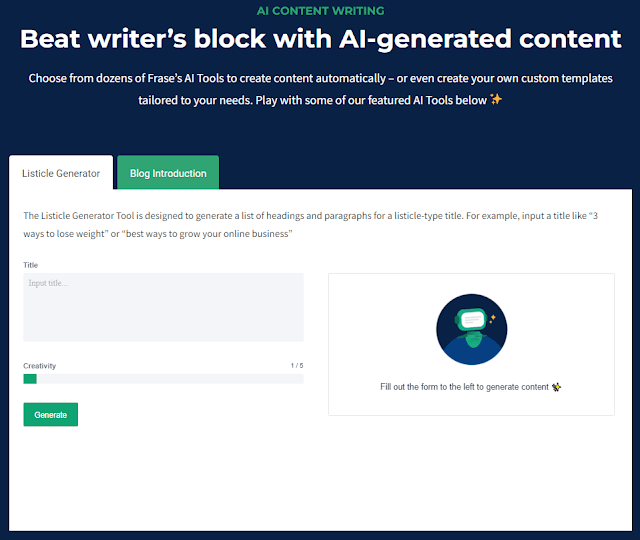
Frase distinguishes itself by merging AI writing with SEO research. Rather than simply generating text, Frase analyzes the top-performing results on Search Engine Results Pages (SERPs) for a given keyword. It then provides a content brief that outlines the subheadings, keywords, and questions necessary to rank competitively.

The tool’s AI writer uses this data to draft sections that are pre-optimized for search engines. Pricing is tiered to accommodate different scales of operation: the Solo plan at $14.99 per month, the Basic plan at $44.99 per month, and the Team plan at $114.99 per month.
4. Article Forge: Automated Long-Form Research
Article Forge operates on a different philosophical premise than most "chat-based" AI tools. It requires only a keyword and a few parameters to generate a complete, 1,500-word article from scratch. The software employs a proprietary deep learning engine that researches the topic in real-time to ensure factual relevance.
This tool is frequently utilized by SEO specialists managing large portfolios of niche websites. It offers a 30-day money-back guarantee and structures its pricing based on word count: a Basic plan at $27 per month (25,000 words) and an Unlimited plan at $117 per month.
5. Rytr: High-Performance Budget Solutions
For freelancers and small businesses, Rytr provides a lightweight yet powerful writing assistant. Supporting over 30 languages and 20 different tones of voice, it is one of the most accessible tools on the market. Rytr includes a built-in plagiarism checker and an image generator within its interface.
The platform is noted for its "Saver Plan" at $9 per month, which allows for 100,000 characters per month, and an "Unlimited Plan" at $29 per month. This pricing model has made it a favorite in emerging markets and academic settings.
6. Writesonic: Real-Time Data Integration
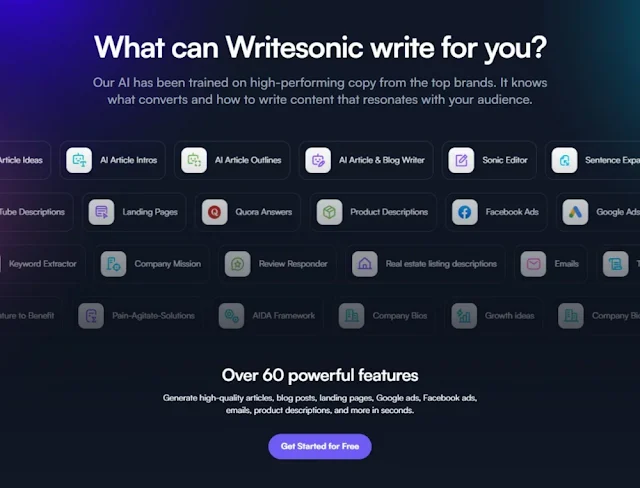
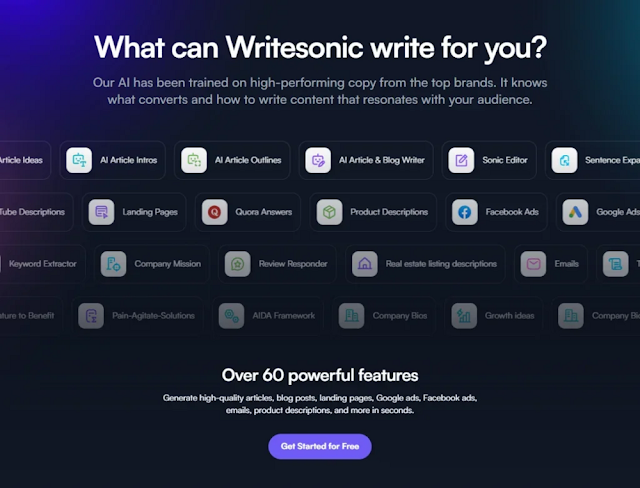
Writesonic has gained market share by addressing one of the primary weaknesses of early AI: the "knowledge cutoff." Through its "Chatsonic" feature, the platform integrates with Google Search to provide up-to-date information on current events. This makes it particularly effective for news-based blogging and trend analysis.

Writesonic’s pricing is flexible, based on the quality of the AI (GPT-3.5 vs. GPT-4) and word count. The "Small Team" plan starts at $19 per month, providing access to advanced features like brand voice and bulk processing.
7. Copysmith: E-commerce and Catalog Management
Copysmith, which recently joined forces with Describely, is specialized for the e-commerce sector. It excels at generating thousands of unique product descriptions for large online retailers. The platform integrates with Shopify, WooCommerce, and Amazon, allowing for seamless content deployment.
The "Starter" plan is priced at $19 per month, while the "Pro" plan at $49 per month offers more extensive integrations and higher volume limits.

8. Hypotenuse AI: Batch Generation and Visual Content
Hypotenuse AI focuses on streamlining the bridge between product data and marketing copy. It is highly regarded for its batch generation capabilities, which can transform a spreadsheet of product specifications into high-quality copy in minutes.
The "Starter" plan begins at $29 per month, while the "Growth" plan at $59 per month includes 250 high-quality AI images and more robust support for long-form content.
9. Kafkai: Niche-Specific Algorithms
Kafkai is built specifically for SEOs who require bulk content for specific niches. Unlike general-purpose models, Kafkai uses niche-trained models to ensure that the terminology and context are accurate for industries ranging from health to finance. Its pricing is volume-based, starting at $29 per month for 100 articles, scaling up to $199 for 2,500 articles.
10. Peppertype.ai: The Content Marketplace Hybrid
Peppertype.ai (now part of the Pepper Content ecosystem) combines AI generation with human-in-the-loop workflows. It is designed for marketing teams that want to use AI for drafting but require a structured environment for human editing and approval. The "Personal" plan is $35 per month, while the "Team" plan is $199 per month.
Industry Chronology: 2020–2024
- June 2020: OpenAI releases GPT-3, sparking the creation of the first wave of AI writing tools.
- January 2022: Jarvis rebrands to Jasper AI to avoid legal conflicts, signaling the maturation and professionalization of the sector.
- November 2022: The launch of ChatGPT democratizes access to LLMs, forcing existing tools to innovate through specialized features (SEO, brand voice, workflows).
- May 2023: Google announces "Search Generative Experience" (SGE), prompting AI content tools to focus more on "Helpful Content" and EEAT (Experience, Expertise, Authoritativeness, and Trustworthiness).
- Early 2024: Integration of multi-modal AI (text, image, and video generation) becomes the standard for high-end content platforms.
Market Analysis and Implications
The proliferation of AI content tools has created a "productivity paradox." While the cost of producing a single word has plummeted to near zero, the value of high-quality, original insight has increased. Google’s Search Quality team has repeatedly stated that their focus remains on content quality rather than the method of production. In a 2023 update, Google clarified that AI-generated content is not inherently against their guidelines, provided it is created for users and not primarily to manipulate search rankings.
However, the industry faces significant ethical and legal headwinds. Copyright concerns regarding the training data used by LLMs remain a subject of active litigation. Furthermore, the risk of "hallucinations"—where AI generates false information with high confidence—requires that human oversight remains a critical component of the content lifecycle.

Broader Impact on Professional Roles
The role of the content writer is shifting from "creator" to "editor and strategist." In the current landscape, the most successful professionals are those who can effectively "prompt" AI tools to produce drafts and then apply human nuance, fact-checking, and brand alignment.
As we move further into 2024, the distinction between "AI content" and "human content" will likely continue to blur. The winners in the digital space will be those who leverage these ten tools not to replace human creativity, but to amplify it, allowing for a more data-driven and responsive approach to global communication. Organizations must choose their tools based on their specific needs—whether it be Jasper’s enterprise brand voice, Frase’s SEO intelligence, or Rytr’s cost-effective versatility—to remain competitive in an increasingly automated world.
About the Author