The digital marketing landscape is currently undergoing a transformative shift as artificial intelligence (AI) moves from a niche experimental technology to a fundamental pillar of content strategy. As of 2022, the demand for high-volume, search-engine-optimized (SEO) content has outpaced the manual capacity of many marketing teams, leading to the rapid adoption of AI-driven writing assistants. These tools, primarily powered by sophisticated natural language processing (NLP) models such as OpenAI’s GPT-3, are designed to alleviate "blank page syndrome" and significantly reduce the time required to produce blog posts, social media updates, and product descriptions.
The integration of AI into the creative process is not merely about speed; it is about the ability to maintain relevance in an increasingly saturated information market. By analyzing vast datasets, these generators can mimic specific brand voices and adhere to complex SEO requirements that would take human editors hours to research. This report examines the leading platforms in the sector, analyzing their features, pricing structures, and the broader implications for the content creation industry.

The Evolution of AI Writing: A Brief Chronology
The journey toward modern AI content generation began with rudimentary "article spinners" in the early 2010s, which often produced unreadable, grammatically incorrect text. However, the release of GPT-2 in 2019 and the subsequent launch of GPT-3 in 2020 marked a turning point. These models allowed software developers to build interfaces that could generate human-like prose.
In early 2022, the industry saw significant consolidation and rebranding, most notably with the platform Jarvis transitioning to Jasper. This change followed legal considerations regarding trademark similarities to the Marvel Cinematic Universe, but it also signaled a broader maturation of the market. Throughout the year, these tools have moved beyond simple text generation to include features like integrated SEO auditing, plagiarism detection, and multi-language support, reflecting the diverse needs of a globalized digital economy.
Leading AI Content Generation Platforms of 2022
1. Jasper AI: The Enterprise Standard
Jasper, formerly known as Jarvis, has established itself as the market leader for long-form content. It is specifically engineered for marketing professionals who require high-quality blog posts and reports. The platform’s "Boss Mode" is a notable feature, allowing users to issue direct commands to the AI, effectively treating the software as a collaborative partner rather than a static tool.
Jasper’s pricing reflects its premium positioning, with Boss Mode starting at $99 per month. The tool’s ability to integrate with SEO tools like SurferSEO has made it a favorite among agencies. Industry data suggests that Jasper can reduce content production time by up to 80%, though it requires significant human oversight to ensure factual accuracy.
2. Copy.ai: Solving the Creative Block
Copy.ai focuses heavily on short-form marketing copy. With over 90 templates ranging from "Hook Text" to "Instagram Captions," it caters to social media managers and advertising specialists. The platform operates on a freemium model, offering a 7-day trial followed by a Pro plan at $49 per month. Its primary value proposition lies in its ability to generate dozens of variations for a single prompt, allowing marketers to A/B test different messaging styles efficiently.
3. Frase AI: SEO Optimization and Research
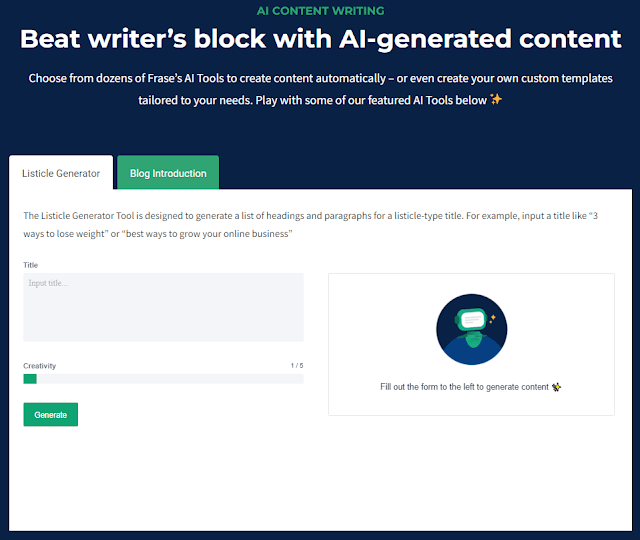
Unlike tools that focus solely on writing, Frase AI prioritizes the research and optimization phases of content creation. It analyzes the top-ranking search results for a given keyword and generates a content brief based on what search engines currently favor. This data-driven approach ensures that the resulting content is not only well-written but also strategically positioned to rank. Pricing for Frase is tiered, with solo plans starting at $14.99 per month, scaling up to $114.99 for teams.

4. Article Forge: High-Efficiency Automation
Article Forge distinguishes itself through a "one-click" philosophy. While other tools require constant guidance, Article Forge generates a complete 1,500-word article based on a single keyword. This tool is frequently utilized by SEO specialists managing large networks of websites where volume is the primary metric. Its basic plan starts at $27 per month for 25,000 words.
5. Rytr: The Versatile Assistant
Rytr has gained popularity among freelancers and students due to its affordability and clean user interface. It offers a free tier that permits up to 5,000 characters per month, with a "Saver Plan" at $9 per month. Rytr supports over 30 languages and 20 different tones, making it a highly adaptable tool for international markets.
6. Writesonic: Marketing-Centric Generation
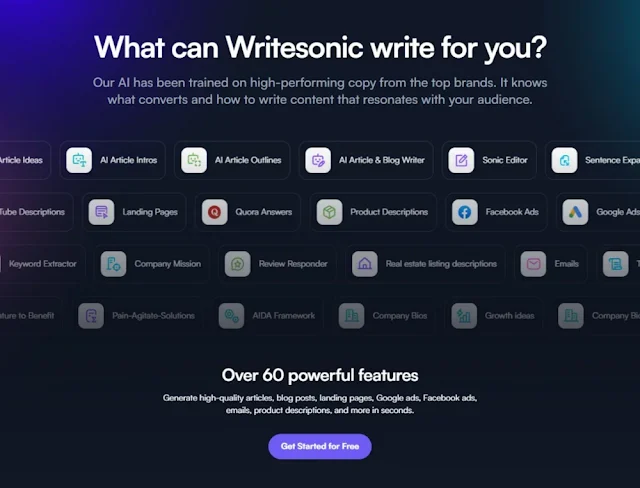
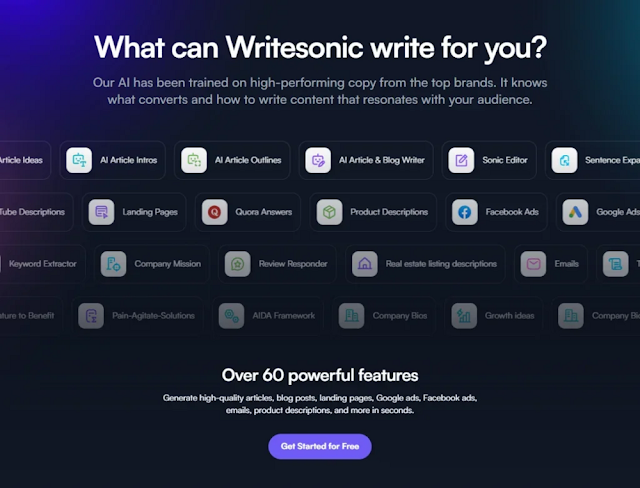
Writesonic is tailored for the needs of e-commerce and digital advertising. It includes built-in grammar and plagiarism checkers, addressing two of the primary concerns associated with AI text. The platform offers a credit-based free trial, with paid plans for short-form and long-form content starting at $15 and $19 per month, respectively.
7. Copysmith: Scalable Solutions for E-commerce
Copysmith is designed for growth-oriented teams and agencies. It offers a wide array of templates and emphasizes collaborative features. The "Starter Plan" begins at $19 per month, but the platform’s real strength lies in its enterprise-level integrations, allowing large businesses to automate product descriptions across thousands of SKUs.
8. Hypotenuse.ai: Specialized Product Copy
Hypotenuse.ai has carved a niche in the e-commerce sector by focusing on product descriptions and marketing visuals. Its interface is streamlined for beginners, offering a "Starter Plan" at $29 per month. The platform’s growth plan, at $59 per month, includes higher word counts and priority support, catering to expanding online retailers.
9. Kafkai: Niche-Specific Algorithms
Kafkai takes a unique approach by training its AI on specific niches rather than general web data. This results in content that often feels more "insider" to particular industries. It operates on a per-article pricing model, with plans ranging from $29 for 100 articles to $199 for 2,500 articles, making it one of the most cost-effective options for bulk content.

10. Peppertype.ai: Small Business Empowerment
Peppertype.ai serves as an entry point for small business owners who lack dedicated copywriters. It focuses on clarity and simplicity, offering a personal plan for $35 per month. The platform is part of the larger Pepper Content ecosystem, which bridges the gap between AI generation and human expert editing.
Supporting Data: The Economic Impact of AI Writing
Statistical analysis of the content marketing industry reveals a significant shift in resource allocation. According to recent market research, the AI writing assistant market is projected to grow at a compound annual growth rate (CAGR) of over 15% through 2025. This growth is driven by the stark difference in costs: while a high-quality human-written article might cost between $100 and $500, an AI-generated draft can be produced for pennies in subscription fees.
However, data also indicates that content produced entirely by AI without human editing often suffers from a "hallucination" rate—where the AI confidently states false information—ranging from 15% to 20% depending on the complexity of the topic. Consequently, the most successful firms are adopting a "human-in-the-loop" model, where AI handles the drafting and humans handle the verification and creative polishing.

Industry Reactions and Ethical Considerations
The rise of these tools has elicited a mixed response from the professional writing community. While some view AI as a threat to job security, others see it as a necessary evolution. "AI doesn’t replace the writer; it replaces the grunt work," stated one digital agency director. "It allows our creative staff to focus on strategy and high-level storytelling rather than repetitive SEO filler."
From an ethical standpoint, the debate centers on transparency and academic integrity. Search engines like Google have updated their guidelines to clarify that while AI-generated content is not inherently penalized, content created solely to manipulate search rankings—without providing value to the user—violates their spam policies. This has led to the development of "AI detection" tools, creating an ongoing technological arms race between generators and detectors.
Analysis of Broader Implications and Future Outlook
The proliferation of AI content generators in 2022 marks the beginning of a new era in digital communication. As these tools become more sophisticated, the barrier to entry for content creation will continue to lower. This will likely lead to an even greater glut of information online, making high-quality, human-vetted content more valuable as a trust signal.
Furthermore, we can expect a shift in the skills required for marketing professionals. "Prompt engineering"—the ability to effectively communicate with and guide an AI—is becoming a sought-after competency. The future of the industry likely lies in a hybrid model where AI serves as the engine of production, but human intuition, ethics, and emotional intelligence remain the steering wheel.
In conclusion, the top 10 AI content generator tools of 2022 offer a diverse range of solutions for modern digital challenges. Whether for a solo blogger using Rytr or a global enterprise utilizing Jasper, these tools represent a permanent change in how the world creates, consumes, and ranks information. Businesses that fail to integrate these efficiencies risk being outperformed by competitors who can produce more, faster, and with greater data-driven precision.
About the Author