The emergence of these tools represents a broader trend in the "Creator Economy," where the focus has shifted from the mechanical act of writing to the strategic act of content orchestration. By utilizing natural language processing (NLP) and machine learning, these platforms can analyze vast datasets to mimic human tone, adhere to specific brand voices, and optimize for search engine visibility. The following analysis examines the leading software solutions currently defining the AI writing market, their technical capabilities, and the economic implications of their widespread adoption.
1. Jasper AI: The Enterprise Standard for Long-Form Content
Formerly known as Jarvis, Jasper AI has solidified its position as the market leader in the generative AI space throughout 2022. The platform’s success is largely attributed to its "Boss Mode" feature, which allows users to direct the AI through long-form documents using natural language commands. Unlike simpler tools that generate isolated paragraphs, Jasper is engineered to maintain context over thousands of words, making it a primary choice for professional bloggers and marketing agencies.

The platform integrates directly with SEO tools like Surfer SEO, creating a workflow that combines creative generation with data-driven optimization. In early 2022, the company underwent a significant rebranding from Jarvis to Jasper to avoid trademark conflicts, a move that coincided with a massive surge in venture capital interest in the sector. Jasper’s pricing model, starting at $99 per month for Boss Mode, reflects its positioning as a premium enterprise tool rather than a budget utility.
2. Copy.ai: Streamlining Short-Form Marketing Copy
While Jasper focuses on long-form narratives, Copy.ai has captured the market for short-form marketing collateral. The platform offers over 90 templates specifically designed for social media posts, Facebook advertisements, product descriptions, and email subject lines. The utility of Copy.ai lies in its ability to overcome "writer’s block" by providing dozens of variations for a single prompt, allowing marketers to A/B test copy with minimal effort.
In terms of market accessibility, Copy.ai offers a competitive "Pro" plan at $49 per month, which includes unlimited projects. This has made it a favorite among small business owners and solopreneurs who require a high volume of daily social content but lack the budget for a dedicated copywriting staff.
3. Frase AI: The Intersection of Research and Optimization
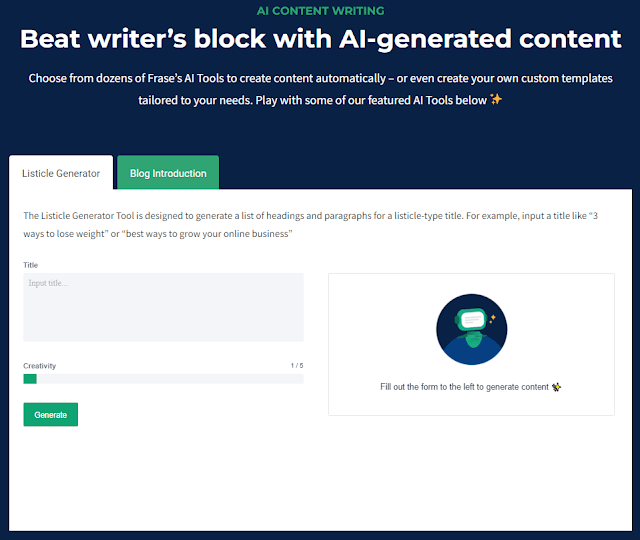
Frase AI distinguishes itself by functioning as both a content generator and a comprehensive SEO research tool. In the current SEO climate, search engines prioritize "content depth" and "topical authority." Frase addresses this by analyzing the top-performing results on Google for any given keyword and generating a content brief that outlines the necessary subheadings, frequently asked questions, and keyword density required to compete.
The platform’s AI writing capabilities are secondary to its analytical functions, yet they are highly integrated. Frase’s "Solo" plan begins at $14.99 per month, making it one of the most cost-effective options for SEO specialists who prioritize data-backed content structures over raw creative output.
4. Article Forge: Automated Bulk Content Generation
Article Forge represents a different philosophical approach to AI writing. While Jasper and Copy.ai function as "co-writers" that require human intervention, Article Forge is designed for near-total automation. By entering a single keyword, the tool researches the topic and generates a complete, unique article of up to 1,500 words.

This tool is frequently utilized by managers of Private Blog Networks (PBNs) and high-volume niche sites where the primary goal is to maintain a consistent publishing schedule for SEO purposes. The platform guarantees that its content will pass Copyscape, ensuring that the generated text is technically unique, though it often requires human editing to ensure stylistic flow.
5. Rytr: High-Utility Freemium Accessibility
Rytr has gained significant traction in 2022 by offering one of the most robust free tiers in the industry. Allowing for 5,000 characters of generation per month at no cost, Rytr has become the entry point for students and novice bloggers. The software supports over 30 languages and 20 different tones of voice, providing a versatile interface for global users.
The "Saver Plan" at $9 per month is particularly disruptive, offering a middle ground for users who need more than the free tier but are not yet ready for the high-cost subscriptions of enterprise-grade tools.
6. Writesonic: Comprehensive Marketing Automation
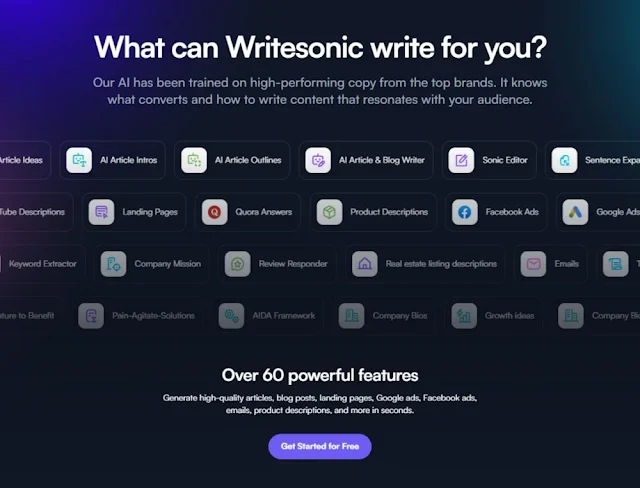
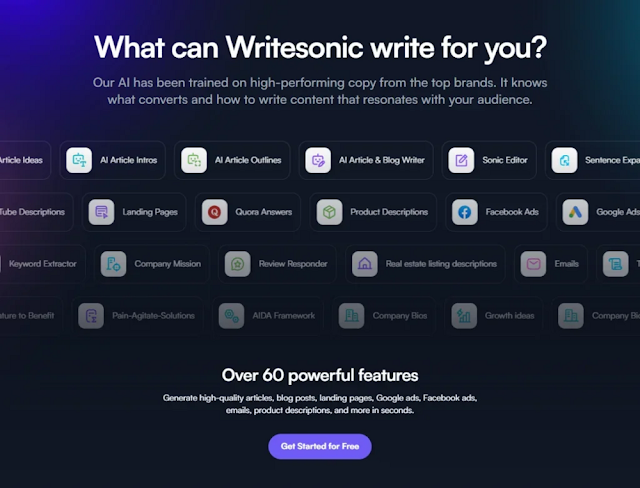
Writesonic is engineered for the full-funnel marketer. Beyond blog posts, it includes specialized tools for generating landing pages, complete with optimized headers and call-to-action buttons. One of its standout features in 2022 is the "AI Article Writer 3.0," which guides users through a four-step process: generating ideas, creating an outline, choosing a title, and finally drafting the article.
This structured approach reduces the "hallucination" rate of the AI—a common issue where the software generates factual inaccuracies—by forcing the model to adhere to a pre-approved logical structure.
7. Copysmith: The E-Commerce Specialist
Copysmith is specifically tailored for e-commerce platforms and large-scale product catalogs. For businesses managing thousands of SKUs, writing unique product descriptions is a monumental task. Copysmith’s API and bulk generation features allow businesses to generate thousands of descriptions simultaneously, ensuring that each product page has unique content to avoid "duplicate content" penalties from search engines.

8. Hypotenuse.ai: Enhancing Visual and Textual Synergy
Hypotenuse.ai has carved out a niche by focusing on the synergy between product images and text. Like Copysmith, it excels in the e-commerce sector, but it places a heavier emphasis on the "Growth Plan," which includes features like Shopify integration and bulk workflows. It is frequently cited for having a particularly intuitive user interface that simplifies the process of generating high-converting product copy from minimal data inputs.
9. Kafkai: Niche-Specific Neural Networks
Kafkai operates on a unique model where it uses niche-specific neural networks. Rather than using a general-purpose model for all tasks, Kafkai allows users to select from dozens of specific niches (e.g., health, finance, or technology). This specialization allows the AI to use industry-specific terminology more accurately than generalized models, making it a powerful tool for marketers operating in highly technical fields.
10. Peppertype.ai: Collaborative Content Creation
Peppertype.ai emphasizes the collaborative nature of content creation. Its "Team Plan" at $199 per month is designed for agencies where multiple stakeholders need to review, edit, and approve AI-generated drafts. The platform focuses on "quality over quantity," with built-in grammar checkers and an interface that prioritizes the readability of the output.

A Chronology of the AI Writing Revolution
The rapid advancement of these tools in 2022 is the result of a decade of development in computational linguistics.
- 2015: The founding of OpenAI, which set the stage for democratizing access to high-level AI.
- 2019: The release of GPT-2 demonstrated that AI could generate coherent paragraphs, though it often lost the narrative thread.
- 2020: The debut of GPT-3 marked a paradigm shift. With 175 billion parameters, the model could suddenly pass the Turing test in short bursts.
- 2021: The "SaaS Explosion" occurred, as developers used OpenAI’s API to build the interfaces now known as Jasper, Copy.ai, and others.
- 2022: The current year has been defined by "Refinement and Regulation," as tools become more specialized and search engines begin to formulate policies regarding AI-generated text.
Official Responses and Market Data
The rise of AI content has not been without controversy. In April 2022, Google’s Search Advocate, John Mueller, stated during an SEO office-hours session that content automatically generated with AI tools is considered "spam" according to the Webmaster Guidelines. However, this stance has evolved. The industry consensus is that Google’s algorithms are designed to detect low-quality content, regardless of whether a human or an AI wrote it. Consequently, the most successful users of AI tools in 2022 are those who use the software to draft content but employ human editors to verify facts and add "Experience, Expertise, Authoritativeness, and Trustworthiness" (E-E-A-T).
Statistically, the adoption of AI in marketing is skyrocketing. According to market research, the AI in marketing market size was valued at approximately $15.84 billion in 2021 and is projected to reach over $107.5 billion by 2028. This represents a compound annual growth rate (CAGR) of nearly 30%.
Broader Impact and Future Implications
The proliferation of AI content generators in 2022 signals a fundamental change in the economics of information. As the cost of producing a 1,000-word article drops from roughly $100 (the rate for a mid-level freelance human writer) to mere cents in computing power, the internet faces a potential "tsunami of content."
The long-term implication is a shift in value. When text is abundant and cheap, the value moves toward original research, primary interviews, and unique perspectives—things AI cannot currently replicate. For businesses, the top 10 tools listed above are no longer "optional" luxuries but are becoming essential infrastructure for staying competitive in a digital-first economy. The challenge for 2023 and beyond will be balancing the efficiency of these machines with the essential human touch that prevents the digital world from becoming a sea of algorithmic noise.
About the Author