
Understanding the true cost of acquiring a potential customer is paramount for businesses seeking to optimize their marketing investments. The metric of Cost Per Lead (CPL) provides a crucial lens through which to evaluate the effectiveness and efficiency of marketing and sales initiatives. This article delves into the significance of CPL, its calculation, and actionable strategies for businesses aiming to reduce it, ultimately driving better return on investment (ROI).
The Genesis of Lead Generation: From Speculation to Strategic Investment
The foundational principle of business growth hinges on a consistent influx of new customers. This influx, in turn, is directly dependent on the ability to generate leads – individuals or entities that have demonstrated an interest in a company’s products or services. Historically, marketing has been viewed as a speculative investment, a necessary expenditure with the expectation of future returns. However, without a clear understanding of the financial outlay required to secure each potential customer, businesses operate in an environment of uncertainty. This is precisely where the Cost Per Lead calculation becomes indispensable. By quantifying the expense associated with attracting each interested party, businesses gain the insight needed to assess the efficacy of their marketing and sales endeavors.
What Constitutes Cost Per Lead?
Cost Per Lead (CPL) is defined as a key marketing metric that quantifies the total financial expenditure incurred in generating a single lead for a business. It represents the average dollar amount invested to attract a potential customer who has expressed interest in a company’s offerings. The definition of a "quality lead" can vary significantly depending on the specific marketing campaign and the industry. Generally, it can encompass individuals who have:
- Downloaded a whitepaper or e-book
- Subscribed to a company newsletter
- Completed a contact form on the company website
- Requested a demo or consultation
- Engaged with a social media advertisement or post
- Attended a webinar or online event
- Visited a company booth at a trade show
The CPL metric serves as a robust barometer for assessing the success, or indeed the shortcomings, of digital marketing efforts. It allows for the evaluation of individual campaigns executed across specific channels, as well as providing an overarching gauge of the efficiency of an organization’s total marketing expenditure.
Distinguishing CPL from Cost Per Acquisition (CPA)
It is critical to differentiate CPL from Cost Per Acquisition (CPA). While CPA measures the total cost associated with acquiring a paying customer or successfully closing a sale, CPL focuses exclusively on the expenditure involved in generating potential customers. Leads are distinct from prospects; the former represents initial interest, while the latter often implies a more qualified and engaged potential buyer. Understanding this distinction is vital for accurate performance analysis.
The Strategic Importance of Cost Per Lead
Marketing investments often constitute a substantial portion of a company’s overall business expenses. Therefore, meticulously measuring the effectiveness of these expenditures and identifying avenues for optimization is not merely beneficial but essential for sustained profitability. Cost Per Lead emerges as a pivotal metric in this regard, providing invaluable insights into the performance of sales and marketing campaigns.
When businesses possess a clear understanding of the cost to generate each potential customer, they can strategically allocate their marketing budgets and refine their client management efforts. This data empowers them to compare the performance of different channels and strategies, identifying those that yield the highest return on investment. Consequently, resources can be redirected towards more effective approaches, while less cost-effective initiatives can be curtailed or eliminated.
Furthermore, by integrating CPL data with other key marketing metrics, businesses can ascertain if a particular campaign or channel is attracting the wrong audience – individuals who are unlikely to convert into paying customers. This allows for timely course correction, thereby saving both time and financial resources.
Beyond performance metrics, CPL also serves to challenge ingrained assumptions. A high-profile campaign generating significant attention and a large volume of leads might be perceived as successful. However, a detailed CPL analysis could reveal that a less conspicuous campaign, despite yielding fewer leads, delivers a superior ROI due to lower operational costs. This analytical rigor ensures that strategic decisions are data-driven rather than based on anecdotal evidence or superficial visibility.
Defining a "Good" Cost Per Lead: A Nuanced Perspective
The question of what constitutes a "good" Cost Per Lead is inherently nuanced and lacks a universal, definitive answer applicable to all businesses and industries. The ideal CPL is contingent upon a confluence of distinct factors, including:
- Industry: Highly competitive sectors or those dealing with high-value products, such as enterprise software, financial services, or complex B2B solutions, often exhibit higher CPLs. This is attributable to the greater perceived value of each lead, extended sales cycles, intricate sales processes, and more specialized target markets.
- Product/Service Price Point: The revenue generated from a lead is a critical determinant of a "good" CPL. For instance, a CPL of $80 might be considered excessive if the average product sale is $20. Conversely, if the product or service commands a price of $2,000, an $80 CPL appears highly favorable.
- Target Audience: The specific demographic or firmographic characteristics of the target audience influence CPL. Reaching niche or highly specific markets can incur higher acquisition costs.
- Marketing Channels Used: Different marketing channels have varying cost structures. Paid advertising, while often effective, can lead to higher CPLs compared to organic strategies like content marketing or SEO, which may have lower upfront costs but longer lead-up times.
- Lead Quality and Conversion Rate: The likelihood of a lead converting into a paying customer significantly impacts the perceived value of that lead. A higher conversion rate can justify a higher CPL.
- Overall Business Expenses: A business’s operational overhead and other fixed costs can indirectly influence the acceptable CPL.
In essence, a "good" CPL is one that is lower than the projected revenue expected from an average lead. Conversely, a "bad" CPL occurs when the cost of lead generation surpasses the anticipated revenue, resulting in a net financial loss. The expected revenue itself is a variable, dependent on average customer spending and conversion rates. Benchmarking against industry averages can provide a useful reference point, but it is crucial to remember that a higher conversion rate can often compensate for a higher CPL. The potential lifetime value of a customer should also be factored into this equation.

Calculating Cost Per Lead: A Step-by-Step Approach
To accurately calculate CPL, two primary components must be meticulously determined: the total cost of lead generation and the total number of leads acquired.
1. Calculating Total Costs:
This encompasses all expenditures directly related to marketing campaigns aimed at generating leads. These costs include:
- Advertising Spend: Direct expenses for paid advertisements across various platforms (e.g., Google Ads, social media ads, print advertising).
- Content Creation: Costs associated with developing blog posts, whitepapers, e-books, videos, infographics, and other marketing collateral.
- Software and Tools: Subscriptions for marketing automation platforms, CRM systems, analytics tools, SEO software, and design tools.
- Agency Fees and Freelancer Costs: Payments to external marketing agencies, consultants, designers, copywriters, and other service providers.
- Internal Labor Costs: Allocated salaries and benefits for marketing team members directly involved in lead generation activities. This includes time spent on campaign management, content creation, social media management, and SEO efforts.
It is beneficial to break down these costs over a consistent time period, such as monthly, quarterly, or annually, to facilitate accurate comparisons.
Cost Per Month = Advertising Costs + Inbound Costs
Where:
Advertising Costs = Ad Spend + Ad Management (Internal Labor + Agency Fees)
Inbound Costs = Content Creation Costs + Software Costs + External Resources (Freelancers/Agencies) + Internal Labor Costs (SEO, Social Media, Content)
2. Calculating Total Leads:
This involves aggregating all leads generated through both paid (outbound) and organic (inbound) marketing efforts.
- Inbound Leads: These are typically generated through organic channels, such as website visitors who fill out a form, download a resource, subscribe to a newsletter, or arrive via organic search, social media engagement, or referrals.
- Outbound Leads: These are generated through paid advertising initiatives, whether digital or traditional.
Total Leads = Inbound Leads + Outbound Leads
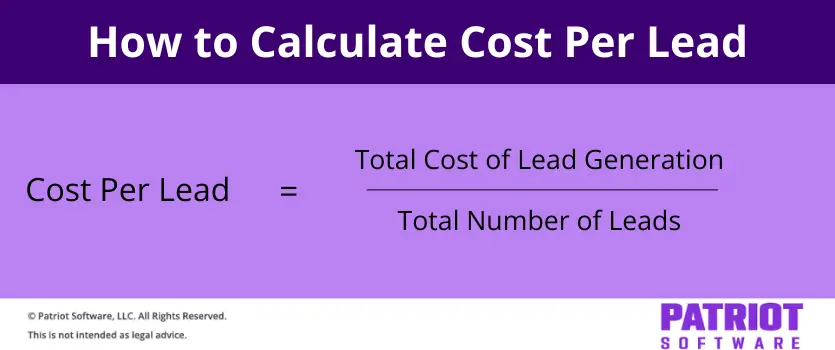
The CPL Formula:
Once the total costs and total leads are determined for a specific period, the CPL can be calculated using the following formula:
Cost Per Lead = Total Cost of Lead Generation / Total Number of Leads
For example, if a business spends $5,000 on a digital marketing campaign that generates 200 leads within a month, the CPL would be $25 ($5,000 / 200).
Leveraging Cost Per Lead for Strategic Decision-Making
The true power of CPL lies in its application. By calculating CPL across different marketing channels, campaigns, and even specific audience segments, businesses can gain granular insights into their performance. This allows for:
- Channel Optimization: Identifying which marketing channels (e.g., search engine marketing, social media advertising, email marketing, content marketing) deliver leads at the lowest cost.
- Campaign Performance Analysis: Evaluating the effectiveness of individual campaigns and their associated spend.
- Audience Segment Assessment: Understanding the CPL for different target demographics or firmographics.
- Geographic Performance Tracking: Analyzing CPL for leads generated from specific regions.
- Content Performance Evaluation: Determining the cost of generating leads through particular content pieces or lead magnets.
Regularly monitoring CPL trends over time is crucial. A steadily increasing CPL may signal a need to re-evaluate marketing strategies, adjust ad targeting, or optimize campaign creative. Conversely, a decreasing CPL indicates improved efficiency and potentially a more effective marketing funnel.
Strategies for Reducing Cost Per Lead
Reducing CPL directly translates to maximizing marketing budgets and achieving a higher ROI. The overarching goal is to attract more qualified leads for a lower cost per lead. Several proven strategies can contribute to this objective:
1. Refine Business Needs and Budget Allocation:
The scale of a business and its market position are significant factors. Larger enterprises with higher revenue streams might be able to sustain a higher overall advertising spend. Conversely, smaller businesses should adopt a more cautious approach, starting with a modest budget and meticulously analyzing campaign data to identify optimal times for scaling investments. Understanding the competitive landscape and the unique value proposition of the business is crucial for determining appropriate expenditure levels.
2. Enhance Audience Targeting:
Precision in audience targeting is paramount for increasing the number of quality leads and subsequently lowering CPL. Implementing retargeting campaigns for individuals who initially showed interest but did not convert can be highly effective. These campaigns can re-engage potential customers with tailored content and compelling offers. If current messaging is not resonating with the intended audience, it is imperative to refine segmentation strategies, focusing on demographics or groups that have historically demonstrated higher interest and conversion rates. This often involves updating sales planning templates to reflect these refined target segments.
3. Optimize Website and Landing Page Performance:
Improving online visibility is a direct pathway to enhancing organic reach and reducing CPL. Businesses should focus on optimizing their search engine rankings by targeting long-tail keywords, which often indicate stronger buyer intent. Maintaining fresh, valuable content and mirroring the style and depth of competing articles can also boost organic traffic. Beyond search visibility, refining website navigation, accelerating page loading speeds, and optimizing landing pages are critical. Lead magnets should offer tangible value, and sign-up forms can include clarifying questions to pre-qualify leads and filter out less engaged individuals.
4. Implement A/B Testing Rigorously:
A/B testing is an invaluable tool for determining which marketing materials and approaches yield the most leads, thereby reducing CPL. This involves testing various elements of landing pages, such as headlines, calls-to-action (CTAs), and imagery, as well as experimenting with different ad creatives and copy. Diversifying marketing channels and avoiding over-reliance on a single strategy is also advisable. Testing can further optimize the timing of ad placements and content releases, aligning them with periods of peak audience activity online.
5. Leverage Appropriate Marketing Tools:
The strategic adoption of automated tools can significantly enhance lead generation efficiency, often surpassing manual efforts. While these tools represent an investment, the resultant efficiency gains in terms of human resources can lead to a substantial reduction in CPL. Ensuring that marketing teams are adequately trained to maximize the utility of these tools is equally important. Key technologies to consider include specialized lead generation software, robust accounting software for expense tracking, marketing automation platforms for email and social media campaigns, and Customer Relationship Management (CRM) systems for managing lead and customer data.
6. Maintain Continuous Tracking and Analysis:
Regularly calculating and analyzing CPL across all marketing methods, channels, and campaigns is non-negotiable. External factors, such as economic shifts, competitive pressures, and evolving market dynamics, can rapidly influence CPL. Therefore, it is essential to evaluate CPL in conjunction with other critical sales and marketing metrics, including conversion rates, cost per acquisition, and overall ROI. Furthermore, soliciting feedback from converted leads through customer satisfaction (CSAT) surveys can provide valuable qualitative insights into campaign success.
Conclusion: The Enduring Value of Cost Per Lead
Calculating and actively managing Cost Per Lead is an indispensable practice for any business seeking to maximize its marketing expenditure. This metric empowers organizations to identify underperforming campaigns and channels, ensuring that marketing budgets are strategically allocated to initiatives with a demonstrably high probability of success. A comprehensive understanding of all advertising costs, encompassing both inbound and outbound efforts, is fundamental to this process. By defining what constitutes a "good" and "bad" CPL based on their specific business context, and by implementing the outlined strategies for reduction, businesses can significantly streamline their marketing spend, cultivate more qualified leads, and ultimately drive sustainable growth. The ongoing pursuit of lower, more efficient CPL is not merely a tactical objective but a strategic imperative in today’s competitive business environment.
About the Author