
Understanding your cost per lead (CPL) is a fundamental aspect of maximizing business expenses and ensuring the efficacy of marketing investments. This key performance indicator (KPI) provides a clear financial metric for evaluating the success of marketing and sales initiatives, allowing businesses to strategically allocate resources and optimize their return on investment. Without a firm grasp of CPL, companies risk inefficient spending and missed opportunities in a competitive marketplace.
Defining Cost Per Lead
Cost per lead (CPL) is a marketing metric that quantifies the total financial outlay required to generate a single prospective customer who has demonstrated interest in a company’s products or services. This interest can manifest in various forms, such as signing up for a newsletter, downloading a whitepaper, filling out a contact form, requesting a demo, or engaging with targeted advertising. Essentially, CPL represents the dollar amount invested to attract an individual who has moved beyond passive awareness to active engagement with the brand.
It is crucial to distinguish CPL from Cost Per Acquisition (CPA). While CPA measures the total expense incurred to acquire a paying customer or close a sale, CPL focuses solely on the cost associated with generating potential customers, irrespective of whether they ultimately convert into paying clients. This distinction is vital for understanding the efficiency of different stages of the sales funnel. As a report by HubSpot indicated, businesses with a well-defined CPL strategy are more likely to achieve higher conversion rates and a stronger return on marketing investment.
The Strategic Importance of CPL
In today’s business landscape, marketing expenditures often constitute a significant portion of a company’s overall budget. Therefore, rigorously measuring the effectiveness of these efforts and identifying avenues for spending optimization are paramount. Cost per lead serves as an indispensable metric for tracking the performance of both sales and marketing campaigns. By understanding the precise cost associated with generating each potential customer, businesses can make informed decisions regarding the allocation of their marketing budget and the direction of their client management strategies.
This insight enables a comparative analysis of different marketing channels and strategies. Companies can identify which approaches yield the highest return on investment (ROI) and subsequently channel more resources into those areas, while simultaneously divesting from less cost-effective methods. Furthermore, when CPL data is integrated with other marketing metrics, it can reveal whether a particular campaign or channel is attracting the "wrong" leads – individuals with little to no likelihood of converting. This allows for timely course correction, preventing wasted time and financial resources.
CPL also plays a critical role in challenging assumptions about marketing effectiveness. A high-profile campaign generating substantial attention might seem successful on the surface. However, a detailed CPL analysis could reveal that a less prominent, lower-cost campaign is actually delivering a better ROI due to lower operational expenses. For instance, a study by the Content Marketing Institute found that companies prioritizing content marketing, often associated with lower CPL, reported higher customer satisfaction and loyalty.
Determining a "Good" Cost Per Lead
The concept of a "good" CPL is not a universal constant; it is highly dependent on a multitude of internal and external factors. There is no one-size-fits-all benchmark that applies across all businesses and industries. Several key elements influence what constitutes an optimal CPL:
- Industry Benchmarks: Different sectors have varying lead generation costs due to market competitiveness, average deal size, and sales cycle length. For example, industries like enterprise software or financial services, characterized by high-value transactions and complex sales processes, typically exhibit higher CPLs compared to e-commerce or local service providers. According to recent data from WordStream, the average CPL for Google Ads across all industries can range from $10 to $50, but this can fluctuate significantly based on sector.
- Product or Service Value: The price point of a company’s offerings directly impacts the acceptable CPL. A business selling low-cost items might find an $80 CPL prohibitive, whereas a company offering high-ticket products or services, such as $2,000 solutions, would likely consider an $80 CPL to be highly cost-effective.
- Target Market and Audience: The specificity and accessibility of the target audience play a role. Highly niche markets or business-to-business (B2B) segments often require more targeted and expensive marketing efforts, leading to a higher CPL. Conversely, broad consumer markets might allow for more scalable and cost-efficient lead generation.
- Marketing Channels and Strategies Employed: The chosen marketing channels significantly affect CPL. Paid advertising campaigns (e.g., Google Ads, social media ads) generally incur higher direct costs than organic strategies like content marketing, SEO, and social media engagement, which tend to have lower CPLs over time as organic traffic builds. A report by Neil Patel highlighted that organic search traffic often has a significantly lower CPL than paid search.
- Lead Quality and Conversion Rates: The inherent quality of the leads generated is a critical determinant. High-quality leads, those more likely to convert into paying customers, can justify a higher CPL. Conversely, a low conversion rate from a particular campaign might indicate a need to re-evaluate the targeting or messaging, even if the initial CPL appears low.
- Customer Lifetime Value (CLV): A business with a high customer lifetime value can afford to invest more in acquiring each lead, as the long-term revenue potential of a converted customer outweighs the initial acquisition cost.
Ultimately, a "good" CPL is one that is lower than the projected revenue expected from an average lead. Conversely, a "bad" CPL occurs when the cost of generation exceeds the anticipated revenue from that lead, resulting in a net loss. To establish this benchmark, businesses must accurately estimate their average customer spend and their typical conversion rates. Industry averages can serve as a useful reference point, but the definitive measure of success lies in the profitability generated by each lead for the specific business. A higher conversion rate can indeed justify a higher CPL, provided the potential lifetime value of the acquired customer is substantial.
Calculating Cost Per Lead
The calculation of Cost Per Lead is a straightforward, yet crucial, process. It involves two primary components: the total cost of lead generation and the total number of leads generated within a defined period.
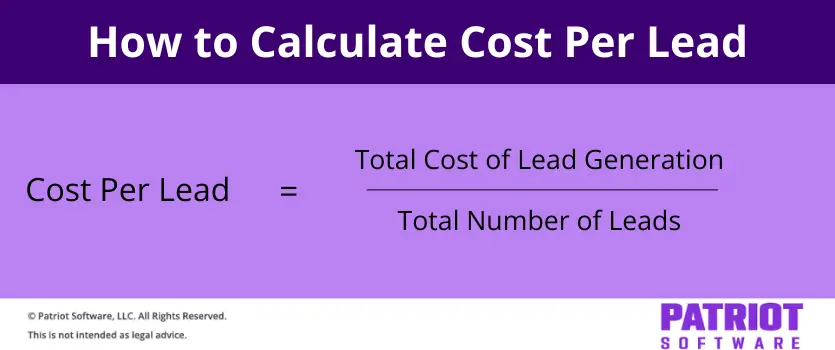
The formula is:
Cost Per Lead = Total Cost of Lead Generation / Total Number of Leads

To accurately implement this formula, businesses must meticulously track all expenses related to their marketing campaigns and the number of leads acquired through each initiative.
Calculating Costs
The "Total Cost of Lead Generation" encompasses every financial investment made in attracting potential customers. This includes:
- Advertising Expenses: This covers the direct spend on paid advertising across various platforms, such as search engine marketing (SEM), social media advertising, display ads, and any traditional advertising like print or radio.
- Content Creation and Marketing: Costs associated with developing blog posts, articles, videos, infographics, e-books, webinars, and other forms of content designed to attract and engage an audience.
- Search Engine Optimization (SEO): Investments in SEO tools, expert consultation, or internal resources dedicated to improving organic search rankings.
- Social Media Management: Costs related to social media tools, content scheduling, and community management.
- Website Development and Maintenance: Expenses associated with landing pages, lead capture forms, and overall website optimization for lead generation.
- Marketing Software and Tools: Subscriptions to CRM systems, email marketing platforms, analytics tools, and other software essential for lead generation and management.
- Agency Fees and Freelancer Costs: Any payments made to external marketing agencies, consultants, or freelancers involved in lead generation efforts.
- Labor Costs: A portion of the salaries for internal marketing and sales teams directly involved in lead generation activities. This can be calculated based on the time spent by these individuals on lead generation tasks.
It is often beneficial to categorize costs into inbound (organic traffic, content marketing, SEO) and outbound (paid advertising, direct outreach) strategies, as these often have distinct CPLs.
A structured approach to cost calculation for a specific period (e.g., monthly, quarterly) might look like this:
Advertising Costs = Ad Spend + Ad Management Costs
(Ad management costs include fees for managing ad campaigns, whether in-house or outsourced.)
Inbound Costs = External Resources (e.g., agency fees for SEO/content) + Internal Resources (e.g., salaries for content creators, SEO specialists)
Total Cost of Lead Generation = Advertising Costs + Inbound Costs + Marketing Software Costs + Other Related Expenses
Calculating Leads
The "Total Number of Leads" refers to the aggregate count of individuals who have met the defined criteria for a lead during the specified period. This includes:
-
Inbound Leads:
- Website form submissions (e.g., contact us, download a resource)
- Newsletter subscriptions
- Webinar registrations
- Content downloads (e.g., e-books, whitepapers)
- Demo requests
- Trial sign-ups
- Referrals from existing customers or partners
- Social media engagement that results in a direct inquiry or sign-up.
-
Outbound Leads:
- Leads generated from paid advertising campaigns (e.g., clicks on ads that lead to a form submission)
- Leads from direct outreach efforts (e.g., cold email campaigns, telemarketing if applicable)
- Leads from trade shows or events.
Total Leads = Total Inbound Leads + Total Outbound Leads
Utilizing Cost Per Lead Data
Once CPL is calculated, its true value lies in its application for strategic decision-making. Businesses can leverage this metric in several key ways:
- Channel Performance Analysis: By calculating CPL for each marketing channel (e.g., Google Ads, Facebook, LinkedIn, email marketing, organic search), companies can identify which channels are most cost-effective for generating leads. This allows for the redirection of marketing spend towards higher-performing channels.
- Campaign Optimization: CPL can be calculated for specific campaigns within a channel. This granular analysis helps in optimizing individual campaigns by identifying underperforming elements and making necessary adjustments.
- Target Audience Segmentation: Analyzing CPL across different demographic segments or customer profiles can reveal which audiences are more cost-efficient to acquire. This informs more precise targeting strategies.
- Budget Allocation: Understanding CPL allows for more accurate budgeting. If a company knows it costs $50 to generate a lead and aims for 100 leads per month, it can allocate $5,000 for that specific lead generation goal.
- ROI Measurement: When combined with conversion rates and customer lifetime value, CPL becomes a powerful tool for calculating the overall ROI of marketing efforts. A low CPL coupled with a high conversion rate and CLV indicates a highly profitable marketing strategy.
- Identifying Trends: Regularly tracking CPL over time can highlight trends. A steadily increasing CPL might signal market saturation, increased competition, or a need to re-evaluate marketing strategies. Conversely, a decreasing CPL suggests improved efficiency.
Beyond the overall business CPL, it is beneficial to calculate CPLs for:
- Specific Marketing Channels: To compare the efficiency of paid search, social media, email marketing, content marketing, etc.
- Individual Campaigns: To assess the performance of specific advertising sets, promotional offers, or content pieces.
- Target Audiences/Segments: To understand which customer groups are most cost-effective to reach.
- Geographic Regions: If the business operates in multiple locations, comparing CPL by region can highlight localized marketing effectiveness.
Monitoring these CPLs over time enables businesses to identify emerging trends and opportunities, allowing for proactive adjustments to marketing strategies. A consistent or increasing CPL across the board may signal a need for a comprehensive review of marketing tactics, messaging, and targeting.
Strategies to Reduce Cost Per Lead
Lowering CPL directly translates to increased marketing efficiency and a greater return on investment. This can be achieved by focusing on strategies that attract more qualified leads at a reduced expense.
1. Align Marketing Efforts with Business Needs
The scale of marketing investment should be commensurate with the business’s size, revenue potential, and market position. Large enterprises with high revenue streams might justify higher overall ad spend due to their capacity to absorb costs and the potential for significant returns. Similarly, businesses operating in highly competitive markets may need to invest more to gain visibility. For smaller businesses, however, it is prudent to start with a more modest budget, meticulously analyze campaign performance data, and strategically scale up investments only when optimal efficiency is achieved.
2. Enhance Audience Targeting Precision
Improving audience targeting is a cornerstone of efficient lead generation. By narrowing down the focus to demographics, interests, and behaviors that align most closely with the ideal customer profile, businesses can ensure their marketing messages reach the most receptive individuals. This not only increases the likelihood of conversion but also reduces wasted ad spend on irrelevant audiences. Implementing retargeting campaigns for individuals who previously interacted with the brand but did not convert can also be highly effective, drawing them back with tailored content and offers. If initial segmentation proves ineffective, a thorough review and adjustment of targeting parameters, based on data from higher-converting groups, are essential. This often involves refining the sales planning template to incorporate new insights into customer acquisition.
3. Optimize Website and Landing Page Performance
A well-optimized website is a powerful engine for organic lead generation. Improving search engine rankings through targeted long-tail keywords (which often indicate higher purchase intent), ensuring content remains fresh and relevant, and matching the quality and depth of competitor content can significantly boost organic visibility. Beyond SEO, optimizing website navigation, enhancing page loading speeds, and refining landing page design are critical. Landing pages should be clear, concise, and focused on a single call to action. High-value lead magnets (e.g., exclusive guides, templates, or free consultations) are essential for capturing interest. Incorporating clarifying questions into sign-up forms can help pre-qualify leads and filter out those with less serious intent, thereby improving lead quality and reducing CPL.
4. Leverage A/B Testing for Continuous Improvement
A/B testing is an indispensable tool for data-driven marketing optimization. By testing different variants of marketing materials, businesses can determine which elements resonate most effectively with their target audience, leading to higher engagement and lead generation. This can include testing headlines, calls-to-action (CTAs), images, video content, and even the layout of landing pages. Testing different ad creatives, subject lines for email campaigns, and social media post formats can also yield significant improvements in CPL. Furthermore, A/B testing can be applied to identify the optimal times for deploying ads and content, aligning with peak audience activity online. Experimenting with different marketing channels to identify those that yield the best results is also a critical aspect of A/B testing.
5. Implement the Right Technology Stack
Automating manual processes through the judicious use of technology can dramatically enhance lead generation efficiency. While there is an initial investment in software, the gains in productivity and reduced reliance on human resources often lead to a lower CPL over time. Essential tools include:
- Lead Generation Software: Platforms designed to identify and engage potential leads.
- CRM Systems: Customer Relationship Management systems are crucial for organizing, tracking, and nurturing leads throughout the sales funnel.
- Marketing Automation Platforms: For automating email marketing, social media posting, and lead nurturing workflows.
- Analytics and Reporting Tools: To track key metrics, including CPL, conversion rates, and ROI.
- Accounting Software: Essential for accurately tracking marketing expenses and calculating overall costs.
Ensuring that teams are adequately trained on these tools maximizes their effectiveness and ROI.
6. Maintain Continuous Tracking and Analysis
Regularly calculating and monitoring CPL across all marketing efforts is non-negotiable. This ongoing process allows for the identification of performance trends and the timely detection of any anomalies. External factors, such as shifts in the economic climate, evolving competitive landscapes, or changes in consumer behavior, can rapidly impact CPL. Therefore, it is vital to evaluate CPL not in isolation, but in conjunction with other critical sales and marketing metrics such as conversion rates, customer acquisition cost (CAC), and overall return on investment (ROI). Periodic customer satisfaction surveys can also provide valuable qualitative feedback on the effectiveness of campaigns and the quality of leads generated.
Conclusion
In the dynamic realm of business growth, understanding and actively managing Cost Per Lead is not merely an option but a strategic imperative. It provides a quantifiable measure of marketing efficiency, enabling businesses to optimize their spending, refine their strategies, and ultimately drive more profitable customer acquisition. By diligently calculating CPL, considering all relevant inbound and outbound costs, and establishing clear benchmarks for what constitutes a "good" or "bad" CPL for their specific context, companies can make informed decisions. Implementing the outlined strategies for reducing CPL—from precise audience targeting and website optimization to leveraging technology and continuous performance tracking—will empower businesses to streamline their marketing spend, maximize their return on investment, and build a more sustainable and successful future.
About the Author