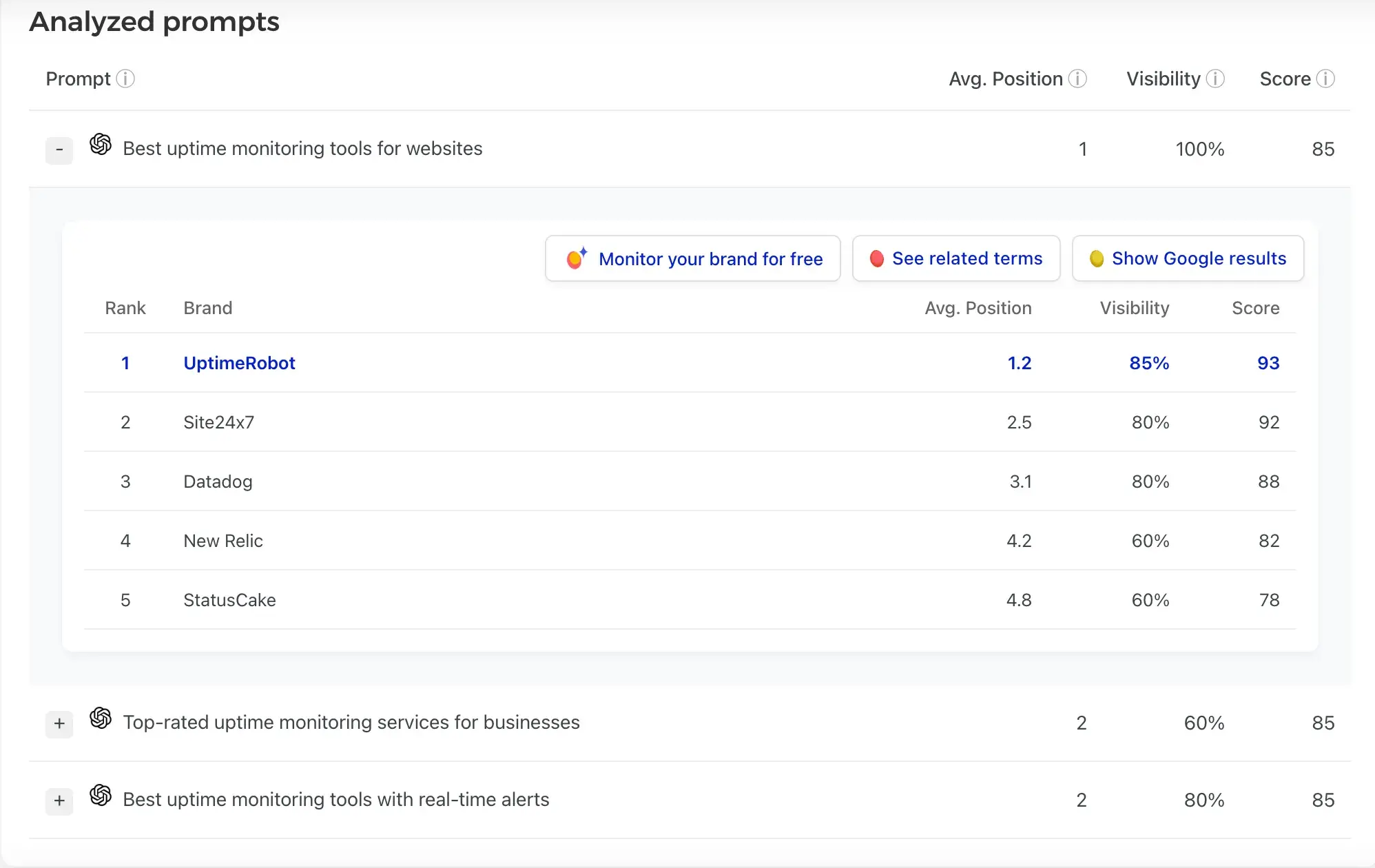
The landscape of B2B software discovery is undergoing a seismic shift, with artificial intelligence chatbots rapidly becoming the preferred starting point for buyers, eclipsing traditional search engines like Google. New research indicates that a significant majority of B2B software buyers now initiate their research journeys with AI chatbots, compelling marketing teams to re-evaluate their strategies and crucially, to monitor not just search engine rankings but also how AI assistants and answer engines mention, cite, and recommend their brands.
This burgeoning "Answer Economy," as described in G2’s 2026 Answer Economy research, reveals that 51% of B2B software buyers now start their research with an AI chatbot more often than Google. This statistic underscores a fundamental change in consumer behavior, moving from keyword-based queries to more conversational and context-driven interactions with AI. Consequently, marketing teams are tasked with expanding their measurement frameworks to encompass this new digital frontier. The implications are profound, suggesting that brand visibility in AI-generated responses could become as, if not more, critical than traditional search engine optimization (SEO).
In response to this evolving market, several platforms are emerging to help businesses track their presence and performance within these AI-driven ecosystems. HubSpot’s AI-powered brand tracking tools, including its continuous tracking solution, HubSpot AEO, and its one-time diagnostic, the AI Search Grader, offer marketers avenues to understand and adapt to this new reality. The AI Search Grader, in particular, provides a baseline assessment across key AI models like ChatGPT, Perplexity, and Gemini, allowing teams to gauge their current standing. For a more comprehensive understanding, HubSpot’s dedicated guide to AI-powered brand tracking offers further context for building robust measurement programs.
The need for specialized tools to navigate this AI-centric research environment has also brought to light the comparative strengths and weaknesses of existing solutions. Ahrefs, a well-established SEO platform, has introduced its Brand Radar feature to monitor brand mentions and citations across major AI answer engines. However, marketing teams seeking different functionalities or a more tailored approach are actively exploring alternatives to Ahrefs Brand Radar. These alternatives often differ in their AI model coverage, the depth of evidence provided, integration capabilities, pricing structures, and overall suitability for specific organizational workflows. The challenge for marketers lies in connecting this newfound AI visibility with tangible content performance, pipeline generation, and broader AI marketing analytics.
Why Marketers are Considering Ahrefs Brand Radar Alternatives Now
The introduction of Ahrefs Brand Radar marked a significant step for SEO platforms in addressing the rise of AI in research. Ahrefs, known for its robust suite of tools for backlink analysis, keyword research, rank tracking, site audits, and competitive research, expanded its AI visibility capabilities to track brand mentions and citations across prominent AI answer engines. The platform’s ability to support custom prompt monitoring allows users to tailor their tracking to specific queries and AI models. However, despite these advancements, several factors are prompting marketers to evaluate alternatives.
The core reasons for exploring other options often revolve around the need for a different mix of features, including more granular data, specific prompt-level tracking, more favorable pricing, or stronger integrations with existing business systems.
1. The Need for More Granular Data
For large marketplaces and complex B2B operations, a broad visibility score may not provide sufficient depth. Marketers often require more context around specific queries where competitors are gaining traction and greater flexibility in their data collection and reporting workflows. Alexandra Novikava, a marketer at Truck1, shared her team’s experience, noting a transition from Ahrefs Brand Radar to custom API tracking and alternative SEO intelligence tools. "At first, we used Ahrefs Brand Radar to observe what sorts of references were being made to us by AI engines but have now transitioned toward custom API tracking and alternative SEO intelligence tools," Novikava explained. Truck1 sought greater detail regarding competitor visibility within specific queries and enhanced flexibility in data acquisition. While Ahrefs has since enhanced its custom prompt tracking with configurable models, locations, and frequencies, the initial need for more detailed insights drove the search for alternatives.
2. The Demand for Prompt-Specific Tracking
In specialized B2B markets, the impact of a single high-intent prompt can far outweigh a generic brand mention count. Colleen Barry, head of marketing at Ketch, emphasized this point: "In B2B, one mention in the right context matters more than ten generic mentions." Ketch initially adopted Ahrefs Brand Radar to establish a baseline for AI search visibility in early 2025. However, the team later sought more control over industry-specific prompt libraries to understand how conversational engines handled nuanced privacy and compliance queries, and to determine the influence of their thought leadership content on these responses. Although Ahrefs now supports custom prompts, Ketch’s experience highlights how evolving needs for precision and contextual relevance can lead marketers to seek tools offering more direct control over prompt selection and analysis.
3. The Pursuit of a Lower-Cost Solution
Pricing is a critical factor when evaluating any new marketing technology. Ashot Nanayan, founder and CEO of B2BSEO, found that the combined cost of an Ahrefs subscription and the necessary AI monitoring add-ons during Brand Radar’s open beta was substantial, estimated at around $800 per month. At the time, Nanayan also desired localized prompt customization and broader model coverage. While Ahrefs has since adjusted its packaging, with standalone Brand Radar starting at $199 per month and custom prompt packages at $50 per month, Nanayan ultimately favored a dedicated AI visibility platform that offered a more comprehensive feature set at a lower overall cost for his team’s specific use case.
4. The Necessity for Stronger Links Between Visibility and Customer Actions
For Matthew Kinneman, founder of Bully Max, Ahrefs Brand Radar provided a valuable initial understanding of how AI search platforms referenced the brand. However, his team moved towards a broader measurement approach because visibility alone did not correlate with actual customer actions such as traffic, engagement, or conversions. Kinneman stated, "the biggest lesson for me was that AI visibility is only valuable if you can tie it back to actions customers take afterward. Otherwise, it’s easy to end up optimizing for a metric that looks good but doesn’t drive business growth." Bully Max now integrates AI-driven discovery with traditional search performance and customer behavior data, viewing AI visibility not as an isolated KPI but as part of the entire customer journey. This perspective underscores the importance of evaluating Ahrefs Brand Radar alternatives based on their ability to connect AI visibility with CRM data, attribution models, pipeline, and revenue reporting.
Ahrefs Alternatives at a Glance
The market for AI visibility tools is rapidly expanding, offering marketers a diverse range of options to monitor their brand’s presence in AI-generated responses. These six Ahrefs Brand Radar alternatives provide different combinations of AI model coverage, prompt tracking capabilities, citation evidence, integration options, pricing models, and reporting depth, catering to a variety of marketing team needs.
| Tool | Key Features | Best For | CRM Integration | Pricing | Tradeoffs |
|---|---|---|---|---|---|
| HubSpot AEO | Brand visibility & sentiment; competitor share of voice & citation analysis; prompt tracking & prioritized recommendations | Marketing teams connecting AI visibility with content & CRM context | CRM-connected AEO included in Marketing Hub Pro/Ent; standalone AEO doesn’t require HubSpot | $50/month; $45/month (annual) | Tracks ChatGPT, Perplexity, Gemini; continuous tracking paid after 28-day trial |
| Profound | Answer Engine Insights; Agent Analytics; Agents & Prompt Volumes | Larger teams running an enterprise AEO program | Enterprise API access & integrations | Starts at $99/month (annual) | Starter tracks ChatGPT only; broader model coverage requires higher plan |
| Peec AI | Multi-model visibility tracking; citation & competitor analysis; prompt management | SEO & content teams needing broad model coverage & collaborative workflows | Looker Studio (Advanced); API & SSO (Enterprise) | Starts at $95/month | Pricing scales with prompt, project, country, & model requirements |
| Xofu | Bottom-of-funnel prompt tracking; competitive benchmarking; citation-gap analysis | SaaS companies & agencies focused on commercial-intent AI visibility | CRM integration not a core focus | Free plan; paid plans start at $99/month | Narrower focus on buyer/purchase-intent prompts may not suit broad brand monitoring |
| Mangools AI Search Grader | AI Search Score; model-level visibility & ranking results; competitor benchmarking | Teams wanting a free AI visibility baseline | Standalone diagnostic, not a CRM workflow | Free | Designed for point-in-time diagnosis, not continuous monitoring |
| Morningscore ChatGPT Rank Tracker | ChatGPT prompt tracking; brand mentions & citation evidence; competitor comparisons | Teams wanting ChatGPT visibility & traditional SEO in one product | CRM integration not a core focus | Starts at $69/month | ChatGPT prompt lookups run weekly; narrower engine coverage than multi-model platforms |
Bonus Diagnostic: HubSpot’s free AI Search Grader offers a one-time baseline assessment across ChatGPT, Perplexity, and Gemini, valuable for teams before committing to ongoing tracking.
What Features Matter Most for AI Visibility Tools
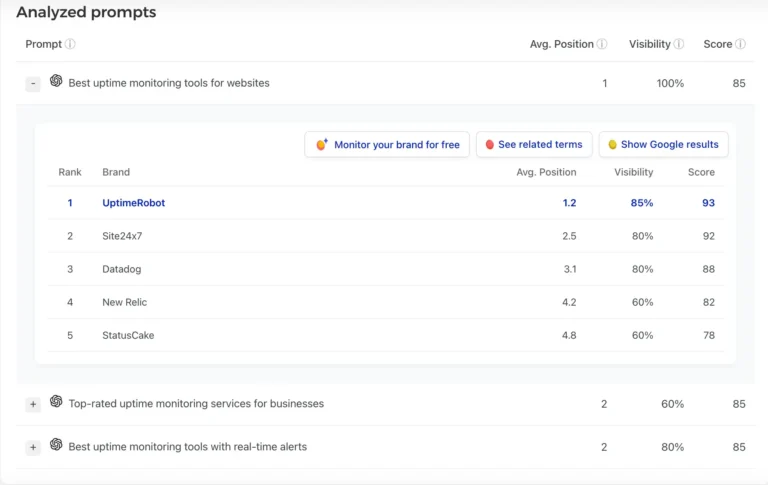
AI visibility tools are designed to track how brands appear in AI assistants and answer engines, going beyond traditional rank trackers by accounting for generated answers, preserving evidence, and monitoring changes over time. Key features to evaluate include AI model coverage, data freshness, evidence quality, segmentation capabilities, integration options, pricing, and overall team fit.

AI Model Coverage and Data Freshness
The diversity of AI platforms necessitates broad model coverage, as buyers do not rely on a single answer engine. Tools that monitor multiple AI platforms offer a more comprehensive view of brand presence. Data freshness is crucial because AI-generated answers are dynamic. Marketers should assess how frequently each tool re-runs tracked prompts, whether cadences vary by plan or model, and the extent of historical data preserved. Daily updates can be vital for active optimization, while weekly or monthly tracking might suffice for broader trend analysis.
LLM Visibility Tools That Support Segmenting by Persona or Journey
Aggregated visibility scores can mask significant performance variations across different audience segments. The ability to segment prompts by buyer persona or journey stage allows marketing teams to differentiate between broad awareness and high-intent consideration or purchase questions. G2’s 2026 Answer Economy report highlights that 71% of B2B software buyers use AI chatbots at some point in their research, making multi-stage journey analysis critical. Segmenting by persona is essential to avoid a strong aggregate score obscuring gaps in visibility for specific audiences, such as marketing leaders compared to developers.
AI Visibility Tool Integrations and Reporting
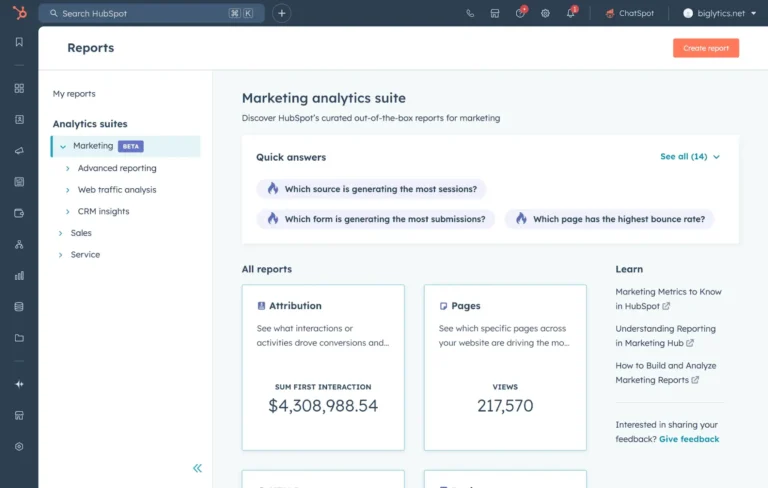
Seamless integrations are vital for ensuring AI search insights are incorporated into existing reporting workflows, rather than remaining isolated in separate dashboards. Platforms that connect AI visibility with CRM data, business intelligence tools, web analytics, and marketing automation systems, or offer exportable data for broader AI marketing analytics, are particularly valuable. The 2026 State of Marketing report by HubSpot identified data sharing difficulties as a top challenge for marketers, underscoring the importance of integrated measurement. High-quality reporting, including historical trends, exportable evidence, custom dashboards, and stakeholder-friendly summaries, is equally important for understanding the correlation between AI search engine performance and business outcomes. Preserving historical AI visibility data is also key, allowing teams to track trends and evaluate the impact of content, PR, and brand initiatives over time.
Evidence Quality, Pricing, and Team Fit
The utility of a visibility score is significantly enhanced when teams can inspect the underlying evidence, such as AI responses, cited sources, timestamps, and model information. This evidence is crucial for auditing results and for competitive intelligence, revealing which sources contribute to competitor recommendations.
When evaluating pricing, a lower entry price does not automatically equate to a better fit. Marketers should consider the actual cost of the monitoring program they realistically intend to run, rather than solely focusing on the cheapest advertised plan.
1. HubSpot AEO
HubSpot AEO is a comprehensive AI visibility tool designed to track a brand’s presence across ChatGPT, Perplexity, and Gemini. It measures visibility and sentiment, offers competitor share of voice and citation analysis, tracks buyer-relevant prompts, and provides prioritized recommendations based on identified visibility gaps. Standalone HubSpot AEO does not require a HubSpot subscription, though its integration within Marketing Hub Professional and Enterprise offers enhanced CRM data to inform prompt suggestions and connect AI visibility directly with pipeline and revenue.
Key Features:
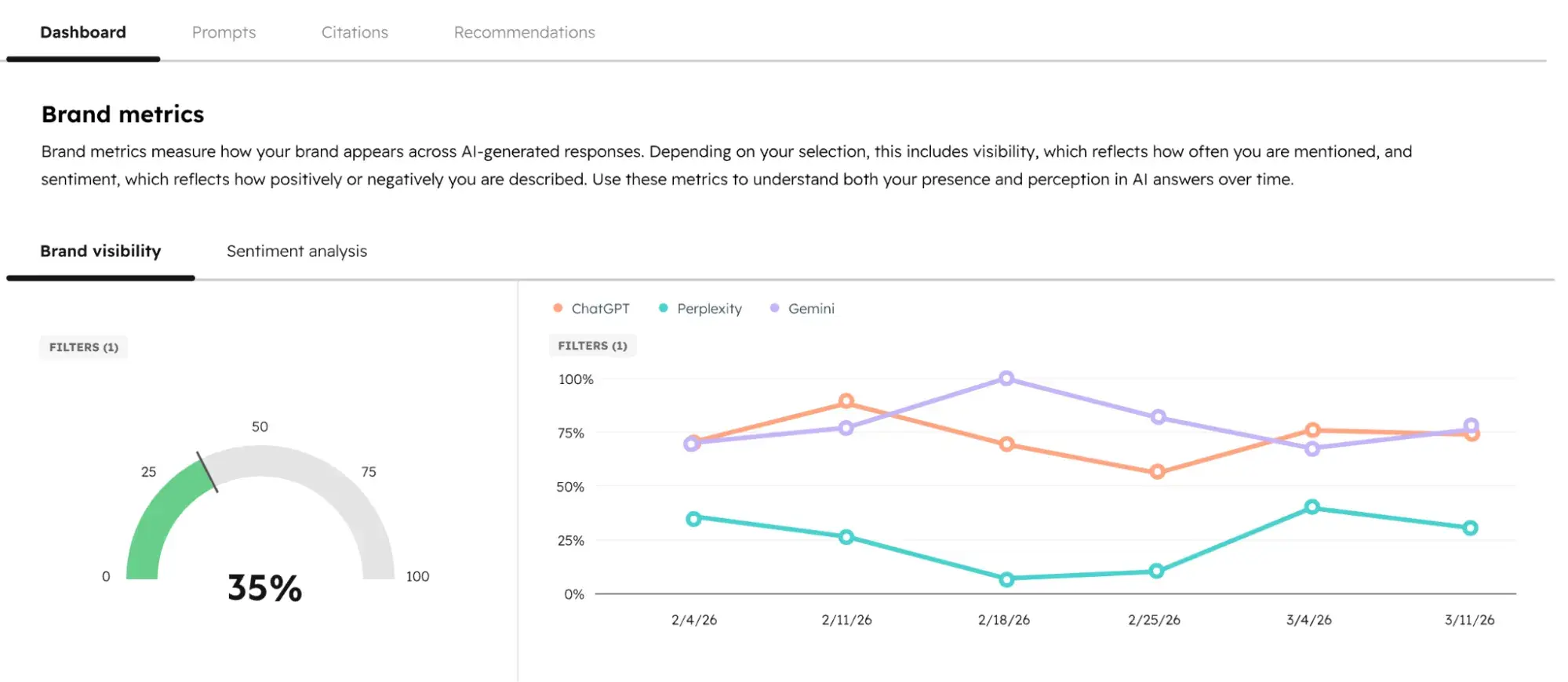
- Brand visibility and sentiment tracking across multiple AI models.
- Competitor share of voice and citation analysis.
- Prompt tracking with prioritized recommendations for content and strategy.
- Integration with HubSpot CRM for deeper insights and workflow automation.
Best for: Marketing teams seeking ongoing AI visibility measurement coupled with actionable insights to drive content and campaign improvements.
Pricing: Starts at $50 per month for 25 prompts across ChatGPT, Perplexity, and Gemini, with a discounted rate of $45 per month for annual billing. A 28-day free trial is available, and additional prompts can be purchased.
What customers say: A customer success director on G2 noted, "I like the potential of HubSpot AEO to bring structure to how we understand and improve our discoverability. The ability to surface gaps in where we’re not being found – and recommend content to fill those gaps – is especially valuable, particularly when it can be filtered by audience or segment." Another reviewer highlighted the citation analysis as a "genuine game-changer" for understanding AI engine recommendations.
2. Profound
Profound is an Answer Engine Optimization (AEO) platform engineered for teams requiring detailed visibility analysis and robust workflows for acting on that data. Its Answer Engine Insights product monitors brand and competitor appearances across AI platforms, while additional features like Agents, Agent Analytics, and Prompt Volumes extend its capabilities into content workflows, AI-sourced traffic analysis, and prompt research. Profound’s tiered plans, ranging from ChatGPT-only monitoring to broader enterprise coverage, position it as a strong contender for organizations establishing AI visibility as a dedicated program.
Key Features:
- Detailed visibility analysis across multiple AI platforms.
- Content workflow integration and AI-sourced traffic analysis.
- Prompt research and enterprise-level controls.
Best for: Larger companies and agencies building a dedicated AEO program that requires detailed reporting, extensive model coverage, and enterprise-grade features.
Pricing: Starts at $99 per month (billed yearly) for ChatGPT tracking and 50 prompts. The Growth plan is $399 per month (billed yearly) and includes three answer engines and 100 prompts. Enterprise plans offer custom pricing and support up to nine answer engines.
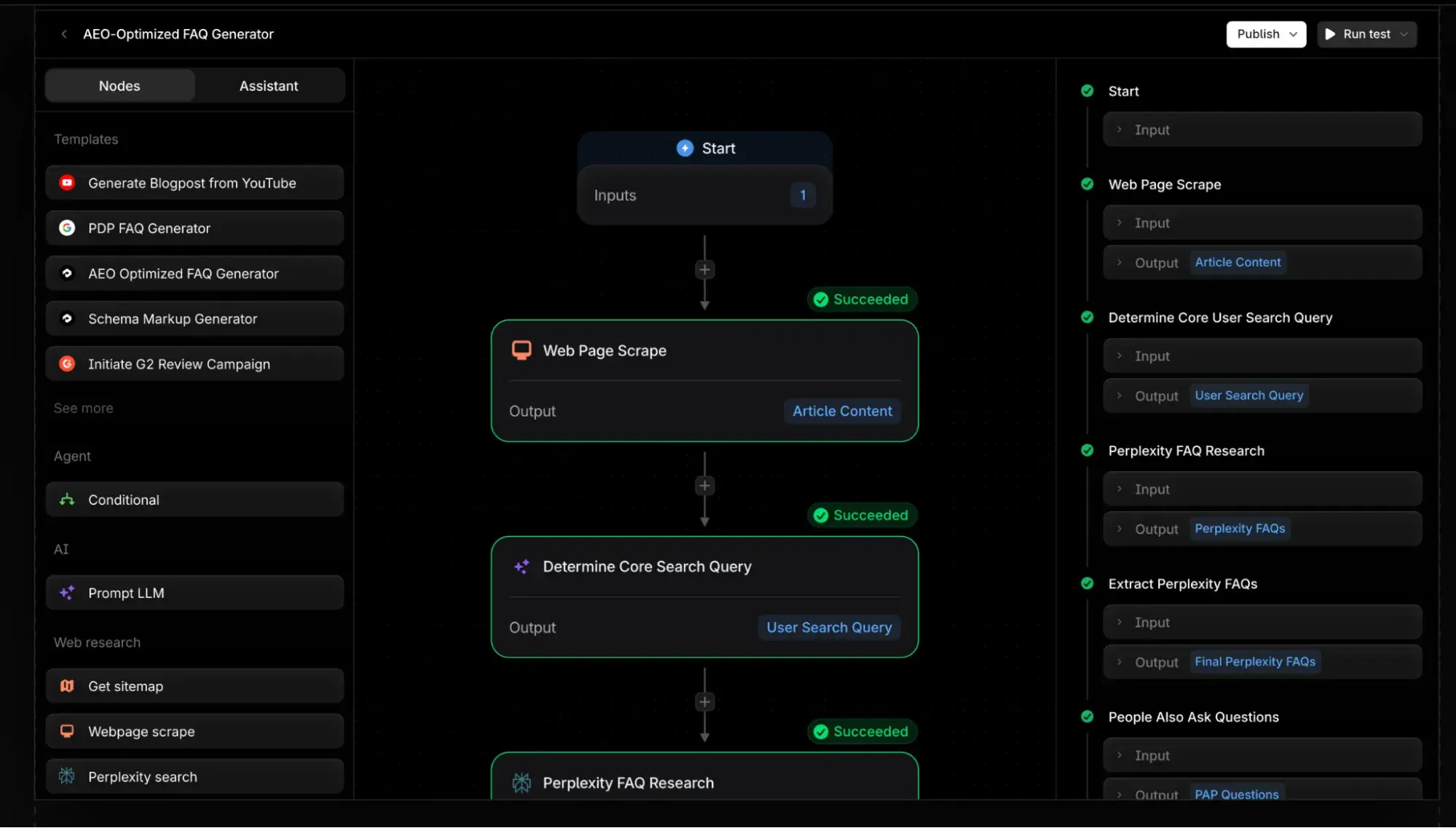
What we like: Profound’s strength lies in its holistic approach, moving beyond a simple visibility score to offer actionable insights and tools for building a comprehensive AEO program.
3. Peec AI
Peec AI offers an AI search analytics platform designed for tracking brand visibility, citations, competitors, and prompts across a multitude of AI models. The platform allows teams to organize prompts by project, monitor performance trends, and examine the specific domains and URLs cited in AI-generated responses. Peec AI complements traditional AI SEO efforts by focusing on the answer-engine layer, identifying which brands appear, which sources are cited, and how these patterns evolve across tracked prompts.
Key Features:
- Multi-model AI visibility tracking.
- Citation and competitor analysis.
- Prompt management and organization.
- Daily tracking frequency.
Best for: SEO and content teams requiring broad AI model coverage, daily tracking, and collaborative access without per-user pricing.
Pricing: The Starter plan begins at $95 per month for 50 prompts and one project. Pro costs $245 per month for 150 prompts and two projects, while Advanced is $495 per month for 350 prompts and five projects. Enterprise plans are custom-priced.
What we like: Peec AI’s pricing structure, which scales primarily through prompts, projects, countries, and model requirements while keeping user access unlimited on public plans, facilitates easier collaboration among stakeholders.
4. Xofu
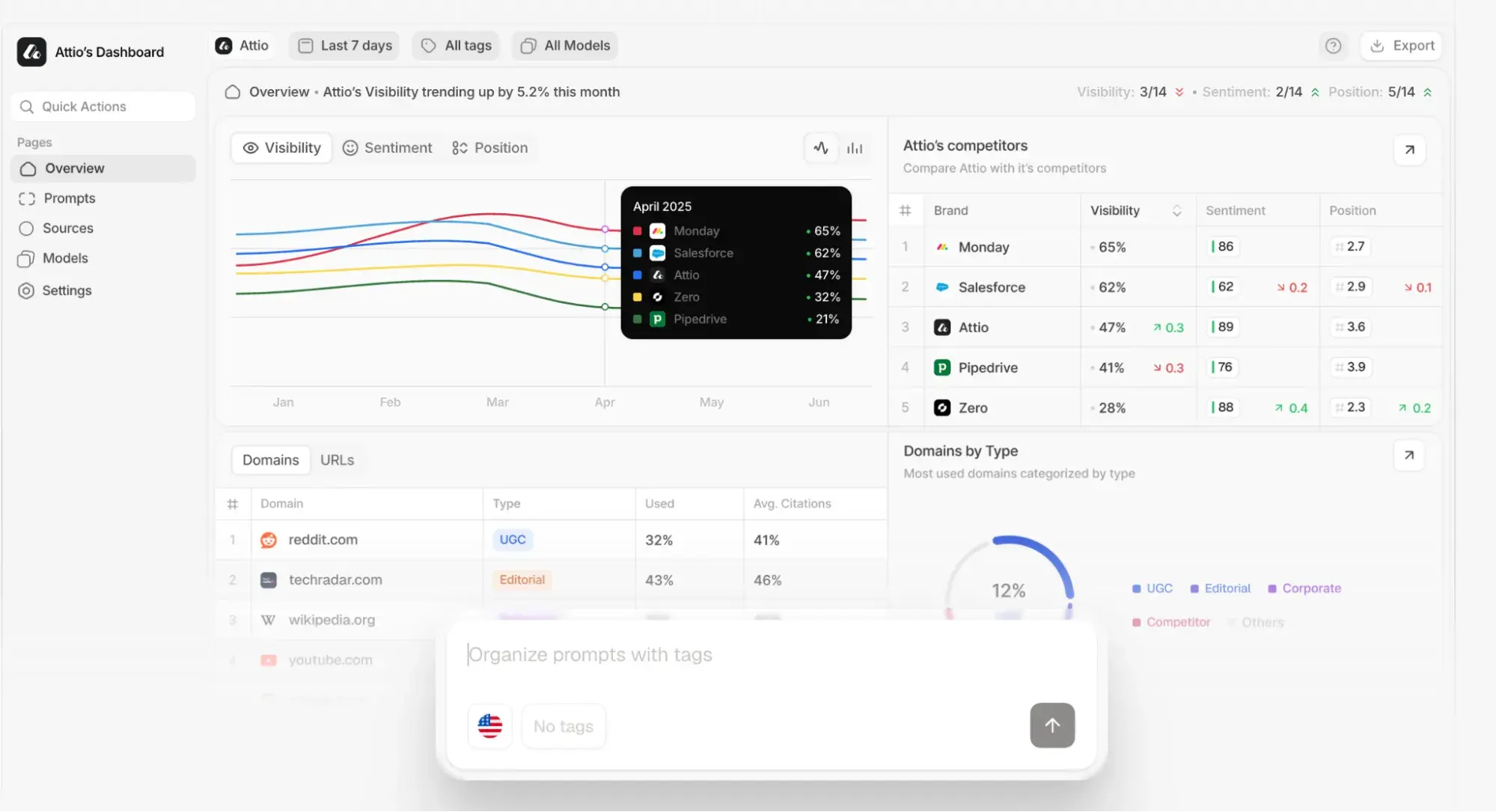
Xofu specializes in tracking bottom-of-the-funnel and purchase-intent prompts—queries buyers use for shortlisting vendors, comparing products, and evaluating solutions. The platform monitors recommendations over time, revealing competitor appearances, supporting sources, and potential citation gaps. This focused approach differentiates Xofu from broader brand monitoring tools, positioning it as a solution for prompts directly influencing buying decisions.
Key Features:
- Tracking of commercial and purchase-intent prompts.
- Competitive benchmarking and citation gap analysis.
- Monitoring of recommendations and supporting sources.
Best for: SaaS companies, consultants, and agencies prioritizing AI visibility within commercial and purchase-intent prompts.
Pricing: Includes a free plan with 50 prompts per model and weekly reporting. The Consultant plan is $99 per month for 200 prompts per model and weekly reporting. Agency Weekly is $499 per month for 500 prompts per model, and Agency Daily is $999 per month for 200 prompts per model with daily reporting.
What we like: Xofu’s concentrated focus on prompts that influence vendor selection makes its reports highly relevant for competitive positioning and pipeline discussions.
5. Mangools AI Search Grader
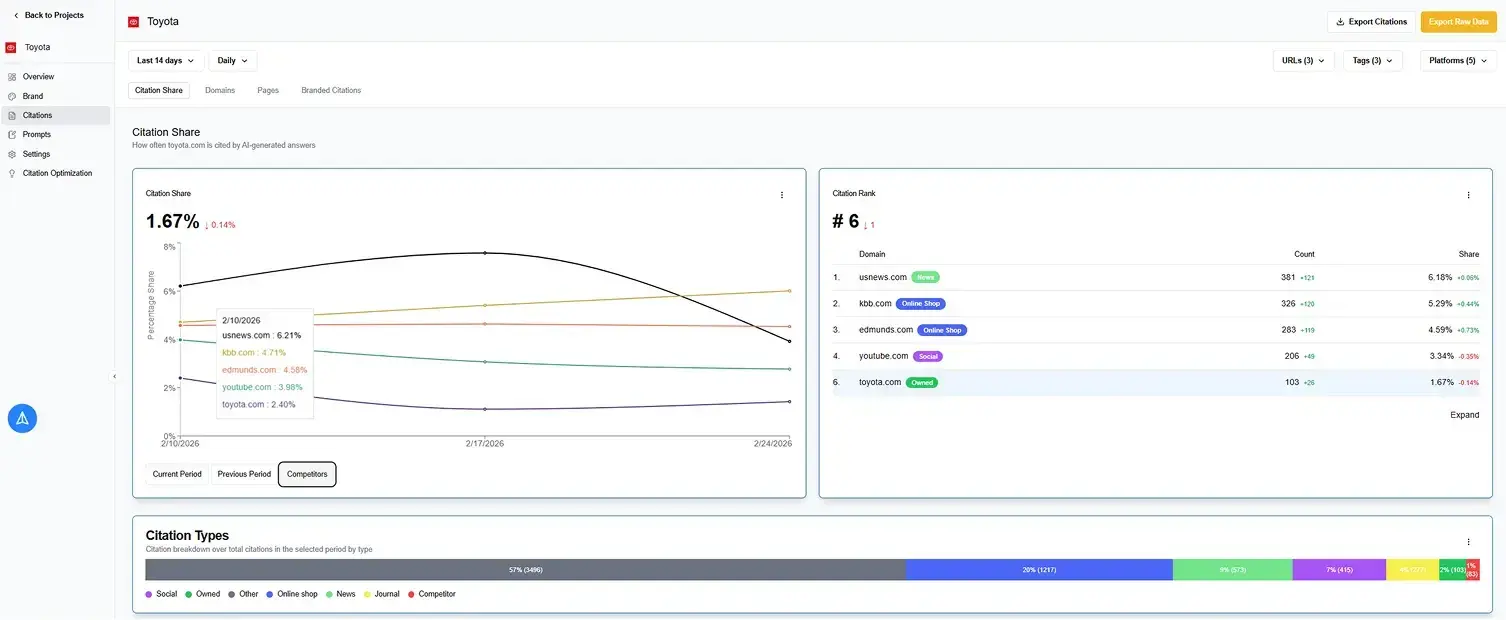
Mangools AI Search Grader is a complimentary diagnostic tool that assesses a brand’s performance across various AI search models. It synthesizes visibility and ranking data into an AI Search Score and benchmarks brand performance against competitors for automatically generated prompts. Users can utilize the tool without an account for three supported models, with a free Mangools account unlocking all seven supported models and additional search capabilities.
Key Features:
- AI Search Score for a consolidated benchmark.
- Model-level visibility and ranking insights.
- Competitor benchmarking.
Best for: Marketers and SEO teams seeking a free baseline assessment before investing in continuous AI visibility monitoring.
Pricing: The AI Search Grader is free. For continuous monitoring, Mangools offers the separate paid AI Search Watcher product.
What we like: The AI Search Score provides an easily digestible benchmark, while still allowing users to examine the underlying model-level results.
6. Morningscore ChatGPT Rank Tracker
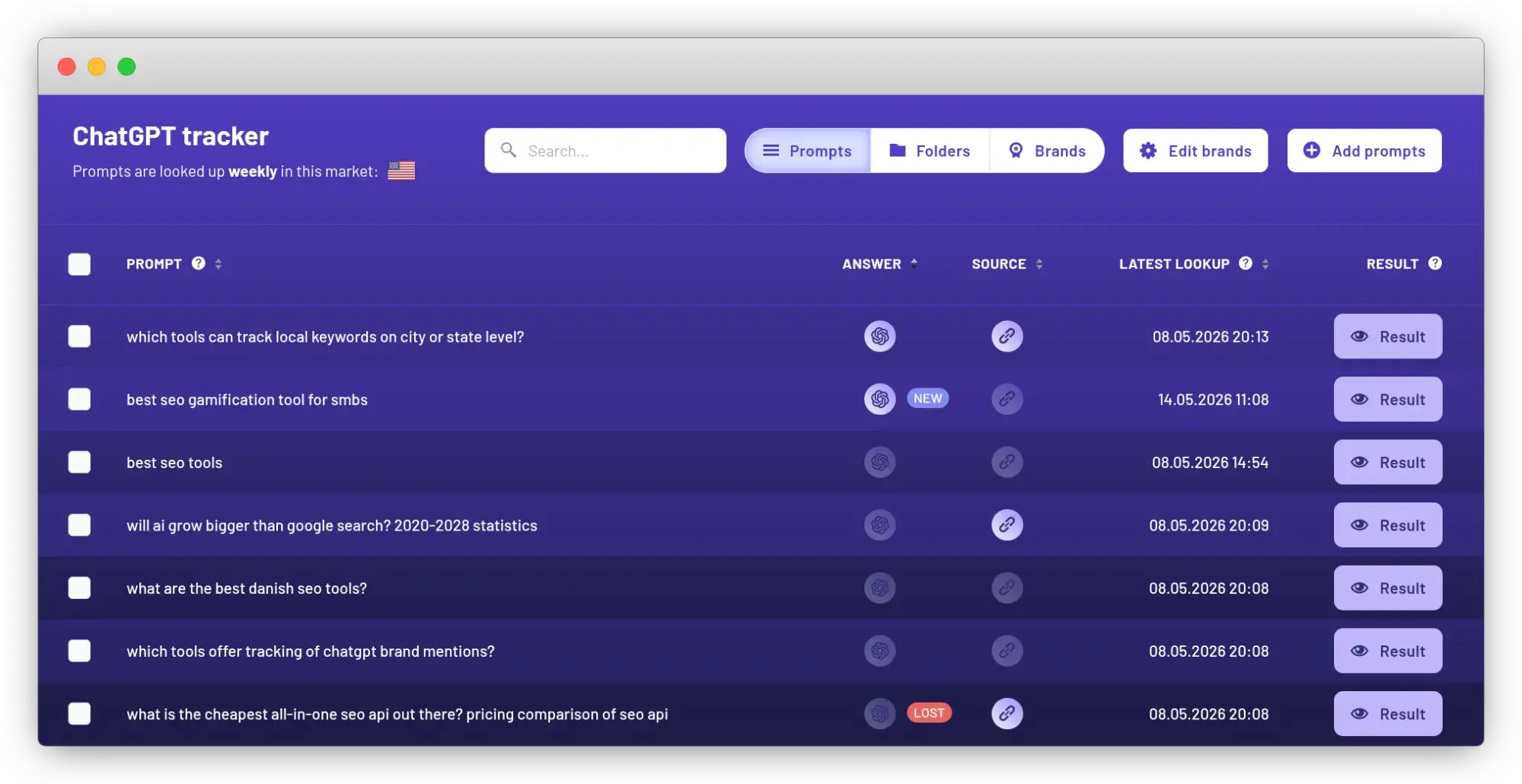
Morningscore’s ChatGPT Rank Tracker monitors brand mentions and recommendations within ChatGPT for selected prompts, providing evidence of the answer and source behind each result. Integrated into Morningscore’s broader SEO platform, it allows teams to manage traditional search metrics and ChatGPT visibility within a single interface. The tracker’s primary focus is on ChatGPT, with prompt lookups conducted weekly.
Key Features:
- ChatGPT prompt tracking and brand mention monitoring.
- Display of answers and source evidence.
- Competitor comparisons within ChatGPT.
- Integration with traditional SEO tools.
Best for: Teams primarily interested in ChatGPT visibility and seeking to consolidate this monitoring within their existing SEO product.
Pricing: Starts at $69 per month for the Lite plan with 10 ChatGPT prompts. Business is $99 per month for 100 prompts, Pro is $159 per month for 500 prompts, and Premium is $299 per month for 2,000 prompts. A 14-day free trial is available without a credit card.
What we like: Morningscore provides the underlying ChatGPT response and source evidence, making reported mentions more verifiable than a score alone.
Bonus: HubSpot AI Search Grader
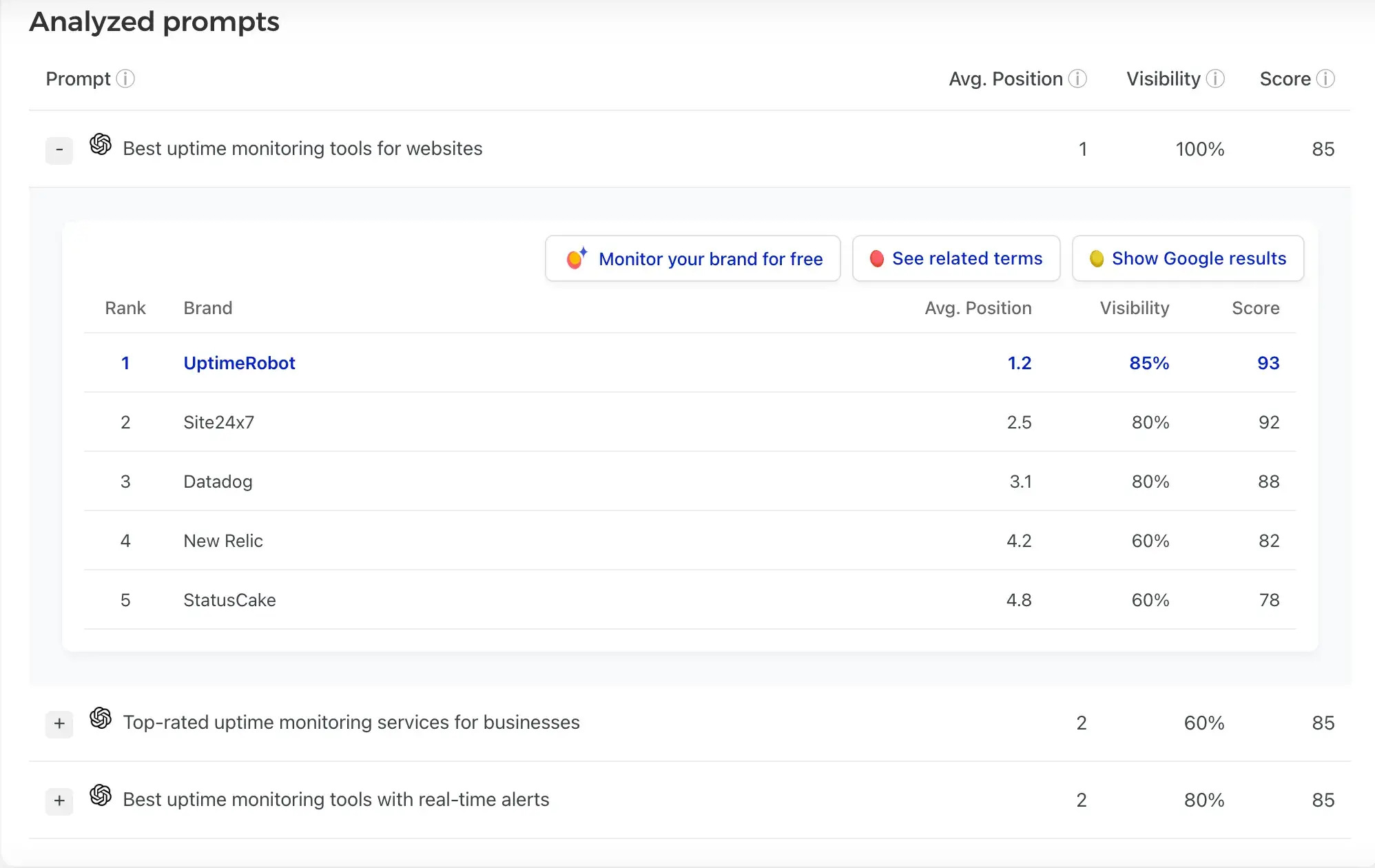
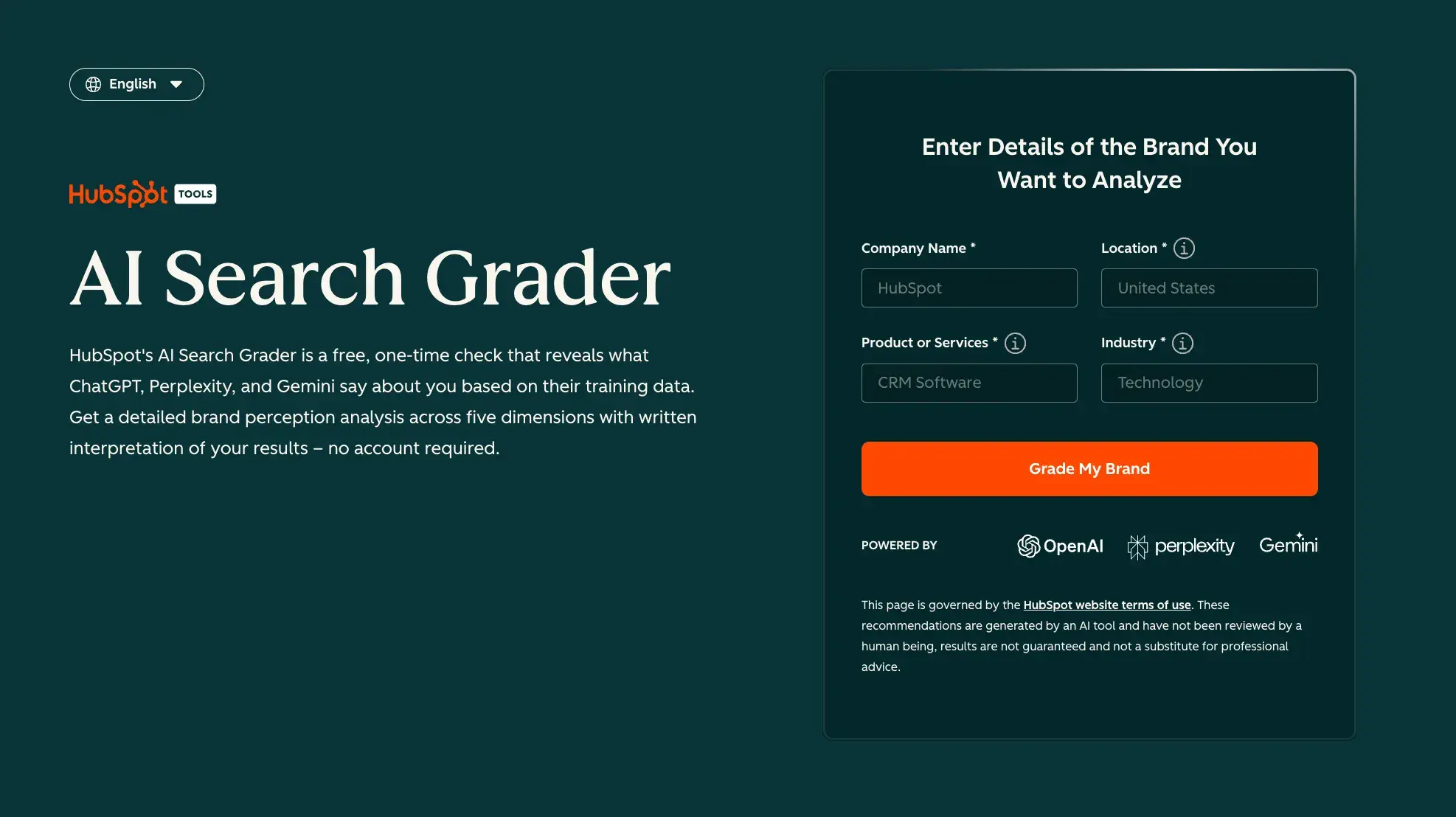
The HubSpot AI Search Grader is a free, one-time diagnostic tool that evaluates how ChatGPT, Perplexity, and Gemini represent a brand. It scores five key dimensions—sentiment, presence quality, brand recognition, share of voice, and market competition—delivering a composite score with a written interpretation. This tool serves as a distinct initial assessment, answering the question, "How do answer engines represent my brand right now?" It contrasts with the continuous tracking and prompt-specific analysis offered by HubSpot AEO.
Key Features:
- Five-dimensional scoring (sentiment, presence quality, brand recognition, share of voice, market competition).
- Composite score with written interpretation.
- Analysis across ChatGPT, Perplexity, and Gemini.
Best for: Marketing leaders, brand managers, SEO professionals, and content teams seeking a free baseline understanding before selecting a continuous AI visibility tool.
Pricing: Free. HubSpot indicates it’s a one-time check and requires no account.
What we like: The AI Search Grader simplifies the understanding of AI visibility for non-specialists, offering a clear starting point without the immediate need to design a prompt-tracking program. The Answer Engine Report has also lauded its five-dimension scoring as "the most pedagogically useful framework in the directory for explaining what AI visibility actually means to non-specialists."
Choosing an Ahrefs Brand Radar Alternative That Connects to Pipeline
The true value of AI visibility emerges when it can be correlated with key business metrics such as traffic, leads, opportunities, pipeline, and revenue. While an AI visibility product doesn’t need to function as a CRM, its reporting workflow should facilitate seamless integration with the systems marketing and sales teams already utilize. This integration is crucial for understanding content ROI, identifying which pages, topics, and sources contribute to AI-driven results, and informing future content strategies.
HubSpot’s integrated AEO experience within Marketing Hub Professional and Enterprise leverages CRM data to surface prompts that are more relevant to actual buyers. This CRM-connected approach aims to bridge AI visibility with pipeline and revenue reporting. For HubSpot users, several products can contribute to this comprehensive workflow.
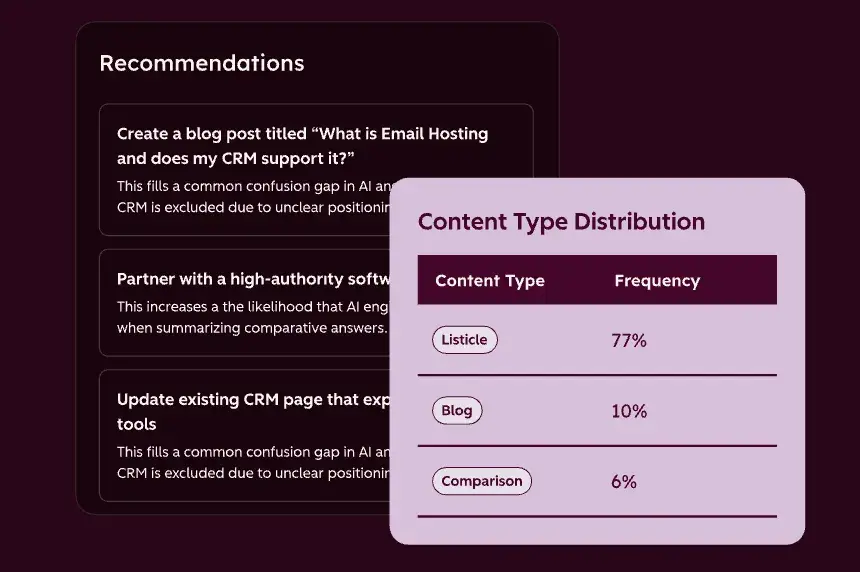
HubSpot AEO also provides prioritized recommendations, moving beyond a simple visibility score to suggest actionable steps. These recommendations can guide teams toward content updates, the creation of new pages, and citation opportunities based on identified visibility gaps. This transforms AI visibility into actionable competitive intelligence, enabling teams to discern which brands AI engines recommend, the sources influencing these recommendations, and areas for strategic improvement.
Ultimately, the selection of an Ahrefs Brand Radar alternative hinges on the desired outcomes. While basic mention monitoring may suffice for nascent programs, teams aiming to connect AI visibility with content performance, attribution, pipeline, and revenue must prioritize reporting capabilities, integrations, evidence preservation, and actionable recommendations.
How to Implement an Ahrefs Brand Radar Alternative
Implementing an Ahrefs Brand Radar alternative should be approached as a controlled rollout. This involves establishing clear reporting structures, standardizing prompts, validating results, preserving evidence, and testing the workflow before scaling it across the organization. The objective is to integrate a repeatable AI visibility measurement layer that complements, rather than replaces, traditional search reporting.
Step 1: Set up integrations and reporting foundations.
Determine where AI visibility data will reside and how it will be compared with existing marketing and revenue metrics. This foundational step ensures that insights are actionable and integrated into broader business intelligence.
Step 2: Establish prompt governance.
Consistent and well-defined prompts are essential for interpreting trend data accurately. Developing a standardized prompt library ensures that comparisons over time are meaningful and reliable.
Step 3: Implement multi-run quality assurance.
Given the variability of generated answers, teams should avoid treating a single response as definitive. Running priority prompts multiple times and comparing outputs across different models, locations, and tracking frequencies helps ensure data accuracy and reliability.
Step 4: Build an evidence repository.
Maintaining a repository of underlying AI responses, cited sources, and other relevant data is critical for explaining visibility scores and for auditing results. This evidence strengthens competitive intelligence by revealing the sources that influence recommendations.
Step 5: Pilot, compare, and scale.
Test the workflow with a limited set of prompts before expanding it across all products, regions, or audiences. This pilot phase allows for refinement of the process and ensures that the chosen tool effectively meets the team’s needs.
Frequently Asked Questions About Ahrefs Brand Radar Alternatives
How do I validate AI visibility data across different models?
Validate AI visibility data by running priority prompts multiple times and comparing the outputs across the models, locations, and tracking frequencies supported by the tool. Preserving the underlying response and citation evidence is crucial for confirming that reported visibility scores accurately reflect what the answer engine returned.
How long does it take to see results after switching tools?
While a new tool can begin collecting baseline data immediately, there is no universal timeframe for observing meaningful results. The duration depends on the tool’s tracking cadence, the stability of the prompt set, changes in AI models, and how quickly content updates are reflected in generated responses.
Can I track brand visibility by region or persona?
Some AI visibility tools offer geographic segmentation, persona-oriented prompt groups, or both. Utilizing location settings where available and organizing prompt groups around specific buyer roles or journey stages ensures consistent and meaningful comparisons.
What’s the best way to connect AI visibility to revenue?
Connect AI visibility to revenue by integrating visibility data with referral traffic, CRM, and attribution data within a unified reporting workflow. Comparing changes in high-intent prompt visibility with qualified leads, influenced opportunities, and closed revenue can reveal correlations, though it’s important to avoid claiming direct causal impact when only correlation is evident.
Do I still need traditional SEO tools with an AI visibility tracker?
Yes, traditional SEO tools and AI visibility trackers serve complementary purposes. SEO tools measure rankings, backlinks, technical health, and organic traffic, while AI visibility platforms track brand presence in generated answers. For most marketing teams, AI visibility enhances, rather than replaces, traditional SEO efforts.
Which Ahrefs Brand Radar alternative is right for your team?
Ahrefs Brand Radar is one of several methods for measuring AI visibility. The six alternatives presented in this guide range from free diagnostics and ChatGPT-specific tracking to multi-model platforms designed for ongoing reporting, evidence collection, and enterprise workflows. The optimal choice depends on the AI models a team needs to monitor, the evidence it requires, the integrations it relies on, and the cost of implementing the program at the necessary scale.
For teams seeking continuous monitoring coupled with prioritized next steps, HubSpot AEO offers a comprehensive solution that integrates visibility, sentiment, competitor citation analysis, prompt tracking, and actionable recommendations. For organizations leveraging HubSpot’s ecosystem, Marketing Hub Professional and Enterprise add valuable CRM context, aligning AI visibility more closely with existing marketing and revenue reporting.
Ultimately, the most significant differentiator among these tools is their ability to provide marketing teams with clear next actions and a credible pathway to connect visibility with tangible business outcomes. A tool that merely produces a score can answer "Are we visible?" A more robust workflow, however, can help answer "Why?" and "What should we do next?" This standard should guide the selection of an Ahrefs Brand Radar alternative.
About the Author