The digital marketing and search engine optimization (SEO) landscape is undergoing a profound transformation, driven by the rapid ascent of artificial intelligence (AI) in answering user queries. With the increasing adoption of AI-powered tools like ChatGPT, Perplexity, and Google’s own AI Overviews, a significant shift is occurring in how consumers find information. Instead of clicking through to websites, users are increasingly relying on direct, synthesized answers provided by AI. This phenomenon necessitates a new strategic approach for businesses, leading to the emergence of Answer Engine Optimization (AEO) and the tools designed to measure its effectiveness: AEO checkers.
The core challenge for brands lies in the potential vanishing act of their visibility. Traditional SEO metrics, which focus on ranking in search engine results pages (SERPs), may no longer fully capture a brand’s presence. When an AI directly answers a user’s question, the brand whose content was used to formulate that answer might not receive a direct click or even be explicitly recognized by the user. This is where AEO checkers become indispensable. They aim to quantify a brand’s presence within these AI-generated responses, providing critical insights into whether a brand is being cited, mentioned, or overlooked in favor of competitors.
Understanding Answer Engine Optimization (AEO)
Answer Engine Optimization (AEO) is the strategic discipline focused on ensuring a brand’s content is accurately and frequently represented within the AI-generated answers provided by conversational AI platforms and AI-enhanced search engines. This contrasts with traditional SEO, which primarily targets ranking for links in a list of search results. AEO aims to secure a place within the synthesized answer itself, a crucial distinction in the current search paradigm.
The evolution of search behavior can be traced back to the introduction of AI-driven features. Google’s integration of AI Overviews in May 2024, for instance, signaled a clear move towards providing summary-first answers, often resolving queries without requiring users to visit external websites. This mirrors the functionality already established by platforms like ChatGPT and Perplexity, which have trained users to expect immediate, comprehensive responses.
![AEO checker tools that measure answer engine visibility [2026]](https://www.hubspot.com/hubfs/aeo-checker-1-20260903-3858273.webp)
AEO and SEO are not mutually exclusive but rather complementary. Robust SEO practices, including creating high-quality, crawlable content and establishing domain authority, remain foundational. AI models rely on these signals to determine which sources are trustworthy and authoritative when synthesizing answers. Therefore, a strong SEO foundation directly supports AEO efforts by making content accessible and credible to AI crawlers. The key lies in presenting information in a way that AI can easily parse, trust, and cite, such as clearly structured web pages, direct answers to common questions, and content supported by verifiable primary sources.
The Function of an AEO Checker
An AEO checker serves as a vital diagnostic tool for businesses seeking to understand and improve their visibility in the AI-driven information ecosystem. These checkers perform several critical functions:
- Measuring Brand Visibility: They assess how frequently a brand’s content is cited or mentioned in AI-generated answers across various platforms. This includes identifying instances where the brand’s domain appears as a source or where the brand name is directly included in the response text.
- Diagnosing Competitive Landscape: AEO checkers analyze which competitors are appearing in AI answers for relevant queries. This competitive intelligence is crucial for identifying content gaps and understanding where rivals are succeeding.
- Identifying Misrepresentations: They flag instances where AI systems may misunderstand or inaccurately represent a brand’s offerings or information, which can be detrimental to brand reputation and customer perception.
- Prioritizing Optimization Efforts: Based on the collected data, AEO checkers provide actionable recommendations. This often involves identifying specific content updates, schema markups, or entity optimizations that are most likely to improve a brand’s citation and mention rates.
- Tracking Performance Over Time: Continuous monitoring allows businesses to track the impact of their AEO strategies, observing trends in visibility and identifying areas that require further attention.
The data gathered by these checkers can then be used to inform content creation, website structure, and semantic optimization strategies, ultimately aiming to increase the likelihood of a brand being included and accurately represented in AI-generated answers.
Manual AEO Checks: A Starting Point
While automated AEO checkers offer scalability and continuous monitoring, manual checks can serve as an initial diagnostic step, particularly for businesses with limited query lists or those new to AEO.
![AEO checker tools that measure answer engine visibility [2026]](https://no-cache.hubspot.com/cta/default/53/9dd5e54b-fbef-4dd0-bc44-1689feb1ea18.png)
Checking Google AI Overviews:
Google’s AI Overviews (AIOs) are designed to surface only when the system determines they add value beyond traditional search results, meaning they do not appear for every query. This dynamic nature requires a careful approach to manual verification.
- Define Priority Queries: Compile a list of crucial search terms, including brand names, branded product terms, and informational questions that potential customers frequently ask.
- Conduct Live Searches: Execute these queries in a signed-out or incognito browser session to simulate a neutral search environment.
- Analyze AI Overviews: For each query, note whether an AI Overview appears. If it does, meticulously examine the inline source links to determine if your domain is cited. Record the specific claims made within the AI Overview.
- Interpret Results and Identify Gaps: Compare queries where AIOs appear and cite your brand against those where an AIO is present but competitors are favored. The latter group represents your content gap list, indicating areas for potential improvement. It’s important to remember that AIOs can vary between sessions, so a single absence should prompt re-testing rather than immediate concern.
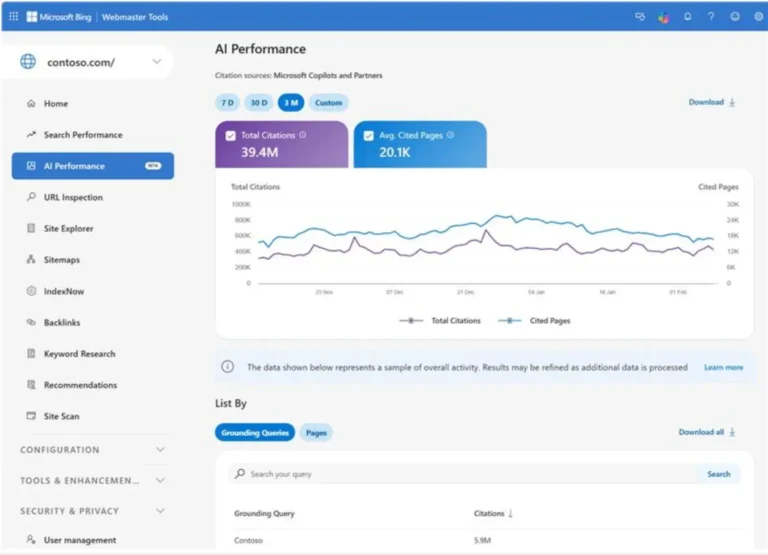
- Build a Reporting Framework: Document each result with the query, date, and search location. This provides a valuable historical record for tracking progress. Standard Google Search Console performance reports do not isolate AI Overview activity, often categorizing it under the broader "Web" search type. While Google has introduced a dedicated generative AI performance report, its initial scope was limited to impressions and a subset of sites.
Checking ChatGPT and Perplexity Citations:
These conversational AI platforms typically provide citations directly within their responses, making manual checks more straightforward.
- Execute Citation Checks: Use the previously defined branded and informational queries. For each query, verify whether your domain appears among the cited sources and whether your brand name is mentioned in the answer text. A citation and a mention are distinct forms of visibility.
- Optimize Prompt Phrasing: To ensure AI models access up-to-date information, craft direct and current questions. For example, queries like "best [product category] tools for [specific use case]" are more likely to trigger web searches for current data.
- Log and Analyze Findings: As sources can vary between queries and sessions, repeat each prompt multiple times in fresh sessions. Record the AI engine, prompt used, date, citation/mention status, and any competitor appearances. This log will highlight inconsistencies and identify areas where competitors are favored, transforming these gaps into actionable tasks. For instance, if a competitor is cited for a query where your brand is relevant but not mentioned, it signals an opportunity to optimize your content or structure for that specific question.
The Need for Automated AEO Checkers
While manual checks offer valuable initial insights, their scalability is limited. The dynamic nature of AI answers means that manual sampling quickly becomes unreliable and time-consuming, especially for businesses with extensive product lines or a broad range of target queries. This is where automated AEO checkers become essential.
![AEO checker tools that measure answer engine visibility [2026]](https://www.hubspot.com/hubfs/aeo-checker-2-20260903-852936.webp)
Key Criteria for Selecting an AEO Checker:
When evaluating AEO checking software, several factors are crucial for ensuring comprehensive and actionable insights:
- Breadth of Engine Coverage: The tool should monitor visibility across the most relevant AI platforms, including Google AI Overviews, ChatGPT, Perplexity, and Gemini.
- Citation and Mention Tracking: It must be capable of distinguishing between direct citations (linking to your domain) and mentions (naming your brand without a link).
- Competitor Analysis: The ability to benchmark your brand’s performance against competitors is vital for identifying opportunities and threats.
- Content and Keyword Prioritization: The tool should help identify which content and keywords are driving AI visibility and which require optimization.
- Data Accuracy and Reliability: Consistent and trustworthy data is paramount for making informed strategic decisions.
- Actionable Recommendations: Beyond reporting, the tool should provide clear, prioritized recommendations for improving AEO.
- Integration Capabilities: Seamless integration with existing marketing stacks, such as CRMs and content management systems, can streamline workflows.
- User-Friendly Interface: An intuitive interface ensures that marketing teams can easily interpret data and implement strategies.
Leading AEO Checker Tools and Their Capabilities:
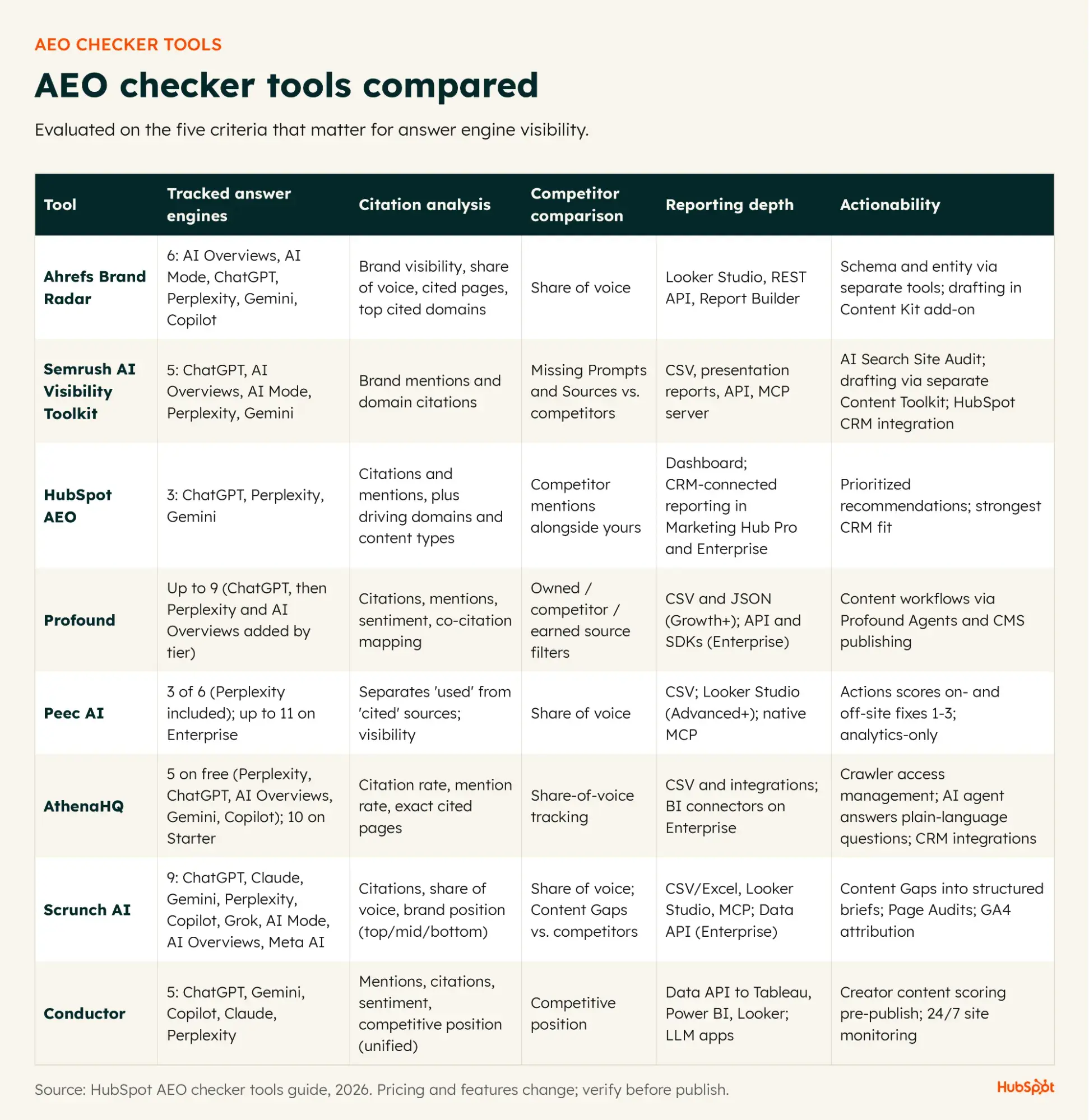
The market for AEO checkers is evolving rapidly, with various tools offering specialized features.
-
Tools with AI Overviews Tracking:
- Ahrefs Brand Radar: This tool leverages real search queries to index AI Overviews, offering a robust dataset for this specific AI feature. It focuses on providing insights into how brands are represented in Google’s AI-generated summaries.
- Semrush AI Visibility Toolkit: Semrush integrates AI Overview tracking within its broader SEO suite, allowing users to identify which ranking keywords trigger AI Overviews and prioritize optimization efforts for those specific terms and associated content.
-
Tools with ChatGPT Citation Detection:
![AEO checker tools that measure answer engine visibility [2026]](https://www.hubspot.com/hubfs/aeo-checker-3-20260903-8904553.webp)
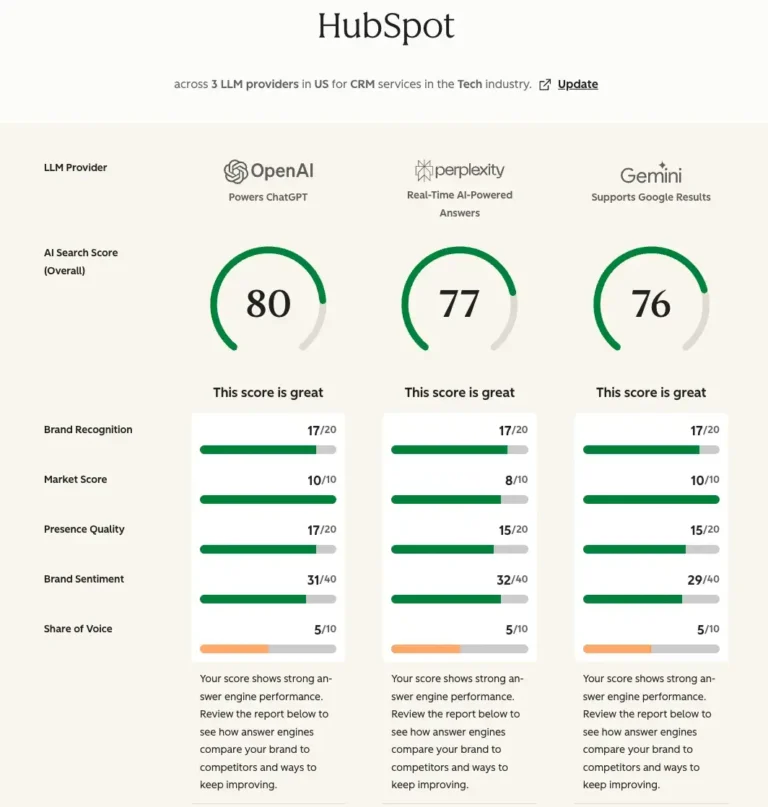
- HubSpot AEO: HubSpot’s offering goes beyond simple citation tracking to include mentions and provides a comprehensive view of visibility drivers for both the brand and its competitors. It integrates with HubSpot’s CRM for connected reporting.
- Profound: This tool delves deeper into citation context, offering sentiment analysis and categorizing citations by source type (owned, competitor, earned), providing a more nuanced understanding of AI visibility.
-
Tools with Perplexity Monitoring:
- Peec AI: A dedicated analytics tool focused on providing clear and actionable data specifically for Perplexity’s search results and AI answers.
- AthenaHQ: Offers Perplexity monitoring across all its plans, including a free tier, and features a conversational assistant for data interaction.
-
Tools for Schema and Entity Readiness:
- Scrunch AI: This tool focuses on the technical readiness of a website for AI crawlers, assessing whether pages can be reached and rendered effectively.
- Conductor: Combines continuous technical monitoring with a content scoring system designed to ensure content is optimized for AI understanding and citation.
Key AEO Metrics to Monitor
Once an AEO checker is implemented, tracking specific metrics is crucial for evaluating the effectiveness of optimization strategies.
- Citation Coverage: The percentage of AI answers that directly link back to your website. This is a primary indicator of direct visibility.
- Mention Volume: The frequency with which your brand name appears in AI answers, even without a direct link. This contributes to brand awareness and recall.
- Competitor Share of Voice: The proportion of AI answer citations or mentions that competitors receive compared to your brand. This highlights competitive strengths and weaknesses.
- Visibility Score: A composite metric, often provided by AEO tools, that summarizes overall brand presence across various AI engines. Tracking this score week over week reveals trends.
- Referral Traffic from AI: While challenging to isolate due to the "zero-click" nature of many AI answers, any traffic directed from AI platforms to your site is a valuable indicator of impact.
- Branded Search Lift: An indirect but important metric. An increase in branded searches can sometimes be correlated with improved visibility in AI answers, as users recall the brand after seeing it in a synthesized response.
These metrics should be viewed as trends over time rather than isolated data points. Consistent improvement in these areas signifies a successful AEO strategy.
From Measurement to Action: Integrating AEO into Workflows
![AEO checker tools that measure answer engine visibility [2026]](https://www.hubspot.com/hubfs/aeo-checker-4-20260903-6212698.webp)
The true value of an AEO checker lies not just in its diagnostic capabilities but in its ability to facilitate action. While many tools identify issues, platforms like HubSpot are integrating AEO insights directly into content creation and marketing workflows.
HubSpot’s AEO, particularly within its Marketing Hub Professional and Enterprise tiers, aims to bridge the gap between identifying optimization needs and implementing solutions. The tool provides prioritized recommendations for content creation or updates. In advanced tiers, features like the "Content Agent" can leverage these recommendations to generate AI-drafted content, which can then be refined and published within HubSpot’s integrated content editor.
This integrated approach allows for a seamless loop: data from AEO monitoring informs content strategy, AI-assisted content generation speeds up the creation process, and the integrated publishing tools ensure efficient deployment. Furthermore, by leveraging HubSpot’s Smart CRM, traffic referred from AI tools can be tracked as a distinct source, linked to specific contacts and deals, thus providing a more holistic view of the marketing funnel and the impact of AEO on pipeline generation.
It’s important to acknowledge the inherent challenge of "zero-click" conversions in the AI era. While AEO checkers can measure visibility, and some tools can attribute click-through traffic, the indirect influence of AI answers on brand awareness and consideration remains difficult to quantify precisely in terms of direct pipeline value. Therefore, a balanced approach that considers both direct metrics (citations, traffic) and indirect indicators (brand mentions, branded search lift) is essential.
Frequently Asked Questions About AEO Checkers
-
How often should AEO checks be performed?
For manual checks, sampling multiple sessions per query is recommended due to the variability of AI responses. Automated checkers should ideally run daily or weekly refreshes to capture these fluctuations accurately. A monthly snapshot may obscure critical short-term shifts.![AEO checker tools that measure answer engine visibility [2026]](https://www.hubspot.com/hubfs/aeo-checker-5-20260903-8938354.webp)
-
Is AEO synonymous with AI search optimization?
While often used interchangeably, AEO is the more precise term. It specifically refers to optimizing for AI-generated answers from platforms like ChatGPT, Perplexity, and Gemini. "AI search optimization" can be a broader term encompassing various AI-driven search enhancements. -
Can citations in ChatGPT and Perplexity be reliably tracked?
Yes, to a degree. Both platforms offer source citations within responses. However, the reliability comes from repeated testing across multiple sessions to identify consistent patterns rather than relying on a single output. -
Do AEO checkers replace traditional SEO tools?
No, they serve different but complementary purposes. SEO tools focus on website rankings, keyword performance, and backlink profiles, which are foundational for AEO. AEO checkers measure visibility within AI-generated answers, a new frontier. Both are necessary for a comprehensive digital strategy.
The emergence of AI in search represents a fundamental shift that demands adaptation. AEO checkers are not merely tools for tracking visibility; they are strategic enablers, empowering brands to navigate this evolving landscape, maintain their relevance, and ensure their voice is heard amidst the synthesized answers of the future. As AI continues to mature, the importance of understanding and optimizing for these answer engines will only grow, making AEO checkers an indispensable part of any forward-thinking digital marketing strategy.
About the Author