The rapidly evolving landscape of Search Engine Optimization (SEO) has introduced a new frontier: Answer Engine Optimization (AEO). As artificial intelligence (AI) models like ChatGPT, Gemini, and Perplexity become increasingly sophisticated in answering user queries directly, businesses are seeking tools to understand and influence their brand’s visibility within these AI-driven environments. Two prominent platforms in this emerging space are Profound and Athena AI. However, navigating the competitive waters of AEO comparisons often leads to a quagmire of vendor-produced content, affiliate reviews, and competitor analyses, making an objective assessment challenging.
This comprehensive analysis aims to cut through the noise by providing an unbiased comparison of Profound and Athena AI, rigorously verifying every pricing figure, feature claim, and security detail directly against the vendors’ official documentation as of September 23, 2026. Where direct verification was not possible, this limitation will be clearly stated, ensuring transparency and a fact-based approach.
Both Profound and Athena AI fall under the umbrella of AI SEO, software designed to track how a brand appears when users query AI engines, as opposed to traditional search engines like Google. For those new to the terminology, understanding core AI SEO concepts is crucial before delving into the specifics of this comparison.
Profound vs. Athena AI for AEO at a Glance
Profound is engineered around an "AI Marketer" concept, utilizing a credit-based system of agents. It features a context manager for storing brand knowledge and a monitoring layer that provides insights into answer engine performance, including prompt volumes and specific answer engine insights. As of the most recent data, Profound offers a free Trial and a custom-quoted Enterprise plan. Notably, there is no longer a published self-serve paid tier for individual brands; previous plans ranging from $99 to $399 per month are no longer advertised and may appear in older, potentially outdated, reviews.
Athena AI, operating under the AthenaHQ brand, presents a more structured pricing model. It offers a credit-based Starter plan with a published price of $295 per month, complemented by a free Essential tier and a custom Enterprise tier. Athena AI emphasizes "action" features, including content optimization agents and direct integrations with platforms like Shopify and Google Analytics 4 (GA4). It also offers a specialized program for agencies.
The fundamental divergence between these platforms lies in their accessibility and the scope of their features. Profound’s primary self-serve option is a time-limited free trial, with all other engagements requiring a sales consultation. Athena AI, conversely, provides a clearly priced self-serve plan with a robust feature set, though its most advanced capabilities, such as the Athena Citation Engine and multi-region tracking, are reserved for its Enterprise offering.
Methodology Note: All figures and feature comparisons are derived from Profound’s pricing page (tryprofound.com/pricing), Athena AI’s plans page (athenahq.ai/plans), and each vendor’s SafeBase-hosted trust center, cross-checked on September 23, 2026. Review platform data, such as G2 counts and star ratings, are dynamic and should be treated as directional indicators, requiring verification against live listings for critical business cases.
Coverage of AI Engines: Breadth vs. Relevance
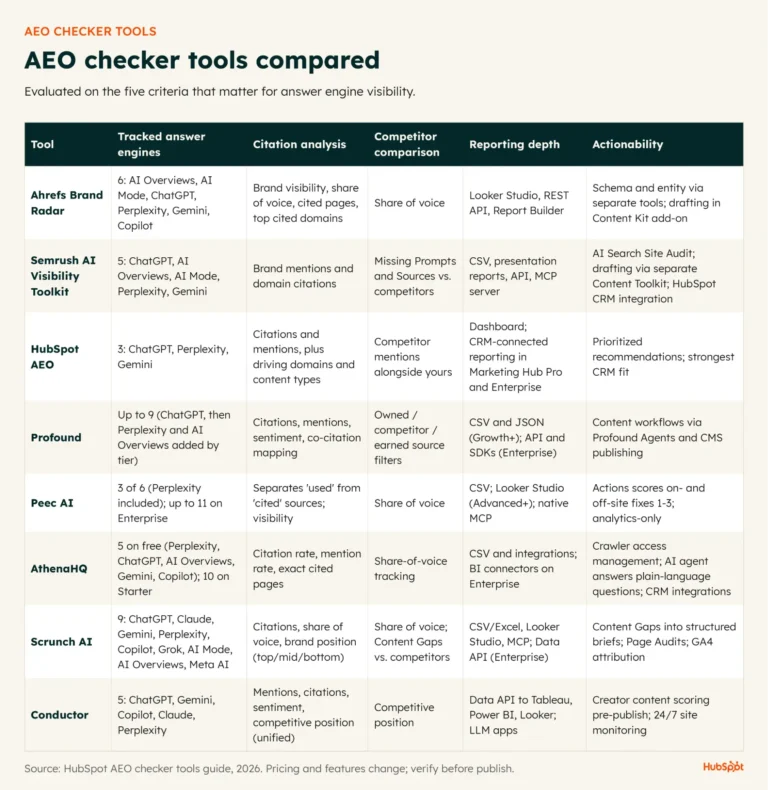
A key differentiator between AI visibility tools is the number and type of AI engines they can monitor. On its self-serve Starter plan, Athena AI lists coverage for 11 named models, including prominent ones like ChatGPT, Perplexity, Google AI Overviews, Gemini, Claude, and Copilot, with additional models available upon request.
Profound’s equivalent self-serve access, via its free Trial, is more limited, covering only ChatGPT, Gemini, and Google AI Overviews. To access a broader range of up to nine engines, including Claude, Copilot, DeepSeek, Google AI Mode, and Exa Search, users must opt for Profound’s custom-quoted Enterprise plan.
This disparity in engine coverage without a sales call is a verifiable difference. However, the sheer number of supported engines is only valuable if those engines are actively used by a brand’s target audience. A B2B software company whose customers primarily use ChatGPT and Perplexity, for instance, would derive minimal benefit from coverage of niche engines like Grok or Mistral. Therefore, it is paramount for businesses to analyze their existing referral and session data from sources like Google Analytics or their CRM to identify which AI referrers are already driving traffic and prioritize coverage accordingly.
Both platforms adopt a similar approach to regional and language reach, with extensive global coverage typically gated behind Enterprise plans. Profound’s free Trial is restricted to a single language and region, while its Enterprise plan offers custom language and region support without a defined public limit. Athena AI’s Starter plan is explicitly single-region and single-language, with multi-region and multi-language tracking designated as Enterprise-exclusive features. Businesses with global aspirations should anticipate that achieving comprehensive international coverage will necessitate engaging in sales discussions and budgeting for Enterprise-level solutions on either platform.
Pro Tip: Requesting a real-time snapshot of your brand’s presence across the vendor’s entire engine list, even if it requires a sales call, can provide invaluable insights into the quality of coverage beyond published feature grids.
Measuring Visibility: Metrics and Methodologies
Understanding how AI visibility is measured is crucial for evaluating Profound and Athena AI. Both platforms aim to bridge the gap left by traditional analytics, which often fail to capture zero-click AI answers.
Profound’s monitoring layer, known as Answer Engine Insights, employs structured prompts to query AI engines and reports on citations, sentiment, rankings, and competitive presence. The free Trial offers analysis of 50 unique prompts daily for seven days across three engines, with data retention limited to the trial period. Enterprise tracking is described as ongoing and daily, with custom prompt volumes and full historical data. Profound also provides "Prompt Volumes," a panel-based estimation of query frequency across AI platforms, aiding in prioritization of visibility gaps.
Athena AI utilizes a credit-based system where "1 credit = 1 AI response." This logic applies across all plans, meaning each monitored prompt draws from a unified credit pool that also covers other account activities, such as using the "Ask Athena" copilot or content agents. This unified credit system means that increasing monitoring frequency or prompt count directly competes with other uses for the same budget. Athena AI’s Enterprise tier introduces a discrepancy-detection feature, "Oracle," designed to identify factual inaccuracies about a brand in AI responses, along with a numerical prompt-volume estimate akin to Profound’s offering.
Caution: Both platforms characterize their visibility data as probabilistic and directional. AI answers are inherently variable, influenced by session context, personalization, region, and even time of day. Therefore, minor fluctuations in visibility scores should be interpreted with caution, and trend analysis over weeks is more indicative of performance than single-day snapshots.
Content Optimization and Workflow Integration
The practical application of insights gained from AEO tools often follows a four-stage loop: Measure, Prioritize, Create/Update, and Monitor. Both Profound and Athena AI claim to address all four stages, but the extent of their automation and how these capabilities are gated varies.
Profound offers its deepest "create" tooling, including Agents, Sheets, and the Context Manager, on both its Trial and Enterprise plans. However, the limited credits on the Trial restrict the practical volume at which these agents can be utilized, effectively pushing extensive content creation and optimization efforts towards the Enterprise tier.
Athena AI includes its content optimization agent and self-learning content improvement features in the $295/month Starter plan. However, its prioritization layer, encompassing the Recommendation Engine and ACE, is an Enterprise-exclusive feature. This means Starter plan users gain content optimization tools but lack the platform’s direct recommendations on what to prioritize first.
Best for: Teams with a clear understanding of their optimization priorities and a need for execution tools may find Athena AI’s Starter plan suitable. For organizations seeking platform-driven prioritization before content development, both vendors reserve this capability for their Enterprise offerings. It’s important to note that neither Profound nor Athena AI are positioned as full-fledged AI workflow automation stacks; they are primarily optimization and monitoring tools, with content production serving as a supplementary function.
Team Access and Agency Suitability
Both Profound and Athena AI advertise "unlimited seats" across their pricing tiers, a feature that warrants careful consideration within specific organizational contexts. Profound’s Trial and Enterprise plans both offer unlimited seats, with support levels varying from "None" on the Trial to a custom mix of email, dedicated Slack, or a 24-hour SLA specialist on Enterprise.
Athena AI also provides unlimited seats and role-based access control (RBAC) on all plans. Single Sign-On (SSO), audit logs, and a 2-hour support SLA are reserved for the Enterprise tier.
Both vendors cater to agencies managing multiple client brands, though their advertised programs highlight different strengths. Athena AI’s published Agency Program emphasizes multi-brand management, discounted reseller licensing, a pitch workspace, and lead routing. Profound mentions a separate self-serve "Agency Growth" option, details of which are best obtained directly from the vendor.
Admin Overhead vs. Control Checklist: Agencies should inquire directly with both vendors about:
- Workspace management capabilities
- Credit allocation across clients
- White-label reporting options
- Data retention policies
Watch out: Publicly available pricing pages often do not fully address the nuances of workspace management, credit distribution, white-labeling, or data retention. Securing these details in writing during the sales process is critical for agencies, as these factors can significantly impact profitability.
International Coverage: A Tiered Offering
International coverage represents another significant area where Profound and Athena AI differentiate their offerings based on pricing tiers. Profound’s free Trial is strictly limited to one language and one region. Its Enterprise plan lists "Custom" for both language and region, but lacks specific public figures for supported countries or languages.

Athena AI’s Starter plan is designed for single-region and single-language use, explicitly stating "Multiple Countries: none" in its plan comparison table. Multi-region and multi-language support, alongside persona targeting, are exclusively available under its Enterprise plan. While some third-party marketing materials for Athena AI suggest coverage across "60+ countries and languages," this figure originates from the vendor’s marketing and should be verified through a demo rather than taken as a confirmed specification.
Watch out: For businesses requiring international tracking from the outset, neither platform’s advertised entry-level pricing will suffice. Both vendors channel multi-region and multi-language capabilities into custom Enterprise pricing, making it essential to incorporate these anticipated costs into initial budget evaluations.
Pricing Models and Scalability Risks
The pricing structures of Profound and Athena AI diverge significantly, and recent updates by both vendors mean that older reviews may present outdated information.
Profound’s Current Pricing: As of September 2026, Profound offers a free 7-day Trial and a custom-quoted Enterprise plan. There is no publicly listed self-serve paid tier for individual brands. This represents a shift from previous pricing models that included advertised self-serve plans such as a $99/month Starter and a $399/month Growth plan. Any specific dollar figures for Profound found in articles older than a few months should be verified directly on tryprofound.com/pricing. Profound’s Agents operate on a separate credit system, with credits consumed based on complexity. Enterprise credit packages are customized, with options for automatic overage billing or usage pausing.
Athena AI’s Current Pricing: Athena AI provides a free initial credit grant (Essential, $25/300 credits), a self-serve Starter plan at $295/month ($245/month billed annually), and a custom Enterprise plan. The Starter plan includes 3,600 credits monthly, with each credit equating to one AI response. Under this model, checking a single prompt across three engines consumes three credits. Monitoring 30 prompts daily across three engines would consume approximately 2,700 credits per month, before accounting for any ad hoc usage of the "Ask Athena" copilot or content agents. Additional credits and API access are paid add-ons to the Starter subscription.
Cost Calculation Exercise: Before committing to either platform, it is advisable to model realistic usage scenarios. For example:
- Scenario A: High-Frequency Monitoring: If your team plans to monitor 50 prompts daily across 5 engines, this equates to 250 prompts per day. With 30 days in a month, that’s 7,500 prompts. At 1 credit per prompt, this requires 7,500 credits per month.
- Athena AI: The Starter plan offers 3,600 credits. You would need to purchase approximately 4,000 additional credits. The cost of additional credits varies, but assuming a rate of $0.08 per credit (based on the Essential tier pricing), this would add $320 per month, bringing the total to $615.
- Profound: This usage would likely fall under an Enterprise plan, requiring a custom quote.
Pro Tip: Base credit-based plan sizing on the number of prompts your team intends to act upon, rather than theoretical maximums. Over-tracking is a common pitfall leading to budget overruns.
Watch out: "Total cost predictability" differs significantly. Athena AI offers a published starting price with predictable variable costs based on credit usage. Profound requires a sales consultation to establish pricing, making direct budget comparisons challenging based solely on public information.
Support and Security: Verified Credentials
Both platforms leverage SafeBase-powered trust centers for their security documentation, allowing for independent verification of certifications.
Profound’s trust center (trust.tryprofound.com) lists SOC 2 Type 2 certification and HIPAA compliance. Supporting documentation, including pentest reports and data flow diagrams, is available. Its Data Processing Agreement references alignment with SOC 2, ISO 27001, and NIST 800-53 standards, though it’s important to distinguish between contractual alignment and holding specific certifications. SSO via SAML or OIDC, role-based permissions, and daily backups with one week of retention are listed as Enterprise features.
Athena AI’s trust center (trust.athenahq.ai) details SOC 2 Type 1 and Type 2 certifications, alongside GDPR compliance. SAML/OIDC SSO, organization-level audit logs, and a 2-hour support SLA are exclusively available with Enterprise plans, mirroring Profound’s structure where advanced access controls and support commitments are reserved for custom contracts.
Watch out: The distinction between "SOC 2 compliant" and "SOC 2 Type II certified" is crucial. Vendor marketing materials may sometimes blur these terms. Always request the full audit report from the trust center for thorough verification, especially for regulated industries.
User Feedback and Market Perception
The public review landscape for these platforms shows a notable difference in volume. As of late 2026, Profound holds an average rating of approximately 4.5 out of 5 stars across over 1,000 G2 reviews. Athena AI (listed as AthenaHQ on G2) boasts a higher average rating, around 4.9 out of 5, but from a significantly smaller base of approximately 30-35 verified reviews. A higher average on a limited sample size is not directly comparable to a well-established average from a large volume of reviews.
Recurring themes in Profound’s reviews highlight its data depth, competitor benchmarking capabilities, and responsive support. However, users frequently mention a steep learning curve, with the interface sometimes described as overwhelming for new users. Pricing is also cited as a constraint for smaller teams. Reddit discussions also note that public reviews rarely address how effectively these tools handle Reddit as a citation source, a crucial detail for community-driven citation strategies.
Athena AI reviews, both on G2 and independent write-ups, consistently praise its ease of use, rapid onboarding, and the practical value of its Action Center recommendations. The credit-based pricing model is the most common point of friction, with several reviewers underestimating credit consumption when enabling broader monitoring. Some community discussions express skepticism regarding the precise attribution of revenue to specific AI citations, a general caution applicable to the entire AEO category.
Note on Naming: When researching "Athena AI," users should be aware that "Athena AI" is also the name of an unrelated AI tutoring product for students. The AEO platform discussed here is AthenaHQ (athenahq.ai).
Lightweight Trial and Fit Plan:
- Define Core Needs: Identify the top 3 AI engines your audience uses and the primary AEO goal (e.g., brand visibility, competitor analysis, content ideation).
- Test Drive: Utilize the free trials or essential tiers of both platforms, focusing on the identified core needs.
- Simulate Workflows: Attempt to integrate the tool’s output into your existing content or marketing planning processes.
Which Tool Should You Choose?
There is no singular "better" tool between Profound and Athena AI for AEO; the optimal choice depends on specific organizational needs and resources.
- For Analytical Depth and Resource Allocation: Profound’s Enterprise tier, after navigating the sales process, offers the most extensive published engine coverage and mature AI Marketer tooling. This option is best suited for teams capable of managing a significant learning curve and a custom-negotiated cost.
- For Predictable Self-Serve Entry and Faster Value: Athena AI’s Starter plan provides a clear, actionable price point and includes content agent tooling without requiring an Enterprise commitment. The primary consideration is its credit-consumption model, which rewards disciplined usage but can surprise teams scaling rapidly.
- For In-House Teams Managing Single Brands: Both platforms can be effective. The decision hinges on whether the team prefers platform-driven prioritization (favoring Enterprise tiers on either vendor) or requires execution tools to complement their own strategic judgment (favoring Athena AI Starter).
- For Agencies Managing Multiple Clients: Athena AI’s documented Agency Program, with its multi-brand management features, reseller licensing, pitch workspace, and lead routing, appears more comprehensively detailed than Profound’s current public offerings, although Profound’s Agency Growth option warrants direct inquiry.
Ultimately, the choice involves a trade-off between measurement depth and automation maturity on one hand, and cost predictability and time-to-value on the other. Maximizing both typically necessitates a custom Enterprise engagement with either vendor.
The Role of HubSpot AEO in Closing the Loop
While Profound and Athena AI excel at measuring and facilitating action on AI visibility, they are standalone solutions. They do not integrate directly into the marketing platforms where most content, campaigns, and customer data reside. This is the gap that Answer Engine Optimization (AEO) within HubSpot aims to fill.
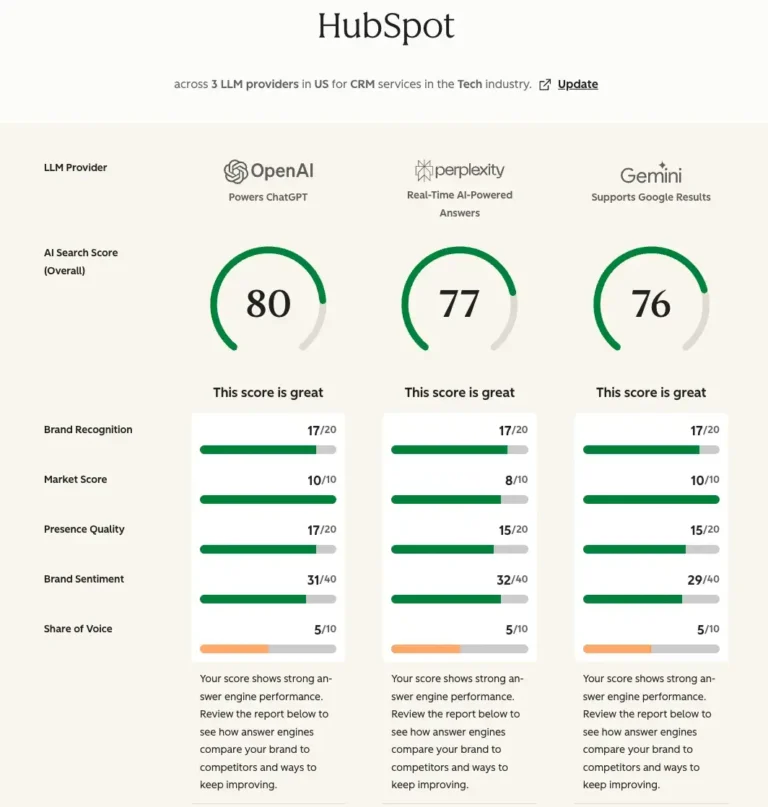
HubSpot AEO provides an ongoing AI visibility score across major answer engines, competitor comparisons, and prioritized recommendations, similar in spirit to the monitoring layers of Profound and Athena AI. Crucially, when integrated within HubSpot’s Marketing Hub Pro and Enterprise, AEO offers distinct advantages: CRM-informed prompt suggestions derived from actual customer and deal data, and a direct pathway from identifying a visibility gap to drafting or updating content within the same platform where it is published, tracked, and reported.
This integrated approach—connecting insight to action through tools like HubSpot’s Content Agent, powered by Smart CRM data and Agent Hub—is a key capability to verify within one’s existing HubSpot plan, as the platform’s execution tooling continues to evolve. For organizations finding that Profound and Athena AI identify visibility gaps but don’t fully address how to close them, HubSpot AEO is engineered to provide that comprehensive solution.
Frequently Asked Questions About Profound vs. Athena AI for AEO
Is Athena AI legitimate?
Yes, Athena AI, specifically the AEO platform AthenaHQ (athenahq.ai), is a legitimate entity founded by individuals with prior experience at Google Search and DeepMind, and backed by Y Combinator. It holds SOC 2 Type 1 and Type 2 certifications and GDPR compliance, and maintains a strong G2 rating, albeit with a smaller review base. It’s important to distinguish it from the unrelated AI tutoring product also named "Athena AI."
How do credits versus tiers impact total cost of ownership?
Credit-based models (Athena AI Starter, Profound Agents) tie costs to usage, making them variable but potentially scalable with activity. Tiered models offer fixed budgets but may cap tracking capabilities. Currently, neither vendor offers a simple, flat published price for significant scale; Athena AI’s flat price has variable credit costs, and Profound lacks a published flat price above its free Trial. Modeling expected usage against both structures is essential.
Do these AEO tools integrate with GA4 and CRM?
Athena AI lists direct integrations with GA4 and Google Search Console. Profound integrates with Google Analytics via its Agent Analytics. Neither platform offers native, out-of-the-box CRM integration. Profound’s API access (Enterprise feature) allows for custom CRM connections, requiring development work.
How should I prioritize AI engine coverage for my brand?
Begin by analyzing existing referral and session data to identify which AI engines are currently driving traffic. Then, compare this list against the vendors’ published engine coverage. Prioritize engines actively used by your audience over sheer quantity. Regional and language coverage should similarly focus on your specific target markets.
Where can I find candid user feedback?
G2 is a primary source for verified reviews, though Profound has a significantly larger review volume than AthenaHQ. Reddit discussions (e.g., "Profound AI Reddit") offer more candid, though less structured, insights, including skepticism about attribution accuracy—a relevant caution for the entire AEO category. Always verify pricing and feature details against current vendor websites.
About the Author