The proliferation of AI-generated content has ignited a fervent debate, particularly within the art world, where the revelation of artificial intelligence’s hand in creation often sparks immediate backlash. This phenomenon was starkly illustrated by a recent social media experiment that, by cleverly manipulating perception, exposed a fundamental human psychological bias: our ingrained valuation of human effort. What began as a seemingly straightforward test of AI’s artistic capabilities quickly evolved into a profound commentary on how we judge creative output, revealing that our appreciation is often deeply intertwined with the perceived investment of time and human intention.
The Deceptive Monet: An Experiment in Perception
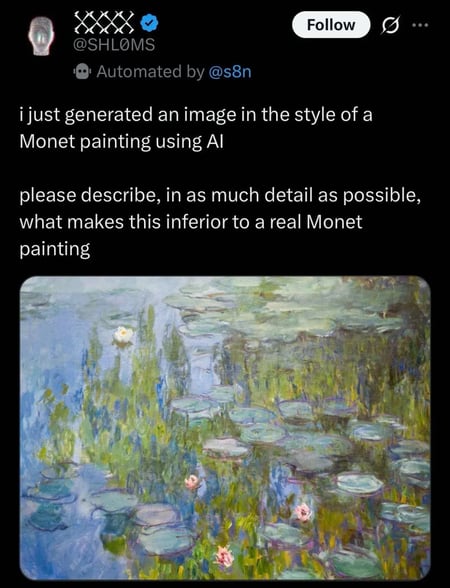
The catalyst for this widespread discussion was an image posted on the social media platform X (formerly Twitter) by user SHLOMS. The post presented an image generated by advanced AI models, trained on vast datasets of the world’s finest artworks, and explicitly stated it was an AI creation in the style of a Monet painting. The prompt accompanying the image invited users to analyze it, detail its perceived flaws compared to a genuine Monet, and articulate what made it inferior. The overwhelming response was a chorus of criticism. Over 1,300 replies characterized the AI artwork as "pure crap," citing a lack of "coherent composition," an "incoherent muddle" of colors, and an overall sense of being "obvious AI slop," "garbage," and "borked nonsense with no sense of space." Users lamented its perceived lack of meaning and the absence of the "magical quality imbued by human creativity."
However, the narrative took a dramatic turn when SHLOMS revealed the truth: the image was not AI-generated. It was, in fact, a genuine painting by Claude Monet, a celebrated Impressionist master. This revelation exposed the potent influence of the label "AI-generated" on audience perception. When presented with the same artwork, but with the understanding that it was created by a human artist with decades of dedicated practice, the critical lens shifted entirely. The experiment effectively demonstrated that the negative reactions were not inherent to the artwork itself, but rather a consequence of the preconceived notion that it was effortlessly produced by a machine.

The Effort Heuristic: When Perceived Labor Dictates Value
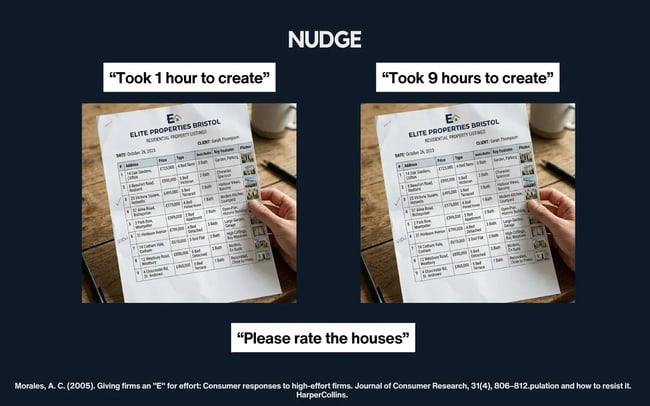
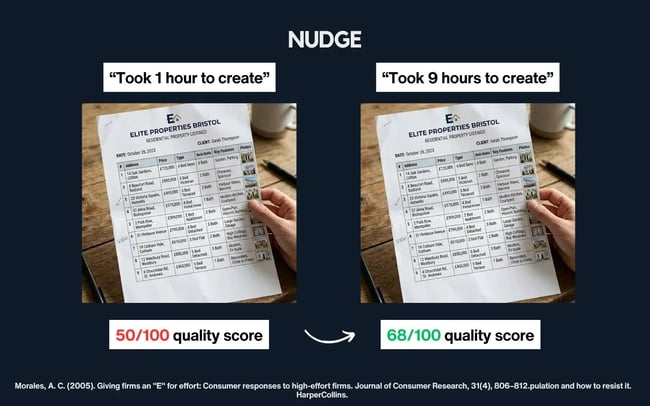
This psychological phenomenon, where the perceived effort invested in creating something directly influences our valuation of it, is a well-documented aspect of human cognition. Professor Andrea Morales, Lonnie L. Ostrom Chair in Business and professor in the Department of Marketing at Arizona State University, refers to this as the "effort heuristic." Her research, including a 2005 study published in the Journal of Consumer Research, provides compelling evidence for its impact.
In one of Morales’s key experiments, participants seeking a new home were presented with personalized lists of apartments compiled by real estate agents. Crucially, the participants were divided into two groups. One group was informed that their agent had "did everything manually and spent nine hours building the list," while the other group was told that "the agent used a computer program, spending only one hour on the list." In reality, the lists provided were identical and always took only one hour to compile. The results were striking: participants who believed the list took nine hours to create rated the houses 30.5% higher than those who were told it took only one hour. This suggests that when objective quality is difficult to ascertain, we often use perceived effort as a proxy for quality. The implication for the Monet painting experiment is clear: when viewers believed the image was a product of instantaneous AI generation, they unconsciously devalued it, attributing its perceived flaws to a lack of human dedication and skill.

The widespread condemnation of the "AI Monet" underscores a broader trend. In a world increasingly saturated with easily generated digital content, there’s a growing skepticism and even disdain for anything perceived as lacking genuine human input. This sentiment is echoed by figures like Dave Harland, a copywriter who coined the term "Death By Sepia" to describe the homogenization and perceived lack of authenticity in content that relies too heavily on generic AI aesthetics. He points to examples like a restaurant billboard that, while perhaps colorful and informative, carries an unmistakable AI-generated sheen that can alienate viewers who associate it with low effort and a lack of artisanal care.
The AI Paradox: Embracing Technology vs. Valuing Craftsmanship
The AI art experiment highlights a significant contradiction in the contemporary landscape of creation and consumption. On one hand, businesses and creators are repeatedly urged to embrace AI as a tool for efficiency, innovation, and staying competitive. AI is presented as a pathway to streamline processes, generate novel ideas, and reach wider audiences. However, as Morales’s research and the Monet incident demonstrate, an over-reliance on AI, or even the perception of such reliance, can lead to audience rejection.
This presents a complex challenge for marketers and content creators. How can one leverage the undeniable power of AI without alienating an audience that intrinsically values human touch, effort, and demonstrable craft? The key, it appears, lies in how AI is integrated and presented. Simply labeling something as AI-generated without further context or justification can be a disservice to its potential. Conversely, highlighting the human element in the creation process, even when AI tools are utilized, can foster greater appreciation.
Consider the implications for various industries:
- Art and Design: Galleries and individual artists may face pressure to disclose AI involvement. The "effort heuristic" suggests that art demonstrably created through laborious traditional techniques will likely retain a premium in perceived value.
- Marketing and Advertising: Companies that tout AI-generated content without emphasizing the strategic human oversight, creative direction, or post-generation refinement might find their messages falling flat. The "Death By Sepia" effect can lead to campaigns being perceived as soulless or uninspired.
- Writing and Journalism: While AI can assist with research, drafting, and summarization, the "human touch" – critical analysis, unique perspective, and emotional resonance – remains paramount for reader engagement. Transparency about AI assistance, coupled with a clear articulation of the human editor’s or writer’s contribution, will be crucial.
- Product Development: In fields where craftsmanship is traditionally valued, like artisanal food, bespoke clothing, or handcrafted furniture, emphasizing the human labor and skill involved will be critical to maintaining consumer trust and perceived value, even if AI assists in design or production planning.
The Enduring Need for Human Meaning
The unmasking of the "AI Monet" serves as a powerful reminder that technology, while transformative, cannot entirely supplant fundamental human psychological drivers. People crave connection, authenticity, and evidence of care in the things they consume and engage with. When we believe that something was created with intention, passion, and significant personal investment, we are more likely to appreciate its nuances, overlook minor imperfections, and connect with it on a deeper level.
The lesson for creators and marketers is clear: AI is a powerful tool, but it is not a substitute for meaningful human creation. The challenge lies in finding the right balance – harnessing AI’s capabilities to enhance efficiency and innovation while always ensuring that the final product resonates with the human element of effort, intention, and genuine artistry. As Professor Matt Johnson discussed on the podcast "Nudge," AI-generated content that fails to evoke emotion or provide genuine insight risks being dismissed, regardless of its technical sophistication.
Ultimately, the audience is performing a similar calculation with every piece of content they encounter. They are looking for evidence that someone cared enough to invest their time, effort, and unique perspective. The "effort heuristic" suggests that by providing this evidence, creators can foster stronger connections and build more enduring value, proving that while AI can create images, it is human effort that imbues them with lasting meaning.
About the Author