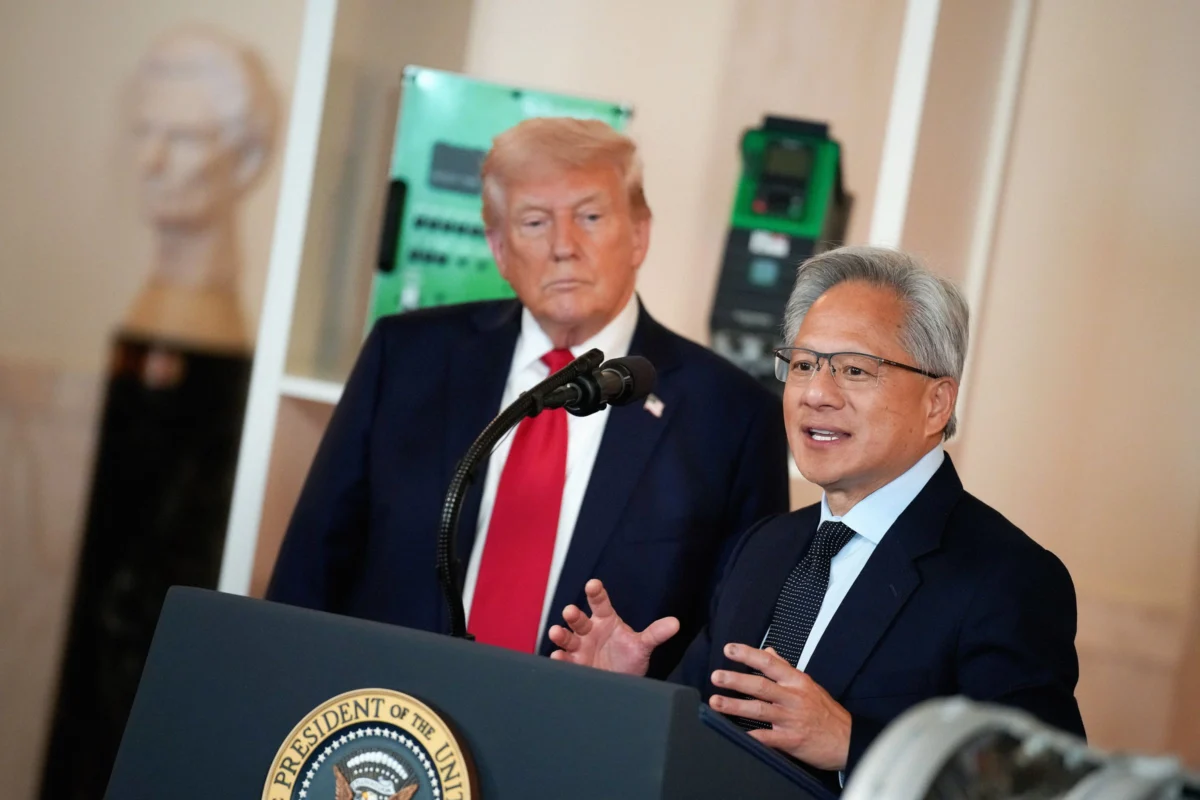
The intersection of high-stakes technology and national politics reached a surreal peak on Thursday morning at the Santa Clara headquarters of Nvidia, the world’s leading manufacturer of artificial intelligence chips. During a scheduled all-hands meeting intended for internal updates and employee engagement, President Donald Trump placed a direct call to Nvidia’s co-founder and CEO, Jensen Huang. The interaction, witnessed by thousands of employees both in person and via a secure virtual livestream, underscores the escalating importance of the semiconductor industry in the contemporary American political and economic landscape.
According to multiple sources present during the event, Huang was in the middle of a presentation—a hallmark of Nvidia’s corporate culture where the CEO frequently engages directly with the workforce—when his mobile phone rang. In an unusual departure from the typical flow of these meetings, Huang stepped aside to answer the call. Because he was still wearing his stage microphone, the distinctive voice of the president was clearly audible to the audience, though the specific details of the conversation were muffled and difficult to discern. The call lasted less than a minute before Huang returned to the stage to resume the company agenda.
While Nvidia’s corporate communications department declined to provide an official comment on the nature of the interruption, the event immediately became a focal point of internal discussion among the company’s 30,000-plus employees. The timing of the call was particularly notable, occurring just hours after Nvidia released a blockbuster second-quarter earnings report and announced a significant shift in its domestic political strategy.
A Financial Juggernaut: The Context of the Call
The president’s outreach followed the release of Nvidia’s second-quarter financial results, which solidified the company’s position as the primary beneficiary of the global generative AI boom. Nvidia reported a staggering revenue of $96 billion for the quarter, representing a 106 percent increase compared to the same period in the previous year. This growth is driven almost entirely by the insatiable demand for the company’s H100 and Blackwell architecture graphics processing units (GPUs), which serve as the foundational hardware for training large language models (LLMs) like OpenAI’s GPT-4 and Google’s Gemini.
Later on Thursday, President Trump took to his social media platform, Truth Social, to publicly acknowledge the company’s success. In a post that mirrored the likely sentiment of the private call, he congratulated Huang on the "incredible" sales figures and the company’s optimistic financial forecast for the coming fiscal year. The public endorsement reflects a broader recognition within the federal government that Nvidia is no longer merely a hardware vendor but a critical piece of national infrastructure.
The financial data released on Wednesday revealed that Nvidia’s data center revenue—the segment responsible for AI chips—has become the dominant driver of its valuation. With profit margins exceeding 75 percent, the company has achieved a market capitalization that rivals the world’s largest tech entities, including Apple and Microsoft. This economic weight has made Huang a frequent visitor to Washington, D.C., where he has been tasked with navigating the complex waters of international trade and national security.
Chronology of a Significant Day for Nvidia
The phone call from the president was the centerpiece of a day marked by several major announcements and developments for the Silicon Valley giant. To understand the gravity of the interaction, it is necessary to examine the timeline of events that unfolded on Thursday:
- Morning: The PAC Announcement. Early in the day, Bloomberg Law reported that Nvidia had officially launched its first employee-funded political action committee (PAC). The move signals a transition for Nvidia from a politically quiet engineering firm to an active participant in federal lobbying and campaign finance. The PAC is designed to support federal candidates who align with the company’s interests as the debate over AI regulation intensifies.
- Mid-Morning: The All-Hands Meeting. Jensen Huang took the stage at the Santa Clara headquarters. These meetings are traditionally used to celebrate internal milestones and align the global workforce on the company’s "full-stack" AI vision.
- 11:00 AM (Approximate): The Interruption. The surprise call from President Trump occurred mid-presentation. Sources noted that while Huang appeared professional, the interruption was clearly unplanned, leading to a brief moment of confusion among staff.
- Afternoon: Acquisition Rumors Solidify. Reports from The Information and Business Insider began circulating more widely regarding Nvidia’s intent to acquire Hugging Face, a cornerstone of the open-source AI community. The deal, estimated at $13 billion, would represent one of the most significant consolidations in the AI software space.
- Evening: Presidential Social Media Post. President Trump’s public message on Truth Social confirmed the friendly nature of the earlier interaction, focusing on the company’s economic contributions and technological leadership.
Strategic Shifts: The Nvidia Political Action Committee
The establishment of a PAC is a watershed moment for Nvidia. For much of its history, the company focused on the niche markets of gaming and professional visualization. However, the emergence of AI as a geopolitical priority has forced the company to build a robust "influence force" in the nation’s capital.
The PAC will allow Nvidia employees to pool resources to support lawmakers who oversee the committees responsible for trade, technology, and commerce. This is particularly relevant as the U.S. government continues to refine export controls. Nvidia has faced significant challenges due to Department of Commerce restrictions on the sale of high-end chips to China—a market that previously accounted for a substantial portion of Nvidia’s revenue.
Navigating these regulations requires a constant dialogue with the executive branch. While the Trump administration and the current leadership in Washington have both prioritized "chip sovereignty," their approaches to open-source AI and domestic manufacturing incentives have differed. By launching a PAC, Nvidia ensures it has a seat at the table regardless of which party holds the White House or Congress.
The Hugging Face Acquisition and Antitrust Scrutiny
The report that Nvidia has agreed to acquire Hugging Face for $13 billion adds another layer of complexity to its relationship with the federal government. Hugging Face is often described as the "GitHub of AI," a repository where researchers and developers share models, datasets, and demo apps. It is the heart of the open-source AI movement.
If the acquisition proceeds, Nvidia would control not only the hardware required to run AI but also the primary platform used by the world’s developers to build and share AI software. This level of vertical integration is likely to trigger intense scrutiny from the Federal Trade Commission (FTC) and the Department of Justice (DOJ).
Antitrust regulators under both the Trump and Biden administrations have expressed concerns regarding "killer acquisitions"—where a dominant firm buys a potential competitor or a critical piece of infrastructure to stifle competition. An acquisition of this magnitude would require a rigorous merger approval process, a fact that Huang is undoubtedly aware of as he maintains open lines of communication with the nation’s highest office.
Analysis of Implications: Technology as Statecraft
The direct line between the President of the United States and the CEO of a semiconductor company illustrates the shift of technology into the realm of statecraft. In previous decades, such calls might have been reserved for the CEOs of major oil companies or defense contractors. Today, the "compute" provided by Nvidia is seen as a resource as vital as oil and as strategically significant as aerospace technology.
There are three primary implications of this evolving relationship:
1. AI as a National Security Asset:
The U.S. government views the lead in AI as a "must-win" race against global adversaries, particularly China. Nvidia’s success is, by extension, a U.S. national security interest. The president’s call can be viewed as an acknowledgment that the health of Nvidia’s balance sheet is tied to the strength of the American economy and its technological edge.
2. The Personalization of Corporate Diplomacy:
Jensen Huang has emerged as a unique figure in Silicon Valley—a CEO who maintains high popularity among his staff while navigating the polarizing world of national politics. His ability to take a call from a figure as prominent as Donald Trump during a staff meeting, and then seamlessly return to business, speaks to a leadership style that prioritizes directness and agility.
3. The Regulatory Tightrope:
Nvidia finds itself in a precarious position. It must cooperate with the government to ensure national security through export controls, yet it must also fight for the right to sell its products in a global market. The launch of the PAC and the potential acquisition of Hugging Face suggest that Nvidia is preparing for a multi-year legal and political battle to maintain its dominance.
Reaction from the Tech Community
While the official word from Nvidia remains "no comment," the broader tech community has reacted with a mix of fascination and caution. Analysts suggest that the visibility of the call may have been intentional—a signal to both employees and investors that Nvidia has the "ear" of the highest levels of government.
"We are seeing the ‘politicization of the chip,’" said one industry analyst who requested anonymity. "You cannot be a $3 trillion company that powers the world’s most transformative technology and stay out of the fray. This phone call is the new normal for Silicon Valley."
As the 2024 political season progresses, the role of AI and the companies that power it will likely remain at the forefront of the national conversation. For Nvidia, the challenge will be to balance its unprecedented growth with the increasing demands of federal oversight and the complexities of being a central player on the world stage. For now, the image of Jensen Huang stepping aside from his own stage to speak with the president remains a potent symbol of the era of the AI superpower.
About the Author