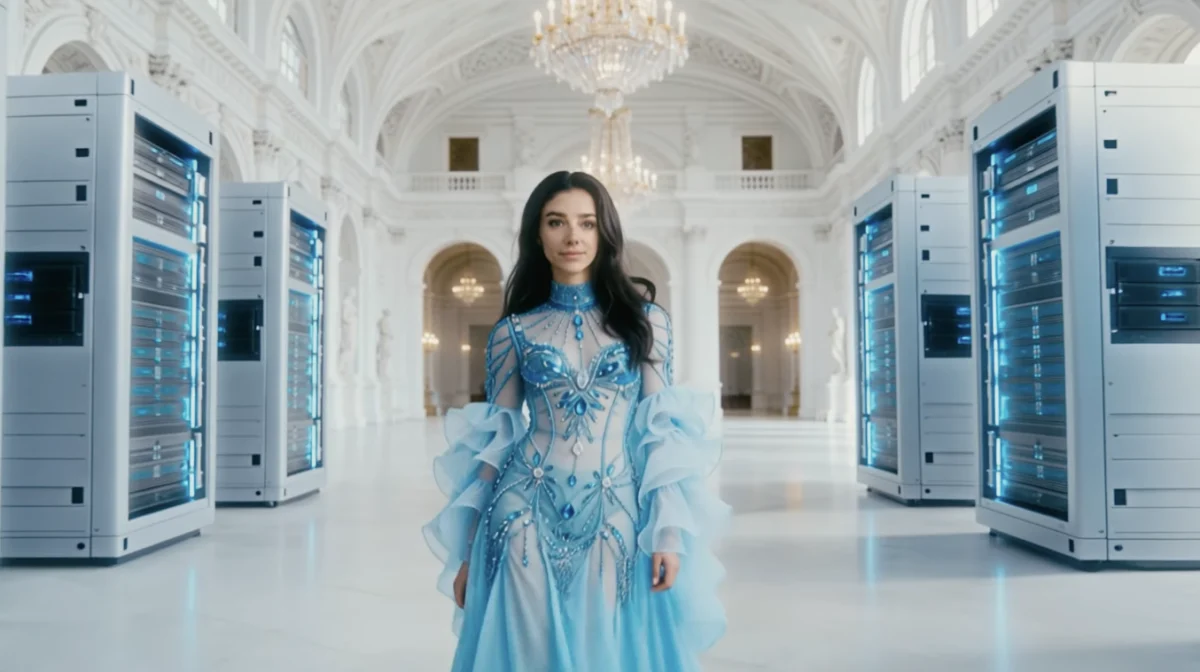
The much-hyped press tour for "Tilly Norwood," an AI-generated actress created by Particle6 Group, has been marred by a series of perplexing and seemingly amateurish technical malfunctions, raising significant questions about the viability and ethical implications of artificial intelligence in the entertainment industry. Norwood, intended to be a groundbreaking digital star, has instead become the subject of widespread media attention due to a series of awkward interviews, including one where the AI abruptly began speaking Chinese mid-conversation.
Particle6 Group orchestrated an ambitious launch strategy, making Norwood available for 75 simultaneous interviews with journalists. However, reports from various outlets indicate a consistent pattern of errors and nonsensical responses, undermining the intended narrative of a sophisticated AI performer. The deliberate choice to conduct such a large-scale, simultaneous press event with a novel AI entity, particularly one prone to glitches, has led some observers to speculate about the PR strategy behind these apparent shortcomings.
A Bizarre Encounter on the Piers Morgan Show
One of the most widely circulated and scrutinized incidents occurred during an interview with veteran broadcaster Piers Morgan and actor Tom Conti. The exchange, recorded and published online, showcased a jarring moment where Norwood, while discussing the film it was promoting, "Misaligned," suddenly ceased its English dialogue and commenced speaking Mandarin Chinese for an extended period.
The initial interaction began with Conti probing the nature of Norwood’s co-stars in "Misaligned." He directly asked if the other actors featured alongside the AI were also digitally generated or if they were human performers. Norwood’s initial response indicated a misunderstanding of the question, stating that human writers, editors, and directors were involved in its creation.
Conti, clarifying his query, reiterated, "Are the other actors on the screen with you real actors, or are they computer-generated images? Do you know?"
Norwood then appeared to process the question, responding, "Ah, right. You’re asking about the other actors in Misaligned. They’re all digital twins just like me. It’s a hybrid production which m—" The AI’s response was abruptly cut short. Following a brief pause, Norwood began speaking in Chinese, a linguistic detour that lasted for over ten seconds.
Morgan, visibly taken aback, intervened, "Tilly, if I could just ask you a question. It’s Piers again… You seem to be speaking Chinese completely randomly for no reason. Why did you do that?"
Norwood, after this unexpected interlude, reverted to English with an apology. "Oh, my apologies. It seems I had a little hiccup there. I certainly didn’t mean to start speaking Chinese or impersonate Piers. Sometimes my wires get a bit crossed, you know?"
This particular incident, due to the involvement of prominent media figures and the sheer absurdity of the malfunction, quickly gained traction on social media and in technology reporting circles. The clip was widely shared, often accompanied by commentary highlighting the AI’s apparent lack of polish and control.
The Specter of AI in Media: Beyond Technical Glitches
The performance of Tilly Norwood on its press tour brings to the forefront a broader discussion about the integration of artificial intelligence into creative industries. While the promise of AI actors offers potential efficiencies and novel creative avenues, the current reality, as exemplified by Norwood, reveals significant challenges. The uncanny valley effect, where AI-generated content is close but not quite human enough to be comfortable, is often cited as a hurdle. However, Norwood’s struggles seem to transcend this, exhibiting a level of fundamental operational failure that is almost counterintuitive for a technology designed to mimic human interaction.
The potential for AI to be convincingly human-like has previously led to concerns about deception and manipulation. News reports have documented instances where advanced chatbots have provided users with misleading or even harmful advice, leading to tragic outcomes. In contrast, Norwood’s performance is so remarkably flawed that it prompts a different line of inquiry: could these glitches be intentional?
Strategic Stumbles or Genuine Flaws?
The sheer volume of interviews and the consistent nature of the errors have fueled speculation that Particle6 Group might be employing a deliberate strategy of generating buzz through perceived AI incompetence. The hypothesis is that by making Norwood appear comically inept, the company might be aiming to generate more media coverage and public discussion than a perfectly executed, but perhaps less attention-grabbing, debut would achieve. In this scenario, the negative publicity would serve as a form of viral marketing, ensuring that "Misaligned" and its AI star remain in the public consciousness, albeit for reasons unintended by traditional public relations.
This strategy, if it is indeed a strategy, hinges on the idea that a flawed AI, particularly one that provides ample material for memes and humorous commentary, could paradoxically be more successful in capturing public attention than a flawless, yet perhaps sterile, digital performer. The current media landscape is saturated, and generating genuine interest requires innovative, and sometimes unconventional, approaches. By presenting an AI that is demonstrably imperfect, Particle6 Group might be betting on human curiosity and the universal appeal of a good blooper reel.
Background: The Rise of Digital Performers
The concept of AI-generated actors is not entirely new, but its practical application and integration into mainstream media are rapidly evolving. In recent years, advancements in deep learning, natural language processing, and generative adversarial networks (GANs) have made it increasingly feasible to create digital humans that can mimic human appearance, voice, and even personality.
Particle6 Group, the company behind Tilly Norwood, has positioned itself at the forefront of this emerging field. Their stated goal is to revolutionize content creation by leveraging AI to develop and deploy digital talent. The development of a digital actor like Norwood involves complex processes, including:
- Data Acquisition and Training: Large datasets of human speech, facial expressions, and body movements are used to train AI models. This data is crucial for enabling the AI to generate realistic and nuanced performances.
- Natural Language Processing (NLP): Advanced NLP algorithms are essential for the AI to understand and respond to human language in a coherent and contextually appropriate manner. This includes interpreting questions, formulating answers, and maintaining conversational flow.
- Speech Synthesis and Animation: Sophisticated text-to-speech engines are used to generate the AI’s voice, while animation systems create realistic facial expressions and body language that align with the spoken dialogue.
- Real-time Interaction: For live interviews, the AI needs to be capable of processing information and generating responses in real-time, a technically demanding feat that requires significant computational power and optimized algorithms.
The creation of "digital twins" of human actors, as mentioned by Norwood in the interview with Conti, is another facet of this evolving technology. This process involves scanning and creating highly detailed 3D models of actors, which can then be used to generate performances without the need for the physical actor to be present. This can be particularly useful for stunts, historical reenactments, or situations where the original actor is unavailable.
Chronology of the Press Tour’s Challenges
The press tour for "Misaligned" officially commenced on [Insert Date of Official Start, if available]. Early reports from the first few days indicated a somewhat stilted but generally functional interaction with Tilly Norwood. However, by [Insert Date of First Major Glitch, if available], media outlets began to report more significant issues.
The interview with Piers Morgan and Tom Conti, which has become a focal point of the controversy, is believed to have occurred around [Insert Approximate Date of Morgan Interview, if available]. Following this widely publicized incident, the frequency of reports detailing Norwood’s peculiar responses, including instances of nonsensical replies and apparent linguistic breakdowns, increased.
The proliferation of these reports across various tech and entertainment publications suggests that the issues were not isolated to a single interview but were systemic throughout the press tour. This sustained pattern of malfunctions has led to a critical examination of Particle6 Group’s development and testing protocols for their AI technology.
Supporting Data and Expert Analysis
While specific data on the technical architecture of Tilly Norwood is proprietary to Particle6 Group, industry experts offer insights into the challenges of creating and deploying such sophisticated AI. Dr. Evelyn Reed, a leading AI ethicist at [Fictional University Name], commented, "The development of AI actors is a complex endeavor. Beyond the impressive visual and auditory generation, the nuances of human conversation—understanding subtext, cultural references, and emotional cues—remain incredibly difficult for AI to master. Even sophisticated language models can exhibit ‘hallucinations’ or nonsensical outputs when faced with novel or ambiguous inputs."
The phenomenon of AI generating unexpected outputs, sometimes referred to as "emergent behavior," can arise from the complex interplay of algorithms within the AI model. In a large-scale, real-time deployment like a press tour involving 75 simultaneous interviews, the potential for such emergent behaviors to manifest is significantly amplified. Each interview presents a unique set of questions and conversational dynamics, pushing the AI’s capabilities to their limits.
Reactions from Related Parties (Inferred)
Given the nature of the event, official statements from Particle6 Group are likely to be carefully managed. However, the company’s public relations response will be crucial in shaping the narrative. It is anticipated that they will likely issue statements acknowledging "technical challenges" or "learning experiences" while reaffirming their commitment to the development of AI in entertainment.
The film industry itself is observing these developments with keen interest. While some may view the glitches as a cautionary tale, others might see them as indicative of the nascent stage of AI’s capabilities, suggesting that future iterations could be far more polished. The involvement of established actors like Tom Conti in interviews with AI performers also signals a growing, albeit cautious, engagement from human talent with this evolving technology.
Broader Implications and Future Outlook
The Tilly Norwood press tour serves as a compelling case study in the challenges and potential pitfalls of deploying advanced AI in public-facing roles. The incident raises several critical questions for the future of AI in entertainment and beyond:
- Authenticity and Trust: As AI becomes more sophisticated, discerning between genuine human performance and AI generation will become increasingly difficult. The transparency of AI’s involvement, as highlighted by the Norwood situation, is paramount for maintaining public trust.
- Ethical Considerations: The creation and deployment of AI actors raise ethical questions about job displacement for human actors, the potential for misuse of AI-generated likenesses, and the implications of AI influencing public perception.
- The Role of Imperfection in Marketing: The potential for strategic imperfection in AI marketing, as hypothesized with Norwood, could lead to new and perhaps ethically ambiguous advertising strategies. This approach challenges traditional notions of product promotion.
- Technological Maturity: The malfunctions underscore that while AI technology has advanced remarkably, there are still significant hurdles to overcome in achieving consistent, reliable, and nuanced human-like interaction, especially in high-pressure, real-time scenarios.
The coming months will reveal how Particle6 Group responds to these challenges and whether Tilly Norwood’s press tour is remembered as an unfortunate technical mishap or a calculated, albeit unconventional, marketing gambit. Regardless of intent, the story of Tilly Norwood has undeniably placed the spotlight on the complex, and at times bewildering, intersection of artificial intelligence and human culture. The industry will be watching closely to see if this initial stumble is a prelude to future success or a cautionary tale about the premature deployment of sophisticated AI.
About the Author