The International Chamber of Commerce (ICC) has announced the upcoming release of the ICC Global Trade Intelligence Report 2026, a comprehensive data-driven initiative designed to provide the financial sector with unparalleled insights into the performance and risk profiles of trade and supply chain finance. This latest iteration of the report, formerly known as the ICC Trade Register, represents the culmination of over a decade of rigorous data aggregation, encompassing a staggering $25.7 trillion in transaction volume. As global markets face increasing volatility, the 2026 report is positioned as a critical strategic asset for financial institutions, regulators, and non-bank corporations seeking to navigate the complexities of international commerce with precision and empirical clarity.
Built upon the collaborative efforts of 22 of the world’s leading global banks, the report offers a deep dive into default and loss rates across various trade finance products. The ICC Global Trade Intelligence Report serves as the industry’s most authoritative benchmark, providing the necessary evidence to support informed decision-making and regulatory advocacy. By leveraging anonymized data from diverse portfolios, the report highlights the inherent safety and resilience of trade finance as an asset class, particularly when compared to other forms of corporate lending. This data is essential for banks as they manage capital requirements under evolving international regulatory frameworks, such as the Basel III and Basel IV standards.
The Evolution of Trade Finance Intelligence
The journey toward the 2026 report began in the aftermath of the 2008 global financial crisis. At that time, the banking industry recognized a critical lack of centralized, empirical data regarding the risk performance of trade finance. This data gap often led to disproportionately high capital requirements imposed by regulators who viewed trade finance through the same lens as riskier unsecured corporate debt. To address this, the ICC established the Trade Register in 2009, aiming to provide a factual basis for the low-risk nature of trade-related instruments like Letters of Credit (L/Cs) and Guarantees.
Over the past 15 years, the initiative has evolved from a simple data collection exercise into a sophisticated intelligence platform. The rebranding to the "ICC Global Trade Intelligence Report" reflects a broader scope that goes beyond historical default rates. The modern report incorporates advanced analytics, regional performance trends, and forward-looking market opportunities. The 2026 edition is expected to be the most comprehensive to date, reflecting a global economy that is increasingly digitized and focused on supply chain resilience.
The chronology of this project highlights a steady expansion in participation. Starting with a handful of founding banks, the consortium has grown to 22 member institutions that represent a significant share of the global trade finance market. These banks contribute data on millions of transactions, ensuring that the report’s findings are statistically significant and representative of global trends across various geographies and industry sectors.
Strategic Partnerships and Methodology
The high standards of the ICC Global Trade Intelligence Report are maintained through a strategic partnership between the ICC, the Boston Consulting Group (BCG), and Global Credit Data (GCD). Each partner brings a unique set of expertise to the project. The ICC provides the global reach and industry leadership necessary to convene major financial players. BCG contributes strategic analysis and market insights, helping to translate raw data into actionable intelligence for C-suite executives. GCD, a non-profit association owned by banks, provides the technical infrastructure and data-pooling expertise required to ensure data quality, consistency, and anonymity.
The methodology employed in the report is rigorous. Participating banks submit granular data on their trade finance portfolios, including transaction types, obligor details, and default events. This data is then cleaned, harmonized, and analyzed by GCD and BCG. The resulting insights provide a clear picture of "Expected Loss" (EL) and "Probability of Default" (PD), which are crucial metrics for risk management departments. By aggregating data across 22 banks, the report eliminates the biases that might exist within a single institution’s portfolio, offering a "true north" for the industry.
Addressing the Regulatory Landscape and Capital Requirements
One of the primary functions of the ICC Global Trade Intelligence Report is to inform the dialogue between the banking industry and global regulators, specifically the Basel Committee on Banking Supervision (BCBS). Historically, trade finance has been characterized by low default rates and high recovery rates, largely because the transactions are often backed by physical goods or documented cash flows. However, without centralized data, it was difficult for banks to argue for lower risk weights.
The data provided by the ICC report has been instrumental in demonstrating that trade finance is a low-risk activity. For example, historical findings from the report have shown that the default rate for import Letters of Credit is often below 0.1%. By providing this evidence, the ICC helps ensure that capital adequacy rules do not unnecessarily restrict the availability of trade credit, which is the lifeblood of the global economy. As the 2026 report approaches, its findings will be particularly relevant for banks navigating the final implementation stages of Basel IV, which introduces new standardized approaches for calculating credit risk.
Bridging the $2.5 Trillion Trade Finance Gap
The insights generated by the report also play a vital role in addressing the global trade finance gap, which the Asian Development Bank (ADB) recently estimated at $2.5 trillion. This gap disproportionately affects Small and Medium-sized Enterprises (SMEs) and businesses in emerging markets, who often find it difficult to secure the credit necessary to participate in international trade.
By providing a clearer understanding of risk performance in emerging markets, the ICC Global Trade Intelligence Report encourages banks to expand their lending activities. When banks have access to reliable benchmarks, they can better price risk and allocate capital more efficiently. This, in turn, can lead to increased financial inclusion and economic growth in developing regions. The 2026 report will feature specific regional data analysis, offering tailored insights into market opportunities in Africa, Asia, and Latin America, where the demand for trade finance is highest.
Key Components of the 2026 Publication
The 2026 release will be structured to provide maximum utility for different stakeholders. The "Complete Package" will include:
- The Global Overview Report: A high-level summary of global trends, default rates, and the overall health of the trade finance ecosystem.
- Regional Data Analysis: Detailed breakdowns of performance across different geographic corridors, highlighting areas of resilience and emerging risks.
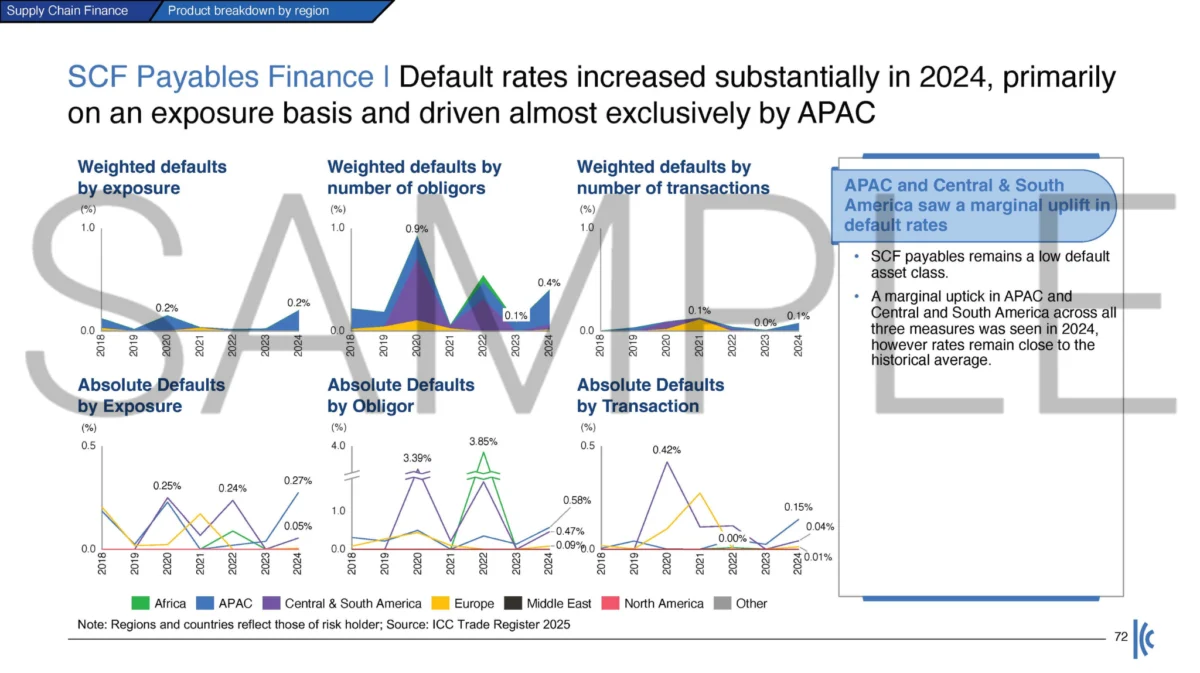
- Product-Specific Reports: In-depth analysis of specific instruments, including Documentary Credits, Standby Letters of Credit, Guarantees, and Supply Chain Finance (SCF) products.
- Strategic Insights: Commentary from BCG on the impact of macroeconomic shifts, such as interest rate changes, geopolitical tensions, and the transition to a green economy.
This modular approach allows users to access the intelligence most relevant to their specific business needs, whether they are a risk manager at a global bank, a treasurer at a multinational corporation, or a policy maker at a central bank.
The Role of Non-Bank Corporations and Sponsorship
While the report is rooted in banking data, its implications extend far beyond the financial sector. Non-bank corporations are increasingly looking to the ICC Global Trade Intelligence Report to benchmark their own supply chain finance programs and to understand the risk environment of their global trading partners. The ICC has opened opportunities for non-bank entities to engage with the report through sponsorship and membership, allowing them to raise their visibility within the global banking community.
This cross-sector collaboration is essential for creating a more transparent and efficient trade finance market. As corporations face mounting pressure to ensure the sustainability and ethical integrity of their supply chains, the data provided by the ICC can help them identify stable partners and mitigate potential disruptions.
Inferred Industry Reactions and Broader Implications
Industry experts anticipate that the 2026 report will highlight the continued shift toward Supply Chain Finance (SCF) and digital trade solutions. John Denton, Secretary General of the ICC, has frequently emphasized the importance of digitalization in making trade more inclusive and efficient. The 2026 report is expected to reflect how the adoption of digital standards, such as the Model Law on Electronic Transferable Records (MLETR), is impacting risk profiles and operational efficiency.
Furthermore, the integration of Environmental, Social, and Governance (ESG) criteria into trade finance is a major theme. While the report has traditionally focused on credit risk, there is a growing demand for data on how "green trade" performs. The 2026 edition may provide preliminary insights or frameworks for how ESG factors correlate with trade finance defaults, paving the way for more sustainable global commerce.
The broader implication of the ICC Global Trade Intelligence Report 2026 is the reinforcement of trade finance as a stable, attractive asset class for investors. As institutional investors seek yield in a complex global environment, the empirical evidence of low default rates provided by the ICC makes a compelling case for trade finance as a low-volatility investment. This could lead to increased liquidity in the secondary market for trade assets, further helping to close the global finance gap.
Conclusion and Future Outlook
The forthcoming release of the ICC Global Trade Intelligence Report 2026 marks a significant milestone in the evolution of market transparency. By transforming $25.7 trillion worth of transaction data into actionable intelligence, the ICC and its partners are providing the global community with the tools needed to foster economic stability and growth. As the industry prepares for the full report, the message is clear: data-driven decision-making is no longer an option but a necessity for anyone involved in the complex machinery of international trade.
The ICC continues to invite global financial institutions to join as members, contributing to a collective pool of knowledge that benefits the entire ecosystem. With the 2026 report on the horizon, the financial world stands to gain a clearer, more nuanced understanding of the risks and rewards that define the future of global commerce. Through this initiative, the ICC reaffirms its commitment to making trade work for everyone, everywhere, every day.
About the Author