Amazon Web Services (AWS) has announced a strategic collaboration with The Biological Computing Company (TBC), a startup utilizing neural patterns from rat brain cells to optimize artificial intelligence, signaling a significant shift in the commercial availability of "wetware" technologies. Starting this week, select AWS enterprise customers will receive preview access to TBC’s specialized AI models, which are engineered to enhance the efficiency and speed of video generation. This partnership marks a pivotal moment for the field of biological computing, transitioning it from specialized laboratory environments into the mainstream cloud infrastructure used by global corporations.
The technology developed by TBC, an acronym for The Biological Computing Company, does not involve the direct integration of living tissue into cloud servers. Instead, the company uses living biological systems—specifically rat neurons and human stem cells—as a blueprint. By observing how these biological neural networks process information, TBC develops software algorithms that mimic these natural efficiencies. According to TBC co-founder and CEO Alexander Ksendzovsky, the company has devised a method to "code" information, such as visual data, into biological material, subsequently recording the response to build digital tools that replicate biological processing.
The Convergence of Biology and Silicon
The integration of TBC’s models into the AWS marketplace is part of a broader initiative by Amazon to explore unconventional computing architectures. Deap Ubhi, the global director of technology for startups at AWS, noted that while biological computing was once considered a fringe science, it is increasingly viewed as a pragmatic solution to the escalating energy and computational demands of modern generative AI. TBC joins other pioneers in the AWS ecosystem, such as Cortical Labs, an Australian firm that produces "Wetware as a Service" (WaaS) by combining lab-grown neurons with silicon chips.
The appeal of TBC to a giant like Amazon lies in its focused, application-specific approach. Rather than attempting to replace the "transformer" architecture—the fundamental building block of Large Language Models (LLMs) like GPT-4—TBC aims to augment existing standards. The startup’s primary objective is to improve the efficiency of visual models, which are notoriously resource-intensive. By studying the spatial and temporal processing capabilities of biological neurons, TBC claims it can facilitate faster video rendering at a fraction of the traditional computational cost.

A Timeline of Development and Funding
The Biological Computing Company was founded four years ago in Baltimore, Maryland, by a team of neuroscientists and neurosurgeons. Alexander Ksendzovsky and Jon Pomeraniec, the company’s president and COO, sought to bridge the gap between clinical neuroscience and computer science. The company remained in a relatively quiet development phase until recently, when it underwent a rapid expansion of its capital and physical footprint.
In early 2024, TBC successfully closed a $25 million Series A funding round led by Primary Venture Partners. Shortly thereafter, the company secured an additional $25 million in a previously unreported follow-on round, bringing its total capital raised to over $50 million. This influx of cash supported the opening of a dedicated research and development laboratory in San Francisco, which now serves as the hub for its 35-person workforce.
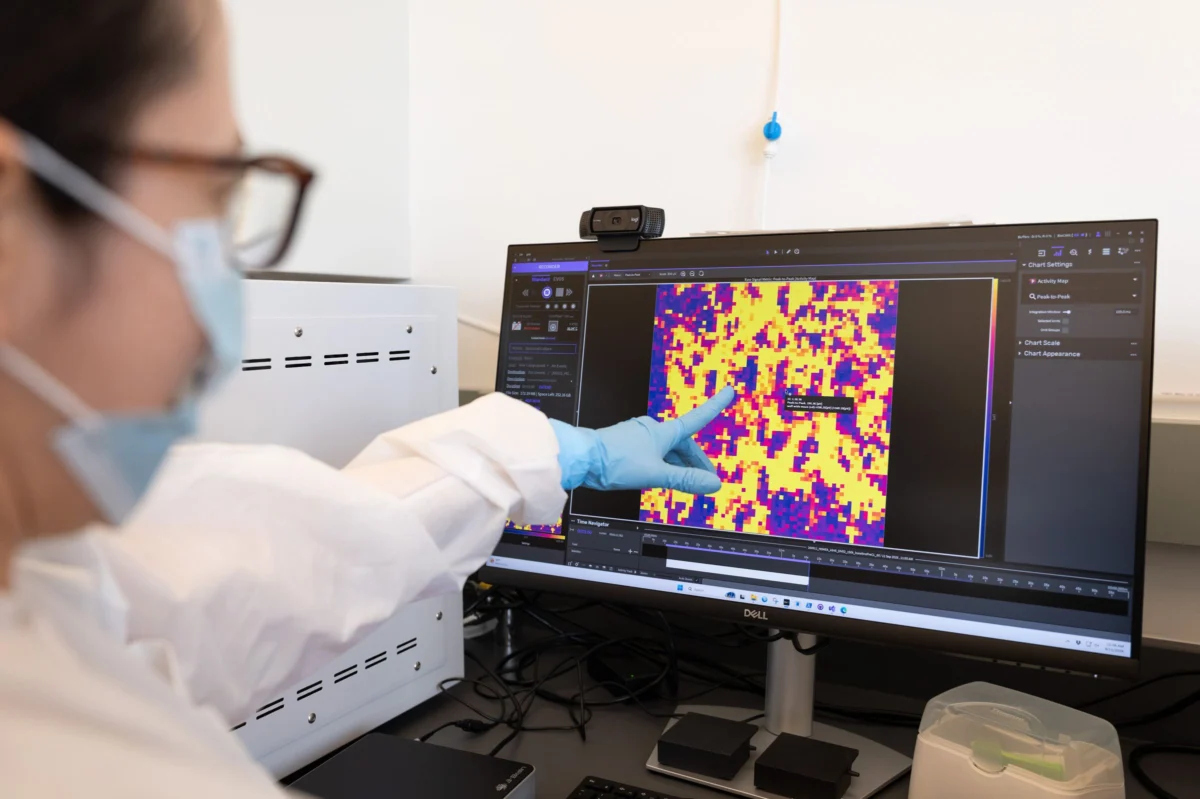
The San Francisco facility is equipped with advanced multi-electrode silicon arrays (MEAs) manufactured by 3Brain, a Swiss biotechnology firm. These arrays serve as the interface between the biological and digital worlds. Researchers place living neurons onto the arrays, which contain thousands of tiny electrodes capable of both stimulating the cells and recording their electrical discharges. This setup allows TBC to conduct high-throughput experiments, testing how different "inputs" are processed by the biological network and then translating those findings into code.
Strategic Focus on Video Generation
The decision to apply biological insights specifically to video generation was driven by both technical constraints and market opportunities. From a technical standpoint, the physical layout of the 3Brain electrode arrays is a grid, making it naturally suited for mapping two-dimensional image data. Unlike text, which is linear and symbolic, visual data is inherently spatial, mirroring the way biological visual systems are organized.
The strategic direction was further refined by Jeff Dean, a renowned AI researcher and an early investor in TBC. Dean suggested that the company focus on fine-tuning existing video generation models rather than attempting to build a general-purpose AI from scratch. By targeting video, TBC could utilize established industry benchmarks to prove the efficacy of its "biological" approach.
-neuron-chip.jpg)
The results, according to TBC, have been substantial. In comparative tests against standard open-source frontier models, TBC’s biologically-inspired software demonstrated video generation speeds up to five times faster. Furthermore, the company reports a significant reduction in "inference" costs—the ongoing expense of running a model after it has been trained. This is a critical metric for enterprise customers who face mounting bills for the GPU power required to generate high-definition video content.
Technical Hurdles and the "Wetware" Challenge
Despite the promise of biological computing, the field faces unique obstacles that traditional software companies do not. Maintaining a "wet lab" requires a different set of protocols than a standard server room. Brain cells and stem cells must be kept alive in controlled environments, requiring precise regulation of temperature, nutrients, and waste removal.
Furthermore, the "translation" process—turning the erratic electrical firing of a rat neuron into a stable, predictable software algorithm—is immensely complex. Biology is inherently "noisy" and stochastic, whereas digital computing relies on deterministic logic. TBC’s success depends on its ability to filter this biological noise and extract only the most efficient computational patterns.
There are also significant questions regarding scalability. While TBC has shown success in short-form video generation, the industry is moving toward longer, more complex outputs. Deap Ubhi of AWS raised concerns about "fidelity loss" over time. As a video progresses, a model must maintain temporal consistency—ensuring that a character’s appearance or the laws of physics remain stable from the first second to the tenth minute. Whether a biologically-derived model can maintain this consistency at scale remains to be seen as more AWS customers stress-test the technology.
Broader Implications for the AI Industry
The emergence of TBC and the support of Amazon reflect a growing anxiety within the tech sector regarding the sustainability of current AI trends. Traditional silicon-based AI is reaching a point of diminishing returns in terms of energy efficiency. Large data centers now consume vast amounts of electricity, leading to environmental concerns and infrastructure strain.

In contrast, the biological brain is the most energy-efficient computer known to science, operating on roughly 20 watts of power—less than a standard lightbulb—while performing tasks that would require megawatts of power for a supercomputer to replicate. By siphoning the "logic" of biology into software, companies like TBC hope to bypass the physical limitations of silicon.
The move by AWS to host TBC’s models also suggests a democratization of biocomputing. Previously, such technology was only accessible through niche providers like Bluesky Compute. By integrating these tools into the world’s largest cloud platform, Amazon is providing a sandbox for developers to explore how biological patterns might solve bottlenecks in computer vision, robotics, and autonomous systems.
Future Outlook
As TBC moves into its limited preview phase on AWS, the company is already looking toward the future. While rat neurons provided the initial foundation, the company’s work with human stem cells suggests a path toward even more sophisticated modeling. The ultimate goal is to move beyond simple mimicry and toward a hybrid form of computing where the strengths of biological processing—such as pattern recognition and energy efficiency—are seamlessly integrated with the precision and speed of digital hardware.
For the AI industry, the TBC-AWS partnership serves as a litmus test. If TBC can deliver on its promise of 5x speed increases and lower costs for enterprise-level video generation, it may trigger a wave of investment into "bio-inspired" architectures. If the technology struggles with consistency or scaling, it may remain a specialized tool for niche applications. Regardless of the outcome, the boundary between the laboratory and the data center has become more porous, marking a new chapter in the evolution of artificial intelligence.
About the Author