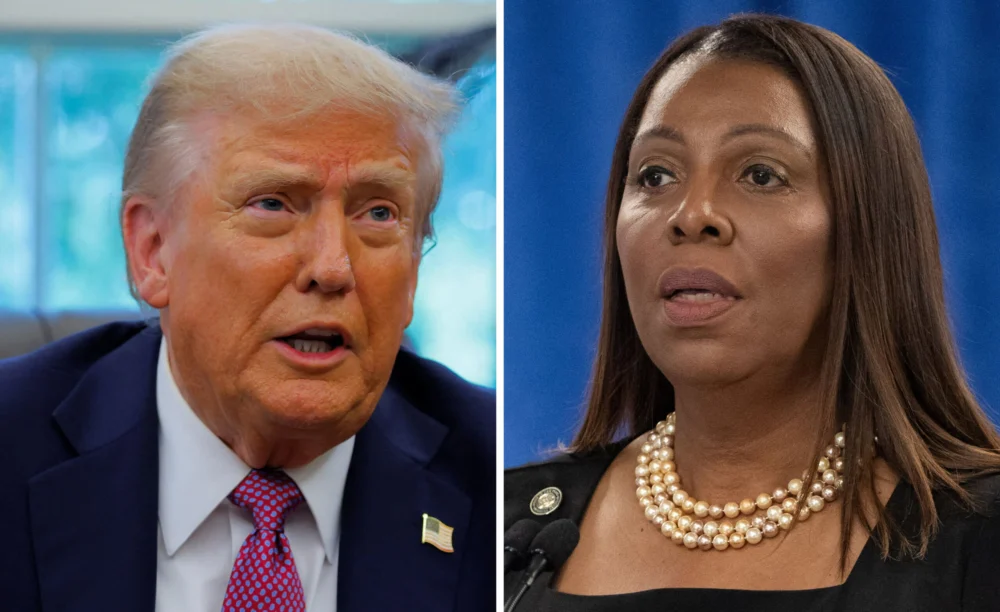
New York Attorney General Letitia James, leading a formidable coalition of 24 state attorneys general, is poised to launch a fresh legal challenge against President Donald Trump’s recently re-imposed global tariff regime. This imminent lawsuit, expected to be filed Thursday in the Court of International Trade, arrives just days after a landmark Supreme Court decision invalidated the president’s previous tariff efforts, marking a significant legal setback for the administration’s trade policy. The states’ action aims to declare Trump’s new tariffs illegal and secure billions in refunds for affected entities.
The move underscores an escalating legal and economic confrontation between the executive branch and a substantial bloc of states over the fundamental authority to levy taxes and regulate commerce. The dispute centers on the President’s interpretation and application of trade laws, specifically Section 122 of the Trade Act of 1974, which the states argue is being misused to circumvent congressional authority and the recent Supreme Court ruling. This legal battle is unfolding amidst a period of considerable global economic uncertainty, exacerbated by fluctuating trade policies and their cascading effects on domestic businesses and consumers.
A Swift Reversal and Renewed Confrontation
The current legal offensive is a direct response to President Trump’s swift action following the Supreme Court’s February 20 ruling. That decision struck down the majority of his sweeping "Liberation Day" tariffs, which had been implemented last year under the International Emergency Economic Powers Act (IEEPA). The nation’s highest court determined that the President’s use of IEEPA to impose broad duties was improper, underscoring limits to executive power in trade matters. This ruling represented one of the most significant legal defeats for the Trump administration in its second term, particularly concerning its economic agenda.
However, the administration wasted no time in seeking to maintain its signature trade policy. Immediately following the Supreme Court’s decision, President Trump announced a new wave of tariffs, strategically basing them on Section 122 of the Trade Act of 1974. This new global tariff rate was initially set at 10%, with the Trump administration signaling plans to escalate it to 15% in the near future, as confirmed by statements from Treasury Secretary Bessent and other officials. This immediate pivot signaled the President’s unwavering commitment to his "America First" trade agenda, regardless of judicial challenges.
New York Attorney General Letitia James, a vocal critic of the administration’s trade policies and a leading figure in the previous successful challenge, did not mince words in her statement provided to CNBC. "After the Supreme Court rejected his first attempt to impose sweeping tariffs, the president is causing more economic chaos and expecting Americans to foot the bill," James asserted. She further elaborated on the constitutional implications, stating, "President Trump is ignoring the law and the Constitution to effectively raise taxes on consumers and small businesses." This sentiment is echoed by the coalition of state attorneys general, most of whom were integral to the prior effort that successfully blocked Trump’s original tariffs.
The implications of the Supreme Court’s prior ruling are already materializing. Just days before the new lawsuit was announced, a federal court ruled that companies which had paid tariffs under the IEEPA regime, now struck down, are due billions of dollars in refunds. This financial consequence highlights the tangible economic impact of the legal battles over trade policy and the potential for massive financial repercussions should the new lawsuit succeed.
The Legal Labyrinth: Misuse of Law and Constitutional Overreach
At the heart of the new lawsuit lies a fundamental disagreement over the proper interpretation and application of Section 122 of the Trade Act of 1974. James and the coalition of attorneys general contend that President Trump is flagrantly misusing this specific statute. They argue that Section 122 was originally designed with a very different historical context and purpose in mind: to address specific monetary imbalances and exchange rate issues prevalent during the era of the gold standard. Its legislative intent, they maintain, was never to serve as a broad instrument for imposing global tariffs as a primary trade policy tool, independent of specific, targeted trade distortions.
Beyond the specific interpretation of Section 122, the attorneys general will also mount a robust constitutional challenge, asserting that the new tariffs violate the foundational principle of separation of powers. The U.S. Constitution, specifically Article I, Section 8, Clause 1, vests Congress with the exclusive power "to lay and collect Taxes, Duties, Imposts and Excises." By unilaterally imposing sweeping tariffs without explicit congressional authorization for such a broad economic measure, the states argue that the President is overstepping his executive authority and encroaching upon a power explicitly reserved for the legislative branch. This argument reinforces the constitutional checks and balances designed to prevent any single branch from accumulating excessive power, particularly in matters of taxation and commerce that directly impact the populace.

Furthermore, the lawsuit is expected to contend that Trump’s levies violate another critical requirement embedded within the 1974 Trade Act: that any tariffs imposed under its provisions must be applied consistently across countries. The states will likely argue that the administration’s tariff implementation lacks the uniformity and consistency mandated by the statute, potentially creating arbitrary distinctions or failing to meet the legal criteria for such broad application. This nuanced legal challenge seeks to dismantle the administration’s tariff policy not just on constitutional grounds but also on statutory non-compliance.
"The effort is a clear attempt to escape the Supreme Court’s ruling in the case against the tariffs imposed under IEEPA," James emphasized, highlighting the administration’s perceived sidestepping of judicial oversight. This implies that the current strategy of invoking Section 122 is merely a technical workaround rather than a substantively different approach that respects legal boundaries.
A Chronology of Contention: The Tariff Wars Timeline
The current legal skirmish is but the latest chapter in a protracted battle over presidential authority in trade policy, particularly during the Trump administration.
- Last Year (2025): President Trump implements sweeping "Liberation Day" tariffs under the International Emergency Economic Powers Act (IEEPA). New York Attorney General Letitia James, alongside 11 other states, files a lawsuit to halt these original tariffs. These state-led efforts are eventually combined with suits from small businesses affected by the tariffs, leading to a consolidated case that reaches the Supreme Court.
- February 20, 2026: The Supreme Court issues a landmark decision, invalidating most of Trump’s IEEPA-based tariffs. The ruling states that the President’s use of IEEPA for imposing broad duties was improper, curtailing executive power in this domain.
- February 20, 2026 (Same Day): Immediately following the Supreme Court’s adverse ruling, President Trump announces a new wave of global tariffs, this time citing Section 122 of the Trade Act of 1974 as the legal basis. The initial rate is set at 10%.
- March 4, 2026: Treasury Secretary Bessent indicates plans to raise the global tariff rate to 15% within weeks, with a potential return to prior rates within five months, adding to the policy’s volatile nature.
- Wednesday, March 5, 2026: A federal court rules that companies which paid tariffs under the IEEPA regime (struck down by the Supreme Court) are due billions of dollars in refunds, underscoring the financial stakes and prior legal victories against the administration.
- Thursday, March 6, 2026 (Expected): New York Attorney General Letitia James and 23 other state attorneys general plan to file a new lawsuit in the Court of International Trade, challenging the legality of the tariffs imposed under Section 122 of the Trade Act of 1974.
Broader Economic and Political Implications
The ongoing tariff saga and the continuous legal challenges have profound economic and political implications. Economically, the constant flux in trade policy generates significant uncertainty for businesses, particularly those engaged in international trade, manufacturing, and retail. Companies face unpredictable import costs, disruptions to global supply chains, and difficulty in long-term strategic planning. Studies on the previous rounds of tariffs often highlighted that the costs were largely borne by American consumers and businesses, rather than foreign producers, through higher prices and reduced competitiveness. For example, analyses by organizations like the National Bureau of Economic Research and the Federal Reserve have frequently pointed to tariffs acting as a tax on domestic consumers, increasing the cost of imported goods and components. The "billions of dollars in refunds" now due to companies for previously invalidated tariffs further illustrate the financial burden and administrative complexity these policies impose.
The proposed increase to a 15% global tariff rate would undoubtedly amplify these effects. Small businesses, which often have less flexibility in absorbing increased costs or navigating complex customs regulations, are particularly vulnerable. The tariffs could lead to job losses in import-dependent sectors, reduce consumer purchasing power, and potentially trigger retaliatory tariffs from trading partners, further complicating global commerce. The prospect of these tariffs being deemed illegal again, following the prior Supreme Court decision, adds another layer of instability, leaving businesses in limbo regarding future costs and liabilities.
Politically, this renewed legal battle underscores the persistent tension between the executive branch’s desire for swift, unilateral action in trade and the legislative and judicial branches’ roles as checks on presidential power. It also highlights the growing assertiveness of state attorneys general in challenging federal policies they deem unconstitutional or illegal, particularly when those policies have direct impacts on their constituents. This dynamic is especially potent in an election year, where economic policies and the balance of power between federal and state governments are often central campaign issues.
Furthermore, the legal and political entanglements between President Trump and Attorney General James are well-documented. Their adversarial relationship extends beyond trade policy, with James having pursued numerous legal actions against Trump’s business dealings and his administration’s policies on various fronts. While less central to the immediate trade tariff news, it is worth noting that Trump’s administration’s Justice Department previously indicted James in October on two counts, bank fraud and making false statements to a financial institution. However, James faced no charges after a judge threw out her indictment, and two grand juries separately declined to revive those efforts. This history of direct legal confrontation adds a layer of intensity to the current proceedings, transforming the tariff dispute into not just a policy debate but also a high-stakes legal and political showdown between two formidable opponents.
As the lawsuit proceeds, it will once again test the boundaries of executive authority in trade and set potential precedents for how future administrations can implement economic policy. The outcome will have significant ramifications for American businesses, consumers, and the delicate balance of power within the U.S. government, further shaping the trajectory of the nation’s trade relations on the global stage.
About the Author